A sales letter is used to communicate directly with a customer or prospect in writing, with a specific commercial goal: introducing a product, recovering a lapsed relationship, requesting feedback, resolving a complaint, or acknowledging a referral. Unlike mass marketing, a well-written sales letter feels personal and targeted, which is why response rates for direct mail and formal correspondence remain higher than broadcast email for many B2B segments.
How long should a sales letter be?
One page is the standard for most sales letters. Readers decide in the first few seconds whether to continue, so front-load the value. Product announcement letters and apology letters can be as short as three paragraphs; customer revival letters may run slightly longer if they need to reestablish context. If your letter doesn't fit on one page, cut — don't shrink the font.
What's the difference between a sales letter and a cover letter?
A sales letter is sent to a customer to drive a commercial action — purchase, feedback, or re-engagement. A cover letter accompanies a job application or a formal document submission and addresses a hiring manager or recipient, not a customer. The structures are similar, but the objective and audience are different.
Do sales letters still work in a digital-first world?
Yes, particularly in B2B and for high-value customer relationships. A printed or formally formatted letter stands out precisely because most communication is digital. For key accounts, customer apologies, or significant announcements, a physical or formally designed letter signals that the message matters. Digital formats — PDF via email — work well for lower-stakes situations.
Should I use a template or write a sales letter from scratch?
Start with a template. A template ensures you hit every structural element — hook, value proposition, call to action, sign-off — without missing anything. Customize the language to match your customer, product, and brand voice. Writing from scratch risks omitting key components and takes significantly longer.
How do I personalize a sales letter at scale?
Use mail merge fields for name, company, account history, and relevant offer. Beyond the name, the most effective personalization references a specific customer behavior — a recent purchase, a lapsed period, or a service interaction — rather than just inserting a first name. Templates in this folder include placeholder fields designed for mail merge workflows.
What tone should a customer apology letter use?
Empathetic, direct, and accountable. Acknowledge what went wrong specifically — avoid vague language like "if you experienced any inconvenience." State what you are doing to fix it and what the customer can expect next. Avoid defensive language and excessive apologies, which can undermine confidence. One clear, sincere apology followed by a resolution plan is more effective than repeated sorry's with no action.
Can I use these templates for email as well as print?
Yes. All templates are provided in editable Word format and can be reformatted for email delivery. For email, shorten the opening and replace the formal sign-off block with a standard email signature. The body content — especially the value proposition and call to action — transfers directly.
Sales Letters & Customer Service vs. related documents
Sales Letters & Customer Service vs. Marketing email
A sales letter is a formal written document — typically a signed letter on company letterhead — while a marketing email is an informal, often broadcast message sent through an email platform. Sales letters carry more weight in B2B contexts and for high-value customers because they feel personal and considered. Use a sales letter for one-to-one customer communications; use email campaigns for broad outreach.
Sales Letters & Customer Service vs. Sales proposal
A sales letter introduces, announces, or maintains a relationship without requiring a formal response. A sales proposal is a detailed document that outlines a specific offer, pricing, and terms in response to a known need. Use a sales letter to create awareness or reopen a conversation; use a proposal to close a deal.
Sales Letters & Customer Service vs. Customer service script
A sales letter is a written, asynchronous communication sent to a customer. A customer service script is a real-time conversation guide for phone or chat interactions. Both ensure consistent messaging, but scripts govern spoken exchanges while letters govern written correspondence. This folder includes both — see the Customer Service Script template for the spoken equivalent.
Sales Letters & Customer Service vs. Complaint letter
A complaint letter is sent by a customer to a business to document a problem. A customer apology letter or complaint resolution response is sent by the business back to the customer. This folder contains both types: templates for businesses responding to complaints and a Complaint Letter template for when your business is the one raising an issue with a supplier or partner.
Key clauses every Sales Letters & Customer Service contains
Effective sales letters share the same structural elements regardless of purpose — mastering these components turns a generic note into a letter that gets results.
Opening hook. The first sentence must immediately state the reason for writing and give the reader a reason to continue.
Value proposition. A clear, specific statement of what the customer gains — not what the product does, but what problem it solves for them.
Personalization. Reference the customer's name, account history, or specific situation to distinguish the letter from a mass communication.
Social proof or credibility marker. A brief reference to results, testimonials, or tenure that supports the claim being made.
Call to action. One specific next step — call, reply, visit, or redeem — with a clear deadline or incentive where appropriate.
Tone calibration. The register shifts by letter type: urgent for revival, empathetic for apology, enthusiastic for announcements, and professional throughout.
Sign-off and contact information. A named signatory with a direct phone number or email makes the letter feel accountable and easy to act on.
Follow-up reference. Noting when and how the sender will follow up sets expectations and keeps the sales cycle moving.
How to write a sales letter
A sales letter that converts follows a predictable structure — here's how to build one from scratch.
1
Define the single objective
Decide on one action you want the reader to take — book a call, try a product, submit feedback — and write the entire letter toward that goal.
2
Identify the recipient and their situation
Know whether you're writing to a lapsed customer, a new prospect, or a loyal account — the tone and offer differ substantially.
3
Write a specific, benefit-led subject line or opening sentence
Lead with what the reader gains, not with your company name or a generic greeting.
4
State the offer or reason clearly in the first paragraph
Readers skim — put the core message in the first three sentences so nothing is missed.
5
Support the claim with one piece of evidence
A number, a customer result, or a brief testimonial builds credibility without padding the letter.
6
Write a single, unambiguous call to action
Tell the reader exactly what to do next, when to do it, and what they'll get — vague CTAs kill response rates.
7
Edit for length and tone
Most sales letters should fit on one page; cut anything that doesn't support the objective or the call to action.
8
Sign with a name and direct contact
A named signatory with a phone number or email makes the letter credible and removes friction from responding.
At a glance
What it is
A sales letter is a written communication designed to inform, persuade, or retain customers by announcing products, resolving issues, requesting feedback, or strengthening the business relationship. Sales letters range from a brief product announcement to a detailed customer revival campaign.
When you need one
Any time your team needs to communicate proactively with customers — announcing a new product, recovering a lapsed account, or responding to a complaint — a structured template keeps messaging consistent and professional.
Covers acknowledgment, accountability, and resolution in one letter.
Customer Apology Letter
Responding to a low rating on a customer questionnaire
Directly addresses survey feedback with a clear path to recovery.
Apology for Poor Service Rating on Customer Questionnaire
Requesting feedback from a customer after a transaction
Short, professional prompt that increases response rates.
Request for Customer Feedback
Thanking a customer who referred new business
Reinforces referral behavior with a warm, personal acknowledgment.
Thank You for Customer Referral
Notifying customers that their service contact has left the company
Manages the transition professionally and maintains customer trust.
Customer Letter for Departed Employee
Glossary
Sales letter
A formal written communication sent to a customer or prospect with a specific commercial objective, such as generating a purchase, response, or continued relationship.
Customer revival
A targeted outreach effort aimed at re-engaging customers who have become inactive or lapsed over a defined period.
Call to action (CTA)
The specific instruction at the end of a sales letter telling the reader what to do next — call, reply, visit, or redeem.
Value proposition
A clear statement of the concrete benefit a customer receives from a product or service, distinct from a list of features.
Mail merge
A technique for producing personalized letters at scale by inserting variable fields — such as name and account number — into a standard template.
Customer apology letter
A formal written acknowledgment of a service failure that includes accountability, explanation, and a resolution plan.
Product announcement letter
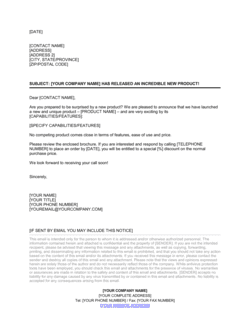
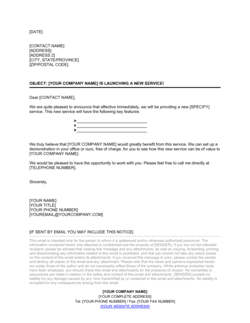
A written communication to customers introducing a new product or service, typically highlighting benefits and inviting a next step.
Referral acknowledgment
A letter sent to thank a customer who referred new business, reinforcing the behavior and strengthening the relationship.
Customer retention
The practice of keeping existing customers active and satisfied rather than solely focusing on acquiring new ones.
Service transition letter
A communication sent to customers when their dedicated contact, account manager, or service representative has left the company.
Feedback request
A written prompt asking a customer to share their experience, typically after a transaction or service interaction.
What is a sales letter?
A sales letter is a written business communication sent to a customer or prospect with a specific commercial purpose — announcing a product, recovering a lapsed account, requesting feedback, resolving a complaint, or acknowledging a referral. Unlike a marketing brochure or a broadcast email campaign, a sales letter is addressed to an individual and structured to prompt one specific response. Done well, it reads as a personal communication from one professional to another, not as a mass-produced marketing piece.
Sales letters fall into a few broad categories. Outbound letters initiate or reopen a conversation — product announcements and customer revival letters belong here. Relationship letters maintain the bond between a business and its customers — thank-you notes, congratulations letters, and referral acknowledgments fall into this group. Resolution letters respond to a problem or complaint — apology letters, survey response letters, and complaint resolutions. Each type has a different tone and structure, but all share the same core architecture: a clear opening, a specific value statement, and a single call to action.
The 40 templates in this folder cover all three categories, from a one-paragraph thank-you for a referral to a full customer revival campaign letter, and include supporting documents — feedback forms, complaint forms, onboarding checklists, and service policies — that give you everything needed to manage customer communications end to end.
When do you need a sales letter?
Sales letters become necessary any time a significant customer communication needs to be delivered in a formal, written format — not a quick chat or a casual email, but a document that represents the company and carries weight. The trigger is usually a business event: a product launch, a lapsed account, a service failure, or a customer milestone.
Common triggers:
Launching a new product or service and notifying existing customers first
Re-engaging customers who haven't purchased in 90 days or more
Responding formally to a complaint or a low rating on a customer survey
Thanking a customer who sent a referral that converted into business
Notifying customers that their dedicated account contact has left the company
Acknowledging praise a customer gave about a specific employee
Requesting structured feedback after a completed project or transaction
Reaching out to a customer who missed a scheduled service appointment
Skipping a formal written communication in these situations creates gaps: complaints go unacknowledged, referral behavior goes unrewarded, product launches miss the existing customer base, and lapsed accounts drift further away without a structured revival effort. A professional sales letter closes those gaps efficiently — and the right template means you can produce one in minutes rather than starting from a blank page.
Award-winning platform
Great Place to Work 2025
BIG Award — Product of the Year 2025
Smartest Companies 2025
Global 100 Excellence 2026
Best of the Best 2025
How our templates are made
Every template is written by the Business in a Box editorial team and reviewed by Bruno Goulet, CEO & Editor-in-Chief. Business in a Box has published business and legal templates for more than 20 years. Each document page explains what the template covers and how to fill it in; for legal documents, have a qualified professional review the final version when the stakes warrant it.
Create your document in 3 simple steps.
From template to signed document — all inside one Business Operating System.
1
Download or open template
Access over 3,000+ business and legal templates for any business task, project or initiative.
2
Edit and fill in the blanks with AI
Customize your ready-made business document template and save it in the cloud.
3
Share with your team
Share your files and folders with your team. Create a space of seamless collaboration.
Save time, save money, and create top-quality documents.
★★★★★
"Fantastic value! I'm not sure how I'd do without it. It's worth its weight in gold and paid back for itself many times."
Managing Director · Mall Farm
RW
Robert Whalley
Managing Director, Mall Farm Proprietary Limited
★★★★★
"I have been using Business in a Box for years. It has been the most useful source of templates I have encountered. I recommend it to anyone."
Business Owner · 4+ years
MF
Dr Michael John Freestone
Business Owner
★★★★★
"It has been a life saver so many times I have lost count. Business in a Box has saved me so much time and as you know, time is money."
Owner · Upstate Web
DM
David G. Moore Jr.
Owner, Upstate Web
Run your business with a system — not scattered tools
Stop downloading documents. Start operating with clarity. Business in a Box gives you the Business Operating System used by over 250,000 companies worldwide to structure, run, and grow their business.