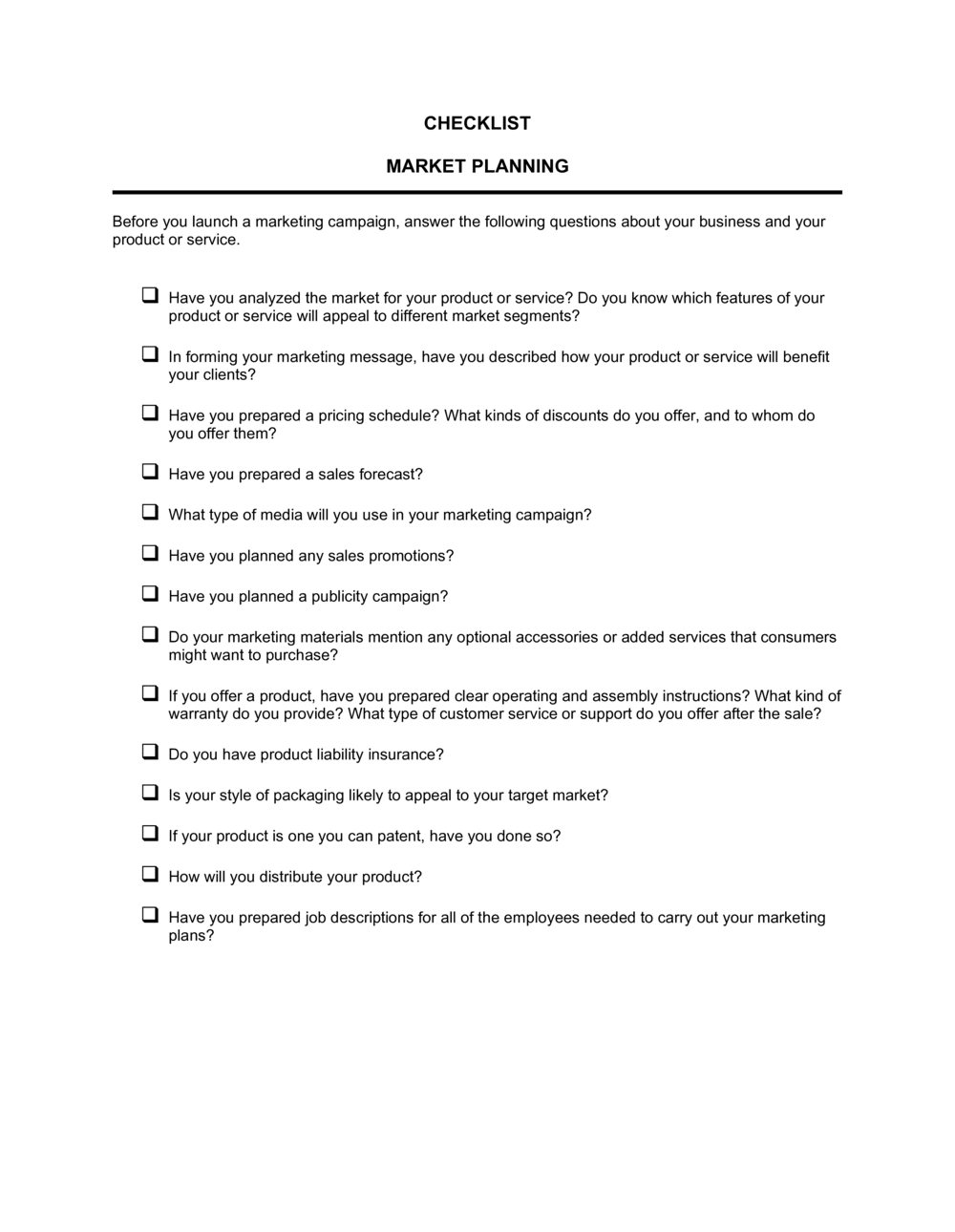
Checklist Market Planning

Free download β€’ Use as a template β€’ Print or share

1 pageβ€’20–25 min to useβ€’Difficulty: Standard
Learn more ↓
FreeChecklist Market Planning Template

At a glance

What it is
A Market Planning Checklist is a structured form that guides marketing teams and business owners through every key step of building a market plan β€” from defining target customer segments to setting budgets, selecting channels, and establishing success metrics. This free Word download is pre-formatted and editable online, giving you a ready-to-use framework you can adapt for a product launch, campaign, or annual marketing cycle.
When you need it
Use it at the start of any new campaign, product launch, or fiscal-year marketing cycle to confirm that no critical planning steps are skipped before budget or resources are committed.
What's inside
Target market definition, competitive landscape review, positioning and messaging, channel selection, budget allocation, timeline and milestones, KPI targets, and a final sign-off section to confirm all items have been reviewed and approved before execution begins.

What is a Market Planning Checklist?

A Market Planning Checklist is a structured form that guides marketing teams and business owners through every critical decision point in building a market plan β€” from defining target customer segments and mapping the competitive landscape to selecting channels, allocating budget, setting KPIs, and confirming sign-off before execution begins. Rather than a narrative document, it functions as a sequential gate: each completed field confirms that a specific planning decision has been made and documented before the next phase begins. This free Word download is pre-formatted for immediate use and can be adapted for a product launch, quarterly campaign, or full annual marketing cycle.

Why You Need This Document

Running a marketing campaign without a completed planning checklist is the operational equivalent of approving a construction project without a blueprint review β€” individual tasks may proceed, but misaligned assumptions surface only after budget has been spent. Skipped steps compound: undefined target segments produce generic messaging; missing competitive context leads to positioning that mirrors a market leader; budgets allocated without a reserve leave teams unable to shift spend when a channel underperforms. A market planning checklist eliminates these gaps systematically before a single dollar is committed, creating a documented record of every key planning decision that stakeholders and reviewers can audit throughout the campaign cycle.

Which variant fits your situation?

If your situation is…Use this template
Planning a full annual marketing strategy with financialsMarketing Plan
Launching a specific new product or serviceProduct Launch Plan
Documenting a detailed digital advertising campaignDigital Marketing Plan
Tracking marketing spend across channels and quartersMarketing Budget Template
Evaluating brand positioning against competitorsCompetitive Analysis Template
Aligning sales and marketing on target accountsSales Plan Template
Reviewing market conditions before entering a new territoryMarket Analysis Report

Common mistakes to avoid

❌ Skipping the competitive landscape field

Why it matters: Without documenting competitors, positioning statements are created in a vacuum β€” teams often duplicate messaging already owned by a market leader, reducing campaign effectiveness.

Fix: Complete at least a three-competitor summary before filling in the value proposition field. The two fields are interdependent.

❌ Setting KPIs without baseline values

Why it matters: A target of '500 leads per month' is meaningless if the current baseline is unknown β€” you cannot tell whether the plan represents a 10% improvement or a 400% stretch goal.

Fix: Pull the last three months of actuals for each KPI before filling in targets. If no data exists, set a 60-day measurement period as the first milestone.

❌ Allocating 100% of budget at the start of the cycle

Why it matters: Channel performance varies by 20–40% from projections in most campaigns β€” with no reserve, teams either overspend or lose the ability to capitalize on high-performing channels mid-cycle.

Fix: Reserve at least 10% of total budget as an unallocated optimization fund, released only after first-month performance data is reviewed.

❌ Leaving milestone owners blank

Why it matters: Shared ownership of a milestone is equivalent to no ownership β€” when a deadline slips, there is no clear accountability, and the delay cascades through the rest of the timeline.

Fix: Assign exactly one named owner per milestone, even for collaborative deliverables. That person is responsible for coordination, not necessarily sole execution.

The 10 key fields, explained

Target market and customer segments

Market size and opportunity

Competitive landscape summary

Value proposition and key messages

Channel selection and rationale

Budget allocation by channel

Timeline and key milestones

KPIs and success metrics

Risks and mitigation notes

Review and sign-off

How to fill it out

  1. 1

    Define your target market and customer segments

    Start by naming your primary and secondary customer segments with enough detail to guide messaging β€” industry, company size, role, or behavior. Avoid generic descriptions like 'businesses of all sizes.'

    πŸ’‘ If you have existing customer data, pull the top 20% of accounts by revenue and describe their shared characteristics β€” that profile is your primary segment.

  2. 2

    Estimate market size with a bottom-up check

    Record TAM and SAM figures with source citations. Then validate with a bottom-up calculation: count reachable customers and multiply by expected average contract or transaction value.

    πŸ’‘ If your top-down and bottom-up estimates differ by more than 30%, revisit your assumptions before proceeding.

  3. 3

    Complete the competitive landscape summary

    List at least three competitors β€” direct and indirect β€” with one specific strength and one weakness for each. Then write a single sentence on your differentiated advantage.

    πŸ’‘ Use a 2Γ—2 positioning matrix (e.g., price vs. capability) to make the competitive gaps immediately visible to reviewers.

  4. 4

    Write the value proposition for each target segment

    For each segment, write one sentence that names the specific outcome your product or service delivers and the mechanism that produces it. Add two or three supporting proof points.

    πŸ’‘ Test the value proposition against the 'so what?' question β€” if the answer is obvious, the benefit is not specific enough.

  5. 5

    Select channels and allocate budget

    Choose two to four channels based on where each target segment makes purchasing decisions. Assign a dollar amount and percentage of total budget to each channel, and retain at least 10% as a reserve.

    πŸ’‘ Rank channels by estimated cost-per-acquisition before committing budget β€” the most familiar channel is rarely the most efficient one.

  6. 6

    Set milestones with named owners and KPIs with baselines

    Assign each milestone a specific due date and a named owner. For each KPI, record the current baseline value alongside the target so progress can be measured from a defined starting point.

    πŸ’‘ Limit yourself to five or fewer KPIs β€” plans tracking more than five metrics rarely optimize any of them consistently.

  7. 7

    Complete the risks and sign-off sections

    Note at least two known risks with a brief mitigation action for each. Then route the completed checklist to the appropriate reviewer for sign-off before any spend is authorized.

    πŸ’‘ Schedule a 30-minute review meeting rather than requesting asynchronous sign-off β€” reviewers who read the checklist in context catch far more gaps.

Frequently asked questions

What is a market planning checklist?

A market planning checklist is a structured form that guides marketing teams and business owners through the key steps of building and validating a market plan before execution begins. It covers target market definition, competitive analysis, value proposition, channel selection, budget allocation, KPIs, and sign-off β€” ensuring nothing is skipped before budget or resources are committed.

How is a market planning checklist different from a marketing plan?

A marketing plan is a comprehensive strategic document β€” typically 15–30 pages β€” covering market analysis, financial projections, and detailed campaign roadmaps. A market planning checklist is a shorter pre-execution tool that confirms all critical planning steps have been addressed before a campaign or launch begins. The checklist is often used as a gate before the full marketing plan is activated.

When should I use a market planning checklist?

Use it at the start of any new marketing campaign, product launch, or annual planning cycle β€” before budget is committed and resources are allocated. It is also useful when onboarding a new client or team member onto an active marketing program, as it provides a structured overview of all active planning decisions.

What KPIs should I include in a market planning checklist?

Choose KPIs directly linked to your campaign objective. Common options include cost per lead, conversion rate, customer acquisition cost, monthly qualified pipeline generated, and return on ad spend. Limit the checklist to five or fewer KPIs β€” tracking more dilutes focus and rarely improves outcomes. Always pair each KPI with a current baseline value and a time-bound target.

How often should a market planning checklist be updated?

Complete a fresh checklist at the start of each new campaign or planning cycle β€” typically quarterly for active marketing programs and annually for strategic market planning. Mid-cycle updates are warranted when a major competitive shift, budget change, or channel performance issue requires replanning. Treat it as a living document, not a one-time exercise.

Do I need marketing expertise to complete this checklist?

No specialized expertise is required for most fields. The checklist is designed to prompt structured thinking rather than assume prior knowledge. Fields like market size estimation benefit from basic research skills β€” access to industry reports or a simple bottom-up calculation is sufficient. For complex go-to-market strategies, a marketing consultant can review the completed checklist in one to two hours.

Can this checklist be used for both B2B and B2C marketing planning?

Yes. The core fields β€” target market, competitive landscape, value proposition, channel selection, budget, and KPIs β€” apply to both B2B and B2C contexts. The specific inputs differ: B2B planning typically focuses on industry segments, account-based channels, and longer sales cycles, while B2C planning emphasizes consumer demographics, mass-reach channels, and transaction volume metrics.

How is this different from a product launch checklist?

A product launch checklist focuses on the tactical execution steps required to bring a specific product to market β€” feature readiness, pricing, sales enablement, and launch-day logistics. A market planning checklist addresses the broader strategic layer: who you are targeting, how you are positioned, which channels you will use, and what success looks like across the full planning cycle. A product launch typically requires both.

How this compares to alternatives

vs Marketing Plan

A full marketing plan is a 15–30 page strategic document with detailed financial projections, campaign roadmaps, and narrative analysis. A market planning checklist is a concise pre-execution gate β€” faster to complete and designed to confirm critical decisions are in place before spend begins. Use the checklist to validate your plan, then use the full marketing plan as the governing document for the cycle.

vs Product Launch Plan

A product launch plan covers the tactical steps to bring a specific product to market β€” readiness criteria, pricing, sales enablement, and launch-day logistics. A market planning checklist covers the broader strategic context for any marketing activity, not just a product launch. For a new product, both documents are typically needed: the checklist validates strategy, the launch plan manages execution.

vs Competitive Analysis Template

A competitive analysis template produces a detailed, standalone review of competitors β€” positioning maps, feature comparisons, and win/loss data. The market planning checklist includes a compressed competitive summary as one field among many. Use the full competitive analysis to develop the input, then transfer the key findings into the checklist's competitive landscape field.

vs Sales Plan

A sales plan covers territory design, quota allocation, pipeline targets, and sales team activities. A market planning checklist addresses the upstream marketing decisions that feed the sales pipeline β€” target segments, messaging, and channel mix. The two documents are complementary: marketing planning sets the demand generation strategy; sales planning converts that demand into closed revenue.

Industry-specific considerations

SaaS / Technology

Channel selection weighted toward digital-first touchpoints; KPIs centered on MQL volume, trial conversion rate, and CAC payback period.

Retail / E-commerce

Seasonal campaign planning with budget allocation shifting between paid social, email, and promotions by quarter; KPIs tied to ROAS and repeat purchase rate.

Professional Services

Market planning focused on niche segment targeting and referral channel development; competitive differentiation based on specialization rather than price.

Manufacturing

Channel selection includes trade shows, distributor networks, and trade publications; market sizing based on industry-specific databases and distributor coverage maps.

Template vs pro β€” what fits your needs?

PathBest forCostTime
Use the templateMarketing managers, small business owners, and founders building or reviewing a market plan independentlyFree1–2 hours to complete
Template + professional reviewTeams entering a new market or launching a major campaign who want an experienced marketer to validate the plan$200–$600 for a 1–2 hour marketing consultant reviewHalf a day
Custom draftedEnterprise marketing teams or agencies requiring a fully customized planning framework integrated with internal tools or brand standards$1,000–$3,000 for custom template design and facilitation3–5 business days

Glossary

Target Market
The specific group of customers a business intends to reach with a product or marketing campaign, defined by demographics, needs, or behavior.
Value Proposition
A clear statement of the specific benefit a product or service delivers to a target customer and why it is better than alternatives.
Go-to-Market Strategy
The plan for how a company will reach its target customers and achieve a competitive advantage at launch or entry into a new market.
Positioning
How a brand or product is perceived relative to competitors in the minds of the target customer β€” the space it occupies in the market.
KPI (Key Performance Indicator)
A measurable value that tracks whether a marketing activity is achieving its intended objective β€” for example, cost per lead or conversion rate.
Marketing Channel
The medium or platform through which a business communicates with and acquires customers, such as paid search, email, social media, or trade events.
Customer Segment
A distinct subgroup within a target market sharing common characteristics β€” such as industry, company size, or purchase behavior β€” that justifies a tailored message.
Budget Allocation
The distribution of total marketing spend across channels, campaigns, or time periods based on expected return and strategic priority.
Competitive Landscape
A structured overview of direct and indirect competitors β€” their positioning, pricing, and market share β€” used to identify gaps and opportunities.
Milestone
A specific, date-bound checkpoint in a marketing plan that confirms a key activity has been completed before the next phase begins.

Part of your Business Operating System

This document is one of 3,000+ business & legal templates included in Business in a Box.

  • Fill-in-the-blanks β€” ready in minutes
  • 100% customizable Word document
  • Compatible with all office suites
  • Export to PDF and share electronically

Create your document in 3 simple steps.

From template to signed document β€” all inside one Business Operating System.
1
Download or open template

Access over 3,000+ business and legal templates for any business task, project or initiative.

2
Edit and fill in the blanks with AI

Customize your ready-made business document template and save it in the cloud.

3
Save, Share, Send, Sign

Share your files and folders with your team. Create a space of seamless collaboration.

Save time, save money, and create top-quality documents.

β˜…β˜…β˜…β˜…β˜…

"Fantastic value! I'm not sure how I'd do without it. It's worth its weight in gold and paid back for itself many times."

Managing Director Β· Mall Farm
Robert Whalley
Managing Director, Mall Farm Proprietary Limited
β˜…β˜…β˜…β˜…β˜…

"I have been using Business in a Box for years. It has been the most useful source of templates I have encountered. I recommend it to anyone."

Business Owner Β· 4+ years
Dr Michael John Freestone
Business Owner
β˜…β˜…β˜…β˜…β˜…

"It has been a life saver so many times I have lost count. Business in a Box has saved me so much time and as you know, time is money."

Owner Β· Upstate Web
David G. Moore Jr.
Owner, Upstate Web

Run your business with a system β€” not scattered tools

Stop downloading documents. Start operating with clarity. Business in a Box gives you the Business Operating System used by over 250,000 companies worldwide to structure, run, and grow their business.

Start freeΒ Β·Β No credit card required