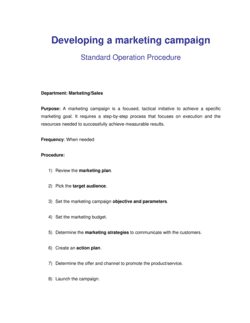
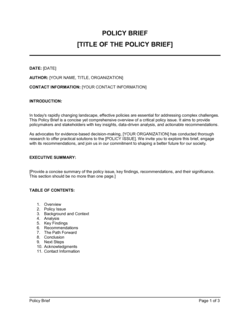
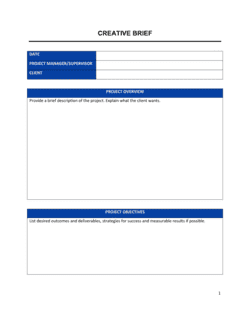
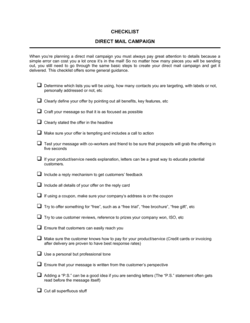
Marketing Campaign Brief Template

Free Word download • Edit online • Save & share with Drive • Export to PDF

2 pages20–30 min to fillDifficulty: StandardSignature requiredLegal review recommended
Learn more ↓
FreeMarketing Campaign Brief Template

At a glance

What it is
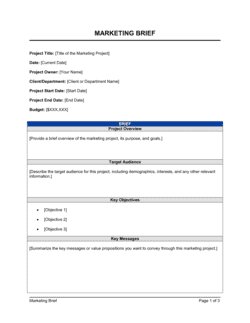
A Marketing Campaign Brief is a binding document between a brand or client and an agency, freelancer, or internal marketing team that defines the scope, objectives, deliverables, budget, timeline, approval process, and IP ownership for a specific marketing campaign. This free Word download gives you a structured, signable starting point you can edit online and export as PDF — replacing vague email threads with a single authoritative reference document.
When you need it
Use it before any paid, organic, or integrated marketing campaign begins — whether you are engaging an external agency, a freelance creative, or coordinating an in-house team across multiple channels. It is especially critical when budget exceeds $5,000, multiple vendors are involved, or campaign assets will be licensed or repurposed after the initial run.
What's inside
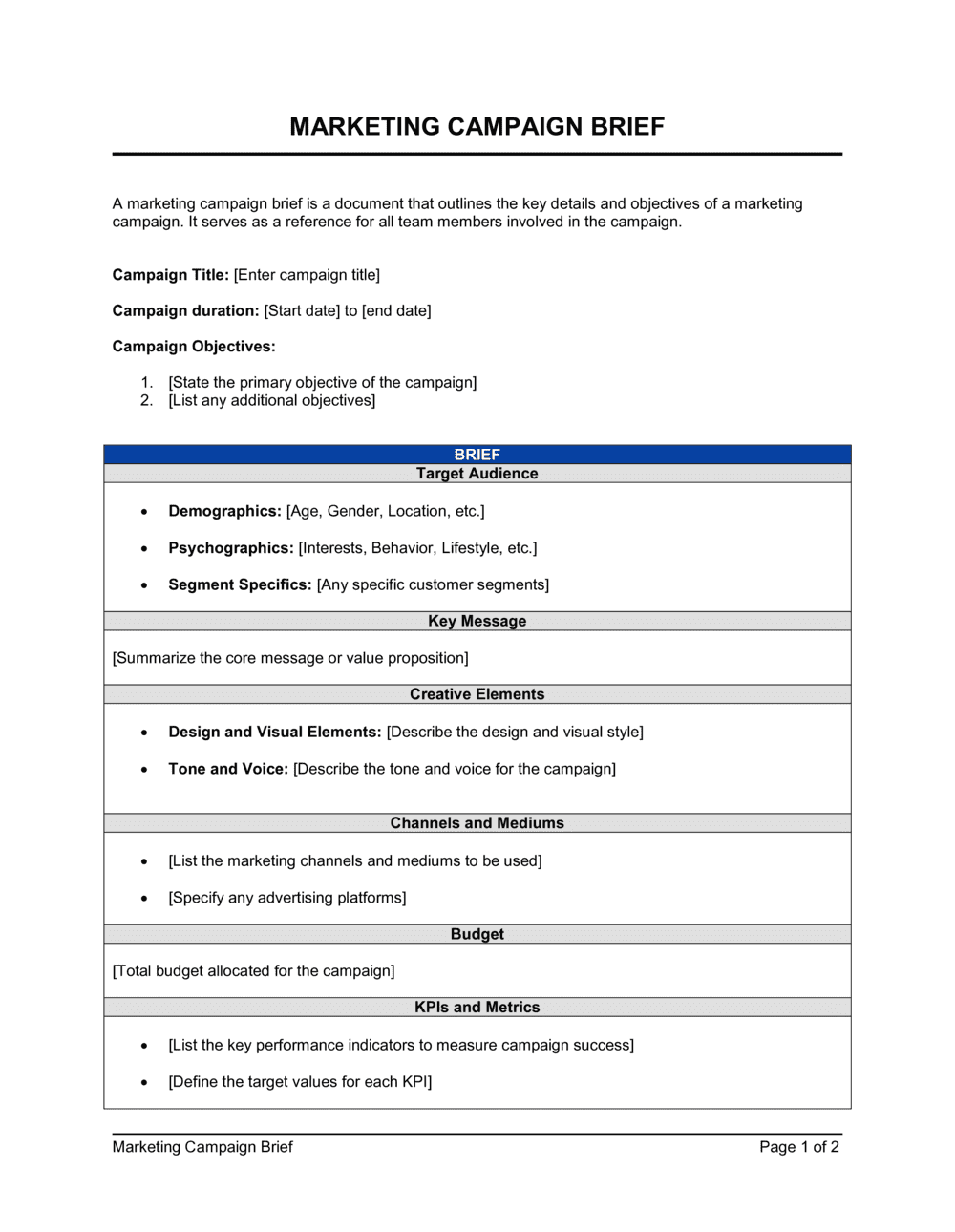
Campaign objectives and KPIs, target audience definition, scope of work and deliverables, budget allocation and payment schedule, timeline and milestone dates, brand guidelines and approval workflow, IP and usage rights, and confidentiality and termination provisions.

What is a Marketing Campaign Brief?

A Marketing Campaign Brief is a binding document between a client — brand, company, or marketing team — and an agency, freelancer, or internal creative team that governs every material dimension of a specific marketing campaign: objectives and KPIs, target audience definition, scope of work, deliverables with technical specifications, budget allocation, payment schedule, campaign timeline, approval workflow, intellectual property ownership, and confidentiality obligations. Unlike an informal email chain or a one-page creative overview, a properly executed campaign brief creates enforceable obligations on both sides and resolves, in advance, the questions that most commonly derail campaigns — who owns the assets, what happens if the client cancels, and who has final say on approval.

Why You Need This Document

Without a signed marketing campaign brief, both the brand and the agency are exposed simultaneously. The client risks producing a full campaign's worth of assets that the agency technically still owns under default copyright rules — meaning the brand cannot legally adapt, repurpose, or license those assets without going back to the creator. The agency risks investing staff time, vendor fees, and production costs into a campaign the client cancels with no contractual basis for recovery. Vague scope descriptions generate revision cycles that consume budget and miss launch dates; undefined approval authority turns stakeholder feedback into a loop with no exit. A signed brief, executed before any work begins, closes all of these gaps. This template gives you a structured, attorney-informed starting point that covers every critical provision — so the only thing left to negotiate is the work itself.

Which variant fits your situation?

If your situation is…Use this template
Briefing an agency on a single creative concept or visual assetCreative Brief
Engaging a freelance designer, copywriter, or photographer for campaign assetsFreelance Services Agreement
Running a co-branded campaign with a partner companyCo-Marketing Agreement
Launching a social media influencer campaignInfluencer Marketing Agreement
Commissioning a brand identity or logo as part of the campaignGraphic Design Contract
Briefing a PR agency on a product launch media campaignPublic Relations Agency Agreement
Planning an integrated multi-channel campaign with a defined annual budgetMarketing Services Agreement

Common mistakes to avoid

❌ Vague campaign objectives with no numeric targets

Why it matters: Without a measurable target, neither party can determine whether the campaign succeeded, making performance-based payment clauses unenforceable and post-campaign disputes nearly inevitable.

Fix: Require at least one primary objective with a specific number, platform, and deadline — for example, '400 sign-ups via paid social at a CPA of $35 or less by October 15.'

❌ No IP assignment clause

Why it matters: Under copyright law in the US, UK, Canada, and the EU, the creator owns the work by default — meaning assets delivered without an explicit assignment may still legally belong to the agency even after the client pays.

Fix: Include a clause stating that all deliverables become the sole property of the client upon receipt of full payment, and that the agency irrevocably assigns all copyright and related rights.

❌ Omitting technical specifications for deliverables

Why it matters: When a brief says 'video ad' without specifying resolution, aspect ratio, duration, and caption requirements, the agency and client each form a different mental image — and the resulting deliverable almost always requires a costly redo.

Fix: For every deliverable, state format, dimensions or duration, quantity, file type, and platform destination. Attach a production spec sheet as an exhibit if the campaign is asset-heavy.

❌ No kill fee or termination payment provision

Why it matters: Agencies that invest in research, talent booking, and production before a client cancels with no contractual recourse routinely absorb thousands of dollars in unrecoverable costs.

Fix: Include a kill fee equal to at least 25–50% of remaining contract value for client-initiated termination after work has begun, plus reimbursement of documented third-party costs.

❌ No designated client approver with sign-off authority

Why it matters: When multiple stakeholders provide conflicting revision feedback without a designated decision-maker, revision rounds multiply beyond what the brief's budget covers, and the agency has no contractual basis to stop the cycle.

Fix: Name one individual by title as the sole authorized approver, and include a deemed-approval clause stating that non-response within the review window constitutes acceptance.

❌ Starting work before the brief is signed

Why it matters: Work performed before execution weakens both parties' legal positions: the client's IP claim is murkier, and the agency has no written protection for its fees if the client later disputes the engagement.

Fix: Make execution of the signed brief a condition precedent to kickoff in your agency's intake process. Use eSignature to eliminate the 'I'll sign it after the call' delay.

The 10 key clauses, explained

Parties, campaign name, and effective date

In plain language: Identifies the client and agency (or vendor) as legal entities, names the specific campaign covered, and records the date the brief takes effect.

Sample language
This Marketing Campaign Brief ('Brief') is entered into as of [DATE] between [CLIENT LEGAL NAME], a [STATE/COUNTRY] [ENTITY TYPE] ('Client'), and [AGENCY LEGAL NAME], a [STATE/COUNTRY] [ENTITY TYPE] ('Agency'), for the campaign known as [CAMPAIGN NAME].

Common mistake: Using a trade name or brand name instead of the registered legal entity. If the contracting party name doesn't match the invoicing entity, payment disputes and IP enforcement become difficult.

Campaign objectives and KPIs

In plain language: States the specific, measurable outcomes the campaign must achieve and how success will be measured — with numeric targets and deadlines.

Sample language
The campaign objective is to generate [X] qualified leads at a cost per lead of no more than $[X] by [DATE], as measured by [TRACKING PLATFORM]. Secondary KPIs: [METRIC 1] target [X], [METRIC 2] target [X].

Common mistake: Writing aspirational objectives without numeric targets — 'increase brand awareness' with no benchmark. Vague objectives make it impossible to assess whether the agency delivered and create disputes over payment tied to performance.

Target audience definition

In plain language: Describes the intended audience by demographic, psychographic, behavioral, or firmographic characteristics so the agency can align messaging and channel selection.

Sample language
Primary audience: [DEMOGRAPHIC DESCRIPTION], aged [X–Y], located in [GEOGRAPHY], with [BEHAVIORAL OR FIRMOGRAPHIC TRAIT]. Secondary audience: [DESCRIPTION]. Audience persona reference: [DOCUMENT LINK OR ATTACHMENT].

Common mistake: Providing only demographic data without behavioral or need-state context. An audience defined only as '25–45, college-educated females' gives the agency no insight into what motivates the purchase decision.

Scope of work and deliverables

In plain language: Lists every asset, task, and output the agency is contracted to produce, with format specifications and the delivery date for each.

Sample language
Agency shall deliver: (a) [X] social media graphics ([DIMENSIONS], [FORMAT]) by [DATE]; (b) one 30-second video ad ([SPECS]) by [DATE]; (c) [X]-word landing page copy by [DATE]. All other deliverables require a written change order.

Common mistake: Omitting technical specifications (file format, dimensions, word count, resolution). Disputes over whether a deliverable 'met spec' are among the most common agency–client conflicts, and they originate almost entirely from an underspecified brief.

Budget allocation and payment schedule

In plain language: States the total campaign budget, how it is allocated across deliverable categories, and the schedule of payments with trigger dates or milestones.

Sample language
Total budget: $[AMOUNT]. Allocation: creative production $[X], media spend $[X], agency fee $[X]. Payment schedule: 50% ($[X]) on execution of this Brief; 50% ($[X]) on final delivery and Client approval. All invoices payable within [30] days of receipt.

Common mistake: Separating the agency fee from the media spend budget without making clear who controls and is accountable for the ad spend. Agencies who manage client media budgets without written authorization expose both parties to overspend liability.

Timeline, milestones, and campaign flight dates

In plain language: Sets the start and end dates for the campaign, key internal milestone dates (strategy, concepts, drafts, approvals), and the live campaign flight window.

Sample language
Campaign kickoff: [DATE]. Creative concepts due: [DATE]. Client feedback due within [X] business days of receipt. Final assets due: [DATE]. Campaign live: [START DATE] to [END DATE]. Agency is not liable for delays caused by Client's failure to provide feedback within the stated review window.

Common mistake: No clause addressing delayed client feedback. When a client takes 3 weeks to approve a draft that required a 3-day turnaround, the campaign flight date slips — and without a contractual provision, the agency may still be held responsible for missing the live date.

Brand guidelines and approval workflow

In plain language: Specifies the brand standards all assets must comply with, the number of revision rounds included, and who has final approval authority on the client side.

Sample language
All assets must comply with Client's Brand Guidelines (attached as Exhibit A). Agency shall submit each deliverable for Client review. Client shall have [2] rounds of revisions per deliverable. Additional revision rounds are billable at $[X]/hour. Final approval authority: [NAME/TITLE].

Common mistake: Not specifying who has final sign-off authority. When multiple stakeholders provide conflicting feedback and no one is designated as decision-maker, revision cycles multiply and the brief's timeline and budget collapse.

Intellectual property and usage rights

In plain language: Assigns ownership of all campaign assets to the client upon final payment and defines any limitations on the agency's right to use the work in its portfolio.

Sample language
Upon receipt of full payment, Agency assigns to Client all right, title, and interest in all deliverables, including copyright. Agency retains the right to display the work in its portfolio with prior written consent of Client, which shall not be unreasonably withheld. Stock assets licensed for campaign use are subject to the terms of the applicable license.

Common mistake: No IP assignment clause at all — or an assignment that takes effect on project start rather than final payment. Without an assignment tied to payment, clients who receive assets before paying in full may distribute work the agency technically still owns.

Confidentiality

In plain language: Prohibits the agency from disclosing the client's campaign strategy, budget, audience data, or unreleased product information to third parties during and after the engagement.

Sample language
Agency shall keep confidential all non-public information provided by Client in connection with this Brief, including campaign strategy, budget, audience data, and product launch details, and shall not disclose such information to any third party without Client's prior written consent.

Common mistake: Omitting a definition of what constitutes confidential information. Without a clear definition, agencies may share campaign performance data, media mix details, or creative strategy with prospective clients as case study material — information the brand considers proprietary.

Termination, kill fee, and change orders

In plain language: States the conditions under which either party may terminate the brief, the kill fee owed to the agency on client-initiated termination, and the process for authorizing scope changes.

Sample language
Either party may terminate this Brief with [14] days written notice. If Client terminates after work has commenced, Client shall pay Agency a kill fee equal to [X]% of the remaining unpaid contract value, plus costs incurred to date. Any changes to scope, budget, or timeline require a signed Change Order before work begins.

Common mistake: No kill fee provision at all. Agencies that begin production — booking talent, purchasing stock, allocating staff — and face sudden client cancellation with no contractual recourse frequently absorb losses of $5,000–$50,000 on mid-size campaigns.

How to fill it out

  1. 1

    Enter both parties' legal entity names and the campaign name

    Use the full registered name for both the client and the agency — not a brand name or abbreviation. Name the specific campaign so the brief unambiguously covers only that engagement.

    💡 If the agency invoices under a different entity than it contracts under, confirm both names before signing — mismatched entity names create payment and IP enforcement problems.

  2. 2

    Define campaign objectives with numeric targets

    Write at least one primary objective with a specific numeric target (e.g., 500 qualified leads at $40 CPL by September 30) and list secondary KPIs with their measurement source and target values.

    💡 Objectives tied to a platform metric (Google Ads CPA, Meta ROAS) should name the specific account or campaign ID so there is no ambiguity about which data governs.

  3. 3

    Describe the target audience in behavioral terms

    Go beyond demographics: include the audience's primary need-state, key objections, and the channels where they are most reachable. Attach any existing audience persona documents as an exhibit.

    💡 Agencies produce stronger work when given a specific pain point to address — 'SMB owners who have tried and abandoned accounting software' beats 'small business owners aged 30–50.'

  4. 4

    List every deliverable with full technical specifications

    For each asset, state the format, dimensions or word count, quantity, and the delivery deadline. Confirm which deliverables require media placement and whether the agency or client controls ad spend.

    💡 Add a line item explicitly marking what is out of scope — this single addition eliminates most scope-creep disputes before they start.

  5. 5

    Set the budget allocation and payment schedule

    Break the total budget into creative fees, media spend, and any third-party costs. Define payment milestones — typically 50% on signing and 50% on delivery — and specify the invoice payment window.

    💡 If the agency manages client media spend, add a separate clause capping weekly ad spend and requiring written approval before exceeding it.

  6. 6

    Define the approval workflow and designate a decision-maker

    State the number of revision rounds included per deliverable, the review window the client has (e.g., 3 business days), and the name and title of the person with final sign-off authority.

    💡 Build in a deemed-approval clause: if the client does not respond within the review window, the submitted version is considered approved. This prevents indefinite timeline drift.

  7. 7

    Complete the IP assignment and portfolio rights sections

    Confirm that IP transfers to the client on final payment, list any licensed stock assets that carry separate restrictions, and state whether the agency may include the work in its portfolio.

    💡 For regulated industries (pharma, financial services), add a clause prohibiting any public portfolio use until the campaign has concluded and the client has given written clearance.

  8. 8

    Sign before any work begins

    Both parties must execute the brief before kickoff. Work that begins before signing weakens the client's IP position and the agency's payment protections simultaneously.

    💡 Use an eSignature tool and timestamp execution. Store the fully signed brief alongside all creative assets for the life of the campaign plus at least 3 years.

Frequently asked questions

What is a marketing campaign brief?

A marketing campaign brief is a document — typically binding when signed by both parties — that defines the objectives, target audience, scope of work, deliverables, budget, timeline, approval process, and IP ownership for a specific marketing campaign. It serves as the single authoritative reference for both the client and the agency or vendor, replacing informal email threads and verbal agreements with enforceable written terms.

Is a marketing campaign brief legally binding?

Yes, when signed by both parties with adequate consideration, a marketing campaign brief is generally enforceable as a contract in most jurisdictions. It contains the core elements of a binding agreement: offer, acceptance, and consideration (typically the fee). Courts in the US, UK, Canada, and the EU have enforced agency briefs as contracts for payment, IP ownership, and confidentiality obligations. An unsigned brief is a reference document only and provides no legal protection to either party.

What should a marketing campaign brief include?

At minimum: parties and effective date, campaign name and objectives with numeric KPIs, target audience definition, complete scope of work with technical specifications, budget allocation and payment schedule, campaign timeline and milestone dates, brand guidelines reference, approval workflow with a named decision-maker, IP assignment, confidentiality obligations, and termination and kill-fee provisions. Missing the IP assignment and kill fee clauses are the two omissions that most commonly generate disputes.

Who owns the creative assets produced under a marketing brief?

Under copyright law in the US, Canada, the UK, and the EU, the creator owns the work by default unless there is an explicit written assignment. The client only owns campaign assets if the brief contains a clear IP assignment clause transferring ownership upon full payment. Without one, the agency retains copyright even after the client has paid, which can prevent the client from adapting, repurposing, or licensing the assets without the agency's permission.

What is the difference between a marketing campaign brief and a creative brief?

A creative brief focuses narrowly on the messaging strategy and visual direction for a specific asset or concept — tone, look and feel, key message, and call to action. A marketing campaign brief is broader: it governs the entire campaign engagement, including budget, payment terms, IP, confidentiality, and termination. A creative brief is often an exhibit or attachment within a larger marketing campaign brief, not a standalone legal document.

What happens if the client wants to add deliverables after the brief is signed?

Any addition to the agreed scope of work after the brief is executed should be documented in a signed change order before the additional work begins. Work performed outside the original scope without a written change order creates disputes over whether it is billable and whether the original timeline still applies. A well-drafted brief states explicitly that all scope changes require a signed change order to be effective.

What is a kill fee in a marketing campaign brief?

A kill fee is a contractually agreed payment owed to the agency if the client terminates the engagement after work has begun. It compensates the agency for resources already committed — staff time, vendor bookings, stock licenses — that cannot be recovered. Kill fees are typically expressed as a percentage of the remaining unpaid contract value, commonly 25–50%, plus reimbursement of documented third-party costs incurred to the date of termination.

Does a marketing campaign brief need to be reviewed by a lawyer?

For standard agency engagements under $10,000 with a single vendor, a high-quality template is typically sufficient. Legal review is worth the cost when the campaign budget exceeds $25,000, when the engagement involves multiple vendors with complex IP interactions, when the client is in a regulated industry (pharma, financial services, healthcare), or when the brief includes performance-based payment tied to specific revenue targets. A 1–2 hour attorney review typically costs $200–$500 and is particularly valuable for the IP assignment and confidentiality sections.

How is a marketing campaign brief different from a marketing services agreement?

A marketing services agreement is a master contract governing an ongoing relationship between a client and an agency — covering general terms, liability, insurance, and framework payment terms that apply to all work. A marketing campaign brief is a project-specific document that operates under the master agreement and defines the deliverables, budget, and timeline for a single campaign. When no master agreement exists, the campaign brief must include all governing terms itself, making a comprehensive template essential.

How this compares to alternatives

vs Creative Brief

A creative brief defines the messaging strategy, visual direction, and tone for a single asset or concept — it is a strategic input, not a contract. A marketing campaign brief governs the full engagement: budget, payment, IP, confidentiality, and termination. A creative brief is typically attached as an exhibit within the campaign brief, not used in its place.

vs Marketing Services Agreement

A marketing services agreement is a master contract setting the framework terms for an ongoing agency–client relationship — liability caps, insurance, general IP policy, and dispute resolution. A campaign brief is a project-specific document executed under that master agreement for a single campaign. When no master agreement exists, the campaign brief must stand alone and cover all governing terms.

vs Independent Contractor Agreement

An independent contractor agreement governs the working relationship with a self-employed individual — classification, tax responsibility, and general service terms. A marketing campaign brief is project-specific and focuses on deliverables, campaign objectives, and brand-specific IP. Use an independent contractor agreement for the ongoing relationship and a campaign brief for each discrete campaign engagement.

vs Statement of Work

A statement of work (SOW) is a detailed scope document often used within a larger professional services agreement. It covers deliverables and timelines but typically lacks campaign-specific elements like KPIs, audience definitions, brand guidelines, and kill fees. A marketing campaign brief combines the operational scope of an SOW with the campaign-specific legal provisions that protect both the brand and the agency.

Industry-specific considerations

Consumer Goods and Retail

Seasonal campaign flights tied to retail calendars, co-op advertising budget requirements from brand partners, and multi-channel asset suites spanning in-store, digital, and broadcast.

Technology / SaaS

Performance-based KPIs tied to trial sign-ups or MQL targets, integration with CRM and attribution platforms, and strict IP controls over product screenshots and unreleased feature messaging.

Healthcare and Pharma

Regulatory review gates (FDA, Health Canada, MHRA) built into the approval workflow, mandatory fair balance language in all consumer-facing assets, and prohibition on agency portfolio use of campaign materials.

Financial Services

Compliance review requirements from legal and compliance teams before any asset goes live, restricted use of performance claims and testimonials, and mandatory disclosures on all ad formats.

Jurisdictional notes

United States

Under US copyright law (17 U.S.C. § 101), works created by an independent contractor are not works-for-hire unless the agreement is in writing and the work falls into specific statutory categories — marketing campaign materials typically do not qualify. An explicit IP assignment clause is therefore essential. State law governs enforceability of non-solicitation and confidentiality provisions; California applies a stricter reasonableness standard than most other states.

Canada

Canadian copyright law (Copyright Act, R.S.C. 1985) similarly vests copyright in the creator by default. A written assignment is required to transfer ownership to the client. Quebec agencies operating under the Civil Code of Québec may require brief terms to be available in French under the Charter of the French Language for provincially regulated commercial activity. GST/HST must be correctly reflected in the payment schedule.

United Kingdom

Under the Copyright, Designs and Patents Act 1988, copyright in work created by a freelancer or agency belongs to the creator unless expressly assigned in writing. Works created by employees in the course of employment belong to the employer — but agency staff are not the client's employees. Post-Brexit, UK and EU data protection frameworks have diverged; briefs involving audience data or CRM targeting should address UK GDPR compliance separately from EU GDPR.

European Union

EU member states follow the Berne Convention, under which copyright belongs to the creator by default and moral rights (the right to be identified as author and to object to derogatory treatment) are generally inalienable — waivers should be addressed where local law permits. Where campaign briefs involve processing personal data for audience targeting, the brief should reference or incorporate a Data Processing Agreement (DPA) to comply with GDPR (Regulation 2016/679). Enforceability of non-compete and confidentiality clauses varies significantly by member state.

Template vs lawyer — what fits your deal?

PathBest forCostTime
Use the templateStandard agency or freelancer engagements under $25,000 with straightforward deliverables and no regulated industry requirementsFree30–60 minutes
Template + legal reviewCampaigns over $25,000, engagements with performance-based payment tied to revenue targets, or clients in regulated industries$200–$5001–3 days
Custom draftedMulti-agency integrated campaigns, licensing of assets for broadcast or international use, or campaigns with complex co-brand IP arrangements$1,000–$3,500+1–2 weeks

Glossary

Campaign Objective
A specific, measurable outcome the campaign is designed to achieve, such as a target number of leads, a revenue figure, or a brand awareness lift percentage.
KPI (Key Performance Indicator)
A quantifiable metric used to evaluate whether the campaign objective has been met — for example, cost per lead, click-through rate, or return on ad spend.
Scope of Work
The complete list of deliverables, tasks, and activities the agency or vendor is contracted to produce under the brief.
Deliverable
A specific, tangible output the vendor must provide by a defined date — such as a 30-second video ad, a set of six social media graphics, or a 2,000-word landing page.
IP (Intellectual Property) Assignment
A clause transferring ownership of all campaign assets — copy, visuals, video — created under the brief from the agency to the client upon full payment.
Usage Rights
The specific channels, geographies, and time periods for which the client is licensed to use campaign assets — distinct from full IP assignment.
Approval Workflow
The documented process for submitting, reviewing, and signing off on creative drafts, including the number of revision rounds included and who has final sign-off authority.
Brand Guidelines
A reference document specifying permitted colors, fonts, logo usage, tone of voice, and imagery style that all campaign assets must comply with.
Out-of-Scope Change
Any deliverable or task requested after brief execution that falls outside the agreed scope of work, typically subject to a written change order and additional fee.
Kill Fee
A contractually agreed payment owed to the agency if the client terminates the campaign brief after work has begun but before completion.
Change Order
A signed written amendment to the original brief that adds, removes, or modifies deliverables, budget, or timeline.

Part of your Business Operating System

This document is one of 3,000+ business & legal templates included in Business in a Box.

  • Fill-in-the-blanks — ready in minutes
  • 100% customizable Word document
  • Compatible with all office suites
  • Export to PDF and share electronically

Create your document in 3 simple steps.

From template to signed document — all inside one Business Operating System.
1
Download or open template

Access over 3,000+ business and legal templates for any business task, project or initiative.

2
Edit and fill in the blanks with AI

Customize your ready-made business document template and save it in the cloud.

3
Save, Share, Send, Sign

Share your files and folders with your team. Create a space of seamless collaboration.

Save time, save money, and create top-quality documents.

★★★★★

"Fantastic value! I'm not sure how I'd do without it. It's worth its weight in gold and paid back for itself many times."

Managing Director · Mall Farm
Robert Whalley
Managing Director, Mall Farm Proprietary Limited
★★★★★

"I have been using Business in a Box for years. It has been the most useful source of templates I have encountered. I recommend it to anyone."

Business Owner · 4+ years
Dr Michael John Freestone
Business Owner
★★★★★

"It has been a life saver so many times I have lost count. Business in a Box has saved me so much time and as you know, time is money."

Owner · Upstate Web
David G. Moore Jr.
Owner, Upstate Web

Run your business with a system — not scattered tools

Stop downloading documents. Start operating with clarity. Business in a Box gives you the Business Operating System used by over 250,000 companies worldwide to structure, run, and grow their business.

Start free · No credit card required