Content Strategy

Free Word download β€’ Edit online β€’ Save & share with Drive β€’ Export to PDF

3 pagesβ€’20–25 min to fillβ€’Difficulty: Standard
Learn more ↓
FreeContent Strategy Template

At a glance

What it is
A Content Strategy is a planning document that defines what content a business will create, for whom, through which channels, and how success will be measured. This free Word download gives marketing teams, founders, and agencies a structured framework they can edit online and export as PDF to align stakeholders and guide execution across every content touchpoint.
When you need it
Use it when launching a new brand, repositioning an existing content program, onboarding a new marketing hire or agency, or preparing a quarterly content plan for leadership approval. It is also the right tool when content efforts feel scattered and disconnected from business revenue goals.
What's inside
Business goals and content objectives, audience personas, competitive content audit, channel and format selection, editorial guidelines, content calendar framework, distribution and promotion plan, and KPI measurement framework with reporting cadence.

What is a Content Strategy?

A Content Strategy is a planning document that defines what content a business will produce, who it is created for, which channels will carry it, and how performance will be measured against business goals. It covers every editorial decision upstream of execution β€” audience personas, topic pillars, channel selection, brand voice, publishing cadence, distribution tactics, and KPIs β€” and connects each of those decisions to a specific business outcome such as lead generation, organic traffic growth, or customer retention. Unlike a content calendar, which schedules individual assets, a content strategy provides the governing logic that makes every scheduling and topic decision intentional rather than reactive.

Why You Need This Document

Without a documented content strategy, marketing teams default to producing content based on whoever had the most recent idea β€” cycling through topics, formats, and channels with no coherent thread connecting output to revenue. The consequences are concrete: content budgets get cut because leadership cannot trace their impact on pipeline, SEO efforts fail to build topical authority because posts cover unrelated subjects, and new hires or agencies receive inconsistent briefs that produce wildly inconsistent results. A written content strategy eliminates all four failure modes simultaneously β€” it gives writers clear direction, gives managers a framework for prioritizing requests, gives executives a measurable program to evaluate, and gives the business a compounding editorial asset that builds audience and organic reach month over month. This template gives you the complete structure to build that strategy in a single working session.

Which variant fits your situation?

If your situation is…Use this template
Planning content for a new product or brand launchContent Strategy (Launch)
Mapping out weekly or monthly publishing across channelsEditorial Calendar
Auditing and improving an existing content libraryContent Audit Template
Planning a single campaign around one theme or offerMarketing Campaign Plan
Building out an SEO-driven content plan with keyword targetsSEO Content Plan
Presenting a social-channel-only content approach to leadershipSocial Media Strategy
Defining blog, newsletter, and podcast content for a B2B brandB2B Content Marketing Plan

Common mistakes to avoid

❌ No connection between content goals and business revenue

Why it matters: When content KPIs live in a separate world from sales and revenue metrics, the program is the first budget cut in any downturn β€” because leadership cannot trace its value.

Fix: Map every content objective to at least one business metric β€” leads, pipeline, retention, or revenue β€” and include that metric in every monthly report.

❌ Personas built from internal assumptions, not customer data

Why it matters: Content written for an imagined audience misses the language, questions, and concerns of actual buyers, resulting in low engagement and poor conversion rates regardless of publishing volume.

Fix: Conduct at least five short customer interviews before finalizing personas, and refresh them annually with updated behavioral data from search queries and CRM records.

❌ Setting an unsustainable publishing cadence

Why it matters: Committing to five blog posts a week with a one-person team almost always collapses within six weeks, creating content gaps that damage SEO rankings built on publishing consistency.

Fix: Calculate realistic capacity in hours per week before setting cadence. One high-quality, well-distributed post per week beats three rushed posts with no promotion.

❌ Skipping the distribution plan

Why it matters: Publishing without promotion means even well-written content reaches only a tiny fraction of the potential audience, and the per-asset ROI stays permanently low.

Fix: Treat distribution as part of content production β€” every asset must have a minimum three-channel promotion checklist completed before the piece is considered done.

❌ Tracking only vanity metrics

Why it matters: Reporting on page views and social impressions without connecting them to leads or revenue makes it impossible to optimize toward business outcomes or defend budget decisions.

Fix: Add at least one conversion metric β€” form completions, email sign-ups, or demo requests β€” to every content report alongside traffic numbers.

❌ Defining brand voice in abstractions only

Why it matters: Vague guidelines like 'be conversational and authentic' give writers no actionable direction, and the result is inconsistent tone across authors, channels, and content types.

Fix: Write concrete examples of on-brand and off-brand sentences for each tone descriptor, and include a short banned-phrases list with explanations of why each phrase is excluded.

The 9 key sections, explained

Business goals and content objectives

Audience personas and segments

Competitive content audit

Channel and format selection

Content pillars and topic clusters

Editorial guidelines and brand voice

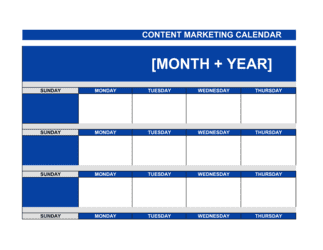
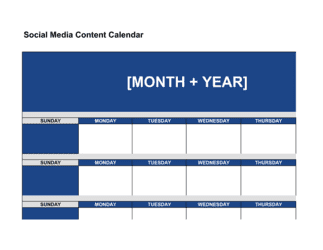
Content calendar framework

Distribution and promotion plan

KPIs and measurement framework

How to fill it out

  1. 1

    Set business goals and content objectives

    Start by listing two to three specific business outcomes the content program must contribute to β€” lead volume, revenue, or market awareness. For each, write a measurable content objective with a target number and deadline.

    πŸ’‘ Use the OKR format (Objective + Key Result) to keep each goal testable: 'Drive 500 MQLs from organic content by Q4' is testable; 'improve content marketing' is not.

  2. 2

    Build audience personas from real data

    Interview at least three to five current customers or target prospects. Document their job role, primary challenge, content consumption habits, and the specific questions they Google before buying. Limit personas to two to four β€” more dilutes focus.

    πŸ’‘ Pull search query data from Google Search Console and customer support tickets to validate persona pain points with behavioral evidence rather than assumptions.

  3. 3

    Audit competitor content

    Identify three to four direct competitors. Use a free tool like Ahrefs Webmaster Tools or Semrush's free tier to estimate their top-traffic pages, publishing cadence, and keyword rankings. Note two to three content gaps where they rank weakly or not at all.

    πŸ’‘ Focus on gaps in topics with at least 500 monthly searches and a domain authority requirement your site can realistically compete for within six months.

  4. 4

    Select channels and formats based on audience data

    Choose two to three primary channels where your personas are most active and where your team has capacity to produce quality content. Define one to two content formats per channel.

    πŸ’‘ Fewer channels executed well outperform many channels executed poorly β€” resist the pressure to be everywhere until you have a system that runs efficiently on two channels.

  5. 5

    Define content pillars and keyword clusters

    Write three to five topic pillars that each map to a business goal and a target persona's primary concern. Under each pillar, list five to eight supporting cluster topics tied to real keyword research.

    πŸ’‘ A pillar page should answer a broad question in 2,000+ words; cluster posts answer specific sub-questions at 800–1,500 words and link back to the pillar β€” this internal linking structure drives topical authority.

  6. 6

    Write editorial guidelines your whole team can use

    Document tone of voice with three to four specific descriptors and real examples of on-brand versus off-brand language. Add formatting rules, reading level targets, and a short list of banned phrases.

    πŸ’‘ Include two or three side-by-side examples ('say this / not that') β€” concrete examples are 10 times more useful than abstract tone descriptors.

  7. 7

    Assign the content calendar and ownership

    Map out the next 30 to 90 days of content with topics, formats, channels, owners, and publish dates. Confirm the cadence is sustainable at current headcount before committing it to stakeholders.

    πŸ’‘ Build a 20% buffer in the calendar for reactive content β€” trending topics, product news, or unexpected PR opportunities that will displace planned content.

  8. 8

    Define KPIs and the reporting cadence

    For each content objective, assign one to two KPIs with a current baseline value and a 90-day target. Set a fixed reporting day β€” weekly for execution metrics, monthly for pipeline metrics.

    πŸ’‘ Include at least one revenue-connected metric (MQLs, pipeline influenced, or content-assisted conversions) so the content program is always evaluated against business value, not just traffic.

Frequently asked questions

What is a content strategy?

A content strategy is a planning document that defines what content a business will produce, who it is for, which channels it will use, and how results will be measured. It connects content production decisions to business goals β€” such as lead generation, SEO traffic, or customer retention β€” and gives teams a shared framework for prioritizing effort and evaluating performance.

What is the difference between a content strategy and a content calendar?

A content strategy defines the why and the what β€” goals, audiences, channels, pillars, and KPIs. A content calendar is a tactical scheduling tool that maps specific topics, formats, owners, and publish dates across a defined time window. The calendar should be built from and constrained by the strategy β€” without a strategy, a calendar is just a list of publishing dates with no guiding logic.

How long should a content strategy document be?

For most marketing teams and small businesses, 10 to 20 pages covers all the essential sections. Larger organizations with multiple brands, product lines, or audience segments may produce strategies of 25 to 40 pages. Depth matters more than length β€” a concise, evidence-based 10-page strategy outperforms a vague 40-page one every time.

How often should a content strategy be updated?

Review and update annually as a baseline, with a lighter mid-year checkpoint to adjust channel priorities and KPI targets based on actual performance. Trigger an out-of-cycle update when the business launches a new product, enters a new market, or undergoes a significant brand repositioning. A strategy more than 18 months old is likely misaligned with current search behavior and competitive conditions.

What metrics should a content strategy track?

Effective content strategies track metrics across three layers: reach (organic sessions, impressions), engagement (time on page, scroll depth, email open rate), and business impact (MQLs, pipeline influenced, content-assisted conversions). The exact metrics depend on the content objectives β€” an awareness-focused strategy weights reach metrics more heavily, while a demand-generation strategy weights pipeline metrics.

Do I need a content strategy if I already have a marketing plan?

Yes β€” a marketing plan sets overall campaign objectives, budget allocation, and channel mix, but rarely goes deep enough on the editorial specifics: audience personas, topic clusters, brand voice, publishing cadence, and content governance. Without a content strategy, content production decisions default to whoever is most opinionated in the room on any given week, with no consistent logic connecting individual assets to business outcomes.

Can a small team or solo marketer use this template?

Yes. A solo marketer or small team benefits most from completing the audience personas, content pillar, and KPI sections β€” these three sections alone reduce wasted effort by focusing output on topics and formats with the highest probable return. Sections like the competitive audit and distribution plan can be simplified for a one-person operation without losing the strategic value of the document.

What is the difference between content strategy and SEO strategy?

SEO strategy focuses specifically on ranking content in search engines through keyword research, on-page optimization, and link building. Content strategy is broader β€” it covers all channels and formats, including email, social, video, and podcasts, many of which have no SEO dimension. A well-built content strategy incorporates SEO as one channel within a larger framework rather than treating it as the whole program.

Who should own the content strategy in an organization?

In most companies, the content strategy is owned by the head of content or content marketing manager, with input from demand generation, product marketing, and the CEO or CMO. For early-stage startups without a dedicated content hire, the founder or first marketing employee typically owns it. Regardless of company size, the strategy document should have one named owner who is accountable for its execution and quarterly performance review.

How this compares to alternatives

vs Marketing Plan

A marketing plan covers the full mix of channels, campaigns, budget allocation, and go-to-market objectives for a defined period. A content strategy goes deeper on one dimension of that plan β€” specifically what editorial content will be created, for whom, through which channels, and how it will be measured. You typically need both: the marketing plan provides the strategic context; the content strategy provides the editorial execution framework.

vs Editorial Calendar

An editorial calendar is a scheduling and workflow tool β€” it maps who publishes what, when, and on which channel. A content strategy is the upstream document that justifies those decisions: it defines the audience, pillars, and KPIs that the calendar implements. Building a calendar without a strategy produces busywork; building a strategy without a calendar produces a document that never gets executed.

vs Social Media Strategy

A social media strategy focuses exclusively on social channel selection, posting cadence, community engagement, and paid social amplification. A content strategy covers all content formats and channels β€” including blog, email, video, and podcast β€” and treats social as one distribution channel within a larger system. Use a social media strategy when social is your primary or standalone channel; use a content strategy when you need to coordinate content across multiple channels.

vs Brand Style Guide

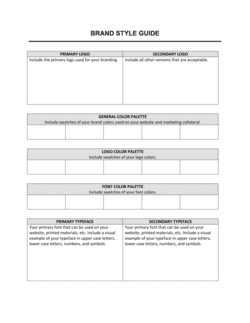
A brand style guide governs visual identity β€” logo usage, color palette, typography, and imagery standards. A content strategy governs editorial identity β€” audience, tone of voice, topic pillars, and publishing logic. The two documents complement each other: the style guide ensures visual consistency; the content strategy ensures message and topic consistency. Neither substitutes for the other.

Industry-specific considerations

SaaS / Technology

SEO-driven blog content targeting high-intent keywords, product-led content tying feature updates to use-case articles, and bottom-of-funnel comparison pages targeting competitor keywords.

E-commerce / Retail

Product-focused content clusters, buying guides and comparison articles targeting commercial-intent searches, and email content sequences tied to purchase and post-purchase stages.

Professional Services

Thought leadership and case study content that establishes practitioner authority, with a heavy focus on LinkedIn distribution and email nurture for long-cycle B2B buying decisions.

Healthcare / MedTech

Medically accurate, E-E-A-T-optimized content written by or reviewed by credentialed practitioners, with strict editorial governance to comply with FTC and FDA guidelines on health claims.

Financial Services

Compliance-reviewed educational content covering personal finance or investment topics, with legal approval workflows built into the content calendar before any asset is published.

Marketing / Creative Agencies

Client-facing strategy deliverables that demonstrate channel expertise, supported by original research or benchmark data that positions the agency as a category authority.

Template vs pro β€” what fits your needs?

PathBest forCostTime
Use the templateMarketing managers, solo marketers, and founders building a content program from scratch or restructuring an existing oneFree4–8 hours to complete
Template + professional reviewTeams launching a content program tied to a significant budget or a new product, who want an external strategist to pressure-test the plan$500–$2,000 for a content strategist review session1–2 weeks
Custom draftedEnterprise marketing teams, brands entering a new market, or organizations that need a full-service content strategy engagement with research, competitive audit, and roadmap$5,000–$25,000+ for a full agency engagement4–8 weeks

Glossary

Content Audit
A systematic review of all existing content assets to assess quality, relevance, performance, and gaps relative to business goals.
Buyer Persona
A semi-fictional profile of an ideal customer based on research β€” including job role, goals, pain points, and preferred content formats.
Content Pillar
A broad topic or theme that anchors a cluster of related content pieces, ensuring thematic coherence across channels.
Editorial Calendar
A scheduling tool that maps content topics, formats, channels, and publish dates across a defined time period.
Share of Voice
The proportion of content or mentions your brand captures in a topic area relative to competitors, measured by volume or visibility.
Content Distribution
The process of promoting and syndicating content across owned, earned, and paid channels to maximize reach beyond organic search.
Funnel Stage
A classification of content by where it serves the buyer journey β€” awareness (top), consideration (middle), or decision (bottom).
Content Velocity
The rate at which a team produces and publishes content β€” measured in pieces per week or month β€” balanced against quality standards.
Organic Traffic
Website visits generated through unpaid search results, driven by SEO-optimized content that ranks for relevant keyword queries.
Content Governance
The policies, workflows, and ownership structures that ensure content is created, reviewed, approved, and retired consistently.

Part of your Business Operating System

This document is one of 3,000+ business & legal templates included in Business in a Box.

  • Fill-in-the-blanks β€” ready in minutes
  • 100% customizable Word document
  • Compatible with all office suites
  • Export to PDF and share electronically

Create your document in 3 simple steps.

From template to signed document β€” all inside one Business Operating System.
1
Download or open template

Access over 3,000+ business and legal templates for any business task, project or initiative.

2
Edit and fill in the blanks with AI

Customize your ready-made business document template and save it in the cloud.

3
Save, Share, Send, Sign

Share your files and folders with your team. Create a space of seamless collaboration.

Save time, save money, and create top-quality documents.

β˜…β˜…β˜…β˜…β˜…

"Fantastic value! I'm not sure how I'd do without it. It's worth its weight in gold and paid back for itself many times."

Managing Director Β· Mall Farm
Robert Whalley
Managing Director, Mall Farm Proprietary Limited
β˜…β˜…β˜…β˜…β˜…

"I have been using Business in a Box for years. It has been the most useful source of templates I have encountered. I recommend it to anyone."

Business Owner Β· 4+ years
Dr Michael John Freestone
Business Owner
β˜…β˜…β˜…β˜…β˜…

"It has been a life saver so many times I have lost count. Business in a Box has saved me so much time and as you know, time is money."

Owner Β· Upstate Web
David G. Moore Jr.
Owner, Upstate Web

Run your business with a system β€” not scattered tools

Stop downloading documents. Start operating with clarity. Business in a Box gives you the Business Operating System used by over 250,000 companies worldwide to structure, run, and grow their business.

Free Forever PlanΒ Β·Β No credit card required