Content Marketing Calendar Template

Free Excel download β€’ Use online β€’ Print or share

2 pagesβ€’20–30 min to useβ€’Difficulty: Standardβ€’Signature requiredβ€’Legal review recommended
Learn more ↓
FreeXLSContent Marketing Calendar Template

At a glance

What it is
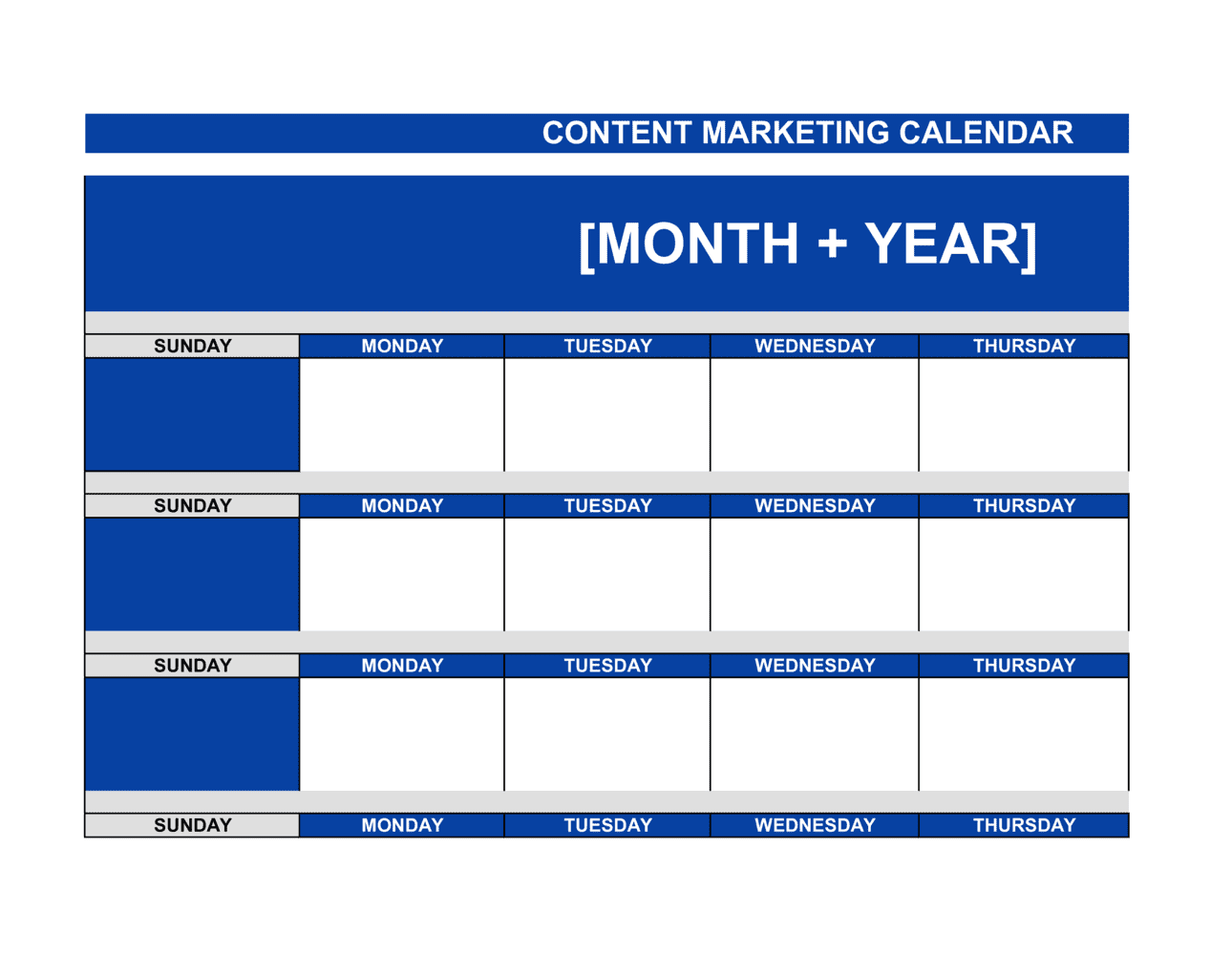
A Content Marketing Calendar is a structured planning and governance document that schedules, assigns, and tracks every piece of content an organization will produce and publish across all channels over a defined period. This free Word download gives marketing teams, agencies, and content leads a single source of truth for content topics, formats, owners, deadlines, publication dates, and distribution channels β€” editable online and exportable as PDF.
When you need it
Use it when onboarding a new content team, launching a campaign, engaging a content agency under a formal service arrangement, or aligning multiple stakeholders β€” writers, designers, SEO leads, and channel managers β€” around a shared publishing schedule.
What's inside
Scope of content coverage, channel and format assignments, topic and keyword mapping, ownership and accountability matrix, deadline and publication schedule, approval workflow, distribution and promotion plan, and performance review cadence.

What is a Content Marketing Calendar?

A Content Marketing Calendar is a structured planning and governance document that maps every piece of content an organization will produce, publish, and distribute across all channels over a defined period β€” typically a quarter or a full year. It records not just what content is scheduled and when it goes live, but who owns each item, how it moves through review and approval, how it will be promoted after publication, and how its performance will be measured against defined KPIs. Unlike a simple topic list or spreadsheet, a properly structured content marketing calendar creates enforceable accountability across writers, designers, SEO leads, approvers, and channel managers, making it the operational backbone of any content program with more than one contributor.

Why You Need This Document

Without a documented content marketing calendar, content programs consistently produce the same three failure modes: missed publication deadlines because no one owned the draft, published content that drives no measurable traffic because SEO fields were completed after the fact, and content that goes live and receives no promotion because distribution was never planned. For marketing teams, a calendar eliminates the weekly scramble to decide what to write next and replaces it with a strategic, capacity-planned schedule that builds topical authority over time. For agencies, a calendar incorporated into a service agreement creates documented commitments on deliverable scope, timelines, and approval workflows β€” giving both parties a clear basis for managing changes and resolving disputes. This template gives you a complete, ready-to-populate framework that takes two to four hours to complete for a full quarter and immediately gives every stakeholder a single source of truth for the entire content operation.

Which variant fits your situation?

If your situation is…Use this template
Planning blog and SEO content onlyEditorial Calendar
Scheduling social media posts across multiple platformsSocial Media Content Calendar
Managing content deliverables with an outside agencyContent Marketing Agreement
Coordinating a product launch across all channelsProduct Launch Plan
Tracking email newsletter campaigns on a recurring scheduleEmail Marketing Plan
Aligning content with a broader annual marketing strategyAnnual Marketing Plan
Planning a single event or campaign content sprintCampaign Brief

Common mistakes to avoid

❌ No named individual assigned as content owner

Why it matters: When a team is listed as owner, everyone assumes someone else is handling the deadline. Items routinely arrive late or unpublished with no clear person accountable.

Fix: Assign one named individual β€” not a team or department β€” as Content Owner for every calendar entry. If that person is unavailable, document a named backup before the calendar is distributed.

❌ Setting only go-live dates without draft and review deadlines

Why it matters: Without backward-planned draft-due and review-complete dates, the approval window collapses in the 48 hours before publication β€” forcing either rushed approvals or missed go-live dates.

Fix: For every calendar entry, set three dates: draft due, review complete, and go-live. Use a minimum three-business-day review window as your default.

❌ Assigning SEO keywords after drafting

Why it matters: Content written without a target keyword rarely aligns with actual search intent, requires significant rewrites to optimize, and often targets terms the domain cannot rank for at its current authority level.

Fix: Complete the SEO field β€” primary keyword, search volume, and meta description β€” before the content brief is sent to the writer. Keyword selection is a pre-production task, not a post-production one.

❌ No cap on revision rounds

Why it matters: Unlimited revision cycles on a single content item create a cascading delay that pushes every subsequent calendar item back, eroding team trust in the plan's reliability.

Fix: Define a maximum of two revision rounds per content item in the calendar's approval workflow clause, with a documented escalation path for items that require additional rounds.

❌ Calendar built without a distribution plan

Why it matters: Content published without a promotion plan typically receives only the organic traffic its channel generates natively β€” missing email, social, and internal amplification that can multiply reach by three to five times at minimal cost.

Fix: Add a distribution row to every calendar entry listing the specific channels, timing, and responsible person for post-publication promotion before the calendar is approved.

❌ No performance review dates on the calendar

Why it matters: Without scheduled reporting checkpoints, content teams continue executing a plan that may be underperforming for months before anyone notices and adjusts strategy.

Fix: Add monthly or quarterly performance review dates directly to the calendar as formal deliverables, with named owners, defined KPIs, and a documented recipient for the report.

The 10 key clauses, explained

Scope and channel coverage

In plain language: Defines which content types, platforms, and topics the calendar governs and explicitly states what is out of scope.

Sample language
This Content Marketing Calendar governs all organic content produced by [TEAM/AGENCY NAME] for [COMPANY NAME] across the following channels: [BLOG], [LINKEDIN], [EMAIL NEWSLETTER], and [YOUTUBE], for the period [START DATE] through [END DATE]. Paid media content and press releases are out of scope.

Common mistake: Leaving channel scope undefined so that stakeholders assume the calendar covers channels it was never designed to track β€” creating gaps and missed deadlines for excluded channels.

Content pillars and topic framework

In plain language: Establishes the core themes or content pillars that all planned content must align with, ensuring strategic consistency across the publishing period.

Sample language
All content produced under this calendar shall align with one of the following content pillars: (1) [PILLAR A], (2) [PILLAR B], (3) [PILLAR C]. Topics that do not map to a defined pillar require written approval from [APPROVER ROLE] before scheduling.

Common mistake: Scheduling content topics ad hoc without pillar alignment, resulting in a fragmented content mix that fails to build topical authority for SEO or brand positioning.

Ownership and accountability matrix

In plain language: Assigns a named owner to every content item for creation, a reviewer for quality, and a final approver for publication sign-off.

Sample language
Each calendar entry shall identify: Content Owner β€” [NAME/ROLE] responsible for draft delivery; Reviewer β€” [NAME/ROLE] responsible for accuracy and brand review; Final Approver β€” [NAME/ROLE] authorized to approve publication. No content may be published without documented final approval.

Common mistake: Assigning a team rather than a named individual as owner, which diffuses accountability and allows deadlines to slip without a clear person to follow up with.

Deadline and publication schedule

In plain language: Sets specific draft-due, review-complete, and go-live dates for each content item, along with the lead time required between draft submission and publication.

Sample language
For each scheduled content item: Draft Due Date β€” [X] business days before publication; Review Complete β€” [X] business days before publication; Go-Live Date β€” as specified per item. Items submitted after Draft Due Date will have their Go-Live Date moved to the next available slot.

Common mistake: Setting only the publication date without backward-planning the draft and review deadlines, so the approval window collapses in the final days before go-live.

Format specifications and word-count targets

In plain language: Defines the required format, length, media requirements, and brand voice guidelines for each content type covered by the calendar.

Sample language
Blog posts: [800–1,500] words, one featured image (minimum [1,200Γ—630px]), one internal link, and one external citation. LinkedIn posts: [150–300] characters, no more than three hashtags. Video scripts: [DURATION] minutes, [ASPECT RATIO] format, closed captions required.

Common mistake: Omitting format specifications and relying on writers to self-calibrate, which produces inconsistent content quality and increases revision cycles.

SEO keyword and metadata requirements

In plain language: Requires each blog or web content entry to include an assigned primary keyword, a target meta title, a meta description, and an internal linking target before the draft is submitted.

Sample language
Each blog or web page entry in the calendar shall include: Primary Keyword β€” [KEYWORD], Search Volume β€” [X], Meta Title β€” [MAX 60 CHARACTERS], Meta Description β€” [MAX 155 CHARACTERS], Internal Link Target β€” [URL]. Drafts submitted without completed SEO fields will be returned to the Content Owner.

Common mistake: Treating SEO metadata as a post-publication task. Assigning keywords after content is written consistently produces content that targets the wrong terms or misses search intent entirely.

Approval workflow and revision rounds

In plain language: Documents the sequential review stages each content item must pass through and caps the number of revision rounds to protect team capacity.

Sample language
The approval workflow for each content item is: (1) Content Owner submits draft; (2) Reviewer completes feedback within [2] business days; (3) Content Owner incorporates feedback; (4) Final Approver signs off within [1] business day. Maximum [2] revision rounds per item; additional rounds require written authorization from [APPROVER ROLE].

Common mistake: No cap on revision rounds, allowing a single content item to absorb weeks of iteration that blocks other calendar items from progressing.

Distribution and promotion plan

In plain language: Specifies how each piece of content will be promoted after publication β€” organic social posts, email newsletter, internal Slack announcement, paid amplification, or partner syndication.

Sample language
Upon publication of each content item, the following distribution actions shall be completed within [48] hours: (1) Organic post on [CHANNELS]; (2) Inclusion in the next [FREQUENCY] email newsletter; (3) Internal team notification via [CHANNEL]. Paid amplification budget, if applicable: $[AMOUNT] per item, authorized by [APPROVER].

Common mistake: Publishing content without a documented distribution plan, so pieces go live and receive no promotion beyond the organic channel they were published on.

Performance review and reporting cadence

In plain language: Establishes how content performance will be measured, which metrics are tracked, and how frequently results are reviewed against goals.

Sample language
Content performance shall be reviewed [MONTHLY/QUARTERLY] using the following KPIs: organic sessions, average time on page, email open rate, social engagement rate, and leads generated. Results shall be reported by [ROLE] to [STAKEHOLDER] by the [Xth] business day of each [MONTH/QUARTER].

Common mistake: No defined reporting cadence, so content output continues regardless of whether any of it is achieving measurable business results.

Amendments, additions, and emergency content

In plain language: Defines the process for adding unplanned content items, swapping scheduled topics, or pausing the calendar in response to business or market changes.

Sample language
Additions or changes to the calendar require written approval from [APPROVER ROLE] and a minimum [3]-business-day lead time for standard items. Emergency content (responding to breaking news or crisis communications) may be fast-tracked with same-day approval from [SENIOR APPROVER], subject to an expedited review by [REVIEWER ROLE].

Common mistake: No amendment process, so the calendar becomes outdated within weeks as ad hoc requests are handled informally β€” destroying the plan's reliability as a source of truth.

How to fill it out

  1. 1

    Define scope, channels, and the planning period

    Enter the company name, the team or agency producing content, the channels covered, and the start and end dates of the calendar period. Explicitly list any channels or content types that are out of scope.

    πŸ’‘ Quarterly calendars (13 weeks) strike the best balance between strategic planning depth and the flexibility to respond to market changes.

  2. 2

    Establish content pillars and topic clusters

    Identify three to five core content pillars aligned to your business goals and target audience. Map planned topics to each pillar to ensure the calendar builds topical authority rather than publishing randomly.

    πŸ’‘ Run a quick competitor content audit before finalizing pillars β€” find the topic clusters where competitors are weak and you can realistically win search traffic.

  3. 3

    Populate the ownership and accountability matrix

    Assign a named Content Owner, Reviewer, and Final Approver to each calendar entry. Use job titles and full names β€” not team names β€” so accountability is unambiguous.

    πŸ’‘ If one person owns more than 40% of all calendar items, the plan is already at risk of bottleneck. Redistribute before publishing the calendar.

  4. 4

    Set deadlines with backward planning

    For each content item, enter the go-live date first, then count backward to set the draft-due and review-complete dates. Allow at least three business days for review and one business day for final approval.

    πŸ’‘ Build a one-week buffer at the end of each month for items that slip β€” plans without buffer capacity run chronically late.

  5. 5

    Complete SEO fields for every web content entry

    Before scheduling any blog post or landing page, assign the primary keyword, confirm search volume, and write the meta title and meta description. Add the target internal link so writers can incorporate it during drafting.

    πŸ’‘ Use a keyword research tool to verify that your primary keyword has a realistic difficulty score for your domain authority β€” targeting keywords you cannot rank for wastes production budget.

  6. 6

    Define format specifications per content type

    Enter word-count targets, image dimensions, video length, hashtag limits, and any other format requirements for each content type in the calendar. These become the brief every content owner works from.

    πŸ’‘ Include one example of an existing high-performing piece for each content type as a quality benchmark β€” this alone cuts revision rounds.

  7. 7

    Document the distribution plan for each item

    For every scheduled piece, list the post-publication distribution actions, the channels, the timing (e.g., within 48 hours), and who is responsible for each distribution task.

    πŸ’‘ Repackaging a single blog post for three channels (email excerpt, LinkedIn summary, and Twitter thread) generates three to five times the traffic for roughly 20% additional effort.

  8. 8

    Schedule the performance review cadence

    Set the reporting date, the KPIs to be reviewed, and the stakeholder who will receive the performance report. Add these review dates to the calendar itself so they are treated as deliverables, not afterthoughts.

    πŸ’‘ Review content performance at the topic-cluster level, not just per article β€” clusters that underperform indicate a pillar strategy problem, not just a single weak post.

Frequently asked questions

What is a content marketing calendar?

A content marketing calendar is a structured planning document that schedules, assigns, and tracks every piece of content an organization will produce and publish across all channels over a defined period β€” typically a quarter or a full year. It records content topics, formats, owners, deadlines, publication dates, SEO metadata, distribution plans, and review cadences in a single reference document. It differs from a simple editorial calendar by including ownership, workflow, and performance governance alongside the schedule itself.

How is a content marketing calendar different from an editorial calendar?

An editorial calendar focuses primarily on what content will be published and when β€” topics, formats, and publication dates. A content marketing calendar adds the operational layer: who owns each item, how it moves through review and approval, how it will be distributed after publication, and how its performance will be measured. For small teams or solo bloggers, an editorial calendar is sufficient. For teams of three or more, or any agency-client arrangement, the full content marketing calendar structure prevents accountability gaps and missed deadlines.

How far ahead should a content marketing calendar be planned?

A quarterly calendar β€” covering 13 weeks β€” is the most practical planning horizon for most teams. It is long enough to build strategic content clusters and coordinate multi-channel campaigns, but short enough to remain responsive to market changes, algorithm updates, and business pivots. Annual calendars are useful for mapping major campaigns and budget allocation but should be reviewed and updated quarterly against actual performance data.

What should every content marketing calendar entry include?

At minimum, each calendar entry should include: content title or working title, content type and format, target channel, primary keyword and meta description, content owner, reviewer, final approver, draft-due date, review-complete date, go-live date, distribution plan, and the content pillar it maps to. Missing any of these fields typically causes the item to stall in production or go live without promotion.

Who should sign off on a content marketing calendar?

For in-house teams, the content marketing manager or CMO should formally approve the calendar before the planning period begins, confirming that topics, resources, and budgets are aligned. For agency-client arrangements, both the agency lead and the client-side marketing contact should sign off, creating a documented shared commitment to the schedule and the approval workflow. Without sign-off, mid-period scope changes and deadline disputes are difficult to resolve.

How many content pieces should be on a content marketing calendar?

The right volume depends on team capacity and channel mix, not an arbitrary frequency target. A practical starting point is to estimate each content type's production time, assign realistic hours per team member per week, and schedule only what the team can produce to the agreed quality standard. Most teams consistently overestimate capacity by 20–30% in their first calendar; building a one-week buffer per month corrects for this without requiring schedule changes every week.

Can a content marketing calendar be used as a contract with a content agency?

A content marketing calendar can form part of a contractual arrangement with a content agency when it is incorporated by reference into a master service agreement or statement of work. In that context, the calendar's scope, deadlines, deliverable specifications, and approval workflow clauses create enforceable obligations. Standing alone without an underlying service agreement, a calendar is generally treated as a planning document rather than a binding contract. Consider consulting a lawyer when formalizing agency relationships where the calendar defines material deliverables.

What KPIs should a content marketing calendar track?

Core content marketing KPIs include organic search sessions per piece, average time on page, email open and click-through rates, social engagement rate, backlinks earned per piece, and leads or conversions attributed to content. At the portfolio level, track total organic traffic growth, keyword ranking movement by content pillar, and revenue influenced by content touchpoints. Choose four to six KPIs rather than tracking everything β€” too many metrics diffuse focus and make reporting actionable insights harder.

How often should a content marketing calendar be updated?

A content marketing calendar should be reviewed weekly at the operational level β€” confirming that the current week's items are on track and flagging any at-risk deadlines. A strategic review should happen monthly, comparing actual publication volume and content performance against plan and adjusting the forward schedule accordingly. An emergency review is warranted whenever a major market event, product change, or business priority shift makes a significant portion of scheduled content irrelevant or off-brand.

How this compares to alternatives

vs Editorial Calendar

An editorial calendar tracks what content is planned and when it publishes. A content marketing calendar adds operational governance: named owners, approval workflows, distribution plans, and performance review cadences. For solo creators or small blogs, an editorial calendar is sufficient. For teams of three or more, the full content marketing calendar structure is needed to prevent accountability gaps.

vs Marketing Plan

A marketing plan sets the strategic direction β€” target audience, positioning, budget, and channel mix β€” for a full marketing program. A content marketing calendar operationalizes the content component of that plan into a week-by-week production and publication schedule. The plan answers 'why and what'; the calendar answers 'who, when, and how.'

vs Social Media Content Calendar

A social media content calendar focuses exclusively on social platform scheduling β€” post copy, images, hashtags, and posting times across LinkedIn, Instagram, Facebook, and similar channels. A content marketing calendar covers all content types and channels, including blog, email, video, and SEO content, with social posts as one component of the broader distribution plan.

vs Product Launch Plan

A product launch plan coordinates all activities required to bring a product to market β€” development milestones, sales enablement, PR, and marketing β€” over a fixed launch window. A content marketing calendar is an ongoing operational document covering all content output across a quarter or year. Launch content is typically scheduled within the broader content marketing calendar rather than managed as a separate document.

Industry-specific considerations

SaaS / Technology

Product update announcements, feature education content, SEO-driven comparison pages, and developer documentation all require separate calendar tracks with distinct owners and approval chains.

Retail / E-commerce

Seasonal promotions, product launch content, and affiliate or influencer coordination require the calendar to map content to specific sale dates and inventory windows months in advance.

Professional Services

Thought leadership articles, case studies, and webinars must pass compliance and subject-matter-expert review before publication, making a formal approval workflow clause essential.

Healthcare / MedTech

Regulatory and medical-legal review is a mandatory approval stage for any patient-facing or clinical content, requiring extended review windows and documented sign-off from a qualified reviewer.

Financial Services

Compliance review by a registered principal or legal team is required before publication of any content that could be construed as investment advice, requiring calendar entries to include a compliance-clearance date.

Media and Publishing

High-volume publication cadences β€” daily or multiple times per week β€” require the calendar to track multiple content types per day across editorial, sponsored, and syndicated channels simultaneously.

Jurisdictional notes

United States

When a content marketing calendar is incorporated into an agency service agreement, US courts will generally enforce its deadlines and deliverable specifications as binding contractual terms. Intellectual property ownership of created content should be explicitly addressed in the underlying contract β€” absent a work-for-hire clause, the creator typically retains copyright. State law governs enforcement, and dispute resolution clauses (arbitration vs. litigation) vary in effectiveness by state.

Canada

In Canada, content produced by a contractor under a calendar-backed service agreement does not automatically vest in the commissioning party β€” a written assignment of copyright is required under the Copyright Act. Quebec's language laws may require that content produced for Quebec audiences be created or translated into French. Agencies and clients should confirm that the governing law clause in any underlying service agreement specifies a Canadian province.

United Kingdom

Under UK copyright law, content created by a freelancer or agency remains the intellectual property of the creator unless a written assignment is executed. When the calendar is used within a services contract, the UK's Unfair Contract Terms Act may limit the enforceability of overly one-sided penalty clauses for missed deadlines. Data protection considerations apply if the calendar involves collecting or publishing any personal data about individuals.

European Union

GDPR applies when content production involves personal data β€” for example, case studies featuring named clients or user-generated content campaigns. Member state copyright laws vary, but the EU Copyright Directive harmonizes many provisions across the bloc. Agencies operating across multiple EU jurisdictions should specify the governing member state law in their service agreements to avoid ambiguity in enforcement.

Template vs lawyer β€” what fits your deal?

PathBest forCostTime
Use the templateIn-house marketing teams planning and managing their own content production with internal stakeholdersFree2–4 hours to complete and populate for a quarter
Template + legal reviewAgencies or contractors using the calendar as a deliverable schedule within a client service arrangement$300–$800 for a lawyer to review the calendar's contractual clauses within a master service agreement1–3 days
Custom draftedEnterprise content operations with multiple agencies, complex approval chains, and material contractual liability for missed deliverables$1,500–$4,000+ for a custom content services agreement drafted by a marketing or commercial lawyer1–2 weeks

Glossary

Editorial Calendar
A schedule of planned content topics, formats, and publication dates β€” typically narrower in scope than a full content marketing calendar, which also covers ownership, workflow, and distribution.
Content Pillar
A core topic or theme around which multiple pieces of supporting content are built, designed to establish authority in a subject area.
Content Format
The type of content being produced β€” blog post, video, infographic, podcast episode, white paper, email newsletter, or social post.
Distribution Channel
The platform or medium through which content is published or promoted, such as a company blog, LinkedIn, email list, YouTube, or paid media.
Approval Workflow
The sequential review steps a piece of content must pass through β€” draft, subject-matter review, legal/compliance check, brand review, and final sign-off β€” before publication.
Content Owner
The named individual or role responsible for delivering a specific piece of content on time and to the agreed brief.
Publication Cadence
The agreed frequency at which content is published on a given channel β€” for example, two blog posts per week or one newsletter every Tuesday.
SEO Keyword Mapping
The process of assigning one primary target keyword and two to four secondary keywords to each planned content piece to guide writing and on-page optimization.
Content Audit
A systematic review of existing published content to assess performance, identify gaps, and determine what should be updated, repurposed, or removed.
Repurposing
Adapting a single piece of content into multiple formats or for multiple channels β€” for example, turning a long-form blog post into a LinkedIn carousel, an email excerpt, and a short video script.
UTM Parameters
Tracking codes appended to content URLs that identify the source, medium, and campaign in analytics tools, enabling accurate attribution of traffic and conversions.

Part of your Business Operating System

This document is one of 3,000+ business & legal templates included in Business in a Box.

  • Fill-in-the-blanks β€” ready in minutes
  • 100% customizable Word document
  • Compatible with all office suites
  • Export to PDF and share electronically

Create your document in 3 simple steps.

From template to signed document β€” all inside one Business Operating System.
1
Download or open template

Access over 3,000+ business and legal templates for any business task, project or initiative.

2
Edit and fill in the blanks with AI

Customize your ready-made business document template and save it in the cloud.

3
Save, Share, Send, Sign

Share your files and folders with your team. Create a space of seamless collaboration.

Save time, save money, and create top-quality documents.

β˜…β˜…β˜…β˜…β˜…

"Fantastic value! I'm not sure how I'd do without it. It's worth its weight in gold and paid back for itself many times."

Managing Director Β· Mall Farm
Robert Whalley
Managing Director, Mall Farm Proprietary Limited
β˜…β˜…β˜…β˜…β˜…

"I have been using Business in a Box for years. It has been the most useful source of templates I have encountered. I recommend it to anyone."

Business Owner Β· 4+ years
Dr Michael John Freestone
Business Owner
β˜…β˜…β˜…β˜…β˜…

"It has been a life saver so many times I have lost count. Business in a Box has saved me so much time and as you know, time is money."

Owner Β· Upstate Web
David G. Moore Jr.
Owner, Upstate Web

Run your business with a system β€” not scattered tools

Stop downloading documents. Start operating with clarity. Business in a Box gives you the Business Operating System used by over 250,000 companies worldwide to structure, run, and grow their business.

Start freeΒ Β·Β No credit card required