Marketing Brief Template

Free Word download β€’ Edit online β€’ Save & share with Drive β€’ Export to PDF

3 pagesβ€’20–30 min to fillβ€’Difficulty: Standardβ€’Signature requiredβ€’Legal review recommended
Learn more ↓
FreeMarketing Brief Template

At a glance

What it is
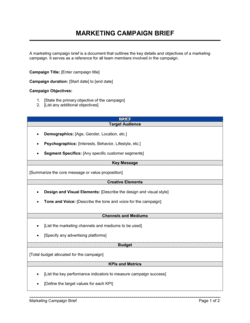
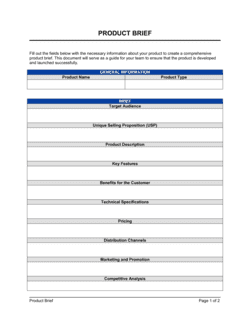
A Marketing Brief is a binding document between a client and a marketing agency, freelancer, or internal team that sets out the scope, objectives, deliverables, budget, and timeline for a campaign or project. This free Word download gives you a structured starting point you can edit online and export as PDF β€” establishing clear obligations before any creative work begins.
When you need it
Use it at the start of any paid campaign, brand project, or agency engagement where misaligned expectations could result in wasted spend, missed deadlines, or disputed deliverables. It is equally important for in-house teams briefing external vendors as it is for agencies receiving a client mandate.
What's inside
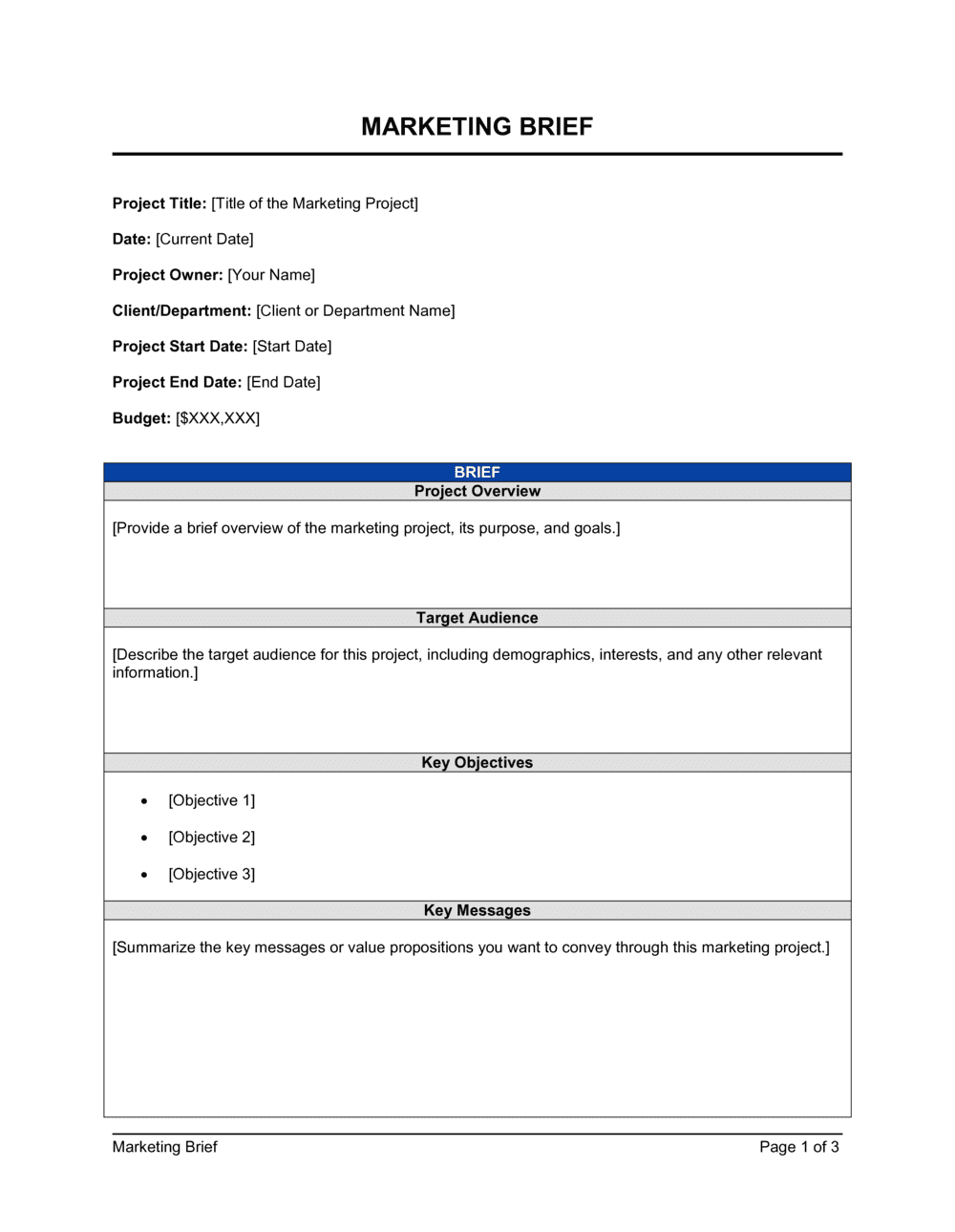
Project background and objectives, target audience definition, key messages and brand guidelines, deliverables and approval process, budget and payment schedule, timeline and milestones, IP ownership, confidentiality, and governing law.

What is a Marketing Brief?

A Marketing Brief is a signed document between a client and a marketing agency, freelancer, or internal team that defines the objectives, target audience, deliverables, budget, timeline, approval process, and legal obligations for a campaign or project. Unlike an informal email chain or a slide deck presented in a kick-off meeting, a signed marketing brief creates mutual accountability β€” each party's obligations are specific, measurable, and enforceable. It covers not only the creative direction but also the commercial and legal terms: IP ownership, confidentiality, revision rounds, kill fees, and governing law.

Why You Need This Document

Without a signed marketing brief, scope disputes are a near-certainty on any engagement that runs longer than a few weeks. Agencies deliver work the client considers incomplete; clients request revisions the agency considers out of scope; timelines slip because feedback windows were never agreed. The financial consequences compound quickly β€” unresolved disputes over deliverables routinely delay invoice payment by 30 to 60 days, and cancelled projects with no kill fee clause leave agencies absorbing 100% of committed resource costs. A signed brief eliminates these gaps by converting verbal understandings into written obligations before any creative resource is committed. For clients, it ensures the budget is tied to specific outputs with defined approval rights. For agencies, it protects fees, caps revision exposure, and establishes clear IP transfer conditions. This template gives both parties a structured, professional starting point that can be completed in under an hour and reviewed by a lawyer in one to two days when the stakes warrant it.

Which variant fits your situation?

If your situation is…Use this template
Briefing a creative agency on a full brand campaignCreative Brief
Commissioning digital advertising across paid channelsDigital Marketing Brief
Engaging a freelancer for a one-off design or copywriting projectFreelance Project Brief
Launching a new product with a coordinated go-to-market strategyProduct Launch Plan
Setting scope and fees for an ongoing agency retainer relationshipMarketing Agency Retainer Agreement
Running a PR or media relations campaignPR Brief
Planning an event or experiential marketing activationEvent Marketing Brief

Common mistakes to avoid

❌ Vague or unmeasurable objectives

Why it matters: Without a specific metric and deadline, neither party can evaluate whether the campaign succeeded, which makes performance disputes impossible to resolve and budget justification difficult.

Fix: Rewrite each objective using a number and a date: 'achieve 300 marketing-qualified leads by October 15' rather than 'increase leads this quarter.'

❌ No out-of-scope list

Why it matters: Omitting exclusions leaves the deliverable list open to interpretation β€” agencies receive requests they never priced and clients believe everything is included, creating invoice disputes mid-project.

Fix: Add a dedicated 'out of scope' section immediately after the deliverables list, naming at least three to five things explicitly excluded from the engagement.

❌ Unlimited revision rounds

Why it matters: Open-ended revision obligations allow clients to request changes indefinitely without additional payment, eroding agency margins and incentivizing under-investment in early-stage quality.

Fix: Cap revision rounds per deliverable (two is standard) and include an hourly rate for out-of-scope revisions, making the cost of additional cycles visible and agreed in advance.

❌ No deposit or milestone payment structure

Why it matters: Agencies that begin work without a deposit have no financial leverage if the client cancels mid-project; clients with no milestone payments lose accountability over delivery timing and quality.

Fix: Structure payments as 50% deposit on signing, 25% at a defined midpoint milestone, and 25% on final approval β€” tying money to output at each stage.

❌ IP assumed to transfer on delivery, not on payment

Why it matters: In most common-law jurisdictions, copyright remains with the creator until the contractual transfer condition β€” typically full payment β€” is met. Clients who publish assets before final payment may infringe the agency's retained copyright.

Fix: State explicitly that IP transfers upon receipt of full payment, and that the agency grants a limited licence to use deliverables for review purposes only until that condition is satisfied.

❌ Signing after creative work has already started

Why it matters: Kill fee, IP assignment, and revision cap clauses signed after work begins may lack fresh consideration in common-law jurisdictions, making them difficult to enforce if the project is later disputed.

Fix: Treat brief execution as a prerequisite to any resource commitment β€” brief signed and deposit cleared before kick-off is a standard agency policy that protects both parties.

The 10 key clauses, explained

Parties and project identification

In plain language: Names the client and the agency or vendor as legal entities, assigns a project name and reference number, and records the execution date.

Sample language
This Marketing Brief is entered into on [DATE] between [CLIENT LEGAL NAME], a [STATE/COUNTRY] [ENTITY TYPE] ('Client'), and [AGENCY/VENDOR LEGAL NAME], a [STATE/COUNTRY] [ENTITY TYPE] ('Agency'). Project: [PROJECT NAME], Reference: [REF NUMBER].

Common mistake: Using a trading name rather than the registered legal entity name. If the entity named in the brief doesn't match invoices or bank records, enforcing payment obligations or IP ownership becomes legally complicated.

Background and objectives

In plain language: Describes the business context that prompted the campaign and states specific, measurable objectives β€” not generic aspirations.

Sample language
Client is launching [PRODUCT/SERVICE] in [MARKET] on [DATE]. The objectives of this campaign are to: (a) achieve [X] new leads within [TIMEFRAME]; (b) increase brand awareness among [TARGET SEGMENT] by [X]%; (c) drive $[X] in attributed revenue by [DATE].

Common mistake: Stating objectives as vague aspirations β€” 'increase brand awareness' β€” with no measurable baseline or target. Without a specific metric, neither party can evaluate success or justify additional spend.

Target audience definition

In plain language: Describes the primary and secondary audiences by demographics, psychographics, behavior, or job function, and names any audience segments to be excluded.

Sample language
Primary audience: [DESCRIPTION β€” e.g., B2B decision-makers, age 35–55, in [INDUSTRY], with purchasing authority over $[X] budgets]. Secondary audience: [DESCRIPTION]. Excluded: existing customers identified by [METHOD].

Common mistake: Defining the audience so broadly that creative execution has no meaningful direction β€” 'adults 18–65' gives an agency nothing to work with and produces generic output.

Scope of work and deliverables

In plain language: Lists every specific deliverable β€” format, size, quantity, language, and channel β€” and explicitly states what is out of scope.

Sample language
Agency shall deliver: (a) [X] social media ad creatives in [FORMATS/DIMENSIONS] for [PLATFORMS]; (b) [X] email templates in [PLATFORM]; (c) [X] revision rounds per deliverable. Out of scope: media buying, influencer contracting, and paid distribution.

Common mistake: Failing to list what is out of scope. Without exclusions, agencies receive deliverable requests they never priced and clients believe everything is included β€” the single most common source of brief disputes.

Timeline and milestones

In plain language: Sets the project start date, key milestone dates, final delivery date, and the consequences of missed deadlines on both sides.

Sample language
Project start: [DATE]. Milestone 1 β€” [DELIVERABLE] draft: [DATE]. Client feedback due: within [X] business days of receipt. Final delivery: [DATE]. If Agency misses any milestone by more than [X] business days without prior written notice, Client may engage an alternative supplier for that deliverable.

Common mistake: Setting a final delivery date without intermediate milestones or feedback turnaround windows. When only the end date is fixed, feedback delays compound invisibly until the deadline is impossible to meet.

Budget, fees, and payment schedule

In plain language: States the total project budget or fee, the payment schedule (deposit, milestones, final payment), the invoicing process, and late-payment consequences.

Sample language
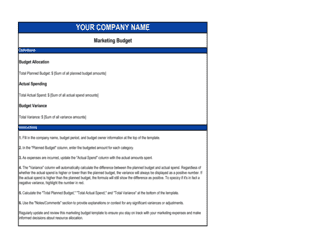
Total fee: $[AMOUNT] [CURRENCY]. Payment schedule: (a) 50% deposit due on execution: $[AMOUNT]; (b) 25% on delivery of [MILESTONE]: $[AMOUNT]; (c) 25% on final approval: $[AMOUNT]. Invoices payable within [14/30] days. Late payments accrue interest at [X]% per month.

Common mistake: Agreeing a total budget without specifying the deposit structure. Agencies that begin work without a deposit have no leverage if a client cancels mid-project; clients with no milestone payments lose leverage over delivery quality.

Approval process and revision rounds

In plain language: Defines the number of included revision rounds, the approval mechanism, who on each side has authority to approve, and what happens if approval is unreasonably withheld.

Sample language
Each deliverable includes [X] revision rounds. Revisions beyond this limit are billed at $[RATE]/hour. Approval authority: Client's [TITLE]. If Client does not provide written feedback within [X] business days of delivery, the deliverable is deemed approved.

Common mistake: No cap on revision rounds. Open-ended revision obligations are one of the most common causes of agency scope creep, unpaid time, and project delays.

Intellectual property ownership and usage rights

In plain language: States when and how IP in the deliverables transfers from agency to client, what rights the agency retains (e.g., portfolio use), and any third-party asset licenses the client must maintain.

Sample language
Upon receipt of full payment, Agency assigns to Client all right, title, and interest in the deliverables, including copyright. Agency retains the right to display deliverables in its portfolio. Client is responsible for licensing any third-party stock assets, fonts, or music included in the deliverables.

Common mistake: Assuming IP transfers automatically on delivery, before full payment has been received. In most common-law jurisdictions, IP remains with the creator until the contractual condition for transfer β€” typically full payment β€” is satisfied.

Confidentiality

In plain language: Prevents both parties from disclosing the other's business strategies, pricing, audience data, and campaign details to third parties during and after the engagement.

Sample language
Each party shall keep confidential all non-public information received from the other party in connection with this project, including campaign strategy, pricing, customer data, and creative concepts, and shall not disclose such information to any third party without prior written consent.

Common mistake: A one-sided confidentiality clause that protects only the client. Agencies share proprietary methods, pricing structures, and unreleased creative concepts β€” mutual confidentiality is the correct standard.

Kill fee, termination, and governing law

In plain language: States each party's right to terminate, the notice required, the kill fee the client owes if the project is cancelled after work begins, and the jurisdiction whose law governs.

Sample language
Either party may terminate this Brief with [X] business days' written notice. If Client terminates after work has commenced, Client shall pay a kill fee equal to [X]% of the total fee for work completed to date, plus any third-party costs already incurred. This Brief is governed by the laws of [STATE/PROVINCE/COUNTRY].

Common mistake: No kill fee provision. Without one, an agency that has spent 60% of its hours on a project the client cancels has no contractual basis to recover that time β€” leaving the loss entirely on the agency.

How to fill it out

  1. 1

    Enter legal entity names and the project reference

    Use the full registered legal names of both the client and the agency or vendor. Assign a unique project reference number that will appear on all related invoices and communications.

    πŸ’‘ Confirm the agency's legal entity name against their invoice header before signing β€” mismatches between the brief and invoices create payment-processing delays.

  2. 2

    Write specific, measurable objectives

    State each objective with a target metric and a deadline β€” e.g., '500 qualified leads by August 31' or '15% lift in unaided brand awareness among [SEGMENT] by Q4.' Avoid objectives like 'grow our brand' that cannot be evaluated.

    πŸ’‘ Limit objectives to three to five. More than five dilutes focus and makes performance assessment inconclusive.

  3. 3

    Define the target audience with exclusions

    Describe your primary audience using at least three defining characteristics β€” job title, industry, age range, buying behavior, or pain point. Name any segments the campaign should explicitly avoid.

    πŸ’‘ Include a one-sentence 'audience insight' β€” the single most important thing the agency needs to know about what motivates this audience to act.

  4. 4

    List every deliverable with format and quantity

    Enumerate each output the agency must produce, specifying format (e.g., 1080Γ—1080 JPEG), quantity, channel, and language. Then write a separate 'out of scope' list that excludes anything you are not commissioning.

    πŸ’‘ Attach a deliverables matrix as an appendix if the list exceeds six items β€” it keeps the main brief readable and serves as the acceptance checklist at project close.

  5. 5

    Set milestones with feedback turnaround windows

    Map every milestone to a calendar date. For each milestone, specify how many business days the client has to return feedback. Build at least three to five business days of buffer before the final delivery date.

    πŸ’‘ Send a calendar invite to both teams for each milestone date at the moment of signing β€” this converts the timeline from a document clause into a live shared commitment.

  6. 6

    Confirm the fee, deposit, and payment schedule

    State the total fee in the project currency, the deposit due on signing, the milestone payment amounts and triggers, and the final payment trigger. Add a late-payment interest rate.

    πŸ’‘ A 50% deposit on signing is the professional standard for most agency engagements β€” it signals client seriousness and funds initial agency resource allocation.

  7. 7

    Cap revision rounds and name approval authorities

    Specify the number of included revision rounds per deliverable (two is standard for most projects). Name the individuals on each side who have authority to give final approval.

    πŸ’‘ A 'deemed approved' clause β€” where silence after a defined window counts as approval β€” prevents projects from stalling indefinitely on the client side.

  8. 8

    Sign before any creative work begins

    Both parties must sign before the agency commits resources. Post-commencement signatures leave the kill fee, IP assignment, and revision cap clauses untested and potentially unenforceable.

    πŸ’‘ Use a timestamped e-signature service so both parties have a dated, auditable execution record β€” especially important for remote or international engagements.

Frequently asked questions

What is a marketing brief?

A marketing brief is a document β€” typically signed by both client and agency β€” that defines the objectives, target audience, deliverables, budget, timeline, and approval process for a marketing campaign or project. It creates mutual accountability before any creative work begins, reducing scope disputes, missed deadlines, and budget overruns. A signed brief is also the primary reference document if either party disputes what was agreed.

What is the difference between a marketing brief and a creative brief?

A marketing brief covers the full commercial context of a campaign β€” business objectives, budget, timeline, IP ownership, payment schedule, and legal obligations. A creative brief is a subset focused specifically on the creative direction: tone of voice, visual references, messaging hierarchy, and mandatory inclusions. Most agencies use both β€” the marketing brief governs the engagement, and the creative brief directs the execution team.

Does a marketing brief need to be signed to be enforceable?

A written and signed marketing brief is generally enforceable as a contract in most jurisdictions when it meets the standard elements β€” offer, acceptance, and consideration (payment). An unsigned brief can still create obligations if one party has acted on it, but proving the exact agreed terms becomes significantly harder without a signature. Signing before work begins is the clearest way to establish mutual agreement on all terms.

Who should sign a marketing brief?

Both the client and the agency or vendor should sign. On the client side, the signatory should have actual authority to commit the stated budget β€” typically a marketing director, CMO, or business owner. On the agency side, the account director or a principal with authority to bind the firm should sign. Junior contacts exchanging emails about scope do not constitute a binding brief even if they reference the document.

What is a kill fee in a marketing brief?

A kill fee is a contractually agreed payment the client owes the agency if the project is cancelled after work has begun. It compensates the agency for time and resources already committed that cannot be recovered. A typical kill fee is calculated as a percentage of the total project fee for work completed to date β€” commonly 25–50% depending on how far the project has progressed. Without a kill fee clause, an agency has no automatic contractual right to recover cancelled work.

How many revision rounds should a marketing brief include?

Two revision rounds per deliverable is the professional standard for most marketing projects. One round is workable for simple deliverables like social ad resizing; three rounds may be appropriate for complex video productions or brand identity projects. The key is to state the number explicitly and to include an hourly rate for any revisions beyond the included rounds β€” making the cost of additional cycles visible to the client before they request them.

When does IP ownership transfer from the agency to the client?

In most common-law jurisdictions, copyright in creative work remains with the creator until the contractual transfer condition is met β€” which in most marketing briefs is receipt of full payment. Until that point, the agency retains ownership and the client holds only a limited licence to review the work. Publishing or distributing deliverables before full payment may infringe the agency's retained copyright. Confirm the transfer condition in the brief's IP clause to avoid ambiguity.

Can a marketing brief be used for in-house teams, not just external agencies?

Yes β€” a marketing brief is equally useful when briefing internal teams, cross-functional stakeholders, or a combination of internal and external contributors. For internal use, the IP assignment and payment clauses are typically removed or simplified, but the objectives, audience definition, deliverables, and timeline remain equally important for keeping teams aligned and preventing scope creep across departments.

What happens if the agency misses a milestone deadline?

The brief should specify the consequences of a missed milestone β€” for example, the right to engage an alternative supplier for that deliverable or to withhold the corresponding milestone payment. Without such a clause, the client's only remedy is a general breach-of-contract claim, which is harder to quantify and enforce. Most agencies accept milestone-linked consequences when the brief also defines client feedback turnaround windows, creating symmetrical accountability on both sides.

How this compares to alternatives

vs Creative Brief

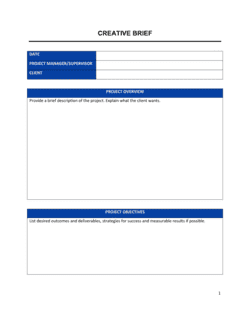
A creative brief focuses narrowly on the creative direction β€” tone, visual references, mandatory messaging, and audience insight β€” without covering budget, payment schedule, IP ownership, or legal obligations. A marketing brief is the governing commercial document; the creative brief is the execution direction handed to the creative team after the marketing brief is signed.

vs Marketing Agency Retainer Agreement

A retainer agreement governs an ongoing monthly relationship β€” defining the scope of services, monthly fee, notice period, and termination terms for a sustained engagement. A marketing brief governs a single campaign or project with a defined start and end date. For agencies with ongoing clients, a retainer agreement sets the framework and a marketing brief scopes each individual project within it.

vs Statement of Work

A statement of work is a more granular technical document used in consulting and IT engagements, specifying acceptance criteria, testing requirements, and change control procedures in contractual detail. A marketing brief is lighter and more strategic, prioritizing audience insight, creative direction, and campaign objectives. For large agency engagements, a statement of work may supplement rather than replace the marketing brief.

vs Non-Disclosure Agreement

A non-disclosure agreement protects confidential information shared during preliminary discussions before a marketing engagement is confirmed. A marketing brief contains its own confidentiality clause that governs information shared during the active project. Both may be used in sequence β€” an NDA for initial conversations, and the brief's confidentiality clause once the project is underway.

Industry-specific considerations

Consumer goods and retail

Seasonal campaign calendars, promotional pricing restrictions, and retailer co-op advertising requirements create complex scope boundaries that a signed brief enforces across multiple agency partners.

Technology and SaaS

Product launch briefs must specify message hierarchy across developer, IT buyer, and end-user audiences simultaneously, with separate deliverable sets and approval chains for each segment.

Healthcare and pharmaceuticals

Regulatory review requirements (FDA, MHRA, EMA) add mandatory approval steps and copy-clearance timelines that must be built into the milestone schedule and may extend standard feedback windows significantly.

Financial services

Compliance and legal sign-off on all consumer-facing materials is non-negotiable β€” the brief must name the compliance approval authority and allocate adequate time for regulatory review in the project timeline.

Professional services

Thought leadership and content marketing briefs require subject-matter expert interviews and multiple internal review cycles, making feedback turnaround windows and revision caps especially critical to manage.

Food and beverage

Packaging and claims language must comply with labeling regulations by market, meaning briefs for international campaigns need jurisdiction-specific copy approval milestones built into the timeline.

Jurisdictional notes

United States

US copyright law vests automatically in the creator at the moment of creation β€” IP does not transfer to the client without an explicit written assignment. Work-for-hire doctrine may apply if the agency is engaged as an employee or the work falls into a statutory category, but this rarely applies to independent agency relationships. State laws on non-competes and confidentiality vary, so specifying governing state law in the brief matters.

Canada

Under the Copyright Act of Canada, copyright belongs to the author unless there is a written agreement to the contrary. Quebec-based agencies and clients must consider that contracts governed by Quebec's Civil Code follow different default rules on IP ownership and confidentiality compared to common-law provinces. Bilingual deliverables may be required for campaigns targeting Quebec under the Charter of the French Language.

United Kingdom

Under the Copyright, Designs and Patents Act 1988, copyright in commissioned works remains with the creator β€” not the client β€” unless explicitly assigned in writing. UK briefs should also consider ICO guidance on data protection when audience data or customer lists are shared with an agency, as this constitutes data processing under UK GDPR and typically requires a data processing agreement.

European Union

IP ownership rules vary by member state β€” some civil-law jurisdictions (France, Germany) have strong moral rights that cannot be waived even by contract. GDPR applies whenever audience data, customer lists, or email databases are shared with an agency for targeting purposes, requiring a Data Processing Agreement (DPA) to be in place alongside the marketing brief. Campaigns targeting consumers must also comply with ePrivacy rules on cookies and direct marketing.

Template vs lawyer β€” what fits your deal?

PathBest forCostTime
Use the templateStandard agency-client campaign projects with a clearly defined scope and budget under $50,000Free30–60 minutes
Template + legal reviewProjects involving significant IP creation, regulated industries, or international agency relationships$300–$6001–2 days
Custom draftedEnterprise campaigns with multi-agency coordination, complex IP licensing, or high-value media production contracts$1,500–$4,000+1–2 weeks

Glossary

Marketing Brief
A document that defines the objectives, audience, messages, deliverables, budget, and timeline for a marketing engagement β€” signed by client and agency to create mutual obligation.
Scope of Work
The specific tasks, deliverables, and boundaries of the engagement β€” what is included and, equally importantly, what is not.
Key Performance Indicator (KPI)
A measurable value used to evaluate whether the campaign achieved its stated objectives β€” e.g., cost per acquisition, click-through rate, or brand recall lift.
Target Audience
The specific group of people the campaign is designed to reach, defined by demographics, psychographics, behavior, or job role.
Creative Deliverable
A tangible output produced by the agency or vendor β€” such as ad creative, copy, video, or a landing page β€” as specified in the brief.
Approval Process
The agreed sequence of reviews and sign-offs required before a deliverable is accepted, revised, or published.
Revision Round
A single cycle of client feedback and agency amendments; the brief should cap the number of included revision rounds to avoid scope creep.
Intellectual Property (IP) Assignment
A clause transferring ownership of campaign materials produced under the brief from the creator to the client upon payment.
Confidentiality Obligation
A duty imposed on both parties to keep the other's business information, strategies, and data private during and after the engagement.
Kill Fee
A contractually agreed payment the client makes to the agency if the project is cancelled after work has begun β€” compensating for time and resources already committed.
Usage Rights
The specific channels, geographies, durations, and purposes for which the client is permitted to use the delivered creative assets.
Brand Guidelines
A reference document specifying permitted logo usage, color palette, typography, tone of voice, and other standards that agency output must comply with.

Part of your Business Operating System

This document is one of 3,000+ business & legal templates included in Business in a Box.

  • Fill-in-the-blanks β€” ready in minutes
  • 100% customizable Word document
  • Compatible with all office suites
  • Export to PDF and share electronically

Create your document in 3 simple steps.

From template to signed document β€” all inside one Business Operating System.
1
Download or open template

Access over 3,000+ business and legal templates for any business task, project or initiative.

2
Edit and fill in the blanks with AI

Customize your ready-made business document template and save it in the cloud.

3
Save, Share, Send, Sign

Share your files and folders with your team. Create a space of seamless collaboration.

Save time, save money, and create top-quality documents.

β˜…β˜…β˜…β˜…β˜…

"Fantastic value! I'm not sure how I'd do without it. It's worth its weight in gold and paid back for itself many times."

Managing Director Β· Mall Farm
Robert Whalley
Managing Director, Mall Farm Proprietary Limited
β˜…β˜…β˜…β˜…β˜…

"I have been using Business in a Box for years. It has been the most useful source of templates I have encountered. I recommend it to anyone."

Business Owner Β· 4+ years
Dr Michael John Freestone
Business Owner
β˜…β˜…β˜…β˜…β˜…

"It has been a life saver so many times I have lost count. Business in a Box has saved me so much time and as you know, time is money."

Owner Β· Upstate Web
David G. Moore Jr.
Owner, Upstate Web

Run your business with a system β€” not scattered tools

Stop downloading documents. Start operating with clarity. Business in a Box gives you the Business Operating System used by over 250,000 companies worldwide to structure, run, and grow their business.

Free Forever PlanΒ Β·Β No credit card required