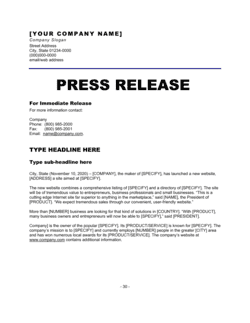
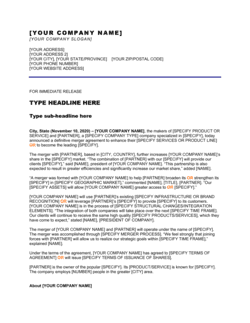
Press Release Opening a New Office Template

Free Word download β€’ Edit online β€’ Save & share with Drive β€’ Export to PDF

2 pagesβ€’20–30 min to fillβ€’Difficulty: Standardβ€’Signature requiredβ€’Legal review recommended
Learn more ↓
FreePress Release Opening a New Office Template

At a glance

What it is
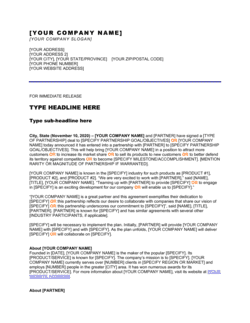
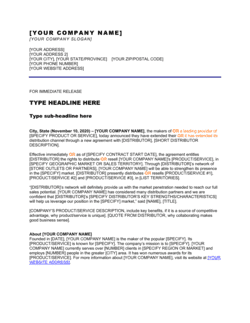
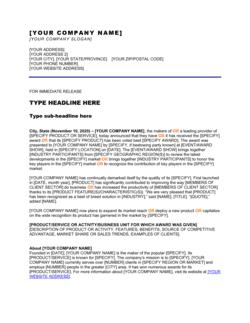
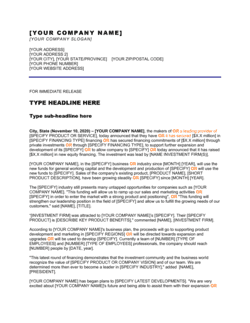
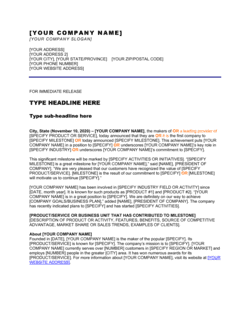
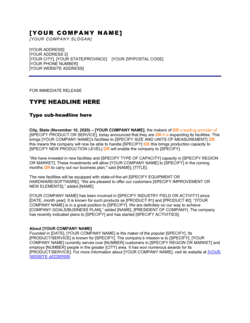
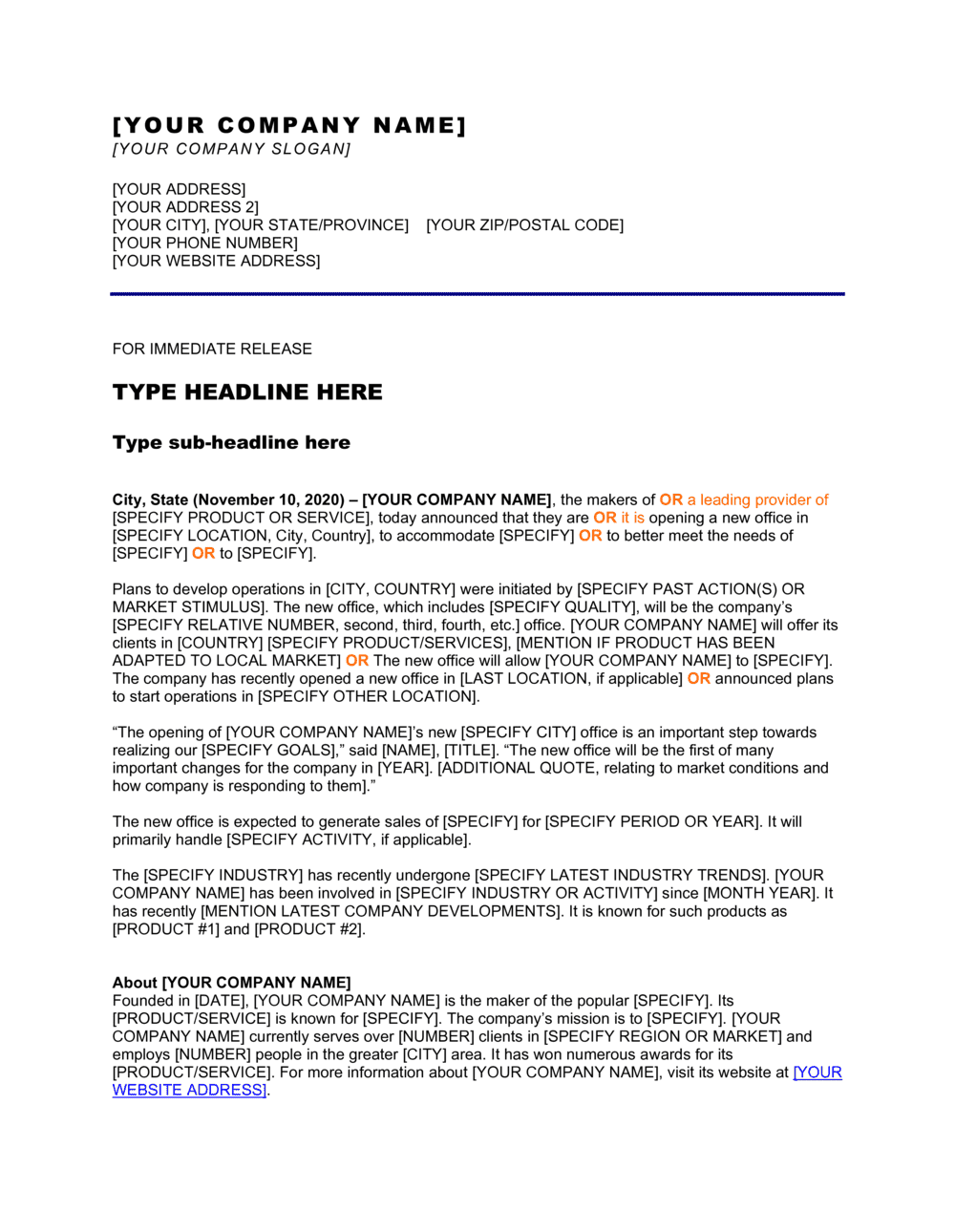
A Press Release Opening a New Office is a formal public announcement distributed to media outlets, journalists, and stakeholders to communicate that a business is establishing a new physical location. This free Word download gives you a structured, publication-ready template you can edit online with your company details, leadership quotes, and market rationale, then export as PDF or distribute directly to wire services.
When you need it
Use it when your company is opening a branch office, regional headquarters, satellite location, or international outpost and needs to generate media coverage, signal market expansion to investors, and notify clients and partners in a single coordinated communication.
What's inside
Headline and dateline, company overview, announcement body with location details and opening date, business rationale for the expansion, executive quote, community or market context, media contact block, and boilerplate company description.

What is a Press Release Opening a New Office?

A Press Release Opening a New Office is a formal public announcement distributed to journalists, media outlets, and stakeholders to communicate that a business is establishing a new physical location. It follows the inverted-pyramid structure β€” most newsworthy facts first, supporting detail below β€” and typically covers the office address and opening date, the strategic rationale for the expansion, a named executive quote, local hiring plans, and a standardized company description. Unlike an internal memo or a social media post, a press release is a dated, attributed public record that wire services index, journalists cite, and search engines rank.

Why You Need This Document

Without a structured press release, a new office opening produces fragmented coverage at best and silence at worst. Journalists receive dozens of announcements daily β€” a release that buries the address, omits the opening date, or leads with adjectives rather than facts gets set aside in under ten seconds. The consequences are concrete: local business journals run a competitor's expansion story instead of yours, clients learn about the new location from a Google listing rather than a coordinated announcement, and the hiring signal you intended to send to the talent market never lands. A properly formatted press release with a specific lede, a quotable executive statement, and a named media contact gives journalists everything they need to publish without additional research β€” which is exactly why editors prefer them. This template gives you the structure to produce a publication-ready release in under two hours, with every required element in the right place.

Which variant fits your situation?

If your situation is…Use this template
Opening a first physical office after operating remotelyPress Release Opening a New Office
Announcing a new headquarters relocationPress Release Relocation of Offices
Announcing a new product or service at the office openingPress Release Introducing a New Product
Communicating a merger that created the new officePress Release Announcing a Merger
Notifying staff internally of the new location before going publicInternal Announcement Memo
Launching a franchise location rather than a company-owned officePress Release Opening a New Franchise
Announcing a new hire leading the new officePress Release Announcing a New Employee

Common mistakes to avoid

❌ Burying the office address in the body text

Why it matters: Journalists and editors scanning for the newsworthiness of a location story need the city and address in the first two sentences. Vague location references result in the release being skipped for more specific competitor announcements.

Fix: State the full address in the lede paragraph and repeat the city name in the headline. The release should be dateline-searchable by location.

❌ Generic executive quotes with no specific content

Why it matters: A quote like 'We are excited to grow our footprint' adds no information. Journalists rarely reprint it, and readers who see it lose confidence in the announcement's substance.

Fix: Include at least one specific fact in the quote β€” a client name, a hiring number, or a business metric β€” and have the executive personally approve the final language.

❌ Distributing without a named media contact

Why it matters: A generic info@ address or switchboard number tells journalists they are not a priority. On deadline, they will find a more accessible source or skip the story entirely.

Fix: Name the specific communications or PR staff member handling coverage, provide a direct mobile number for deadline calls, and brief them on all key facts before distribution.

❌ Using inconsistent NAP data across channels

Why it matters: If the press release lists a different address format than Google Business Profile or the company website, search engines treat them as different locations β€” fragmenting local SEO value and confusing potential clients looking up the new office.

Fix: Standardize the full address in one format before publishing the release, then update Google Business Profile, LinkedIn, and all directory listings on the same day the release goes live.

❌ Omitting the opening date

Why it matters: A press release about a new office that does not state when the office is open for business leaves journalists unable to time their coverage and clients unable to plan visits.

Fix: State the specific opening date β€” or the date of the grand opening event β€” in both the headline and the first paragraph.

❌ Rewriting the boilerplate for each release

Why it matters: Inconsistent company descriptions across releases confuse journalists building a file on your company and signal that your communications program lacks structure.

Fix: Create and approve a single canonical boilerplate paragraph and paste it unchanged into every press release. Review and update it quarterly or after a material change such as a funding round or acquisition.

The 10 key clauses, explained

Headline

In plain language: The single-line title of the release that communicates the core news in under 100 characters. It must make a journalist want to keep reading.

Sample language
[COMPANY NAME] Opens New [CITY] Office to Expand [SERVICE/PRODUCT] Presence in [REGION]

Common mistake: Writing a vague headline like 'Company Announces Exciting News' β€” editors will not read past it, and wire services rank releases partly on headline specificity.

Dateline and release status

In plain language: States 'FOR IMMEDIATE RELEASE' or the embargo date and time, followed by the city and release date to establish geographic and chronological context.

Sample language
FOR IMMEDIATE RELEASE [CITY], [STATE/COUNTRY] β€” [MONTH DAY, YEAR] β€”

Common mistake: Omitting the dateline city, which forces journalists to hunt for the announcement's geographic origin before they can determine newsworthiness for their audience.

Opening lede

In plain language: The first paragraph answers who, what, where, when, and why in two to three sentences β€” the single paragraph that determines whether the release gets picked up.

Sample language
[COMPANY NAME], a [DESCRIPTION OF COMPANY], today announced the opening of its new office at [ADDRESS, CITY], effective [DATE]. The new location will serve [TARGET MARKET/REGION] and support [COMPANY NAME]'s expansion into [MARKET OPPORTUNITY].

Common mistake: Burying the actual news β€” the new address and opening date β€” in the second or third paragraph. Journalists read the lede and stop; put the facts upfront.

Business rationale

In plain language: Explains why the company is expanding to this specific market β€” customer demand, talent availability, proximity to clients, or strategic growth targets.

Sample language
The [CITY] office reflects growing client demand in the [REGION] market, where [COMPANY NAME] has seen a [X]% increase in [REVENUE/CLIENTS] over the past [TIMEFRAME]. The new location will enable [COMPANY NAME] to provide [BENEFIT] to clients across [GEOGRAPHY].

Common mistake: Using generic language like 'to better serve our customers.' Concrete metrics β€” revenue growth percentage, client count, geographic gap filled β€” make the rationale credible and quotable.

Office details and capabilities

In plain language: Describes the physical location, square footage or capacity, services offered from this office, number of employees, and any notable features.

Sample language
Located at [FULL ADDRESS], the [X,XXX] sq. ft. facility will house [X] employees and offer [SERVICES/CAPABILITIES]. The office is equipped with [NOTABLE FEATURE β€” e.g., client meeting suites, a dedicated training center, a product demonstration lab].

Common mistake: Omitting the full street address. Readers and journalists cannot verify or link the announcement to mapping and directory data without a complete NAP entry.

Executive quote

In plain language: An attributed statement from a named senior leader β€” ideally CEO, President, or the regional leader β€” that adds voice and strategic context to the announcement.

Sample language
"[CITY] is a market where we see tremendous opportunity to [SPECIFIC GOAL]," said [EXECUTIVE NAME], [TITLE] of [COMPANY NAME]. "This office allows us to [SPECIFIC BENEFIT FOR CLIENTS/COMMUNITY] and brings us closer to the [X] clients we serve in [REGION]."

Common mistake: Writing a quote that is indistinguishable from marketing copy β€” 'We are thrilled and excited to be here.' The quote should say something specific that only this executive in this context would say.

Community and market context

In plain language: Connects the expansion to local economic conditions, hiring plans, community involvement, or the competitive landscape in the new market.

Sample language
[COMPANY NAME] plans to hire [X] local employees in [ROLES β€” e.g., sales, engineering, client services] over the next [TIMEFRAME], contributing to the [CITY] economy. The company will also [COMMUNITY INITIATIVE, IF ANY].

Common mistake: Skipping this section entirely for domestic expansions. Local journalists and city business journals specifically look for hiring numbers and economic impact when deciding whether to cover a new office story.

Call to action and event details

In plain language: If there is an opening event, ribbon-cutting, or public open house, this paragraph states the date, time, location, and RSVP instructions.

Sample language
[COMPANY NAME] will host a grand opening event on [DATE] at [TIME] at [ADDRESS]. Media and invited guests are welcome to attend. RSVP to [CONTACT NAME] at [EMAIL] by [DATE].

Common mistake: Burying event logistics in the media contact block instead of calling them out as a distinct paragraph β€” journalists miss the invitation and the event goes uncovered.

Boilerplate company description

In plain language: A standardized 75–100 word paragraph that describes the company β€” founding year, headquarters, core business, size, and mission β€” used unchanged across all press releases.

Sample language
About [COMPANY NAME]: [COMPANY NAME] is a [DESCRIPTION] headquartered in [CITY, STATE/COUNTRY]. Founded in [YEAR], the company [CORE BUSINESS DESCRIPTION] for [TARGET CUSTOMER]. With [X] employees and operations in [GEOGRAPHIES], [COMPANY NAME] serves [CLIENT COUNT OR REVENUE] and is committed to [MISSION]. For more information, visit [WEBSITE URL].

Common mistake: Writing a new boilerplate for each release. Inconsistent descriptions confuse journalists building a profile of your company and undermine brand recognition over time.

Media contact block

In plain language: Lists the full name, title, direct phone number, and email address of the person journalists should contact for quotes, interviews, or additional information.

Sample language
Media Contact: [CONTACT FULL NAME] [TITLE] [COMPANY NAME] Phone: [DIRECT PHONE NUMBER] Email: [EMAIL ADDRESS]

Common mistake: Listing a general info@ email address instead of a named individual. Journalists on deadline do not chase anonymous inboxes β€” a named contact with a direct number doubles response rates.

How to fill it out

  1. 1

    Confirm the release status and embargo date

    Decide whether the release goes out immediately or under embargo. If immediate, write 'FOR IMMEDIATE RELEASE' at the top. If embargoed, state the exact date and time the embargo lifts and communicate it directly to each journalist receiving it.

    πŸ’‘ Only use an embargo if you have an existing relationship with the journalist β€” unsolicited embargoes are routinely ignored.

  2. 2

    Write the headline around the most newsworthy fact

    Lead with the company name, city, and the expansion news in under 100 characters. Avoid adjectives like 'exciting' or 'groundbreaking.' State the news β€” city, company, action.

    πŸ’‘ Test the headline by asking: would a business journal editor run this as a one-line story item? If yes, it works.

  3. 3

    Draft the lede with all five Ws

    The first paragraph must answer who (company), what (new office), where (full address and city), when (opening date), and why (market rationale) in two to three sentences. This is the paragraph wire service algorithms and journalists scan first.

    πŸ’‘ Read the lede aloud. If it takes longer than 15 seconds to reach the core news, cut the opening and move the facts forward.

  4. 4

    Add concrete metrics to the business rationale

    Replace generic growth language with specific numbers: percentage revenue increase in the market, client count, headcount, or square footage. Pull from internal reports or publicly available market data.

    πŸ’‘ Even one specific number β€” '42 clients in the Pacific Northwest' β€” increases pickup rates by making the story quotable without additional research.

  5. 5

    Write the executive quote last in this section

    Draft the quote after completing the body so it adds perspective rather than restating facts. Have the named executive review and approve it β€” quote approval is standard practice and protects you from attribution disputes.

    πŸ’‘ A quote that references a community benefit or local hire commitment is more likely to be used verbatim by local press than a quote about company strategy.

  6. 6

    Standardize your boilerplate and lock it

    Write a single 75–100 word company description that you will use on every press release. Have a senior leader approve it. Store it as a locked text block in your template so it is never accidentally modified.

    πŸ’‘ Include your current headcount and one measurable company achievement β€” revenue, customers, or years in business β€” to anchor the boilerplate in facts.

  7. 7

    Complete the media contact block with a named individual

    Enter the full name, direct phone number (not a switchboard), and direct email of the person who will handle press inquiries. Brief that person on all key facts before the release goes out.

    πŸ’‘ If your primary contact will be unavailable during the first 48 hours after distribution, list a secondary contact. Media inquiries that go unanswered in 24 hours typically result in no coverage.

  8. 8

    Proof for NAP consistency before distribution

    Compare the company name, office address, and phone number in the release to your website, Google Business Profile, and LinkedIn company page. Discrepancies create SEO and brand inconsistency that is difficult to correct after wire distribution.

    πŸ’‘ Run a quick Google search for your company name plus the new city before publishing to identify any conflicting information already indexed.

Frequently asked questions

What is a press release for opening a new office?

A press release for opening a new office is a formal written announcement distributed to media outlets and journalists to communicate that a business is establishing a new physical location. It follows the inverted-pyramid structure β€” most newsworthy facts first β€” and includes the office address, opening date, business rationale, an executive quote, and a media contact. Its purpose is to generate press coverage, signal market expansion to clients and investors, and create a permanent public record of the event.

Who should sign off on a new office press release?

At minimum, the executive quoted in the release must approve their attributed statement verbatim. For companies with in-house legal counsel, legal review of the full release is standard before distribution β€” particularly when the release mentions financial metrics, pending regulatory approvals, or the status of new hires. Public companies must also clear the release through investor relations to check for material disclosure obligations.

When should I distribute a new office press release?

Distribute the release on the day of or the day before the office opens, or two to five days before a planned grand opening event to give journalists time to schedule coverage. Tuesday through Thursday between 8 a.m. and 10 a.m. local time generates the highest wire service pickup rates. Avoid distributing on Fridays, Mondays, or days adjacent to major holidays when editorial attention is reduced.

What is the difference between a press release and a media advisory?

A press release announces news and provides full detail intended for publication β€” it is a complete story that journalists can reprint with minimal additional research. A media advisory is a shorter, event-specific notice inviting journalists to attend a ribbon-cutting, press conference, or open house β€” it gives the who, what, where, and when but does not attempt to tell the full story. For a new office opening, you may distribute both: a press release for news pickup and a media advisory two to three days before the event.

Should I use a wire service to distribute a new office press release?

Wire distribution is worthwhile when the opening has regional or national significance β€” a first location in a new country, a major market entry, or a large hiring commitment. For a local second office with limited news value beyond the immediate market, targeted distribution directly to local business journals, city editors, and industry trade publications typically outperforms broad wire syndication in terms of actual coverage. Wire services cost $300–$1,500 per release depending on the distribution network and geographic reach.

How long should a new office press release be?

A standard press release runs 400–600 words β€” roughly one printed page. Journalists prefer concise releases because they are easier to adapt into short news items. If you have significant additional detail (event schedule, executive bios, building renderings), attach it as a fact sheet or media kit rather than extending the body of the release. Releases longer than 800 words rarely receive more coverage than 500-word versions.

Do I need to include a quote from a local official or partner?

Including a secondary quote from a local economic development official, chamber of commerce president, or major client significantly increases pickup by local media. Editors at city business journals look for community voice in expansion stories. Obtaining this quote requires contacting the third party in advance for approval and attribution β€” never fabricate or paraphrase a third-party quote without written sign-off.

Can a press release be used as a formal business record?

Yes. Distributed press releases are timestamped public records. They are used as evidence of public announcements in regulatory filings, M&A due diligence, litigation discovery, and trademark priority claims. For this reason, all factual claims in the release should be accurate at the time of distribution, and a copy with distribution metadata should be retained in your company's records management system.

How this compares to alternatives

vs Press Release Relocation of Offices

A relocation press release announces that an existing office is moving to a new address β€” it is not about expansion but about continuity and updated contact information. An office opening release announces net-new presence in a market. Use the relocation template when closing one location and opening another; use this template when the new location is additive.

vs Press Release Announcing a New Employee

A new-employee press release focuses on a specific hire's credentials and role. An office opening release is about the physical expansion of the business. When a senior leader is hired specifically to head the new office, the two releases can be combined β€” but keep the location as the primary news hook and the hire as supporting context.

vs Press Release Announcing a Merger

A merger announcement addresses a change in corporate structure, ownership, and combined capabilities. An office opening release addresses a geographic expansion within an existing corporate structure. If a merger results in a new office, draft separate releases β€” the merger announcement first, then a follow-on office opening release once the location is operational.

vs Internal Announcement Memo

An internal announcement memo notifies employees and internal stakeholders of the new office before the public announcement. It contains operational details β€” reporting structures, facilities access, relocation packages β€” that are not appropriate for external distribution. Always send the internal memo before the press release goes live to prevent employees from learning about changes from the media.

Industry-specific considerations

Professional Services

Law firms, accounting firms, and consulting practices use office opening releases to signal geographic coverage expansion to existing clients and to establish credibility in new markets where referral networks are relationship-driven.

Technology / SaaS

Tech companies opening engineering hubs or sales offices emphasize local hiring numbers, technical talent pools, and proximity to university pipelines β€” details that attract both press and prospective employees.

Real Estate

Brokerage and property management firms treat new office announcements as local market credibility signals, typically including agent headcount, local transaction volume, and coverage area to differentiate from national competitors.

Retail / Hospitality

Retailers and hospitality brands time office and location releases to coordinate with grand opening events, including foot traffic drivers such as promotions, ribbon-cutting ceremonies, and local influencer partnerships.

Healthcare

Medical groups and health systems opening new offices must navigate HIPAA-compliant messaging, credentialing timelines, and state licensing requirements before confirming a public opening date in any release.

Financial Services

Banks, credit unions, and financial advisory firms opening new branches require compliance review of any claims about services or rates and must ensure the release does not constitute a solicitation in jurisdictions where the firm is not yet licensed.

Jurisdictional notes

United States

Public companies must confirm whether the new office announcement constitutes material non-public information (MNPI) requiring an 8-K filing with the SEC before or concurrent with press distribution. Private companies have no federal disclosure obligation but should confirm state business registration and local business license issuance before stating an operational opening date. Claims about hiring must comply with EEOC guidelines if accompanied by job descriptions.

Canada

Federally regulated industries β€” banking, telecommunications, transportation β€” must confirm CRTC or OSFI approvals before announcing an operational opening. Quebec-based offices must ensure the press release is available in French under the Charter of the French Language (Bill 96) if the company employs 25 or more workers. Public companies listed on the TSX or TSX-V must review continuous disclosure obligations before distribution.

United Kingdom

FCA-regulated firms β€” financial services, insurance, consumer credit β€” must ensure no statements in the release constitute a financial promotion under FSMA 2000 without the appropriate approvals. Claims about employment numbers must not imply guaranteed headcount if hiring is contingent on regulatory approvals. Companies listed on the London Stock Exchange should confirm the release does not trigger a disclosure obligation under the UK Market Abuse Regulation.

European Union

GDPR applies if the press release includes any personal data about named employees, contacts, or clients β€” even in quoted attributions. Ensure named individuals have consented to public identification. In France, Germany, and the Netherlands, works councils may have statutory consultation rights before a new office opening is publicly announced, meaning the press release timing must follow the completion of that consultation. EU-listed companies should review the Market Abuse Regulation (MAR) before distribution.

Template vs lawyer β€” what fits your deal?

PathBest forCostTime
Use the templateSmall and mid-sized businesses announcing a domestic office opening with no material financial disclosures or pending regulatory approvalsFree1–2 hours
Template + legal reviewCompanies making specific financial claims, announcing a regulated-industry location, or issuing on behalf of a public company$200–$500 for a communications or legal counsel review1–2 business days
Custom draftedPublic companies with SEC disclosure obligations, international expansions requiring multi-jurisdiction compliance review, or releases tied to concurrent M&A announcements$1,000–$3,000+ (legal and PR counsel)3–7 business days

Glossary

Dateline
The opening line of a press release that states the city of origin and the release date, establishing geographic and temporal context for journalists.
Boilerplate
A standardized paragraph at the end of every press release that describes the company β€” its mission, founding date, size, and core business β€” in approximately 75–100 words.
For Immediate Release
A standard header phrase indicating the press release may be published by journalists as soon as it is received, with no embargo period.
Embargo
A mutually agreed restriction preventing a journalist from publishing the announcement before a specified date and time.
Wire Service
A distribution service such as PR Newswire, Business Wire, or GlobeNewswire that syndicates press releases to thousands of media outlets simultaneously.
Executive Quote
A attributed statement from a named company leader β€” typically CEO, President, or Regional Director β€” that provides a human perspective on the announcement.
Media Contact Block
The section listing the name, phone number, and email of the person journalists should contact for interviews or additional information.
Lede
The opening sentence or paragraph of the announcement body, written to answer who, what, where, when, and why in a single tight statement.
Inverted Pyramid
The standard press release structure where the most newsworthy information appears first and supporting details follow in descending order of importance.
NAP Consistency
Name, Address, and Phone β€” the three data points that must appear identically across the press release, your website, and directory listings for local SEO purposes.

Part of your Business Operating System

This document is one of 3,000+ business & legal templates included in Business in a Box.

  • Fill-in-the-blanks β€” ready in minutes
  • 100% customizable Word document
  • Compatible with all office suites
  • Export to PDF and share electronically

Create your document in 3 simple steps.

From template to signed document β€” all inside one Business Operating System.
1
Download or open template

Access over 3,000+ business and legal templates for any business task, project or initiative.

2
Edit and fill in the blanks with AI

Customize your ready-made business document template and save it in the cloud.

3
Save, Share, Send, Sign

Share your files and folders with your team. Create a space of seamless collaboration.

Save time, save money, and create top-quality documents.

β˜…β˜…β˜…β˜…β˜…

"Fantastic value! I'm not sure how I'd do without it. It's worth its weight in gold and paid back for itself many times."

Managing Director Β· Mall Farm
Robert Whalley
Managing Director, Mall Farm Proprietary Limited
β˜…β˜…β˜…β˜…β˜…

"I have been using Business in a Box for years. It has been the most useful source of templates I have encountered. I recommend it to anyone."

Business Owner Β· 4+ years
Dr Michael John Freestone
Business Owner
β˜…β˜…β˜…β˜…β˜…

"It has been a life saver so many times I have lost count. Business in a Box has saved me so much time and as you know, time is money."

Owner Β· Upstate Web
David G. Moore Jr.
Owner, Upstate Web

Run your business with a system β€” not scattered tools

Stop downloading documents. Start operating with clarity. Business in a Box gives you the Business Operating System used by over 250,000 companies worldwide to structure, run, and grow their business.

Free Forever PlanΒ Β·Β No credit card required