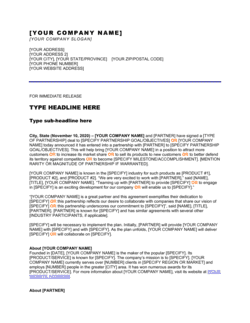
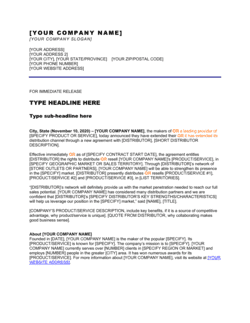
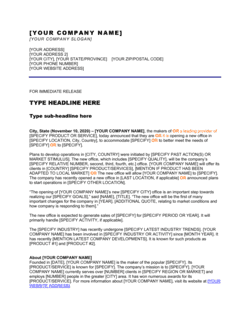
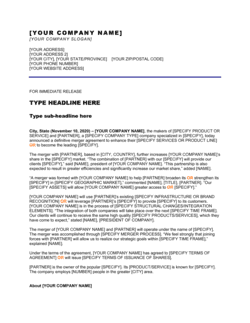
Press Release Company Won an Award Template

Free Word download β€’ Edit online β€’ Save & share with Drive β€’ Export to PDF

2 pagesβ€’20–30 min to fillβ€’Difficulty: Standardβ€’Signature requiredβ€’Legal review recommended
Learn more ↓
FreePress Release Company Won an Award Template

At a glance

What it is
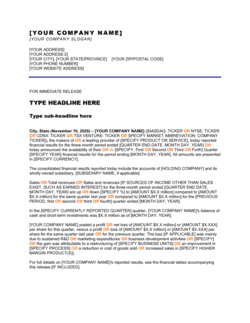
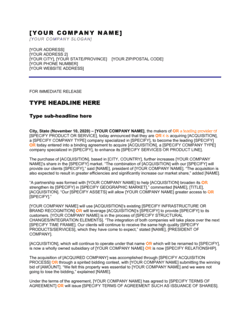
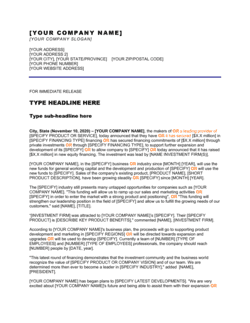
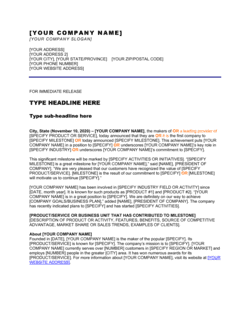
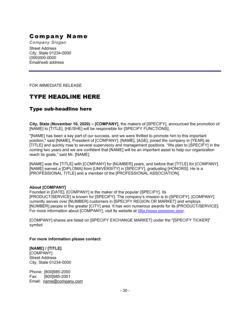
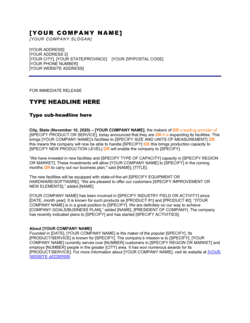
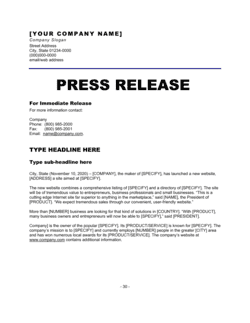
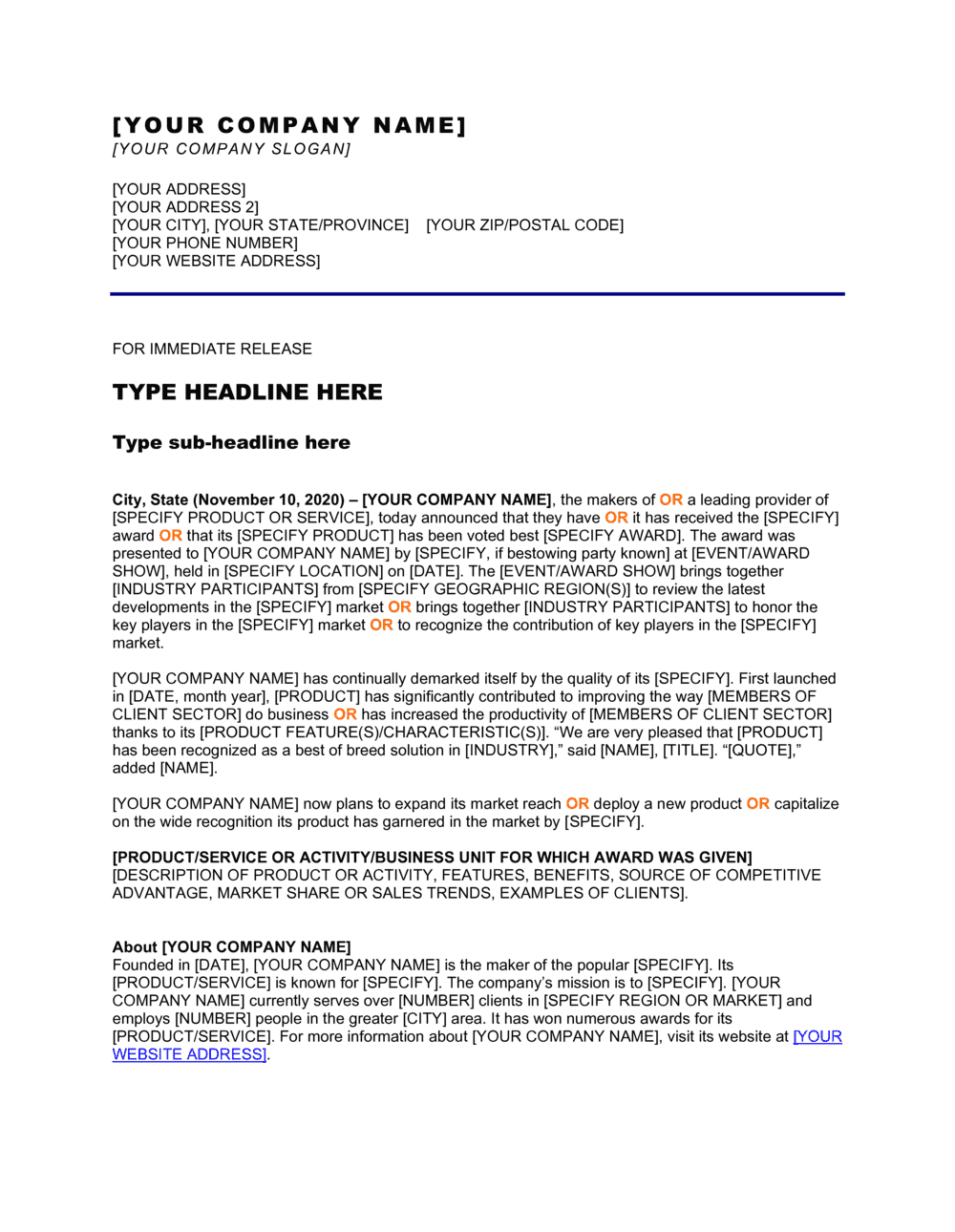
A Press Release: Company Won an Award is a formal written announcement a business issues to media outlets, journalists, and online distribution services to publicize a recognized achievement or industry honor. This free Word download gives you a structured, publication-ready template you can edit online and export as PDF β€” covering headline, dateline, body copy, executive quote, award context, and boilerplate in a single authoritative document.
When you need it
Use it within 48–72 hours of receiving official confirmation of an award to maximize news cycle relevance. It is equally valuable for regional business journal submissions, newswire distribution, and posting directly to your website's press room.
What's inside
A compelling headline and subheadline, dateline, opening paragraph with the five Ws, award description and issuing organization context, executive quote, company impact statement, media contact information, and standardized boilerplate describing the company.

What is a Press Release: Company Won an Award?

A Press Release: Company Won an Award is a formal written announcement a business distributes to journalists, media outlets, and newswire services to publicize an industry recognition or competitive honor it has received. Structured according to standard journalistic conventions β€” headline, dateline, inverted pyramid body, executive quote, boilerplate, and media contact β€” it presents the award as a news event rather than a marketing message, which is the key distinction between earned media coverage and paid advertising. When properly drafted, the document functions simultaneously as a media pitch tool, a website press room asset, and a piece of supporting evidence in sales and investor conversations.

Why You Need This Document

Failing to issue a formal press release after an award win leaves recognition on the table β€” literally. Journalists covering your industry will not discover the award on their own, and a social media post does not create the indexed, citable media record that a distributed press release generates. A poorly formatted announcement without proper attribution, a named media contact, or substantiating evidence is routinely ignored by editors regardless of how prestigious the award is. Beyond media coverage, a well-structured press release creates a permanent, SEO-indexed record of your company's achievements that surfaces in journalist research, investor due diligence, and prospect background checks for years after the original distribution. This template gives you the exact structure that wire services, trade editors, and business journals expect β€” so your award win generates the coverage it deserves rather than disappearing into an inbox.

Which variant fits your situation?

If your situation is…Use this template
Announcing a regional or local business awardPress Release Company Won An Award
Announcing a national or industry-wide award with major media distributionNewswire-Optimized Press Release
Announcing an individual employee or executive awardPress Release Employee Award Announcement
Announcing a product or innovation awardPress Release New Product Launch
Announcing a partnership or joint recognitionPress Release Joint Venture Announcement
Publishing the announcement as a blog post or website featureAward Announcement Blog Post Template
Issuing an internal announcement to staff before external releaseInternal Company Announcement Memo

Common mistakes to avoid

❌ Using marketing language in the headline

Why it matters: Phrases like 'proud to announce' or 'thrilled to share' signal promotional content to editors, who routinely skip or rewrite releases that read like advertising copy.

Fix: Write the headline as a factual news statement: '[COMPANY] Named [AWARD] by [BODY].' Reserve enthusiasm for the executive quote.

❌ Omitting the award context

Why it matters: A press release that names an obscure award without explaining what it is or who issues it reads as self-promotion and gives journalists nothing to substantiate the story.

Fix: Dedicate one paragraph to the award's history, selection criteria, and the issuing organization's credibility. Link to the official announcement page.

❌ Publishing an unapproved third-party quote

Why it matters: Attributing a statement to the issuing organization without written approval is factually risky and can damage the relationship with the awarding body, leading to retraction requests.

Fix: Request an approved quote directly from the issuing organization's communications team before drafting the release, or omit the third-party quote entirely.

❌ Distributing the release more than a week after the award announcement

Why it matters: Press releases are time-sensitive news items. A release issued 10 days after the award ceremony has no news hook and will be ignored by editors working on current stories.

Fix: Aim to distribute within 48–72 hours of receiving official confirmation. If the award has an embargo, plan the release to go out exactly when the embargo lifts.

❌ Using a different boilerplate in each release

Why it matters: Inconsistent company descriptions create conflicting records in media databases and confuse journalists who research the company across multiple releases.

Fix: Maintain a single approved boilerplate document and require all team members to copy from it verbatim for every release issued.

❌ Listing a general email address as the media contact

Why it matters: Journalists on deadline who cannot reach a named individual within minutes typically abandon the story and move to one that offers easier access.

Fix: List a named individual with a direct phone number and monitored email address. Include a mobile number for wire distributions where time-sensitive follow-up is likely.

The 10 key clauses, explained

Release timing header

In plain language: States whether the release is for immediate publication or held under embargo until a specific date and time.

Sample language
FOR IMMEDIATE RELEASE β€” or β€” EMBARGOED UNTIL [DATE] AT [TIME] [TIMEZONE]

Common mistake: Omitting the release timing header entirely. Without it, journalists default to treating the release as embargoed and may delay or skip publication altogether.

Media contact block

In plain language: Provides the full name, title, phone number, and email of the person handling press inquiries β€” placed prominently so journalists can reach the right person without searching.

Sample language
Media Contact: [NAME], [TITLE] | [COMPANY NAME] | Phone: [PHONE NUMBER] | Email: [EMAIL ADDRESS]

Common mistake: Listing a general info@ or reception email instead of a named individual. Journalists who cannot reach a real person quickly move on to the next story.

Headline and subheadline

In plain language: The headline announces the award win in a single declarative sentence; the subheadline adds one clarifying detail β€” the award name, issuing body, or business significance.

Sample language
[COMPANY NAME] Named [AWARD NAME] by [ISSUING ORGANIZATION] | Recognition Highlights [SPECIFIC ACHIEVEMENT OR DIFFERENTIATOR]

Common mistake: Writing the headline in all caps or using promotional language like 'proud to announce.' Wire services and editors rewrite or reject releases with marketing-copy headlines.

Dateline and lede paragraph

In plain language: Opens with the city of origin and date, then immediately delivers the five Ws β€” who won, what the award is, when it was awarded, where the ceremony or announcement occurred, and why the company received it.

Sample language
[CITY, STATE] β€” [DATE] β€” [COMPANY NAME], a [BRIEF COMPANY DESCRIPTION], today announced it has been named the recipient of the [AWARD NAME] by [ISSUING ORGANIZATION], recognizing [SPECIFIC CRITERION].

Common mistake: Burying the award name in the second or third paragraph. Editors who skim only the lede will not understand the news hook and are unlikely to run the story.

Award context paragraph

In plain language: Explains what the award is, the criteria used to select recipients, how many companies were considered or nominated, and the prestige or history of the issuing organization.

Sample language
The [AWARD NAME], now in its [YEAR ORDINAL] year, recognizes [AWARD CRITERIA] across [SCOPE β€” e.g., 'companies in the [INDUSTRY] sector with fewer than [X] employees']. This year, [NUMBER] organizations were evaluated by a panel of [JUDGES/CRITERIA].

Common mistake: Skipping the award context entirely and assuming readers know the award. Unknown awards without context appear self-congratulatory and reduce credibility with journalists and readers.

Executive quote

In plain language: A direct quote from a named company executive β€” CEO, president, or relevant senior leader β€” that provides a human perspective on the significance of the win and ties it to company values or strategy.

Sample language
'[QUOTE THAT CONNECTS THE AWARD TO A SPECIFIC COMPANY VALUE OR TEAM ACHIEVEMENT],' said [EXECUTIVE NAME], [TITLE] of [COMPANY NAME]. '[SECOND SENTENCE ADDING FORWARD-LOOKING CONTEXT OR CUSTOMER IMPACT].'

Common mistake: Using a generic quote like 'We are honored to receive this recognition.' Quotes that restate the obvious offer no new information and are routinely cut by editors before publication.

Company impact and supporting evidence paragraph

In plain language: Provides one to two sentences of specific evidence justifying the award β€” a metric, achievement, product milestone, or customer outcome that makes the recognition credible to a skeptical reader.

Sample language
[COMPANY NAME] achieved [SPECIFIC METRIC β€” e.g., '42% revenue growth in FY[YEAR]'] and expanded its customer base to [NUMBER] clients in [NUMBER] countries, directly contributing to the criteria assessed by [ISSUING ORGANIZATION].

Common mistake: Omitting any supporting data and relying solely on the award itself as proof. Journalists and readers expect at least one verifiable fact that substantiates the claim.

Issuing organization quote (optional)

In plain language: A direct quote from a representative of the awarding body, lending third-party credibility to the announcement. Include only when the issuing organization has provided an approved statement.

Sample language
'[COMPANY NAME] stood out among nominees for [SPECIFIC REASON],' said [ISSUING ORG REPRESENTATIVE NAME], [TITLE] at [ISSUING ORGANIZATION]. '[ADDITIONAL CONTEXT ON SELECTION PROCESS OR SIGNIFICANCE].'

Common mistake: Fabricating or paraphrasing an issuing organization quote without written approval. Publishing an unapproved quote attributed to a third party creates reputational and legal exposure.

Company boilerplate

In plain language: A standardized 'About [Company]' paragraph covering the company's mission, founding year, employee count, locations, core products or services, and any relevant certifications or recognitions.

Sample language
About [COMPANY NAME]: Founded in [YEAR], [COMPANY NAME] is a [DESCRIPTION] headquartered in [CITY, STATE/COUNTRY], with [NUMBER] employees serving clients in [NUMBER] countries. [COMPANY NAME] provides [PRODUCTS/SERVICES] to [TARGET CUSTOMERS]. For more information, visit [WEBSITE URL].

Common mistake: Using a different boilerplate version in each press release. Inconsistent descriptions of the company create conflicting records in media databases and confuse journalists researching the company's history.

End notation and supplementary information

In plain language: Three centered pound signs (###) mark the end of the release body. Any additional technical specifications, methodology notes, or source citations follow below the notation as supplementary information.

Sample language
### Note to Editors: [ADDITIONAL CONTEXT, METHODOLOGY, OR SOURCE CITATION IF APPLICABLE]

Common mistake: Adding post-### content without labeling it. Editors who see content after the end mark assume it was accidentally included and may discard it along with the release.

How to fill it out

  1. 1

    Confirm award details with the issuing organization

    Before writing a single word, obtain the official award name, any approved logo or badge, the exact date of announcement, and whether the issuing organization requires review of your press release before distribution.

    πŸ’‘ Ask the issuing organization for a quote you can include β€” most award bodies are eager to provide one, and third-party quotes significantly improve pickup rates.

  2. 2

    Fill in the release timing header and media contact block

    Decide whether to release immediately or under embargo. Enter the named media contact's direct phone number and email β€” not a general inbox.

    πŸ’‘ For major wire distributions, set an embargo of 48 hours to give journalists time to prepare stories before the public announcement.

  3. 3

    Write the headline and subheadline

    Draft a single declarative headline naming the company, the award, and the issuing body. Add a subheadline that provides one additional detail β€” the significance, the year, or the specific achievement recognized.

    πŸ’‘ Keep the headline under 100 characters so it displays fully in email subject lines and newswire previews without truncation.

  4. 4

    Draft the dateline and lede paragraph

    Open with [CITY, STATE] β€” [DATE] β€”, then answer who, what, when, where, and why in two to three sentences. The award name and issuing organization must appear in the first 25 words.

    πŸ’‘ Read the lede aloud β€” if it takes more than 10 seconds to understand the core news, rewrite it.

  5. 5

    Write the award context paragraph

    Explain what the award is, how recipients are selected, how many companies were evaluated, and why the issuing organization's recognition matters to your industry.

    πŸ’‘ Link the award to a publicly verifiable source β€” the issuing organization's website or announcement page β€” to help journalists fact-check quickly.

  6. 6

    Insert a specific executive quote

    Write a quote from your CEO or the most senior relevant leader. The quote should connect the award to a specific team effort, customer outcome, or company value β€” not simply express gratitude.

    πŸ’‘ Have the quoted executive approve the exact wording before the release is sent. Surprises at the distribution stage cause delays and rushed edits.

  7. 7

    Add supporting evidence and finalize the boilerplate

    Include one concrete metric or achievement that substantiates the award. Then paste your standard company boilerplate β€” ensuring it matches the version used in your two most recent releases.

    πŸ’‘ Store an approved boilerplate in a shared document so every team member uses the identical version for every release.

  8. 8

    Proofread, obtain approvals, and distribute

    Run a final check for factual accuracy, consistent spelling of the award name, and correct attribution of all quotes. Obtain sign-off from the executive quoted and, if required, the issuing organization. Then distribute via your chosen newswire and direct media contacts.

    πŸ’‘ Send to your top five target journalists 2–4 hours before newswire distribution β€” exclusivity windows increase the likelihood of a dedicated story rather than a brief mention.

Frequently asked questions

What is an award win press release?

An award win press release is a formal written announcement a company distributes to journalists, media outlets, and newswires to publicize an industry or organizational recognition it has received. It follows a standard journalistic structure β€” headline, dateline, lede, body, quotes, boilerplate, and media contact β€” and is designed to generate earned media coverage by presenting the award as newsworthy rather than promotional.

When should I send an award press release?

Distribute within 48–72 hours of receiving official confirmation of the award. If the issuing organization has an embargo on the announcement, time your release to go out the moment the embargo lifts. Releases issued more than five to seven days after the award announcement lose their news hook and are significantly less likely to generate coverage.

Who should be quoted in an award press release?

The primary quote should come from the highest-ranking relevant executive β€” typically the CEO, president, or division leader most associated with the achievement. A second quote from a representative of the issuing organization adds third-party credibility but requires written approval before inclusion. Avoid quoting more than two people in a standard release, as multiple voices dilute the narrative focus.

Should a press release be signed?

Internally, the release should be approved and signed off by the quoted executive and, where applicable, the legal or compliance team before distribution. The publicly distributed document itself does not carry a signature, but maintaining a signed approval record is standard practice for regulatory compliance and dispute prevention, particularly for publicly traded companies subject to disclosure rules.

How long should an award press release be?

A standard award press release runs 400–600 words β€” roughly one printed page. Longer releases reduce the likelihood of full publication, as editors typically trim from the bottom. If supporting detail is necessary β€” award methodology, full list of criteria, or technical specifications β€” add it below the ### end notation as supplementary information for editors, not as part of the main release body.

Where should I distribute an award press release?

Distribute through a combination of direct journalist outreach to your top five to ten trade and business media contacts, a paid newswire service (PR Newswire, Business Wire, GlobeNewswire, or regional equivalents), your company's own press room and social channels, and the award issuing organization's own communications channels if they offer co-promotion. Newswire distribution ensures indexing in financial terminals and media databases even if no journalist writes a dedicated story.

What is the difference between a press release and a media pitch?

A press release is a self-contained news document formatted for direct publication or use as source material. A media pitch is a short, personal email to a specific journalist proposing a story angle and offering the press release as supporting material. For award announcements, the press release is the document of record; the pitch is the personalized hook that gets a journalist to open and read it.

Can a small business benefit from issuing an award press release?

Yes β€” for small businesses, a credible award win is one of the most accessible forms of earned media. Regional business journals, trade publications, and local news outlets actively seek award stories from companies in their coverage area. The press release also functions as evergreen content for the company website, email newsletters, and sales collateral, extending its value well beyond initial media pickup.

How this compares to alternatives

vs Press Release New Product Launch

A new product launch press release announces a commercial offering and is designed to drive consumer or buyer action. An award press release announces a third-party recognition and is designed to build credibility. The award release relies on the issuing organization's authority to create newsworthiness, while the product release creates its own news hook through novelty and features.

vs Press Release New Partnership

A partnership press release announces a bilateral agreement between two named organizations, typically requiring approval and quotes from both parties before distribution. An award press release is unilateral β€” issued solely by the recipient β€” though it may optionally include a quote from the awarding body. Partnership releases involve more coordination and longer approval cycles.

vs Press Release Merger and Acquisition

A merger and acquisition press release involves material financial disclosures, regulatory filings, and legal review requirements that make it one of the most complex release types. An award press release is comparatively straightforward, though financial performance claims still warrant a legal check. The M&A release may be subject to SEC disclosure rules and mandatory timing requirements that do not apply to award announcements.

vs Employee Award Announcement Memo

An internal employee award memo communicates a recognition to staff without any external distribution β€” it is an operational HR document, not a media document. A company award press release is specifically structured for journalist and public consumption, following inverted pyramid format and wire distribution standards. Use the memo for internal recognition; use the press release for external earned media.

Industry-specific considerations

Technology / SaaS

G2, Gartner, and Stevie Award wins are used to drive inbound credibility; releases are timed to coincide with product launch cycles or investor updates.

Professional Services

Best Workplace, industry association, and chambers of commerce award releases support recruitment and client acquisition efforts in high-trust sectors.

Retail / E-commerce

Customer service and product excellence awards are leveraged in email marketing and paid social campaigns alongside the press release for maximum earned-plus-owned reach.

Healthcare / MedTech

Clinical quality, patient satisfaction, and innovation awards require careful legal review to ensure no implied efficacy or comparative claims appear in the release copy.

Financial Services

Regulatory sensitivity means all comparative and performance language must be reviewed by compliance before distribution, particularly for publicly traded or SEC-registered entities.

Manufacturing

Safety, sustainability, and operational excellence awards are distributed to trade journals, procurement contacts, and supplier networks as proof of quality standards.

Jurisdictional notes

United States

Publicly traded companies must ensure award press releases do not constitute selective disclosure of material non-public information under SEC Regulation FD. The FTC's Section 5 prohibits deceptive claims, so superlative language such as 'the best' or 'number one' in a release must be substantiated. State consumer protection laws in California and New York also apply to written commercial communications that could be construed as advertising.

Canada

The Competition Act prohibits false or misleading representations in any form of public communication, including press releases. Companies listed on the TSX or TSX Venture Exchange must comply with continuous disclosure obligations β€” an award release that implies material outperformance or contains forward-looking financial information may trigger disclosure requirements. Quebec-headquartered companies should issue a simultaneous French-language version under the Charter of the French Language.

United Kingdom

The ASA's CAP Code applies to press releases that could reasonably be treated as marketing communications, particularly if distributed via owned digital channels. Companies listed on the London Stock Exchange must comply with FCA Disclosure Guidance and Transparency Rules β€” award releases containing financial metrics may require simultaneous regulatory news service (RNS) filing. The Consumer Protection from Unfair Trading Regulations 2008 restricts misleading commercial practices in public statements.

European Union

The EU Unfair Commercial Practices Directive prohibits misleading business communications, including comparative or superlative claims in press releases without substantiation. GDPR requires that personal data of named individuals β€” including media contacts and quoted executives β€” be handled in compliance with applicable data protection law. Listed companies in the EU are subject to the Market Abuse Regulation (MAR), which governs the timing and content of public disclosures that could affect share price.

Template vs lawyer β€” what fits your deal?

PathBest forCostTime
Use the templateSmall businesses and startups issuing a straightforward regional or industry award announcement with no financial claims or comparative languageFree1–2 hours
Template + legal reviewMid-market companies, regulated industries (healthcare, finance), or any release containing performance metrics, comparative claims, or third-party quotes$150–$400 for a 30–60 minute legal or compliance review1–2 business days
Custom draftedPublicly traded companies subject to SEC or LSE disclosure rules, or enterprises issuing simultaneous multi-jurisdiction international distributions$500–$2,000+ depending on legal complexity and jurisdiction count3–7 business days

Glossary

Dateline
The city and date at the opening of a press release that identifies where and when the news originates.
Boilerplate
A standardized paragraph at the end of every press release that describes the company β€” its mission, size, founding date, and key business facts.
Embargo
An agreement between a company and a journalist not to publish the release before a specified date and time.
Newswire
A distribution service β€” such as PR Newswire or Business Wire β€” that distributes press releases to newsrooms, online databases, and financial terminals simultaneously.
Media Contact
The person journalists should contact for follow-up questions, typically a PR manager or communications lead, listed at the top or bottom of the release.
Lede (Lead Paragraph)
The opening paragraph of a press release that answers who, what, when, where, and why in two to three sentences.
Quote Attribution
The identification of the person whose statement appears in the release, including their full name, title, and company.
FOR IMMEDIATE RELEASE
A standard header phrase indicating that the press release may be published as soon as it is received, with no embargo in effect.
### (End Notation)
Three pound signs centered at the bottom of a press release, indicating there are no further pages β€” a standard journalism convention.
Issuing Organization
The body β€” industry association, publication, or independent panel β€” that conferred the award, whose credibility directly affects the newsworthiness of the announcement.

Part of your Business Operating System

This document is one of 3,000+ business & legal templates included in Business in a Box.

  • Fill-in-the-blanks β€” ready in minutes
  • 100% customizable Word document
  • Compatible with all office suites
  • Export to PDF and share electronically

Create your document in 3 simple steps.

From template to signed document β€” all inside one Business Operating System.
1
Download or open template

Access over 3,000+ business and legal templates for any business task, project or initiative.

2
Edit and fill in the blanks with AI

Customize your ready-made business document template and save it in the cloud.

3
Save, Share, Send, Sign

Share your files and folders with your team. Create a space of seamless collaboration.

Save time, save money, and create top-quality documents.

β˜…β˜…β˜…β˜…β˜…

"Fantastic value! I'm not sure how I'd do without it. It's worth its weight in gold and paid back for itself many times."

Managing Director Β· Mall Farm
Robert Whalley
Managing Director, Mall Farm Proprietary Limited
β˜…β˜…β˜…β˜…β˜…

"I have been using Business in a Box for years. It has been the most useful source of templates I have encountered. I recommend it to anyone."

Business Owner Β· 4+ years
Dr Michael John Freestone
Business Owner
β˜…β˜…β˜…β˜…β˜…

"It has been a life saver so many times I have lost count. Business in a Box has saved me so much time and as you know, time is money."

Owner Β· Upstate Web
David G. Moore Jr.
Owner, Upstate Web

Run your business with a system β€” not scattered tools

Stop downloading documents. Start operating with clarity. Business in a Box gives you the Business Operating System used by over 250,000 companies worldwide to structure, run, and grow their business.

Free Forever PlanΒ Β·Β No credit card required