- Effective Date
- The specific date on which a merger legally takes effect, with the surviving entity assuming all assets and liabilities of the merged company.
- Surviving Entity
- The legal company that continues to exist after a merger is completed, absorbing the assets, liabilities, and operations of the other party.
- Forward-Looking Statements Disclaimer
- Boilerplate legal language warning readers that projections and expectations in the release are not guarantees of future results, required under securities safe-harbor rules.
- Boilerplate
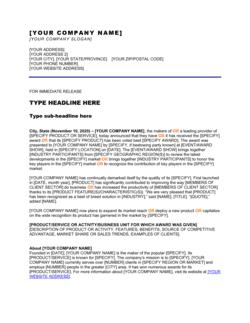
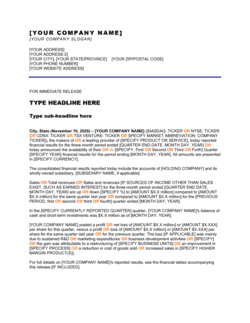
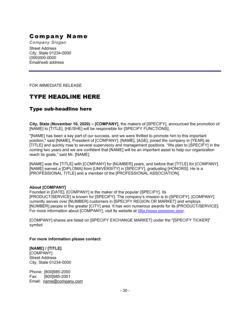
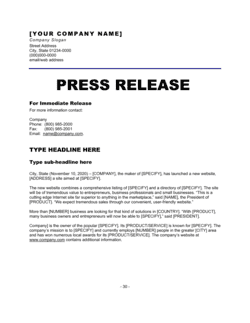
- Standard 'About the Company' paragraphs at the end of a press release that describe each legacy company for journalists and investors unfamiliar with the transaction.
- Newswire
- A commercial distribution service — such as PR Newswire or BusinessWire — that distributes press releases simultaneously to thousands of media outlets and financial terminals.
- Safe Harbor
- A legal provision — codified in the Private Securities Litigation Reform Act in the US — that limits liability for forward-looking statements made in good faith with appropriate cautionary language.
- Regulatory Approval
- Clearance from antitrust or competition authorities — such as the FTC, DOJ, or European Commission — confirming the merger does not substantially lessen competition.
- Hart-Scott-Rodino (HSR) Filing
- A pre-merger notification required in the US for transactions above specified thresholds, allowing the FTC and DOJ to review antitrust implications before closing.
- Consideration
- The payment or exchange made to shareholders of the acquired company — cash, stock, a combination, or other assets — in return for their shares.
- Material Information
- Any fact a reasonable investor would consider significant in making an investment decision — public companies are legally required to disclose material information promptly.
- Embargo
- A pre-agreed time restriction placed on a press release sent to journalists in advance, prohibiting publication until a specified date and time.