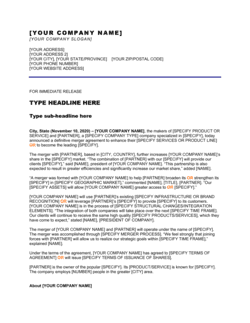
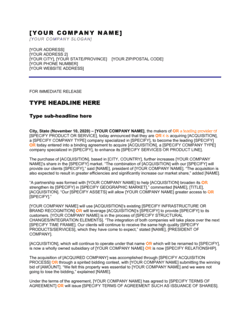
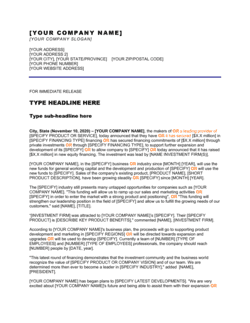
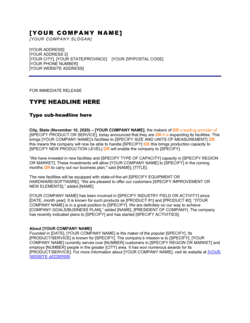
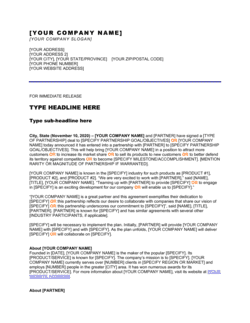
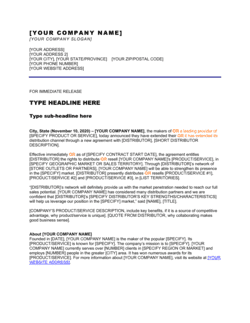
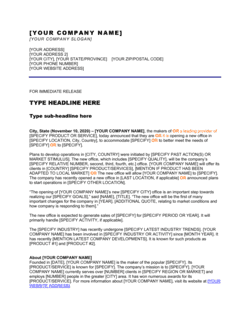
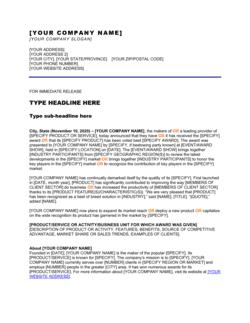
Press Release Company Has Reached a Milestone Template

Free Word download • Edit online • Save & share with Drive • Export to PDF

2 pages20–30 min to fillDifficulty: StandardSignature requiredLegal review recommended
Learn more ↓
FreePress Release Company Has Reached a Milestone Template

At a glance

What it is
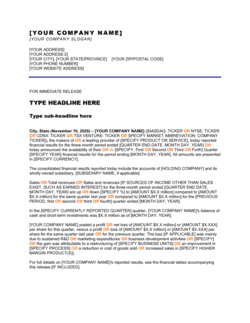
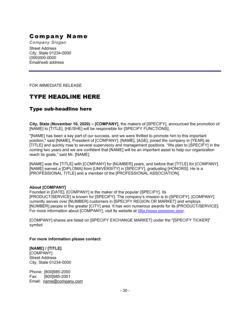
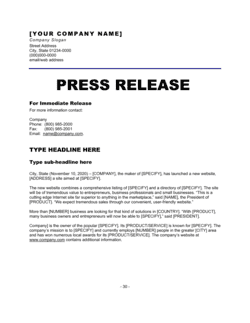
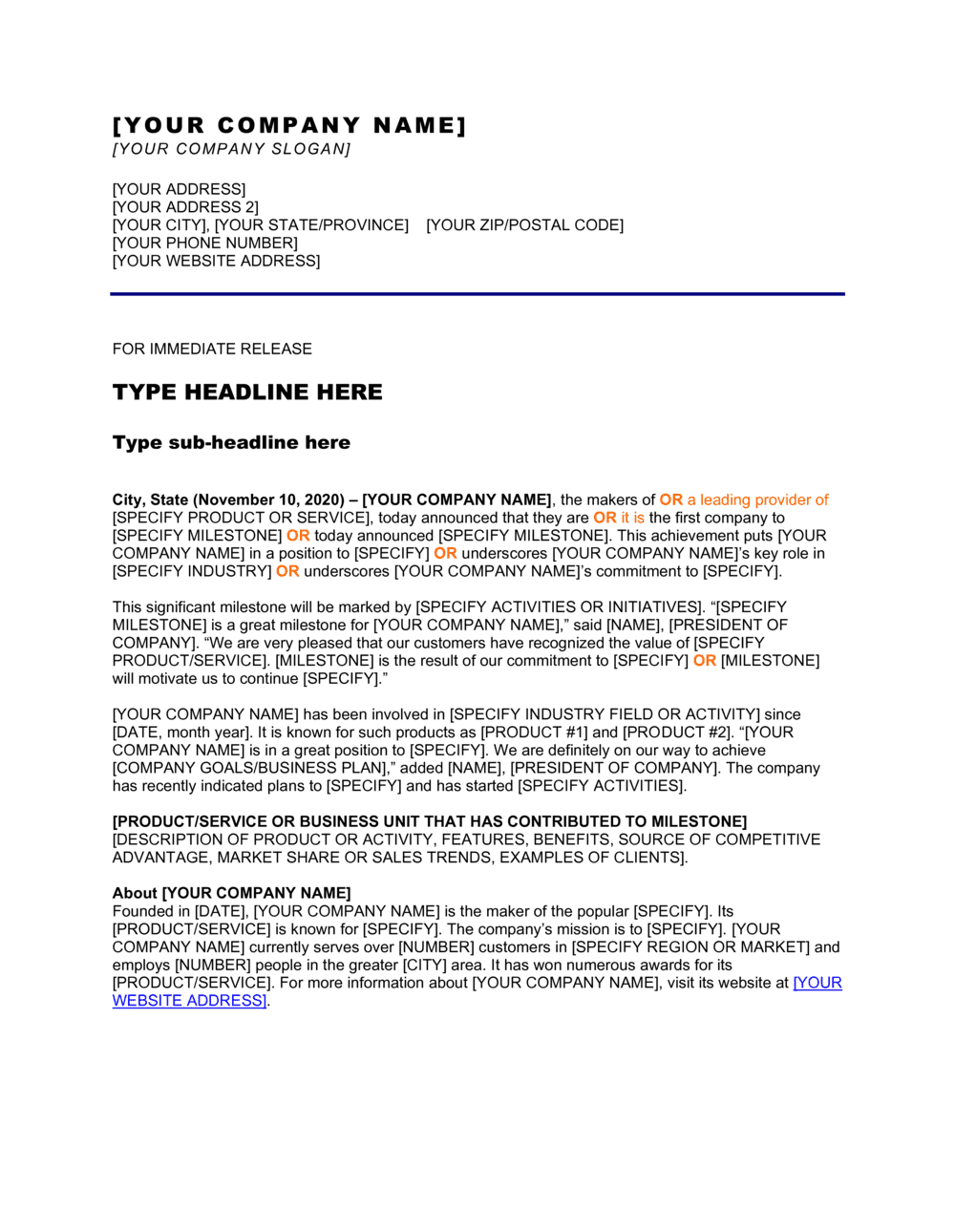
A Press Release — Company Has Reached a Milestone is a structured public announcement document used to communicate a significant business achievement to media, investors, partners, and the public. This free Word download gives you a professional, ready-to-distribute template covering headline, dateline, lead paragraph, supporting quotes, milestone details, and boilerplate — which you can edit online and export as PDF.
When you need it
Use it whenever your company crosses a threshold that merits public attention — a revenue or customer-count milestone, a funding round close, a product launch, an industry award, or a significant operational achievement. It is also appropriate when regulatory, investor-relations, or contractual obligations require formal public disclosure of material developments.
What's inside
A structured headline and subheadline, a dateline and embargo notice, a lead paragraph summarizing the news, a body section with milestone detail and supporting data, attributed executive quotes, and a standardized boilerplate describing the company. Contact information for media follow-up and distribution instructions round out the document.

What is a Press Release — Company Has Reached a Milestone?

A Press Release — Company Has Reached a Milestone is a structured public announcement document used to communicate a verified business achievement to media outlets, investors, partners, and the general public. Unlike an internal report or a private investor update, a milestone press release is drafted for external distribution — via wire services, the company newsroom, and direct journalist outreach — and follows a standardized format that editors expect: headline, dateline, lead paragraph, supporting data, attributed executive quotes, boilerplate, and media contact. For publicly traded and pre-IPO companies, milestone releases may also carry legal obligations under securities disclosure regulations, requiring specific disclaimer language and coordinated timing with investor communications.

Why You Need This Document

A milestone without a formal announcement is an opportunity lost. Journalists, investors, and prospective customers do not track your internal metrics — a press release is the mechanism that converts a business achievement into a public signal of credibility and momentum. Without a properly structured release, your milestone may be reported inaccurately, omitted entirely, or — for regulated companies — trigger a selective disclosure violation if it reaches certain investors before the general public. A poorly drafted release with vague numbers, a buried lead, or a missing forward-looking statements disclaimer can damage media relationships, attract regulatory scrutiny, or expose the company to liability for unsubstantiated claims. This template gives you a compliant, editor-ready document that states your achievement clearly, attributes your leadership's voice correctly, and includes the legal disclaimers your stage of business requires — so the only thing between your milestone and coverage is distribution.

Which variant fits your situation?

If your situation is…Use this template
Announcing a funding round close (seed, Series A, or later)Press Release — Funding Announcement
Announcing a new product or service launchPress Release — New Product Launch
Announcing a strategic partnership or joint venturePress Release — New Partnership
Announcing the appointment of a new executive or board memberPress Release — New Hire
Announcing a merger or acquisitionPress Release — Merger or Acquisition
Announcing a company award or industry recognitionPress Release — Award or Recognition
Announcing a corporate rebrand or name changePress Release — Corporate Rebrand

Common mistakes to avoid

❌ Burying the milestone in the third paragraph

Why it matters: Editors read the first paragraph and decide whether to cover the story. A buried lead means the milestone is never reported, regardless of its significance.

Fix: State the company name and the specific milestone in the first sentence of the lead paragraph, before any background context.

❌ Omitting specific numbers from the milestone claim

Why it matters: Vague claims like 'significant growth' or 'major customer expansion' are not newsworthy. Journalists require a concrete, quotable figure to write a story.

Fix: Replace qualitative descriptors with specific metrics — '500,000 paying customers,' '$10M ARR,' or '200% year-over-year revenue growth' — with a primary source to support each.

❌ Using a general inbox as the media contact

Why it matters: Journalists operate on tight deadlines and need a named individual they can reach within the hour. A generic address signals that no one is managing media relations and reduces pickup rates.

Fix: List a specific individual by name and title, with a direct email and a mobile phone number that will be answered during business hours on the distribution date.

❌ Skipping the forward-looking statements disclaimer for pre-IPO or public companies

Why it matters: Milestone announcements often include growth projections or market position claims that qualify as forward-looking statements under securities law. Omitting the disclaimer exposes the company to regulatory scrutiny.

Fix: Add the standard safe-harbor disclaimer and have counsel review it before the release is distributed through any public channel, including the company website.

❌ Publishing a third-party quote without written approval

Why it matters: A customer, investor, or partner whose words appear in a press release without approval may demand a retraction, issue a correction, or escalate the matter legally.

Fix: Obtain written email approval from every named third party before distribution. Keep the approval on file with the archived release.

❌ Distributing without updating the boilerplate

Why it matters: A boilerplate with a stale headcount, old product description, or incorrect website URL contradicts the milestone being announced and signals poor internal coordination to editors.

Fix: Treat the boilerplate as a living document. Review and update it against current company materials before every distribution.

The 10 key clauses, explained

Headline and subheadline

In plain language: The title of the announcement, written in active voice under 100 characters, plus an optional second line providing supporting context.

Sample language
[COMPANY NAME] Surpasses [MILESTONE — e.g., 1 Million Customers] Globally | Company Reaches Landmark in Under [X] Years, Driven by [KEY DRIVER]

Common mistake: Writing the headline in passive voice or using internal jargon. Editors discard releases with unclear or passive headlines before reading further.

Embargo notice

In plain language: An optional line at the top of the release instructing recipients not to publish before a specified date and time, used when coordinating coverage across multiple outlets.

Sample language
FOR IMMEDIATE RELEASE | — OR — | EMBARGOED UNTIL [DATE] AT [TIME] [TIMEZONE]

Common mistake: Omitting the embargo notice when coordinating pre-briefed coverage. Without it, one outlet may publish early, forcing you to lift the embargo prematurely for all others.

Dateline and lead paragraph

In plain language: The city of origin and release date, followed by a single opening paragraph that answers who, what, when, where, and why — the most important 40–60 words of the release.

Sample language
[CITY], [DATE] — [COMPANY NAME], a leading [DESCRIPTION], today announced that it has reached [MILESTONE], marking a significant achievement in [CONTEXT OR INDUSTRY].

Common mistake: Burying the milestone in the third paragraph. If the achievement is not stated in the first sentence, most editors stop reading and most wire-service search algorithms miss the story.

Milestone detail and supporting data

In plain language: The body paragraphs that explain the milestone with specific numbers, timeframes, and context — what was achieved, how long it took, and what it signifies for the company and its stakeholders.

Sample language
[COMPANY NAME] reached [MILESTONE METRIC] on [DATE], representing a [X]% increase over the prior period. This achievement positions the company as [MARKET CONTEXT], with [SUPPORTING STATISTIC] demonstrating sustained momentum.

Common mistake: Stating a milestone without a comparator. '1 million users' means little without context — when the company launched, how long it took, or how it compares to an industry benchmark.

Executive quote

In plain language: An attributed statement from the CEO or another named executive adding strategic perspective on the milestone — the only section editors are permitted to reproduce verbatim without paraphrasing.

Sample language
'[MILESTONE] reflects the trust our customers place in us every day,' said [NAME], [TITLE] of [COMPANY NAME]. 'We are proud to reach this mark and remain committed to [FORWARD-LOOKING STATEMENT].'

Common mistake: Writing a quote that sounds like marketing copy rather than something a person would actually say. Editors flag unnatural quotes and paraphrase them, removing your ability to control the message.

Customer or partner validation quote

In plain language: An optional second attributed quote from a customer, investor, or partner that provides third-party credibility for the milestone claim.

Sample language
'[COMPANY NAME]'s achievement of [MILESTONE] aligns with what we have observed firsthand,' said [NAME], [TITLE] at [THIRD-PARTY ORGANIZATION]. '[SPECIFIC ENDORSEMENT STATEMENT].'

Common mistake: Including a validation quote without securing written approval from the third party before distribution. Publishing an attributed quote without permission can damage the relationship and expose the company to a correction demand.

Company background and context

In plain language: One to two paragraphs providing context for readers unfamiliar with the company — what it does, who it serves, when it was founded, and why the milestone matters in its market.

Sample language
Founded in [YEAR], [COMPANY NAME] is a [DESCRIPTION] serving [TARGET MARKET]. The company's [PRODUCT / SERVICE] enables [CUSTOMER OUTCOME], and the [MILESTONE] announcement marks the [X]th major milestone in the company's [X]-year history.

Common mistake: Repeating the boilerplate text in the body of the release. The boilerplate section at the end already carries this information — duplication makes the release feel padded and wastes editorial word count.

Forward-looking statements disclaimer

In plain language: For publicly traded or pre-IPO companies, a standard legal paragraph clarifying that statements about future performance are projections, not guarantees, and are subject to risk and uncertainty.

Sample language
This press release contains forward-looking statements within the meaning of [APPLICABLE LAW]. These statements are subject to risks and uncertainties that could cause actual results to differ materially. [COMPANY NAME] undertakes no obligation to update these statements.

Common mistake: Omitting the forward-looking statements disclaimer entirely for companies approaching an IPO or with public investors. Regulators in the US, UK, and Canada treat certain milestone claims as forward-looking representations — omission can trigger securities compliance issues.

Boilerplate (About [Company Name])

In plain language: A standardized 3–5 sentence company description placed after '###', used by editors as background when writing their own coverage.

Sample language
About [COMPANY NAME]: [COMPANY NAME] is a [DESCRIPTION] headquartered in [CITY]. Founded in [YEAR], the company serves [TARGET CUSTOMER] through [PRODUCT / SERVICE]. For more information, visit [WEBSITE URL].

Common mistake: Updating the body of the release but forgetting to update the boilerplate, leaving stale founding year, headcount, or website information that contradicts the announcement.

Media contact block

In plain language: The name, title, email, and phone number of the person journalists should contact for follow-up questions, interview requests, or photography.

Sample language
Media Contact: [NAME] | [TITLE] | [COMPANY NAME] | [EMAIL ADDRESS] | [PHONE NUMBER]

Common mistake: Listing a general company email instead of a named individual. Journalists need a specific person to pitch — generic addresses reduce response rates and signal that the company is not prepared for media engagement.

How to fill it out

  1. 1

    Decide on the milestone and verify the data

    Identify the specific achievement you are announcing — customer count, revenue figure, funding amount, or operational benchmark. Confirm the number from a primary source (CRM, financial statement, or board-approved metric) before drafting.

    💡 A milestone that cannot be defended with a primary data source should not be announced publicly — journalist fact-checking requests are routine.

  2. 2

    Set the embargo status and release date

    Choose 'For Immediate Release' if distributing to wire services without pre-briefing. Set a specific embargo date and time if you are pre-briefing select journalists or coordinating with a partner announcement.

    💡 Embargo times should be set for 9:00 AM in the target market's primary timezone — Eastern Time for North American distribution, GMT for UK and EU.

  3. 3

    Write the headline in active voice

    Draft a headline under 100 characters that states the company name, the milestone, and the significance. Avoid superlatives and jargon — write for a journalist who knows nothing about your company.

    💡 Test the headline by reading it aloud. If it sounds like an ad, rewrite it to sound like a news story.

  4. 4

    Draft the lead paragraph answering who, what, when, where, and why

    State the company name, the milestone achieved, the date it was reached, and why it matters — all in 40–60 words. Every subsequent paragraph expands on this sentence.

    💡 If you cut everything after the lead paragraph, it should still constitute a complete, publishable story. If it does not, revise the lead.

  5. 5

    Add supporting data and comparators

    Include at least two data points that contextualize the milestone — a year-over-year growth rate, a time-to-milestone figure, or an industry benchmark comparison. Cite the source for any third-party statistic.

    💡 Third-party data from a named analyst firm (Gartner, IDC, Statista) is treated as more credible than company-generated statistics and is more likely to be reproduced in coverage.

  6. 6

    Write and attribute the executive quote

    Draft a quote for the CEO or relevant executive that provides strategic context — why this milestone matters and what comes next. Get written sign-off from the quoted individual before distributing.

    💡 Quotes in press releases are legally attributed statements. Ensure the quoted executive has reviewed and approved the exact wording, not just the general sentiment.

  7. 7

    Complete the boilerplate and media contact block

    Update the company boilerplate with current statistics (founding year, headcount, product description, website). Add a named media contact with a direct email and phone number.

    💡 Review the boilerplate against the company's most recent investor materials to ensure all figures are current and consistent.

  8. 8

    Add the forward-looking statements disclaimer if required

    For publicly traded companies, pre-IPO companies, or any release mentioning future revenue, customer growth, or product roadmap, add the standard forward-looking statements disclaimer after the boilerplate.

    💡 Have your general counsel or investor-relations counsel review the disclaimer language before the first use — a template disclaimer may not match your jurisdiction's specific securities law requirements.

Frequently asked questions

What is a milestone press release?

A milestone press release is a formal public announcement that a company has reached a significant business achievement — such as a revenue threshold, customer count, funding total, or operational benchmark. It is distributed to media, posted on the company newsroom, and often filed on wire services to generate earned coverage and signal credibility to investors, partners, and prospective customers.

When should a company issue a milestone press release?

Issue one when the milestone is specific, verifiable, and meaningful to an external audience — not just internally significant. Common triggers include crossing 100K, 500K, or 1M customers; reaching $1M, $10M, or $100M in revenue; closing a funding round; completing a major product rollout; or receiving a significant industry award. Regulatory or investor-relations obligations may also require disclosure of material milestones.

Does a press release need to be signed?

A standard press release does not require a wet signature to be distributed, but the executive quote within it constitutes a legally attributed statement and must be reviewed and approved in writing by the quoted individual before publication. For publicly traded or pre-IPO companies, certain milestone releases may require sign-off from the general counsel or investor-relations officer before distribution as part of securities compliance procedures.

What is the difference between a press release and a media statement?

A press release is a proactive announcement distributed broadly to generate coverage — it follows a structured format with a headline, lead, body, boilerplate, and media contact. A media statement is a reactive document issued in response to a journalist inquiry or breaking story, typically shorter and without the full press-release structure. Milestone announcements are always press releases, not statements.

How long should a milestone press release be?

The standard length is 400–600 words — roughly one page. Wire services and editors expect concise, scannable releases. Longer releases lose reader attention and reduce the likelihood of verbatim reproduction. Supporting materials (financial tables, additional executive bios, high-resolution images) should be offered as attachments or linked from a digital newsroom, not embedded in the release body.

What is an embargo and how does it work in a press release?

An embargo is an agreement between the issuing company and a journalist or outlet to hold the story until a specified date and time. It is used to pre-brief journalists who need time to write a story before the news goes live. The embargo notice must appear at the very top of the release, and the company should obtain verbal or written confirmation from each pre-briefed journalist that they accept the embargo terms before sharing the document.

Do I need a PR agency to distribute a press release?

No. A well-drafted template can be distributed directly via wire services such as PR Newswire, Business Wire, or GlobeNewswire for a flat per-release fee, typically $350–$1,500 depending on distribution breadth. A PR agency adds value when your target is a specific tier-one journalist, when the milestone requires coordinated pre-briefing across multiple outlets, or when the announcement is part of a broader campaign requiring media follow-up and relationship management.

What makes a milestone press release credible to journalists?

Three factors determine credibility: a specific, verifiable number (not a range or a vague descriptor), a named primary source or methodology for the metric, and a named executive quote that provides strategic context rather than marketing language. Releases that include a third-party validation quote — from an investor, customer, or analyst — are consistently treated as more credible and generate higher pickup rates than single-source releases.

How this compares to alternatives

vs Press Release — New Partnership

A new partnership press release announces a relationship between two organizations and requires coordinated approval and quotes from both parties. A milestone release is issued unilaterally by a single company and does not require counterparty sign-off, though it may include an optional third-party endorsement quote.

vs Press Release — New Hire

A new-hire press release focuses on a specific individual joining the company and leads with their background and role. A milestone release focuses on a company-level achievement and leads with a metric. New-hire releases rarely require a forward-looking statements disclaimer; milestone releases often do for regulated companies.

vs Media Statement

A media statement is a short reactive document issued in response to a journalist inquiry or external event. It does not follow the full press-release format and is not proactively distributed. A milestone press release is proactive, structured, and distributed to generate coverage — not to respond to it.

vs Investor Update Letter

An investor update letter is a private communication sent to existing shareholders providing operational and financial updates, including milestones. A milestone press release is a public document intended for media distribution and general audience consumption. For regulated companies, material milestones must be disclosed publicly before or simultaneously with investor communications to avoid selective disclosure violations.

Industry-specific considerations

Technology / SaaS

MRR, ARR, or customer-count milestones that demonstrate product-market fit and support fundraising narratives with investors and press.

Financial Services

Regulatory disclosure requirements for material milestones, forward-looking statements obligations, and investor-relations compliance are critical in this sector.

Retail / E-commerce

Order volume, GMV, or loyalty program enrollment milestones timed to seasonal peaks or platform launches to maximize media relevance.

Healthcare / MedTech

Clinical trial enrollment, FDA clearance, or patient milestone announcements require careful legal review to avoid unsubstantiated efficacy claims.

Professional Services

Years in business, client count, or revenue milestones used to signal stability and growth to prospective enterprise clients and referral partners.

Manufacturing

Production volume, facility expansion, or export market milestones used to attract supply-chain partners, government incentives, and trade press coverage.

Jurisdictional notes

United States

Publicly traded US companies must comply with SEC Regulation FD, which prohibits selective disclosure of material milestones to select investors before public release. Forward-looking statements are protected under the Private Securities Litigation Reform Act only if accompanied by meaningful cautionary language. The FTC also monitors milestone claims for deceptive advertising compliance.

Canada

Canadian securities law, administered by provincial regulators including the OSC and AMF, requires timely public disclosure of material information. Companies listed on the TSX or TSXV must issue press releases for material milestones under continuous disclosure obligations. Quebec-based companies or those targeting Quebec media should consider bilingual (French and English) distribution under the Charter of the French Language.

United Kingdom

Companies listed on the London Stock Exchange or AIM must disclose material milestones via a Regulatory Information Service (RIS) under FCA Disclosure Guidance and Transparency Rules. Private companies face fewer mandatory disclosure requirements but should ensure milestone statistics comply with the UK Advertising Standards Authority's substantiation rules for promotional claims.

European Union

EU Market Abuse Regulation (MAR) requires listed companies to disclose inside information as soon as possible, and a milestone qualifying as inside information must be released via an approved publication mechanism. GDPR considerations apply if the release includes personal data about employees, customers, or partners — including named quotes that could constitute personal data in some contexts.

Template vs lawyer — what fits your deal?

PathBest forCostTime
Use the templatePrivate companies announcing operational or growth milestones for earned media and brand awarenessFree1–2 hours to draft and approve
Template + legal reviewPre-IPO companies, companies with public investors, or releases containing financial projections or market share claims$200–$500 for a general counsel or PR counsel review1–2 business days
Custom draftedPublicly traded companies, releases tied to M&A activity, or announcements subject to SEC, FCA, or securities commission filing requirements$1,000–$5,000+ for securities counsel and IR firm involvement3–10 business days

Glossary

Headline
The primary title of the press release, written in active voice to immediately communicate the news and attract editor attention.
Dateline
The city and date at the start of the lead paragraph indicating where and when the news originates — e.g., 'NEW YORK, May 2, 2026'.
Embargo
A mutually agreed restriction preventing the media from publishing the release before a specified date and time.
Lead Paragraph
The opening paragraph of a press release that answers who, what, when, where, and why — the most important sentences in the document.
Boilerplate
A standardized company description paragraph placed at the end of every press release, providing background on the issuing organization.
###
Three hash symbols centered at the end of a press release body, indicating the end of the release content to editors and wire services.
Wire Service
A distribution platform — such as PR Newswire, Business Wire, or GlobeNewswire — that syndicates press releases to newsrooms and financial terminals simultaneously.
Media Contact
The named individual and contact details at the end of the release whom journalists should reach for comment, interviews, or clarifications.
Attribution
Crediting a specific named individual and their title when reproducing a quote from the press release, making it permissible for media to publish.
Subheadline
A secondary line beneath the headline that provides additional context or a key supporting detail, typically used on wire-distributed releases.
Material Information
For publicly traded or pre-IPO companies, information significant enough that a reasonable investor would consider it relevant to a trading decision — subject to disclosure timing rules.

Part of your Business Operating System

This document is one of 3,000+ business & legal templates included in Business in a Box.

  • Fill-in-the-blanks — ready in minutes
  • 100% customizable Word document
  • Compatible with all office suites
  • Export to PDF and share electronically

Create your document in 3 simple steps.

From template to signed document — all inside one Business Operating System.
1
Download or open template

Access over 3,000+ business and legal templates for any business task, project or initiative.

2
Edit and fill in the blanks with AI

Customize your ready-made business document template and save it in the cloud.

3
Save, Share, Send, Sign

Share your files and folders with your team. Create a space of seamless collaboration.

Save time, save money, and create top-quality documents.

★★★★★

"Fantastic value! I'm not sure how I'd do without it. It's worth its weight in gold and paid back for itself many times."

Managing Director · Mall Farm
Robert Whalley
Managing Director, Mall Farm Proprietary Limited
★★★★★

"I have been using Business in a Box for years. It has been the most useful source of templates I have encountered. I recommend it to anyone."

Business Owner · 4+ years
Dr Michael John Freestone
Business Owner
★★★★★

"It has been a life saver so many times I have lost count. Business in a Box has saved me so much time and as you know, time is money."

Owner · Upstate Web
David G. Moore Jr.
Owner, Upstate Web

Run your business with a system — not scattered tools

Stop downloading documents. Start operating with clarity. Business in a Box gives you the Business Operating System used by over 250,000 companies worldwide to structure, run, and grow their business.

Start free · No credit card required