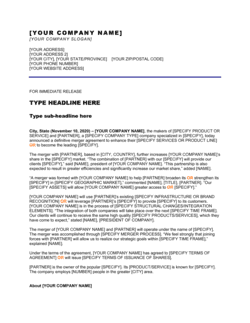
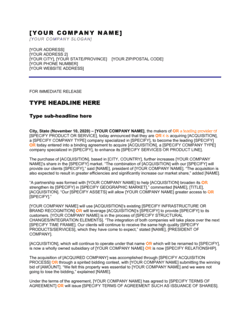
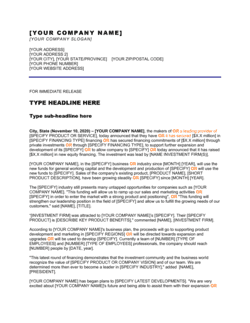
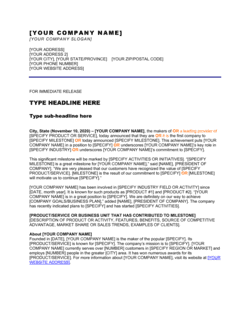
Press Release Company Reports Quarter Results Template

Free Word download • Edit online • Save & share with Drive • Export to PDF

2 pages20–30 min to fillDifficulty: StandardLegal review recommended
Learn more ↓
FreePress Release Company Reports Quarter Results Template

At a glance

What it is
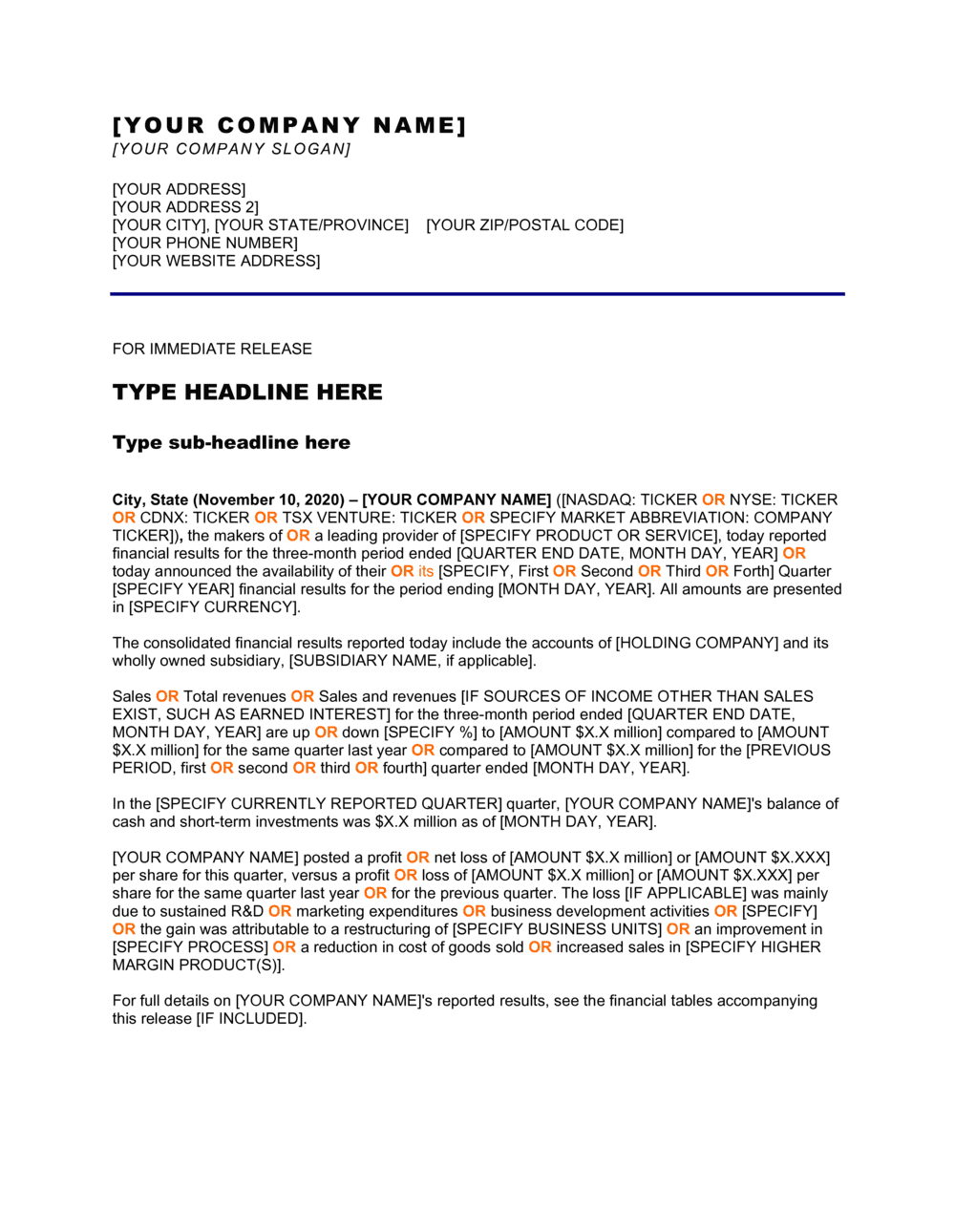
A Quarterly Earnings Press Release is a structured public announcement that a company issues to communicate its financial results for a completed fiscal quarter — revenue, net income, earnings per share, and key operational metrics — alongside management commentary and outlook. This free Word download gives you a complete, investor-relations-ready template you can edit online and export as PDF for immediate distribution.
When you need it
Issue it within 24–48 hours of your board approving quarterly financials, or whenever your investor relations calendar, stock exchange listing rules, or voluntary disclosure policy calls for a public earnings update. Private companies use it to update institutional investors, lenders, or board members.
What's inside
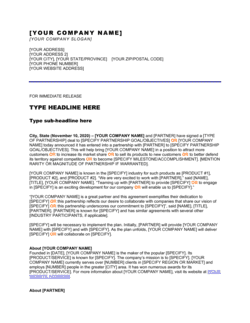
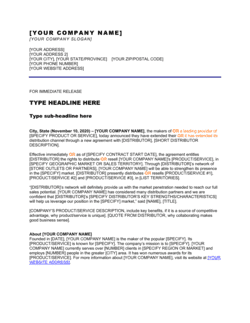
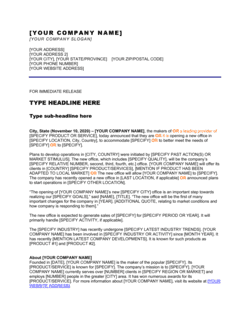
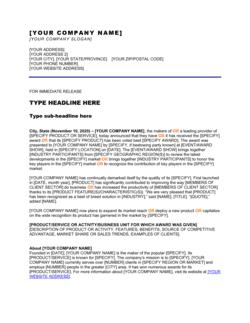
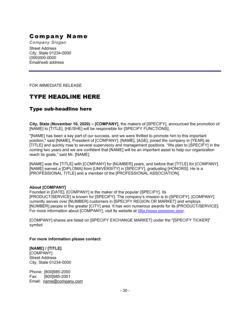
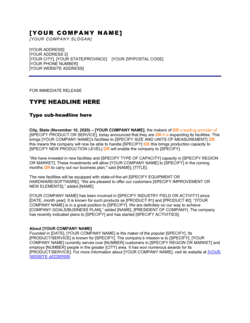
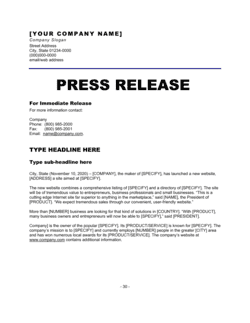
Headline with financial highlight, company dateline, financial summary table, CEO and CFO management quotes, segment or product-line breakdown, forward-looking guidance, safe-harbor disclaimer, and boilerplate company description with investor contact details.

What is a Press Release — Company Reports Quarter Results?

A Quarterly Earnings Press Release is a structured public announcement a company issues to disclose its financial results for a completed fiscal quarter — typically covering revenue, gross margin, net income, earnings per share, and key operational metrics alongside management commentary on performance drivers and forward-looking guidance. Unlike an internal financial report, this document is written for an external audience of investors, analysts, and financial journalists, formatted to meet wire service distribution standards and regulatory disclosure requirements. The release functions simultaneously as a legal disclosure document, a media relations tool, and a signal to capital markets about the health and trajectory of the business.

Why You Need This Document

A missing or poorly constructed earnings press release creates immediate and measurable consequences. Public companies that fail to issue timely results face stock exchange queries, analyst downgrades for poor IR practice, and potential regulatory action under continuous disclosure rules. Private companies that skip quarterly updates lose institutional investor confidence at exactly the moment they may need to return to those same investors for a follow-on round or credit facility. Beyond compliance, a well-crafted quarterly release shapes the narrative — it determines whether a quarter that missed on revenue but beat on margin is reported as a disappointment or a disciplined execution story. This template gives you the complete structural framework: financial tables, management quote blocks, segment breakdowns, guidance language, safe harbor disclaimer, and non-GAAP reconciliation — so your team can focus on the content rather than the format.

Which variant fits your situation?

If your situation is…Use this template
Announcing annual full-year results instead of a single quarterAnnual Results Press Release
Reporting a revenue milestone or record quarter without full financialsBusiness Milestone Press Release
Issuing a profit warning or downward earnings revisionEarnings Guidance Revision Press Release
Reporting results alongside a major acquisition or mergerMerger and Acquisition Announcement Press Release
Updating investors on operational KPIs without GAAP financialsBusiness Update Press Release
Releasing preliminary unaudited results ahead of full earningsPreliminary Results Announcement
Publishing results for a nonprofit or government-funded entityNonprofit Financial Update Press Release

Common mistakes to avoid

❌ Publishing non-GAAP metrics without a reconciliation table

Why it matters: The SEC requires a prominent reconciliation whenever non-GAAP measures are presented in an earnings release. For public companies, omitting it can trigger an SEC comment letter; for private companies, it erodes investor trust.

Fix: Include a clearly labeled reconciliation table for every non-GAAP metric — adjusted EBITDA, non-GAAP EPS, free cash flow — showing each add-back line item with current and prior-period comparisons.

❌ Using a generic safe harbor boilerplate not tied to actual filings

Why it matters: A safe harbor that references Form 10-K for a company that files Form 20-F, or references no specific document at all, provides weak legal protection and signals sloppy IR practice to sophisticated investors.

Fix: Tailor the safe harbor to reference the exact annual report, prospectus, or regulatory filing where the company's risk factors are disclosed, and update it every time that filing changes.

❌ Omitting year-over-year comparisons for every key metric

Why it matters: Absolute dollar figures without growth context are nearly meaningless to analysts and journalists building year-over-year performance stories. A release with no comparables forces extra work and increases the risk of misreporting.

Fix: For every financial metric in the highlights table, include the prior-year comparable figure and the percentage change — both in the summary table and in the body text.

❌ Issuing the release before the financial statements are finalized

Why it matters: Releasing preliminary figures that are later restated in the actual financial filing creates material discrepancies, triggers regulatory scrutiny, and destroys market credibility — sometimes irreparably.

Fix: Implement a formal sign-off checklist requiring CFO and audit committee approval of all figures in the press release before the embargo lifts or wire distribution is authorized.

❌ Writing management quotes with no specific data or strategic content

Why it matters: Quotes like 'We are pleased with our strong performance' are edited out of media coverage and ignored by analysts. They reduce the release's earned-media yield to near zero.

Fix: Every management quote must contain at least one specific financial figure or a concrete forward-looking strategic commitment — something that would be newsworthy on its own if extracted from the release.

❌ Failing to update the boilerplate company description after major changes

Why it matters: A boilerplate describing a company as operating in two markets when it now operates in twelve, or citing an employee count that is three years out of date, signals to institutional investors that the IR function is not actively managed.

Fix: Review and update the boilerplate company description at the start of every fiscal year and immediately following any major acquisition, divestiture, or business-model change.

The 10 key clauses, explained

Headline and subheadline

In plain language: A single declarative sentence naming the company, the period, and the most significant financial result — followed by a subheadline with the second most important metric.

Sample language
[COMPANY NAME] Reports [FISCAL QUARTER AND YEAR] Results with Revenue of $[X]M, Up [X]% Year Over Year — Net Income of $[X]M; Raises Full-Year Guidance

Common mistake: Leading with a vague headline like 'Company Announces Financial Results.' Omitting the key number forces journalists to read the entire release before knowing whether the story is newsworthy — reducing pickup rates.

Dateline and embargo notice

In plain language: The city of origin and release date, plus an embargo timestamp if the release is distributed to media before public disclosure.

Sample language
[CITY], [STATE] — [FULL DATE] — [COMPANY NAME] (NASDAQ/NYSE: [TICKER]) today reported financial results for the [FIRST/SECOND/THIRD/FOURTH] quarter ended [DATE].

Common mistake: Omitting the ticker symbol or exchange for publicly listed companies. Wire services and financial databases use ticker references to auto-tag releases to the correct security.

Financial highlights summary

In plain language: A bulleted or tabular summary of the four to six most important financial metrics for the quarter — revenue, gross profit, operating income, net income, EPS, and free cash flow — with year-over-year comparisons.

Sample language
Revenue: $[X]M (+[X]% YoY) | Gross Margin: [X]% ([X] bps expansion) | Operating Income: $[X]M | GAAP EPS: $[X.XX] | Non-GAAP EPS: $[X.XX] | Free Cash Flow: $[X]M

Common mistake: Presenting only non-GAAP figures without the GAAP equivalent. Regulators, analysts, and journalists expect a reconciliation to GAAP; omitting it invites scrutiny and, for public companies, potential SEC comment letters.

CEO management quote

In plain language: An attributed statement from the CEO that provides strategic context for the financial results — what drove performance, what the quarter signals about the business, and what the company is focused on next.

Sample language
'[COMPANY NAME] delivered strong [QUARTER] results, with revenue growth of [X]% driven by [KEY DRIVER],' said [CEO NAME], Chief Executive Officer. 'We enter [NEXT QUARTER/YEAR] with [STRATEGIC PRIORITY] and remain confident in our [FULL-YEAR/LONG-TERM] outlook.'

Common mistake: Writing a generic quote that could apply to any company in any quarter. Quotes with no specific data point or strategic insight are routinely cut by editors — defeating the purpose of including them.

CFO management quote

In plain language: An attributed statement from the CFO focusing on margin performance, cash generation, balance sheet strength, or capital allocation decisions for the quarter.

Sample language
'Our [X]% gross margin expansion reflects [SPECIFIC DRIVER], and we generated $[X]M in free cash flow during the quarter,' said [CFO NAME], Chief Financial Officer. 'We ended [QUARTER] with $[X]M in cash and no debt, providing [STRATEGIC FLEXIBILITY].'

Common mistake: Combining CEO and CFO commentary into one quote. Separate quotes signal organized leadership and give financial journalists two attributed sources — increasing the likelihood of each being used in coverage.

Business segment or product line results

In plain language: Revenue, growth rates, and key operational metrics broken out by segment, geography, or product line — the detail beneath the consolidated headline numbers.

Sample language
[SEGMENT A]: Revenue $[X]M (+[X]% YoY), [X]% of total revenue. [SEGMENT B]: Revenue $[X]M (+[X]% YoY). Key metric: [METRIC NAME] reached [X], up [X]% from [COMPARABLE PERIOD].

Common mistake: Reporting only consolidated results for companies with multiple material segments. Analysts model each segment separately — a release that hides segment-level detail generates follow-up questions that consume IR bandwidth.

Financial outlook and guidance

In plain language: Management's forward-looking forecast for the next quarter and full fiscal year, expressed as specific ranges for revenue, EPS, or operating margin.

Sample language
For [NEXT QUARTER], the Company expects revenue in the range of $[X]M to $[X]M and non-GAAP EPS of $[X.XX] to $[X.XX]. For [FULL FISCAL YEAR], the Company raises its revenue outlook to $[X]M–$[X]M from the prior range of $[X]M–$[X]M.

Common mistake: Providing guidance ranges so wide they convey no useful information. A $50M revenue range on a $200M company signals management has limited visibility — which itself becomes the story.

Safe harbor and forward-looking statements disclaimer

In plain language: A mandatory legal paragraph stating that any projections, estimates, or non-historical statements are forward-looking and subject to risks and uncertainties, with a reference to the company's most recent SEC filings or risk disclosure documents.

Sample language
This press release contains forward-looking statements within the meaning of Section 27A of the Securities Act of 1933 and Section 21E of the Securities Exchange Act of 1934. These statements involve known and unknown risks, uncertainties, and other factors that may cause actual results to differ materially. Please refer to [COMPANY NAME]'s most recent [ANNUAL REPORT / FORM 20-F / INFORMATION CIRCULAR] for a description of these risks.

Common mistake: Using a safe harbor boilerplate that references SEC filings for a company that is not SEC-registered. Private companies and non-US issuers must adapt the disclaimer to reference their actual disclosure documents and applicable regulatory framework.

Non-GAAP reconciliation table

In plain language: A table reconciling each non-GAAP financial measure used in the release back to its closest GAAP equivalent, line by line, for both the current quarter and the comparable prior-year period.

Sample language
GAAP Net Income: $[X]M | Add: Stock-Based Compensation: $[X]M | Add: Amortization of Acquired Intangibles: $[X]M | Less: Tax Effect of Non-GAAP Adjustments: ($[X]M) | Non-GAAP Net Income: $[X]M

Common mistake: Placing the reconciliation table as a footnote in small print or omitting it entirely. The SEC and equivalent regulators in Canada and the UK require a prominent, equally visible reconciliation whenever non-GAAP measures are presented.

Boilerplate company description and investor contact

In plain language: A standard two-to-three sentence description of the company used in every press release, followed by the name, phone number, and email address of the investor relations contact.

Sample language
About [COMPANY NAME]: [COMPANY NAME] is a [DESCRIPTION OF BUSINESS], serving [CUSTOMER BASE] across [GEOGRAPHIES]. For more information, visit [WEBSITE]. Investor Contact: [NAME] | [TITLE] | [EMAIL] | [PHONE]

Common mistake: Using an outdated boilerplate that no longer reflects the company's current business or scale. A boilerplate that still describes a company as a 'startup' three years after its IPO undermines credibility with institutional investors.

How to fill it out

  1. 1

    Lock the financial data before drafting

    Obtain board-approved or audit-committee-reviewed financial figures before inserting any numbers. Every figure in the release — revenue, EPS, segment results — must match the financial statements being filed concurrently.

    💡 Create a single source-of-truth spreadsheet that feeds directly into all placeholder values in the template to eliminate manual transcription errors.

  2. 2

    Write the headline around your strongest metric

    Identify the single most impressive or newsworthy financial result — typically revenue growth or EPS beat — and build the headline around it. The subheadline carries the second most important data point.

    💡 Test the headline on someone outside finance. If they can tell you in one sentence what the quarter's story is, the headline works.

  3. 3

    Complete the financial highlights summary table

    Insert current-quarter and year-ago figures for all six standard metrics: revenue, gross profit, operating income, net income, GAAP EPS, and non-GAAP EPS. Calculate year-over-year growth percentages for each.

    💡 Include basis-point language for margins ('gross margin expanded 120 bps to 68.4%') — analysts track margin trends as closely as absolute figures.

  4. 4

    Draft the CEO and CFO quotes

    Write the CEO quote around strategic narrative — what the quarter proves about the business model or market position. Write the CFO quote around financial discipline — margins, cash, capital allocation. Each quote should contain at least one specific number.

    💡 Send quotes to the named executives for approval before the release is distributed. Executives who disown their own quotes create credibility problems with the press.

  5. 5

    Break out segment and product-line results

    For each reportable segment, insert revenue, growth rate, and the most relevant operational metric (ARR, units shipped, active users). Match segment definitions to those used in your most recent annual filing.

    💡 Never introduce a new segment definition mid-year in a press release without explaining the change — analysts who have built models on the prior structure will immediately flag the discrepancy.

  6. 6

    Enter guidance ranges with supporting assumptions

    Insert next-quarter and full-year guidance ranges for revenue and EPS. In the body of the release, briefly note the two or three key assumptions underpinning the guidance — currency rates, new product contribution, seasonal patterns.

    💡 Guidance ranges narrower than 3–4% of midpoint signal high confidence; ranges wider than 8–10% of midpoint signal low visibility and will attract analyst questions on the earnings call.

  7. 7

    Insert the safe harbor disclaimer and adapt it to your jurisdiction

    Replace generic SEC references with the correct regulatory filings for your exchange and jurisdiction. For Canadian issuers, reference NI 51-102; for UK issuers, the UK MAR and FCA Disclosure Guidance.

    💡 Have legal counsel review the safe harbor language annually — the list of risk factors it references should mirror the current risk section of your most recent annual report.

  8. 8

    Build the non-GAAP reconciliation table and update the boilerplate

    Complete the reconciliation table for every non-GAAP metric cited in the release. Then update the boilerplate company description to reflect current business scope, headcount, or geographic footprint.

    💡 Reconciliation tables are frequently scraped by financial data vendors — use consistent line-item labels across every quarterly release to ensure accurate automated data extraction.

Frequently asked questions

What is a quarterly earnings press release?

A quarterly earnings press release is a formal public announcement a company issues to disclose its financial results for a completed fiscal quarter. It typically covers revenue, net income, earnings per share, key operational metrics, and management commentary on performance and outlook. Public companies distribute it via wire services simultaneously with or just before their SEC or exchange filings; private companies use it to update institutional investors, lenders, or board members.

Are public companies legally required to issue quarterly earnings press releases?

In the United States, SEC-reporting companies are required to file quarterly financial statements on Form 10-Q, but the press release format is a market convention rather than a statutory mandate. In practice, exchange listing standards and investor expectations make quarterly earnings releases functionally required for any publicly traded company. In Canada, NI 51-102 requires quarterly disclosure; the UK's FCA and EU's Market Abuse Regulation impose their own periodic reporting obligations.

What financial metrics should a quarterly earnings press release include?

At minimum: total revenue with year-over-year growth, gross profit and gross margin, operating income or loss, GAAP net income, basic and diluted GAAP EPS, and free cash flow. Most companies also include at least one non-GAAP measure (adjusted EBITDA or non-GAAP EPS) with a full reconciliation. SaaS companies typically add ARR, net revenue retention, and customer count; retailers add comparable-store sales; manufacturers add units shipped and backlog.

What is a safe harbor statement and why is it required?

A safe harbor statement is a legal disclaimer that protects a company from shareholder litigation when forward-looking statements — guidance, projections, strategic plans — do not come true, provided the statements are clearly labeled as forward-looking and accompanied by a meaningful description of material risks. For US companies, protection is provided under the Private Securities Litigation Reform Act of 1995. Equivalent frameworks exist in Canada, the UK, and the EU. The disclaimer must reference specific risk disclosures in the company's filings to be effective.

What is the difference between GAAP and non-GAAP earnings?

GAAP earnings are calculated under standardized accounting rules — in the US, Generally Accepted Accounting Principles — and include all income statement items including stock-based compensation, depreciation, amortization of acquired intangibles, and restructuring charges. Non-GAAP earnings exclude one or more of these items to show what management believes is the underlying operating performance of the business. Both are valid — but non-GAAP figures must always be reconciled back to their GAAP equivalents in the same document.

How far in advance should a quarterly earnings press release be prepared?

Most IR teams begin drafting the template — including all sections except the financial figures — two to three weeks before the expected release date. Final figures are inserted after audit committee review, typically two to five days before distribution. The full release, including legal review of the safe harbor and non-GAAP reconciliation, should be board-approved at least 24 hours before the wire embargo lifts.

Can private companies use a quarterly earnings press release template?

Yes. Private companies with institutional investors, significant bank debt, or voluntary disclosure commitments regularly issue quarterly results press releases. The format is identical to a public-company release, but the safe harbor references internal risk summaries rather than SEC filings, and the release may be distributed directly to stakeholders rather than via a public wire service.

What is an earnings guidance range and how wide should it be?

Guidance is management's public forecast for the next quarter or full fiscal year, typically expressed as a dollar range for revenue and an EPS range. Ranges narrower than 3–5% of midpoint signal high management visibility; ranges wider than 10% signal limited confidence. Companies entering periods of significant market uncertainty sometimes withdraw guidance entirely rather than issue a range so wide it is not useful to analysts building financial models.

What should the management quotes in an earnings press release include?

The CEO quote should provide strategic context — what drove performance, what the results signal about the company's market position, and what the company is prioritizing next. The CFO quote should focus on financial discipline — margin trends, cash generation, balance sheet strength, or capital allocation. Each quote must contain at least one specific financial figure and should not be interchangeable with a quote from any other company's earnings release.

How this compares to alternatives

vs Annual Report Press Release

An annual results press release covers the full fiscal year and typically includes audited figures, annual dividend declarations, and a more expansive strategic review than a quarterly release. Quarterly releases cover a single 13-week period with unaudited or reviewed — not fully audited — figures and are issued four times per year. Use the quarterly template for Q1–Q3 and a dedicated annual template for Q4 and full-year results.

vs Business Milestone Press Release

A milestone press release announces a specific achievement — a funding round, a product launch, a customer win, or a revenue record — without the structured financial tables of an earnings release. A quarterly earnings release is required on a regular schedule and follows a standardized format tied to accounting periods. Use an earnings release for periodic financial disclosure and a milestone release for event-driven announcements.

vs Earnings Call Script

An earnings call script is the prepared remarks management delivers to analysts and investors on the live call that typically follows the press release by a few hours. The press release is the official written disclosure; the call script elaborates on it and handles Q&A. Both documents must be consistent — any figure or statement in the script that contradicts the release creates a material disclosure problem.

vs Investor Fact Sheet

An investor fact sheet is a one-to-two page evergreen summary of the company's business model, competitive position, and historical financial performance — updated quarterly but not tied to a specific reporting period. An earnings press release is period-specific, time-stamped, and distributed via wire as an official disclosure. Use both: the fact sheet for ongoing investor education, the earnings release for each quarter's formal results.

Industry-specific considerations

Technology / SaaS

ARR growth, net revenue retention, and customer count are disclosed alongside GAAP revenue; stock-based compensation reconciliation is typically the largest non-GAAP add-back.

Financial Services

Net interest margin, return on equity, loan origination volume, and tier-1 capital ratios supplement standard income statement metrics and are required by bank regulatory reporting frameworks.

Retail / E-commerce

Comparable-store sales growth, gross merchandise value, average order value, and active customer count are the operational KPIs that contextualize quarterly revenue for retail analysts.

Healthcare / Pharmaceutical

Pipeline milestone updates, FDA approval timelines, and product-specific revenue breakdowns are required alongside financial results because clinical and regulatory progress drives valuation as much as current-period earnings.

Manufacturing

Order backlog, units shipped, capacity utilization, and materials cost per unit are the segment metrics that explain gross margin movements and supply-chain execution for manufacturing investors.

Professional Services

Billable headcount, utilization rate, revenue per employee, and book-to-bill ratio are the standard operational disclosures that professional services firms include alongside revenue and EBITDA.

Jurisdictional notes

United States

SEC-reporting companies must file Form 10-Q within 40 days of quarter-end (large accelerated filers) or 45 days (accelerated and non-accelerated filers). Earnings press releases are subject to Regulation FD, which prohibits selective disclosure of material non-public information. The Private Securities Litigation Reform Act of 1995 provides safe harbor protection for forward-looking statements when accompanied by meaningful cautionary language referencing risk factors in the most recent 10-K or 10-Q.

Canada

National Instrument 51-102 requires Canadian reporting issuers to file quarterly Management Discussion and Analysis (MD&A) and interim financial statements within 45 days of each quarter-end. Press releases accompanying these filings must comply with continuous disclosure rules under NI 51-102 and securities laws in each province where the issuer is a reporting issuer. Non-GAAP measures are governed by CSA Staff Notice 52-306, which requires a prominent reconciliation and prohibits labeling non-GAAP figures more prominently than GAAP equivalents.

United Kingdom

UK Market Abuse Regulation (UK MAR) requires issuers on UK-regulated markets to disclose inside information — including material financial results — as soon as possible. The FCA's Disclosure Guidance and Transparency Rules (DTR) require half-yearly financial reports but do not mandate quarterly reports for most issuers. Forward-looking statements in UK earnings releases should include cautionary language aligned with the Companies Act 2006 safe harbor provisions. AIM-listed companies are governed by the AIM Rules for Companies rather than the full DTR regime.

European Union

The EU Market Abuse Regulation (EU MAR, Regulation 596/2014) requires prompt disclosure of inside information, including financial results that constitute material non-public information. The Transparency Directive requires half-yearly financial reports but no mandatory quarterly earnings releases for most EU issuers. Non-GAAP measures are addressed by ESMA's Guidelines on Alternative Performance Measures (APMs), which require a reconciliation to GAAP, a clear label distinguishing APMs from IFRS figures, and an explanation of why the APM is useful to investors. GDPR considerations apply if the release includes personal data about named executives.

Template vs lawyer — what fits your deal?

PathBest forCostTime
Use the templatePrivate companies, pre-IPO startups, and small public companies with straightforward quarterly results and no material non-GAAP adjustmentsFree2–4 hours to complete per quarter
Template + legal reviewPublic companies with non-GAAP metrics, forward-looking guidance, or first-time earnings releases requiring legal and IR review$500–$2,000 for legal and IR consultant review1–3 days
Custom draftedLarge-cap or mid-cap public companies with complex segment reporting, material restatements, or earnings releases tied to simultaneous M&A announcements$3,000–$10,000+ for full IR agency or securities counsel drafting1–2 weeks

Glossary

EPS (Earnings Per Share)
Net income divided by the weighted average number of shares outstanding — the single most widely cited per-share profitability metric in an earnings release.
GAAP
Generally Accepted Accounting Principles — the standardized accounting rules used in the United States; earnings releases typically present both GAAP and non-GAAP figures.
Non-GAAP / Adjusted Earnings
A company-defined earnings measure that excludes items like stock-based compensation, restructuring charges, or amortization of acquired intangibles to show underlying operating performance.
Safe Harbor Statement
A legal disclaimer included in earnings releases that protects the company from liability for forward-looking statements that do not materialize, provided the statements are accompanied by meaningful risk disclosures.
Forward-Looking Statement
Any projection, estimate, or guidance about future performance — revenue targets, margin expansion, headcount — that is not a statement of historical fact.
Boilerplate
The standardized paragraph at the end of every press release that describes the company, its business, and where to find more information — used unchanged across all releases.
Wire Service
A commercial distribution service — such as PR Newswire, Globe Newswire, or Business Wire — that simultaneously transmits press releases to news outlets, databases, and financial terminals.
Investor Relations (IR)
The corporate function responsible for managing communication between the company and its shareholders, analysts, and the financial press.
Guidance
Management's public forecast for the next quarter or full fiscal year — typically expressed as a range for revenue, EPS, or operating margin.
Comparable Period
The same quarter or period in the prior year, used as the baseline for year-over-year growth calculations in earnings releases.
EBITDA
Earnings Before Interest, Taxes, Depreciation, and Amortization — a non-GAAP proxy for operating cash generation frequently cited in earnings releases alongside net income.

Part of your Business Operating System

This document is one of 3,000+ business & legal templates included in Business in a Box.

  • Fill-in-the-blanks — ready in minutes
  • 100% customizable Word document
  • Compatible with all office suites
  • Export to PDF and share electronically

Create your document in 3 simple steps.

From template to signed document — all inside one Business Operating System.
1
Download or open template

Access over 3,000+ business and legal templates for any business task, project or initiative.

2
Edit and fill in the blanks with AI

Customize your ready-made business document template and save it in the cloud.

3
Save, Share, Send, Sign

Share your files and folders with your team. Create a space of seamless collaboration.

Save time, save money, and create top-quality documents.

★★★★★

"Fantastic value! I'm not sure how I'd do without it. It's worth its weight in gold and paid back for itself many times."

Managing Director · Mall Farm
Robert Whalley
Managing Director, Mall Farm Proprietary Limited
★★★★★

"I have been using Business in a Box for years. It has been the most useful source of templates I have encountered. I recommend it to anyone."

Business Owner · 4+ years
Dr Michael John Freestone
Business Owner
★★★★★

"It has been a life saver so many times I have lost count. Business in a Box has saved me so much time and as you know, time is money."

Owner · Upstate Web
David G. Moore Jr.
Owner, Upstate Web

Run your business with a system — not scattered tools

Stop downloading documents. Start operating with clarity. Business in a Box gives you the Business Operating System used by over 250,000 companies worldwide to structure, run, and grow their business.

Free Forever Plan · No credit card required