Press Release Company Has Completed an Acquisition Template

Free Word download β€’ Edit online β€’ Save & share with Drive β€’ Export to PDF

2 pagesβ€’25–30 min to fillβ€’Difficulty: Standardβ€’Signature requiredβ€’Legal review recommended
Learn more ↓
FreePress Release Company Has Completed an Acquisition Template

At a glance

What it is
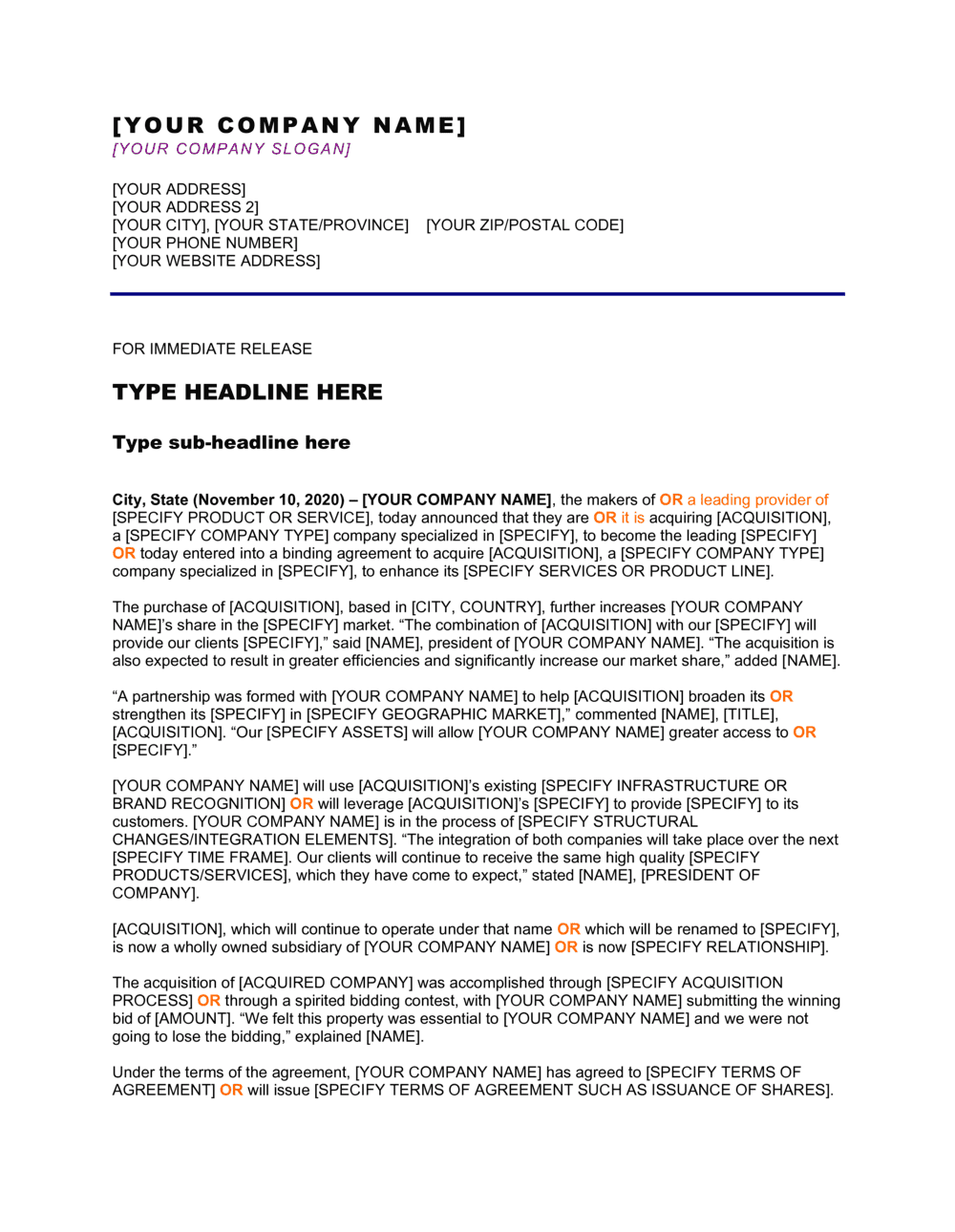
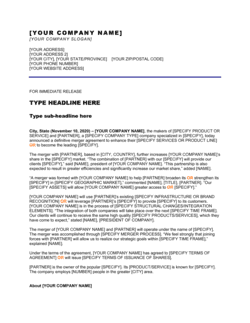
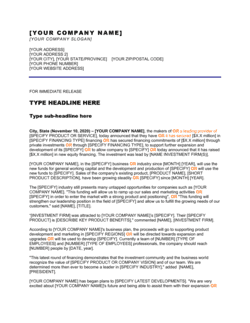
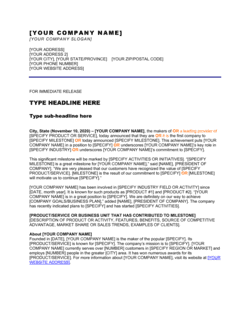
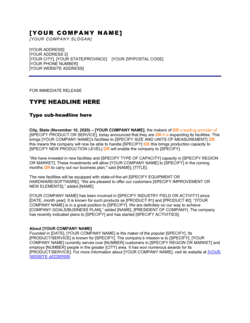
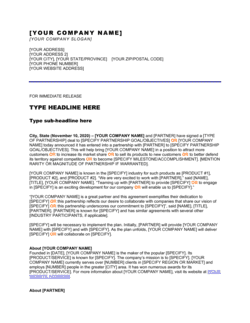
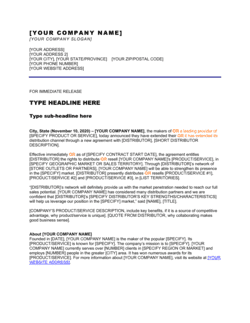
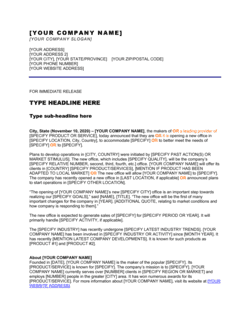
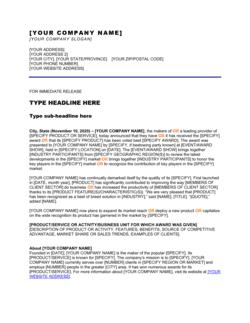
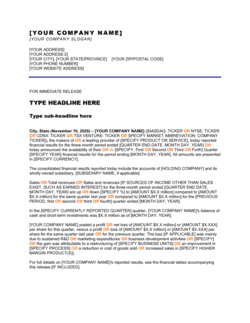
A Press Release: Company Has Completed an Acquisition is a formal public announcement document that notifies media, investors, employees, and stakeholders that a corporate acquisition has officially closed. This free Word download provides a structured template you can edit online and distribute to wire services, journalists, and your own channels within minutes of deal close.
When you need it
Issue it on or immediately after the closing date of an acquisition to meet public-company disclosure obligations, satisfy investor relations requirements, and control the narrative before news breaks through other channels. Private companies use it to signal growth, attract talent, and inform customers and partners about the combined entity.
What's inside
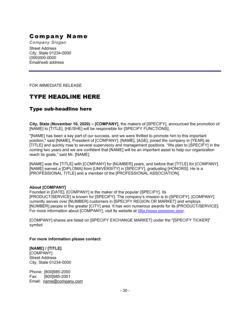
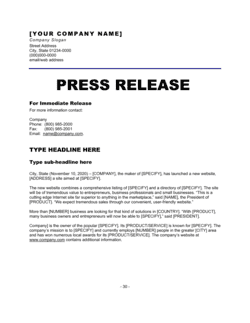
Headline and subheadline, dateline, opening paragraph summarizing the closed deal, transaction rationale and strategic context, executive quotes from both parties, business overview boilerplates, deal terms (where disclosable), forward-looking statements disclaimer, and media contact details.

What is a Press Release: Company Has Completed an Acquisition?

A Press Release: Company Has Completed an Acquisition is a formal public announcement document that confirms a corporate acquisition has legally closed β€” meaning all closing conditions have been satisfied, consideration has been exchanged, and ownership of the target company has transferred to the acquirer. It is the definitive public record of deal completion, identifying both parties by their legal names, stating the effective closing date, summarizing the transaction rationale, providing executive quotes from both companies, and including the boilerplate descriptions and media contacts required for professional distribution. For public companies, it is issued simultaneously with mandatory regulatory filings such as an SEC Form 8-K or a Canadian material change report.

Why You Need This Document

Failing to issue a timely, accurate acquisition completion press release creates compounding problems across legal, investor relations, and commercial dimensions. Public companies that delay or omit the announcement risk violating Reg FD, MAR, or National Instrument 51-102 disclosure requirements β€” each carrying regulatory sanctions and potential securities liability. Private companies that say nothing leave customers, suppliers, and employees to learn about the ownership change through rumor or a competitor's announcement, damaging trust at the most critical integration moment. A poorly drafted release β€” with unsigned quotes, missing disclaimers, or deal terms not cleared for disclosure β€” can generate journalist corrections, analyst skepticism, and breach-of-contract claims from the seller. This template gives acquiring companies a legally structured, professionally formatted starting point that compresses drafting time from hours to minutes and ensures every required element is present before the wire submission deadline.

Which variant fits your situation?

If your situation is…Use this template
Announcing a signed deal before regulatory or shareholder approvalPress Release β€” Company Has Entered Into an Acquisition Agreement
Announcing a merger of equals rather than an outright acquisitionPress Release β€” Merger Announcement
Notifying the public that a private company has been acquired by a public companyPress Release β€” Public Company Acquires Private Target
Announcing a strategic partnership rather than a change of ownershipPress Release β€” Strategic Partnership Announcement
Informing employees and internal stakeholders before the public announcementEmployee Announcement β€” Acquisition Close
Announcing a divestiture or sale of a business unitPress Release β€” Company Has Divested a Business Unit
Issuing a joint announcement on behalf of both acquirer and targetJoint Press Release β€” Acquisition Completed

Common mistakes to avoid

❌ Releasing before legal close is confirmed

Why it matters: Announcing a completed acquisition before all closing conditions are satisfied is factually incorrect and can constitute a material misstatement under securities law, exposing the company to investor litigation.

Fix: Obtain written confirmation from deal counsel that all conditions are satisfied and funds have transferred before approving the release for distribution.

❌ Omitting the forward-looking statements disclaimer on a public company release

Why it matters: Public companies that include performance projections or synergy estimates without a safe-harbor disclaimer lose the protection of the PSLRA and Exchange Act safe harbors, making them vulnerable to securities fraud claims if guidance is missed.

Fix: Include a forward-looking statements section in every acquisition press release issued by or about a publicly traded company, mirroring the language used in recent SEC filings.

❌ Using generic or unattributed executive quotes

Why it matters: Unattributed quotes or quotes from 'a spokesperson' are edited out by wire services and ignored by journalists, reducing media pick-up and signaling that leadership is not aligned on the deal.

Fix: Attribute every quote to a named individual with their exact title, and obtain written approval from the quoted person before submission.

❌ Disclosing deal terms not approved for public release

Why it matters: Purchase agreements typically contain confidentiality provisions covering price adjustments, earnout formulas, and indemnification caps. Premature disclosure can constitute a breach of contract and trigger indemnification claims from the seller.

Fix: Have deal counsel review the final press release against the confidentiality and disclosure provisions of the purchase agreement before distribution.

❌ Failing to update the target company's boilerplate to reflect acquired status

Why it matters: A target boilerplate that still describes the company as an independent entity confuses journalists, customers, and investors about the company's actual post-close status.

Fix: Update the target's boilerplate to read '[TARGET NAME] is a wholly owned subsidiary of [ACQUIRER NAME]' and remove any references to the target's prior independent status.

❌ Distributing the release on an embargo before regulatory filings are submitted

Why it matters: For public companies, pre-releasing material information to journalists under embargo before the 8-K is filed can violate Reg FD if the embargo lifts before the filing is publicly accessible on EDGAR.

Fix: File the 8-K or equivalent disclosure first, then lift the embargo simultaneously β€” coordinate the wire distribution time to match the EDGAR acceptance timestamp.

The 10 key clauses, explained

Headline and Subheadline

In plain language: A concise, active-voice headline that names both companies and confirms the deal is closed, followed by a subheadline with a key deal metric or strategic benefit.

Sample language
[ACQUIRER NAME] Completes Acquisition of [TARGET COMPANY NAME] | Acquisition expands [ACQUIRER NAME]'s presence in [MARKET/GEOGRAPHY] to serve [X] customers globally.

Common mistake: Writing a vague headline like 'Company Announces Strategic Transaction' β€” failing to name both parties and state the deal type causes journalists to skip the release entirely.

Dateline and Opening Paragraph

In plain language: States the city, date, and a single opening paragraph confirming the close with the acquirer name, target name, effective date, and consideration (if disclosable).

Sample language
[CITY], [DATE] β€” [ACQUIRER LEGAL NAME] (NASDAQ: [TICKER]) today announced the completion of its acquisition of [TARGET COMPANY LEGAL NAME] for approximately $[PURCHASE PRICE], effective [CLOSING DATE].

Common mistake: Burying the closing confirmation past the first paragraph. Journalists and wire editors decide within two sentences whether to run a release β€” put who, what, and when in sentence one.

Transaction Rationale and Strategic Context

In plain language: Explains why the acquirer pursued the target β€” market expansion, technology acquisition, talent, geographic reach, or revenue synergies β€” and how the combined entity benefits stakeholders.

Sample language
The acquisition of [TARGET NAME] accelerates [ACQUIRER NAME]'s strategy to [STRATEGIC OBJECTIVE] and adds [KEY ASSET β€” e.g., X patents / Y customers / Z technology] to the combined portfolio.

Common mistake: Using generic language like 'highly complementary businesses' with no specific data point. One concrete metric β€” customer count, revenue contribution, or market share gain β€” makes the rationale credible and quotable.

Acquirer Executive Quote

In plain language: A attributed statement from the acquirer's CEO or a named executive expressing enthusiasm for the deal and the strategic vision for the combined company.

Sample language
"This acquisition marks a defining moment for [ACQUIRER NAME]," said [NAME], [TITLE] of [ACQUIRER NAME]. "[TARGET NAME]'s [SPECIFIC STRENGTH] perfectly complements our existing [CAPABILITY], and together we will [EXPECTED OUTCOME]."

Common mistake: Using an unsigned or unattributed quote, or attributing a quote to 'a spokesperson.' Journalists require a named executive β€” unnamed quotes are routinely cut before publication.

Target Company Executive Quote

In plain language: A statement from the target company's CEO or founder welcoming the transaction and expressing confidence in the acquiring company's stewardship.

Sample language
"Joining [ACQUIRER NAME] gives our team and customers access to [RESOURCE/CAPABILITY]," said [NAME], [TITLE] of [TARGET COMPANY NAME]. "We are proud of what we have built and excited to accelerate our mission as part of the [ACQUIRER NAME] family."

Common mistake: Omitting the target executive quote entirely. A bilateral announcement signals alignment between both parties and reduces market concern about a hostile or contested deal.

Deal Terms and Consideration

In plain language: Discloses the purchase price, payment structure (cash, stock, or combination), and any contingent consideration such as earnouts β€” subject to what the parties are permitted to disclose.

Sample language
Under the terms of the agreement, [ACQUIRER NAME] acquired [TARGET COMPANY NAME] for total consideration of approximately $[AMOUNT], consisting of $[CASH COMPONENT] in cash and [X] shares of [ACQUIRER NAME] common stock.

Common mistake: Including deal terms without legal sign-off on what is permissible to disclose. Premature or inaccurate disclosure of price, structure, or earn-out terms can trigger securities liability or breach the purchase agreement's confidentiality provisions.

Combined Business Overview

In plain language: Describes the scale, capabilities, and market position of the combined entity β€” headcount, revenue, customer base, geography, and key products β€” post-close.

Sample language
Following the close, the combined company employs approximately [X] people across [Y] countries, serves [Z] customers in [MARKETS], and generates combined annual revenue of approximately $[AMOUNT].

Common mistake: Presenting the combined-company figures as audited or guaranteed when they are pro forma estimates. Label combined-entity metrics clearly as 'pro forma' or 'estimated' to avoid investor-relations exposure.

Forward-Looking Statements Disclaimer

In plain language: Safe-harbor language required for public companies stating that any statements about future performance are estimates subject to material risks, and that actual results may differ.

Sample language
This press release contains forward-looking statements within the meaning of [APPLICABLE SECURITIES LAW]. These statements are based on current expectations and involve risks and uncertainties that could cause actual results to differ materially from those projected. [ACQUIRER NAME] undertakes no obligation to update these statements.

Common mistake: Omitting the forward-looking disclaimer entirely for public companies, or using a disclaimer that fails to reference the applicable securities law. A missing or defective safe harbor exposes the company to securities fraud claims if guidance is later missed.

About [Acquirer] and About [Target] Boilerplates

In plain language: Two separate 'About Us' paragraphs at the end of the release β€” one for each entity β€” providing a consistent, pre-approved description of each company's business.

Sample language
About [ACQUIRER NAME]: [ACQUIRER NAME] is a [DESCRIPTION] that [VALUE PROPOSITION]. Founded in [YEAR], the company serves [CUSTOMER DESCRIPTION] in [GEOGRAPHIES]. For more information, visit [WEBSITE]. About [TARGET NAME]: [TARGET NAME] is a [DESCRIPTION] specializing in [FOCUS AREA].

Common mistake: Using outdated or investor-deck language in the boilerplate rather than the company's approved, current public description. Post-close, the target's boilerplate must reflect its new status as a subsidiary or division.

Media Contact Information

In plain language: Names, titles, phone numbers, and email addresses for the designated press contacts at both the acquirer and, where applicable, the target company or its PR firm.

Sample language
Media Contact: [NAME], [TITLE], [ACQUIRER NAME] | Phone: [NUMBER] | Email: [EMAIL] | Investor Contact (if public): [NAME], [TITLE] | Phone: [NUMBER] | Email: [EMAIL]

Common mistake: Listing a generic info@ email or a PR firm contact without a named individual. Journalists on deadline will not chase an anonymous inbox β€” a direct name and mobile number dramatically increases pick-up rates.

How to fill it out

  1. 1

    Confirm all deal conditions have been satisfied

    Before drafting, verify with deal counsel that all closing conditions β€” regulatory clearances, shareholder votes, HSR waiting periods β€” are met and the closing date is confirmed.

    πŸ’‘ Never draft the final press release until you have a signed officer's certificate or closing confirmation from legal. An announcement before legal close creates securities liability.

  2. 2

    Insert both companies' full legal names and ticker symbols

    Use the registered legal entity name for each party throughout the document. Include stock exchange ticker symbols for any publicly traded entity in the headline and first paragraph.

    πŸ’‘ Cross-reference the most recent SEC or regulatory filing to confirm the exact legal entity name β€” trade names and legal names frequently differ.

  3. 3

    State the closing date and purchase consideration

    Enter the exact closing date and the total consideration β€” cash, stock, or combination β€” as approved for disclosure by legal counsel. If terms are confidential, use 'undisclosed financial terms.'

    πŸ’‘ Align the purchase price language precisely with the purchase agreement and any 8-K or material change report filed simultaneously. Inconsistency between the press release and regulatory filing triggers media and analyst scrutiny.

  4. 4

    Draft the transaction rationale with at least one specific metric

    Write two to three sentences explaining why the acquisition was made. Include at least one concrete data point β€” customer count, patent portfolio size, revenue run-rate, or market geography β€” to make the rationale substantive.

    πŸ’‘ Avoid phrases like 'highly complementary' or 'transformative transaction' without supporting data. Specific numbers are quoted by journalists; vague adjectives are cut.

  5. 5

    Obtain approved quotes from named executives at both companies

    Collect sign-off from the acquirer's CEO and the target company's CEO or founder. Quotes must be attributed to a specific named individual with their exact title.

    πŸ’‘ Send quotes to the quoted executives for explicit written approval before submission to the wire. Verbal approvals lead to last-minute changes that delay distribution.

  6. 6

    Add or update both company boilerplates

    Use current, pre-approved 'About Us' copy for the acquirer. For the target, update the boilerplate to reflect its new status β€” e.g., 'a wholly owned subsidiary of [ACQUIRER NAME]' β€” effective as of closing.

    πŸ’‘ The boilerplate is the paragraph most likely to be copied verbatim by journalists. Keep it under 75 words and ensure it has been reviewed by legal and communications.

  7. 7

    Insert the forward-looking statements disclaimer

    For any publicly traded acquirer or target, include the safe-harbor disclaimer referencing the applicable securities law. Private companies may omit this if no securities statements are made.

    πŸ’‘ Use the same disclaimer language from the company's most recent earnings release or 8-K. Consistency across filings reduces legal exposure.

  8. 8

    Coordinate distribution timing with legal and IR

    Set the embargo lift time to coincide with or immediately follow any regulatory filing (8-K, material change report). Distribute simultaneously to the wire service, your website newsroom, and direct media contacts.

    πŸ’‘ Schedule wire distribution at least 30 minutes before market open or after market close to give investors time to read the release before trading begins.

Frequently asked questions

What is an acquisition completion press release?

An acquisition completion press release is a formal public announcement that a corporate acquisition has officially closed β€” meaning all legal, regulatory, and financial conditions have been satisfied and ownership has transferred. It identifies both the acquirer and the target, states the effective closing date, provides the transaction rationale, includes executive quotes, and contains the boilerplate descriptions of both companies. It is distinct from an announcement that a deal has been signed, which precedes close.

When should a completed acquisition press release be issued?

It should be issued on the closing date itself, or within hours of legal close. Public companies typically coordinate distribution to coincide with or immediately follow the filing of an 8-K (US) or material change report (Canada) with the relevant securities regulator. Issuing after market close or before market open is preferred to give investors time to process the announcement before trading begins.

Does an acquisition press release need to be reviewed by a lawyer?

Yes, in almost all cases. For public companies, legal review is required to ensure the release complies with Reg FD, includes an adequate forward-looking statements disclaimer, and does not disclose confidential deal terms. For private companies, review confirms that the release is consistent with the purchase agreement's disclosure provisions and does not create unintended representations to customers or creditors.

What deal terms should be included in the press release?

Only terms expressly approved for public disclosure by both parties and their counsel. Commonly disclosed terms include total transaction value, payment structure (cash vs. stock), and the closing date. Earn-out formulas, working capital adjustments, indemnification caps, and representations and warranties insurance terms are typically kept confidential. If terms are not disclosable, use the phrase "undisclosed financial terms."

Is a completed acquisition press release legally binding?

The press release itself is not a legally binding contract β€” the purchase agreement governs the transaction. However, statements in the release can create legal exposure if they are materially false or misleading, particularly for public companies subject to securities law. Factual statements about the combined company's size, revenue, or customer base that prove to be inaccurate can form the basis of investor claims.

What is the difference between a press release announcing a signed deal and one announcing a completed acquisition?

A signed-deal announcement confirms that the parties have entered into a definitive agreement but that close remains subject to conditions β€” regulatory approvals, shareholder votes, or financing. A completion announcement confirms all conditions have been satisfied and legal ownership has transferred. The language must be precise: announcing completion before close is factually incorrect and legally problematic.

Do private companies need a forward-looking statements disclaimer in their acquisition press release?

Private companies are generally not subject to the same securities disclosure rules as public companies, so the safe-harbor disclaimer is not legally mandated. However, including it is still advisable if the release contains projections about the combined company's future performance, revenue synergies, or customer growth, as it reduces exposure to claims from creditors, lenders, or counterparties who may rely on those statements.

How should the press release handle the target company's brand after acquisition?

The boilerplate and body copy should reflect any announced brand decisions β€” whether the target will operate under its existing name, be rebranded, or be integrated fully. If no brand decision has been publicly made, describe the target as "a wholly owned subsidiary of [ACQUIRER NAME]" without speculating on future naming. Premature brand announcements that are later reversed damage credibility with customers and employees.

What distribution channels should be used for an acquisition press release?

Distribute simultaneously through a paid wire service (PR Newswire, Business Wire, or GlobeNewswire), your company's newsroom page, direct email to your media list, and social media channels. Public companies must also file the release as an exhibit to an 8-K within four business days of close. For cross-border deals, use a wire service with international distribution to ensure coverage in all relevant markets.

How this compares to alternatives

vs Press Release β€” Company Has Entered Into an Acquisition Agreement

An acquisition agreement press release announces that parties have signed a definitive agreement but that close is pending regulatory or shareholder approval. A completion press release announces that all conditions are satisfied and the deal has legally closed. Confusing the two β€” or issuing a completion release before all conditions are met β€” constitutes a material misstatement.

vs Press Release β€” New Strategic Partnership

A strategic partnership announcement covers a commercial or operational agreement between two independent companies with no change of ownership. An acquisition completion release announces a permanent transfer of ownership and control. The distinction matters to customers, regulators, and investors β€” conflating them misrepresents the legal and commercial relationship.

vs Press Release β€” Merger Announcement

A merger announcement typically describes a combination of equals β€” both entities dissolve into a new combined entity β€” whereas an acquisition describes one company purchasing another, with the acquirer surviving as the continuing entity. The surviving entity structure, governance, and brand treatment differ materially between the two transaction types.

vs Letter of Intent (LOI)

A letter of intent is a non-binding pre-deal document outlining proposed acquisition terms between negotiating parties β€” it precedes due diligence and the definitive agreement. A completion press release is issued at the opposite end of the timeline, after the deal has fully closed. The LOI is confidential and internal; the press release is a public document intended for broad distribution.

Industry-specific considerations

Technology / SaaS

Acquisition announcements typically highlight product integration timelines, combined ARR, and engineering team expansion β€” with extra scrutiny on customer data handling under GDPR and CCPA.

Financial Services

Regulatory approval from banking or securities authorities must be confirmed before close is announced, and the release must align precisely with simultaneous filings to the SEC, FINRA, or FCA.

Healthcare / Life Sciences

FDA or EMA regulatory approval status, pipeline asset integration, and HIPAA data-handling commitments for patient records are standard inclusions in life sciences acquisition announcements.

Manufacturing

Plant locations, production capacity additions, and supply chain integration timelines are key metrics; HSR antitrust clearance language is often required for larger manufacturing deals.

Jurisdictional notes

United States

Public companies must file an 8-K with the SEC within four business days of closing and attach the press release as an exhibit. Reg FD requires simultaneous disclosure to all investors. The PSLRA safe harbor protects forward-looking statements if the release includes the required disclaimer. HSR Act filings must be confirmed complete before the release announces close.

Canada

Reporting issuers on Canadian exchanges must file a material change report (Form 51-102F3) promptly after close and issue a news release simultaneously. National Instrument 51-102 governs timing and content requirements. Quebec-based companies must ensure the French-language version of the release is issued concurrently under the Charter of the French Language.

United Kingdom

UK-listed companies must notify a Regulatory Information Service (RIS) under the FCA's Disclosure Guidance and Transparency Rules before public release. The Takeover Code imposes strict content and timing requirements for acquisitions of UK public companies. Post-Brexit, EU disclosure rules no longer apply to UK companies, but simultaneous RIS and press distribution remains mandatory.

European Union

EU-listed companies must disseminate inside information β€” including acquisition completion β€” under the Market Abuse Regulation (MAR) through an approved publication mechanism simultaneously across all member states where the company is traded. GDPR considerations apply if customer or employee data is referenced in the announcement. EC merger regulation clearance language must be included where applicable.

Template vs lawyer β€” what fits your deal?

PathBest forCostTime
Use the templatePrivate company acquisitions where neither party is publicly traded and no regulatory filings are requiredFree30–60 minutes
Template + legal reviewAny deal involving a publicly traded party, securities disclosures, or multi-jurisdiction regulatory approvals$300–$800 for a communications or securities lawyer review1–2 business days
Custom draftedLarge-cap public company M&A, cross-border transactions, or deals requiring simultaneous multi-jurisdiction regulatory filings$2,000–$10,000+ (in-house or outside counsel coordinating with IR and PR agencies)1–2 weeks

Glossary

Acquirer
The company that purchases a controlling interest in or all of the assets of another company in an acquisition transaction.
Target Company
The business being purchased in an acquisition β€” also referred to as the acquired company.
Closing Date
The calendar date on which all conditions to an acquisition are satisfied and legal ownership transfers from seller to buyer.
Deal Rationale
The stated strategic, operational, or financial reasons that justify why the acquirer pursued and completed the acquisition.
Forward-Looking Statements Disclaimer
Boilerplate legal language cautioning readers that statements about future performance are estimates subject to risks and uncertainties, required for public companies to limit securities liability.
Boilerplate (About the Company)
A standardized paragraph at the end of a press release describing the company's business, size, and market position β€” updated after close to reflect the combined entity.
Reg FD (Regulation Fair Disclosure)
A US SEC rule requiring public companies to disclose material information simultaneously to all investors, not selectively to analysts or journalists.
Material Information
Any fact about a company that a reasonable investor would consider significant in deciding whether to buy, sell, or hold its securities β€” acquisition completions typically qualify.
Dateline
The city and date at the start of a press release body that establishes when and where the announcement originates.
Wire Service
A distribution service such as PR Newswire, Business Wire, or GlobeNewswire that distributes press releases simultaneously to thousands of media outlets and financial terminals.
Embargo
A pre-release agreement between the company and journalists that holds publication of a story until a specified date and time β€” common for coordinated acquisition announcements.

Part of your Business Operating System

This document is one of 3,000+ business & legal templates included in Business in a Box.

  • Fill-in-the-blanks β€” ready in minutes
  • 100% customizable Word document
  • Compatible with all office suites
  • Export to PDF and share electronically

Create your document in 3 simple steps.

From template to signed document β€” all inside one Business Operating System.
1
Download or open template

Access over 3,000+ business and legal templates for any business task, project or initiative.

2
Edit and fill in the blanks with AI

Customize your ready-made business document template and save it in the cloud.

3
Save, Share, Send, Sign

Share your files and folders with your team. Create a space of seamless collaboration.

Save time, save money, and create top-quality documents.

β˜…β˜…β˜…β˜…β˜…

"Fantastic value! I'm not sure how I'd do without it. It's worth its weight in gold and paid back for itself many times."

Managing Director Β· Mall Farm
Robert Whalley
Managing Director, Mall Farm Proprietary Limited
β˜…β˜…β˜…β˜…β˜…

"I have been using Business in a Box for years. It has been the most useful source of templates I have encountered. I recommend it to anyone."

Business Owner Β· 4+ years
Dr Michael John Freestone
Business Owner
β˜…β˜…β˜…β˜…β˜…

"It has been a life saver so many times I have lost count. Business in a Box has saved me so much time and as you know, time is money."

Owner Β· Upstate Web
David G. Moore Jr.
Owner, Upstate Web

Run your business with a system β€” not scattered tools

Stop downloading documents. Start operating with clarity. Business in a Box gives you the Business Operating System used by over 250,000 companies worldwide to structure, run, and grow their business.

Start freeΒ Β·Β No credit card required