Compensation and Payroll Templates

4.7from 280+ reviews Trusted by 20M+ businesses

Pay employees accurately, document every agreement, and stay compliant with ready-to-use HR payroll forms.

WordEditable onlinePDF33+ compensation and payroll templates

Other Human Resources categories

250K+Clients
20M+Free users
20+Years
190+Countries
10,000+Law firms
50M+Downloads

Trusted across review platforms

  • Capterra★★★★☆4.649 reviews
  • G2★★★★☆4.713 reviews
  • GetApp★★★★☆4.649 reviews
  • Google Play★★★★☆4.6179 ratings
  • Google Reviews★★★★☆4.567 reviews

Related categories

Frequently asked questions

What should a compensation agreement include?
A compensation agreement should state the employee's base pay rate and payment frequency, any bonus or commission formula, the effective date, and when pay will next be reviewed. It should also reference any applicable benefits, expense reimbursement terms, and how disputes over pay will be resolved. Both parties should sign before the new pay rate takes effect.
Is a payroll deduction authorization form legally required?
In most jurisdictions, employers are required to obtain written employee authorization before deducting anything beyond mandatory statutory deductions such as income tax and social security. Voluntary deductions — health premiums, retirement contributions, loan repayments — typically require a signed authorization form. Check applicable wage and hour laws for your jurisdiction, as requirements vary.
What's the difference between gross pay and net pay on a payslip?
Gross pay is the total amount earned before any deductions — base salary or hourly wages plus overtime, bonuses, and allowances. Net pay is what the employee actually receives after all statutory and voluntary deductions have been subtracted. Payslips must show both figures, along with an itemized list of every deduction, in most jurisdictions.
When should I use a deferred compensation agreement?
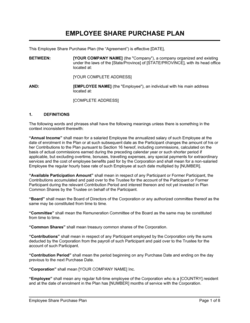
A deferred compensation agreement is most commonly used for senior executives or key employees as a retention tool. It allows part of their current compensation to be set aside and paid out at a future date — often at retirement or after a specified tenure. The agreement should define the deferral amount, the vesting schedule, the payout triggers, and the tax treatment. Consider consulting a tax advisor before finalizing any deferred compensation arrangement.
Do I need a separate severance agreement for employees over 40?
Yes, in the US you should use a separate severance agreement for employees aged 40 or older. The Age Discrimination in Employment Act (ADEA) requires that the employee be given at least 21 days to review the agreement and 7 days to revoke after signing. A standard severance agreement does not include these provisions, making it insufficient for older workers in a US context.
What is a profit sharing plan and who qualifies?
A profit sharing plan is an employer-funded benefit that distributes a portion of company profits to eligible employees, typically based on a predetermined formula tied to salary or tenure. Eligibility criteria, contribution amounts, vesting schedules, and distribution rules must all be documented in a written plan. In many jurisdictions, profit sharing contributions receive favorable tax treatment for both employer and employee.
Can employees participate in both a stock compensation plan and a profit sharing plan?
Yes, the two plans serve different purposes and are not mutually exclusive. Stock compensation grants employees an ownership stake through share grants or options. Profit sharing distributes cash or deferred amounts from annual profits. Many companies offer both as complementary long-term incentive tools, each governed by its own written plan document.
How long should payroll records be kept?
Retention requirements vary by jurisdiction, but a widely accepted minimum is three to seven years for payroll records including payslips, deduction authorizations, and compensation agreements. Some tax authorities and employment regulators require longer retention periods. Store executed originals securely and ensure they are retrievable if an audit or pay dispute occurs.

Compensation and Payroll vs. related documents

Compensation Agreement vs. Employment Agreement

An employment agreement covers the full terms of an employment relationship — role, duties, confidentiality, and termination. A compensation agreement focuses specifically on pay: salary, bonuses, commissions, and review dates. Use a compensation agreement as a standalone document when you need to revise or document pay terms without renegotiating the full employment contract.

Deferred Compensation Agreement vs. Profit Sharing Plan

A deferred compensation agreement lets an individual employee elect to receive a portion of pay at a future date, often for tax or retention reasons. A profit sharing plan distributes a share of company profits to a class of eligible employees based on a predetermined formula. Both are long-term incentive tools, but they serve different retention and tax-planning goals.

Severance Pay Agreement vs. Severance Agreement (over 40)

A standard severance pay agreement documents the separation terms and release of claims for any employee. The over-40 version adds disclosures required by the Age Discrimination in Employment Act (ADEA) in the US, including the right to 21 days to review the offer and 7 days to revoke after signing. If the departing employee is 40 or older and you operate in the US, use the specialized version.

Payslip vs. Payslip Worksheet

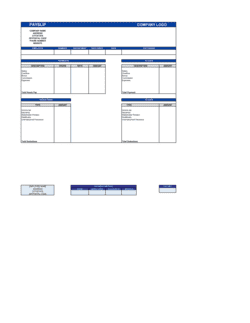
A payslip is the final pay stub issued to an employee showing gross pay, each deduction, and net pay. The payslip worksheet is the internal calculation sheet used by payroll staff to compute those figures before issuing the slip. Use the worksheet during payroll processing, then issue the completed payslip to the employee.

Key clauses every Compensation and Payroll contains

Most compensation and payroll documents share a common set of clauses that establish what is owed, when, under what conditions, and what happens if something goes wrong.

  • Compensation amount and structure. States the base salary or hourly rate, any bonus or commission formula, and the payment frequency.
  • Effective date and review schedule. Identifies when the compensation terms take effect and when they will next be reviewed or adjusted.
  • Deduction authorization. Documents the employee's written consent for each payroll deduction type, as required in most jurisdictions.
  • Benefits eligibility. Specifies which benefit programs the employee qualifies for and any waiting periods before enrollment.
  • Vesting schedule. For equity, profit sharing, and deferred compensation plans, defines the timeline on which the employee earns the benefit.
  • Clawback or forfeiture conditions. States the circumstances — such as voluntary resignation or misconduct — under which unvested or paid compensation can be recouped.
  • Confidentiality of compensation terms. Some agreements restrict disclosure of pay levels to third parties, though this cannot override statutory employee rights in many jurisdictions.
  • Governing law and dispute resolution. Names the jurisdiction whose employment and wage laws apply if a dispute over pay arises.

How to document employee compensation

Proper compensation documentation starts before an offer is accepted and continues through every pay change and separation event during the employment lifecycle.

  1. 1

    Define your pay philosophy

    Draft a Compensation and Benefits Policy that sets company-wide rules for salary bands, bonus eligibility, and benefit tiers.

  2. 2

    Formalize each individual arrangement in writing

    Issue a Compensation Agreement or include a clear compensation schedule in the employment offer before the employee starts.

  3. 3

    Authorize any payroll deductions before they run

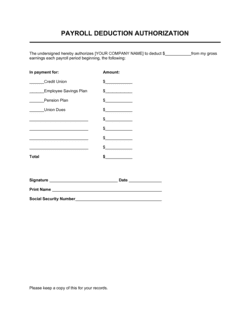
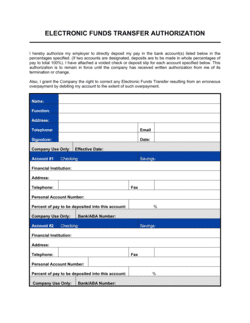
    Have employees sign a Payroll Deduction Authorization form for each recurring deduction — health premiums, retirement contributions, garnishments.

  4. 4

    Set up benefit and incentive plan documents

    Establish written plan documents for profit sharing, share purchase, pension, or reimbursement arrangements so employees understand eligibility and vesting.

  5. 5

    Issue payslips every pay period

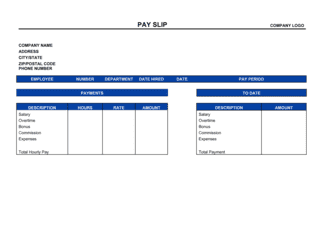
    Use the payslip worksheet to calculate gross pay, deductions, and net pay, then issue the completed payslip to each employee as a permanent record.

  6. 6

    Document every pay change with a written amendment

    When salary increases, bonuses change, or equity is granted, update the relevant agreement or issue a new Compensation Agreement addendum.

  7. 7

    Handle separations with the correct severance document

    For any severance payment, use the age-appropriate agreement to record the amount, conditions, and mutual release before issuing the final payment.

At a glance

What it is
Compensation and payroll documents are the contracts, policies, and administrative forms that govern how employees are paid, what benefits they receive, and how deductions and reimbursements are handled. Together they create a paper trail that protects both employer and employee if pay disputes or compliance questions arise.
When you need one
Any time you hire, promote, restructure pay, offer equity, process deductions, or separate from an employee, you need the right compensation or payroll document in place before the change takes effect.

Which Compensation and Payroll do I need?

The right template depends on whether you're setting policy, formalizing an individual pay arrangement, processing a payroll transaction, or separating from an employee. Match your situation below.

Your situation
Recommended template

Setting company-wide rules for pay, bonuses, and benefits

Establishes consistent pay philosophy and benefit eligibility across the organization.

Authorizing a recurring deduction from an employee's paycheck

Documents employee consent for each deduction type before payroll runs.

Separating from an employee and offering a lump-sum payment

Specifies the severance amount, conditions, and mutual release of claims.

Separating from an employee aged 40 or older

Includes ADEA-required disclosure and the 21-day review and 7-day revocation periods.

Deferring part of an executive's pay to a future date

Defines the deferral schedule, vesting conditions, and payout triggers.

Granting equity compensation to an employee or contractor

Documents share grant terms, vesting schedule, and transfer restrictions.

Formalizing a specific pay arrangement with one employee

Records agreed salary, bonus structure, and review dates in writing.

Issuing a pay stub or wage summary to an employee

Provides a clear itemized record of gross pay, deductions, and net pay.

Glossary

Gross pay
Total earnings before any deductions, including base salary, overtime, bonuses, and allowances.
Net pay
The amount an employee actually receives after all statutory and voluntary deductions are subtracted from gross pay.
Payroll deduction
An amount withheld from an employee's paycheck, either required by law (taxes) or authorized voluntarily (benefits premiums, retirement contributions).
Deferred compensation
A portion of current earnings set aside to be paid out at a future date, often used as a retention incentive for senior employees.
Vesting schedule
The timeline over which an employee earns the right to retain a benefit such as equity, profit sharing, or deferred pay.
Clawback
A contractual provision requiring an employee to return previously paid compensation if specified conditions — such as misconduct — are triggered.
Severance pay
A payment made to an employee upon termination, typically in exchange for a release of claims against the employer.
Profit sharing
An employer-funded plan that distributes a share of company profits to eligible employees based on a defined formula.
Health Reimbursement Arrangement (HRA)
An employer-funded account that reimburses employees for qualifying medical expenses up to a set annual limit.
Base salary
The fixed annual or hourly amount an employee is paid, not including bonuses, overtime, or other variable pay.
ADEA
The Age Discrimination in Employment Act, a US federal law that imposes specific requirements on severance agreements offered to employees aged 40 or older.
Compensable time
Work time for which an employer is legally required to pay an employee, including certain travel, training, and on-call periods.

What is a compensation and payroll document?

A compensation and payroll document is any written agreement, policy, form, or record that governs how an employee is paid, what benefits they receive, and how deductions and reimbursements are administered. These documents span the full employment lifecycle — from the initial compensation agreement signed at hire, through annual pay reviews and equity grants, to the final severance payment on separation. Individually, each document records a specific pay event; collectively, they form the authoritative record of the employment relationship's financial terms.

Compensation and payroll documents fall into four broad types: policy documents (such as a compensation and benefits policy) that set company-wide rules; individual agreements (such as a deferred compensation or stock compensation agreement) that formalize specific arrangements with named employees; administrative forms (such as payroll deduction authorizations and payslips) used to process and document each pay cycle; and separation documents (such as severance agreements) that close out the financial relationship when employment ends.

When you need a compensation and payroll document

Every time pay changes hands — or the terms under which it will change hands are agreed upon — a written record should exist. Relying on verbal agreements or informal emails creates ambiguity that becomes expensive when a pay dispute, audit, or wrongful-termination claim arises.

Common triggers:

  • Hiring a new employee and documenting their salary, bonus formula, and benefits package
  • Promoting or regrading an existing employee with a new pay rate
  • Authorizing a new payroll deduction for health insurance, a retirement plan, or a wage garnishment
  • Establishing or amending an equity, profit sharing, or deferred compensation plan
  • Processing and issuing payslips each pay period as required by wage and hour laws
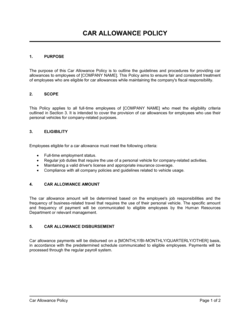
  • Reimbursing employees for medical expenses or work-related costs
  • Separating from an employee and offering a severance payment in exchange for a mutual release
  • Documenting board-approved executive compensation or director indemnification

Without proper compensation documentation, businesses face wage-claim liability, tax penalties for undocumented deductions, and difficulty defending against discrimination or underpayment allegations. Starting from a professionally drafted template reduces drafting time, ensures legally required provisions are included, and gives both employer and employee a clear shared record from day one.

Award-winning platform

  • Great Place to Work 2025
  • BIG Award — Product of the Year 2025
  • Smartest Companies 2025
  • Global 100 Excellence 2026
  • Best of the Best 2025

Create your document in 3 simple steps.

From template to signed document — all inside one Business Operating System.
1
Download or open template

Access over 3,000+ business and legal templates for any business task, project or initiative.

2
Edit and fill in the blanks with AI

Customize your ready-made business document template and save it in the cloud.

3
Save, Share, Send, Sign

Share your files and folders with your team. Create a space of seamless collaboration.

Save time, save money, and create top-quality documents.

★★★★★

"Fantastic value! I'm not sure how I'd do without it. It's worth its weight in gold and paid back for itself many times."

Managing Director · Mall Farm
Robert Whalley
Managing Director, Mall Farm Proprietary Limited
★★★★★

"I have been using Business in a Box for years. It has been the most useful source of templates I have encountered. I recommend it to anyone."

Business Owner · 4+ years
Dr Michael John Freestone
Business Owner
★★★★★

"It has been a life saver so many times I have lost count. Business in a Box has saved me so much time and as you know, time is money."

Owner · Upstate Web
David G. Moore Jr.
Owner, Upstate Web

Run your business with a system — not scattered tools

Stop downloading documents. Start operating with clarity. Business in a Box gives you the Business Operating System used by over 250,000 companies worldwide to structure, run, and grow their business.

Free Forever Plan · No credit card required