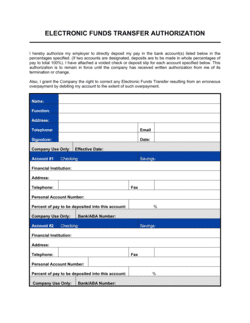
Payroll Deduction Authorization Template

Free Word download • Edit online • Save & share with Drive • Export to PDF

1 page20–30 min to fillDifficulty: StandardSignature requiredLegal review recommended
Learn more ↓
FreePayroll Deduction Authorization Template

At a glance

What it is
A Payroll Deduction Authorization is a legally binding document signed by an employee that consents to the employer withholding a specified amount or percentage from each paycheck for a defined purpose. This free Word download covers voluntary deductions such as benefit premiums, retirement contributions, loan repayments, uniform costs, and parking fees — giving both parties a written record of the agreed deduction amount, schedule, and revocation rights.
When you need it
Use it whenever an employee elects a voluntary payroll deduction — at open enrollment, when issuing a company loan, when enrolling a new hire in a benefits plan, or when recovering an overpayment or advance. A signed authorization is also required in many US states and Canadian provinces before any non-statutory deduction may be processed.
What's inside
Employer and employee identification, deduction type and purpose, deduction amount or calculation formula, frequency and start date, total amount to be recovered where applicable, employee consent and revocation rights, and signatures with dates.

What is a Payroll Deduction Authorization?

A Payroll Deduction Authorization is a legally binding document in which an employee provides written consent for an employer to withhold a specified dollar amount or percentage from each paycheck for a defined voluntary purpose — such as health insurance premiums, retirement plan contributions, employer loan repayments, uniform cost recovery, or commuter benefits. It is distinct from statutory withholdings like income tax, Social Security, or CPP contributions, which are mandated by law and require no employee signature. The authorization defines the deduction amount, frequency, start date, and revocation rights, creating an enforceable written record that protects both the employer from wage-theft claims and the employee from unauthorized withheld wages.

Why You Need This Document

Processing a non-statutory payroll deduction without a signed written authorization exposes an employer to back-pay orders, statutory penalties, and regulatory complaints in virtually every US state, Canadian province, and EU member country. An employee who disputes an undocumented deduction typically wins — the burden of proof rests on the employer to produce the signed consent, and courts do not accept verbal agreements as a substitute. Beyond legal compliance, a completed authorization form eliminates the ambiguity that generates the most common payroll disputes: the employee who claims they never agreed to a premium increase, the departing worker who refuses to repay a loan balance, or the HR audit that uncovers active deductions with no documentation trail. This template gives you a jurisdiction-ready starting point that covers every material element regulators and courts look for — specific purpose, exact amount, termination trigger, minimum-wage acknowledgment, and a clear revocation procedure — so you can process voluntary deductions with confidence and a paper trail that holds up.

Which variant fits your situation?

If your situation is…Use this template
Deducting employee share of health, dental, or vision insurance premiumsPayroll Deduction Authorization — Benefits
Recovering a salary advance or emergency loan issued by the employerPayroll Deduction Authorization — Loan Repayment
Enrolling an employee in a 401(k), RRSP, or pension contribution planRetirement Contribution Deduction Form
Recovering an overpayment of wages made in a prior pay periodWage Overpayment Recovery Authorization
Deducting parking, transit pass, or commuter benefit costsCommuter Benefit Payroll Deduction Form
Recovering the cost of employer-provided tools, uniforms, or equipmentEquipment Cost Recovery Payroll Deduction
Formalizing a broader loan agreement alongside the deduction scheduleEmployee Loan Agreement

Common mistakes to avoid

❌ Using a blanket or open-ended authorization

Why it matters: A form that authorizes 'any deductions the employer deems necessary' is unenforceable in nearly every US state and Canadian province because it lacks the specificity required by wage-payment statutes. Enforcement proceedings frequently cite this as the primary defect.

Fix: Create a separate signed authorization for each deduction type. If multiple deductions are needed simultaneously, list each one as a distinct, itemized line with its own amount and purpose on the same form.

❌ Processing a deduction without a signed form on file

Why it matters: Deducting wages without a prior written authorization is treated as an unlawful wage deduction in most jurisdictions, exposing the employer to repayment claims, statutory penalties, and attorney's fees — even if the employee verbally agreed.

Fix: Establish a payroll controls procedure requiring HR to confirm a signed authorization is on file before any non-statutory deduction code is activated in the payroll system.

❌ Failing to recalculate when the deduction amount changes

Why it matters: If benefit premiums increase at renewal, or if a loan repayment schedule is restructured, processing the new amount without a fresh authorization voids the original consent and creates an unauthorized-deduction liability for the difference.

Fix: Issue a new or amended authorization form whenever the deduction amount, frequency, or purpose changes, and collect a new employee signature before the next payroll run reflects the change.

❌ Ignoring minimum-wage floors when recovering balances from final pay

Why it matters: Recovering an outstanding loan balance from a final paycheck that then falls below minimum wage is an unlawful wage deduction in California, New York, Ontario, and most EU member states — triggering regulatory complaints and back-pay orders.

Fix: Calculate the post-deduction net final pay before processing any lump-sum recovery. If the deduction would breach the minimum wage floor, recover only the permissible amount and pursue the remainder as a civil debt.

❌ Not including a revocation procedure

Why it matters: Without a clear revocation process, employees in many jurisdictions can stop a voluntary deduction immediately and without notice, disrupting benefit remittances and loan-recovery schedules without any contractual remedy.

Fix: Include a written notice period of 14 to 30 days for revocation of voluntary deductions, and specify that outstanding balances survive revocation and remain due under the original repayment terms.

❌ Presenting a voluntary deduction authorization as a mandatory employment condition

Why it matters: Courts treat consent obtained under duress as void. In several US states, conditioning employment on signing a voluntary-deduction form for non-statutory items constitutes an unlawful wage deduction from the first pay period.

Fix: Present benefit and savings deduction authorizations as employee elections during open enrollment or onboarding, with a clear written statement that participation is voluntary and declining will not affect employment status.

The 9 key clauses, explained

Parties and employment identification

In plain language: Identifies the employer legal entity and the employee by full name, job title, employee ID, and department, establishing who is bound by the authorization.

Sample language
This Payroll Deduction Authorization is entered into between [EMPLOYER LEGAL NAME] ('Employer') and [EMPLOYEE FULL NAME], Employee ID [ID NUMBER], [JOB TITLE], [DEPARTMENT] ('Employee').

Common mistake: Using a trade name or brand name instead of the registered employer entity. If the legal name does not match payroll records, the authorization may be unenforceable and creates audit discrepancies.

Deduction purpose and description

In plain language: Specifies exactly what the deduction is for — benefit premium, loan repayment, uniform cost, or other purpose — so neither party can later dispute whether the authorization covers the charge.

Sample language
Employee authorizes Employer to deduct from Employee's wages the amounts set out herein for the following purpose: [DESCRIBE DEDUCTION PURPOSE, e.g., 'Employee's share of monthly health insurance premium under Plan [PLAN NAME]'].

Common mistake: Using a generic purpose like 'miscellaneous deductions.' An authorization must describe the specific deduction; a blanket authorization for unspecified future charges is unenforceable in most jurisdictions.

Deduction amount or calculation formula

In plain language: States the fixed dollar amount or percentage to be withheld per pay period, or the formula used to calculate it, so the employee can verify each paycheck.

Sample language
The deduction amount shall be $[AMOUNT] per [pay period / month] OR [X]% of gross wages per pay period, commencing [START DATE].

Common mistake: Leaving the amount field blank and filling it in later without the employee's knowledge. Changing the deduction amount without a new signed authorization is a wage-theft risk and violates most state wage-payment statutes.

Deduction frequency and start date

In plain language: Confirms how often the deduction is taken — each pay period, monthly, or per a specific schedule — and when it begins.

Sample language
Deductions shall be made each [weekly / bi-weekly / semi-monthly / monthly] pay period, beginning with the paycheck dated [DATE] or the first paycheck issued after execution of this Authorization, whichever is later.

Common mistake: Failing to specify a start date, which leads to the deduction processing immediately on the current payroll run rather than the intended next cycle — causing employee complaints and correction costs.

Total amount and termination of deduction

In plain language: Where the deduction recovers a fixed total (such as a loan or advance), states the total amount to be collected and the date or event on which deductions cease.

Sample language
Total amount to be recovered: $[TOTAL AMOUNT]. Deductions shall cease upon the earlier of: (a) full recovery of $[TOTAL AMOUNT]; (b) [END DATE]; or (c) termination of employment, subject to applicable law.

Common mistake: Not including a termination trigger for loan-recovery deductions. Without one, payroll may continue deducting after the balance reaches zero, creating an overpayment liability and employee relations issues.

Effect of employment termination

In plain language: Addresses what happens to any outstanding deduction balance if the employee's employment ends before the deduction is complete — including any lump-sum recovery from the final paycheck, subject to legal limits.

Sample language
Upon separation from employment, any outstanding balance shall be deducted from Employee's final paycheck to the extent permitted by applicable law. Any remaining balance not recovered through payroll shall become immediately due and payable by Employee.

Common mistake: Attempting to recover the full balance from the final paycheck without checking whether doing so would push net final pay below the applicable minimum wage — a common violation in California, New York, and Ontario.

Employee consent and acknowledgment

In plain language: Records the employee's voluntary, informed consent to the deduction and confirms they received a copy of the completed authorization form.

Sample language
Employee acknowledges that this authorization is voluntary, that Employee has read and understands its terms, and that a copy has been provided to Employee. Employee consents to the deduction(s) described herein.

Common mistake: Presenting the form as a mandatory condition of employment for a truly voluntary deduction. Courts treat coerced consent as void, and several US states treat this as an unlawful wage deduction.

Revocation procedure

In plain language: Explains how the employee can cancel the authorization, the required notice period, and any outstanding repayment obligations that survive revocation.

Sample language
Employee may revoke this Authorization by providing [X] days' prior written notice to [HR / Payroll Department]. Revocation does not extinguish any outstanding balance owed to Employer, which remains due according to the terms agreed.

Common mistake: Omitting any revocation mechanism. In many jurisdictions, a deduction authorization without a clear revocation right is presumed to be revocable at will — meaning the employee can stop deductions immediately with no notice.

Governing law and entire agreement

In plain language: Specifies which jurisdiction's employment and wage-payment laws govern the authorization and confirms this document is the complete record of the deduction agreement.

Sample language
This Authorization is governed by the laws of [STATE / PROVINCE / COUNTRY]. It constitutes the entire agreement between the parties with respect to the deductions described herein and supersedes all prior oral or written understandings.

Common mistake: Choosing a governing law that does not correspond to the employee's actual work location. Several states and provinces apply local wage-protection law regardless of what the authorization says.

How to fill it out

  1. 1

    Enter the employer's legal entity name and the employee's details

    Fill in the employer's full registered legal name — not a trade name — and the employee's legal name, job title, employee ID number, and department. These must match payroll system records exactly.

    💡 Cross-check the employer name against your payroll provider account to ensure they match — mismatches create audit flags during wage-compliance reviews.

  2. 2

    Describe the deduction purpose with specificity

    Write a clear, specific description of what the deduction covers. For benefit premiums, name the plan. For loan repayments, reference the loan agreement date and amount. For overpayment recovery, state the pay period of the original overpayment.

    💡 A single-sentence description such as 'Employee share of Blue Shield PPO Plan premium, Plan Year 2026' is specific enough to be enforceable and easy to match against remittance records.

  3. 3

    Set the deduction amount and pay period frequency

    Enter the exact dollar amount or percentage per pay period. Select the correct frequency — weekly, bi-weekly, semi-monthly, or monthly — to match your payroll schedule. Confirm the start date and, for fixed-total deductions, the expected end date.

    💡 For percentage-based deductions, run a sample calculation at the employee's current rate to confirm the resulting net pay stays above the applicable minimum wage in your jurisdiction.

  4. 4

    State the total amount and the deduction termination trigger

    For loan repayments and overpayment recovery, calculate the total to be recovered and enter it. Define when deductions stop: upon full recovery, on a specific calendar date, or on employment termination — whichever comes first.

    💡 Build in a one-pay-period buffer after full recovery to account for payroll processing timing; then include a refund obligation if an overpayment of deductions occurs.

  5. 5

    Include the termination-of-employment clause

    Specify how any outstanding balance is handled if employment ends before the deduction is complete. State whether the final paycheck will be reduced by the remaining balance and confirm this is subject to applicable minimum-wage protections.

    💡 Check your state or provincial statute before including a final-paycheck lump-sum recovery clause — California, for example, prohibits deductions from final pay that the employee did not specifically authorize for that situation.

  6. 6

    Confirm voluntary consent and provide the employee a copy

    Have the employee read the completed form before signing. Verbally confirm the deduction is voluntary for benefit and savings deductions. Provide a signed copy to the employee and retain the original in the personnel file.

    💡 Obtaining the signature at least 48 hours before the payroll processing deadline avoids rushed consent, which can be challenged as coerced in a wage-claim proceeding.

  7. 7

    File the signed authorization before processing the first deduction

    Upload or file the signed form in the employee's personnel record — either in your HRIS or as a scanned document — before submitting the deduction instruction to payroll. Do not process any deduction without the signed form on file.

    💡 Many payroll audits specifically check for a signed authorization for every active non-statutory deduction. A missing form is a per-violation exposure in most US states.

Frequently asked questions

What is a payroll deduction authorization?

A payroll deduction authorization is a signed legal document in which an employee consents to having a specific amount or percentage withheld from each paycheck for a defined voluntary purpose — such as health insurance premiums, retirement contributions, loan repayments, or equipment costs. It is distinct from statutory withholdings like income tax, which require no employee consent. The signed form creates a written record of the employee's voluntary agreement and protects the employer from wage-deduction claims.

Are payroll deduction authorizations required by law?

In most US states and Canadian provinces, a written authorization signed by the employee is legally required before any non-statutory deduction may be processed. The specific requirement varies by jurisdiction — California, New York, and Illinois have particularly strict written-authorization rules, and Ontario's Employment Standards Act requires written employee consent for all voluntary deductions. In the UK and EU, written authorization is the expected standard under wage-protection legislation. Operating without a signed form exposes the employer to back-pay orders, statutory penalties, and regulatory complaints.

Can an employee revoke a payroll deduction authorization?

Yes, for purely voluntary deductions such as savings plan contributions or commuter benefits, employees can typically revoke their authorization with appropriate written notice — usually 14 to 30 days. However, if the deduction is recovering a loan or advance balance, revocation of the payroll deduction does not extinguish the underlying debt. The employee still owes the outstanding amount; the employer simply loses the payroll mechanism to collect it and must pursue repayment through other means.

What deductions require a signed authorization?

Any deduction that is not mandated by statute typically requires written employee consent. Common examples include employee contributions to health, dental, or vision insurance premiums; 401(k) or RRSP contributions beyond automatic enrollment defaults; employer loan or advance repayments; uniform or equipment cost recovery; parking and transit subsidies; and charitable giving programs. Mandatory statutory deductions — federal and state income tax, Social Security, Medicare, CPP, and EI — do not require separate authorization but should be reflected in onboarding documents.

Can an employer deduct wages to recover an overpayment?

In most jurisdictions, an employer can recover a wage overpayment through payroll deduction, but written employee authorization is required before deducting, and the recovery rate may not push net pay below the applicable minimum wage in a given pay period. Some states — including California — require specific written consent before each recovery deduction and prohibit lump-sum recovery from a final paycheck. A signed payroll deduction authorization specific to the overpayment amount and recovery schedule is the appropriate document for this purpose.

Does a payroll deduction authorization need to be notarized?

Notarization is not required for a payroll deduction authorization in any major US, Canadian, UK, or EU jurisdiction. A signed and dated form with both parties' information is generally sufficient. However, for high-value employer loan repayment arrangements, some employers also execute a separate promissory note or employee loan agreement, which may benefit from notarization to facilitate debt collection if the employee defaults.

What happens to outstanding deduction balances if an employee is terminated?

The treatment depends on the jurisdiction and the type of deduction. For loans and advances, the outstanding balance typically becomes immediately due upon separation, and the employer may deduct it from the final paycheck to the extent permitted by applicable law — which means after minimum wage is satisfied. Any remaining balance is a civil debt the employer can pursue through collections or small claims court. For benefit deductions, the deduction simply ceases at the final paycheck, with no outstanding balance.

Can a single authorization form cover multiple deductions?

Yes, a single form can list multiple deductions as separate, itemized line items — each with its own purpose, amount, frequency, and start date. This is common during benefits open enrollment when an employee elects several voluntary deductions simultaneously. However, each deduction should be described and authorized distinctly; a single catchall line covering multiple purposes is harder to enforce and may be treated as an unlawful blanket authorization.

What is the difference between a payroll deduction authorization and a wage garnishment?

A payroll deduction authorization is voluntary — the employee signs it to consent to a deduction for their own benefit or to repay a debt they owe the employer. A wage garnishment is involuntary and court-ordered or government-issued, typically to satisfy a creditor judgment, child support order, or tax levy. Employers must comply with garnishment orders regardless of employee consent, and the processing rules — including priority and maximum withholding percentages — are governed by federal and state law separately from voluntary deduction rules.

How should payroll deduction authorization forms be stored?

Signed authorizations should be stored in the employee's personnel file — either as physical originals or scanned digital copies in your HRIS — for the duration of employment plus any applicable records-retention period. In the US, the FLSA requires payroll records to be retained for at least three years; several states require longer. In Canada, most provincial employment standards require retention for two to three years post-termination. Having the signed form immediately accessible is essential during wage audits and employee complaints.

How this compares to alternatives

vs Employee Loan Agreement

An employee loan agreement is the primary contract governing the loan terms — principal, interest (if any), repayment schedule, and default consequences. A payroll deduction authorization is the separate consent document that enables the employer to collect repayments through payroll. Both are needed for employer loan programs: the loan agreement establishes the debt; the deduction authorization authorizes the collection mechanism. Using only one of the two leaves a legal gap.

vs Employment Contract

An employment contract may include a general clause acknowledging that certain deductions will be made, but it is not a substitute for a specific signed authorization for each voluntary deduction. Most wage-payment statutes require a separate, specific authorization document even when a general deduction right appears in the employment contract. The deduction authorization provides the item-level detail — amount, purpose, schedule — that the employment contract cannot practically contain.

vs Direct Deposit Authorization

A direct deposit authorization directs where net pay is sent — it governs the payment delivery method, not the paycheck amount. A payroll deduction authorization determines how much is withheld before net pay is calculated. Both are signed employee consent forms processed through payroll, but they operate at different points in the payroll cycle and serve entirely different legal functions.

vs Wage Garnishment Notice

A wage garnishment is an involuntary, court-ordered or government-issued withholding that the employer is legally required to process regardless of employee consent. A payroll deduction authorization is a voluntary document the employee signs willingly. The processing rules, priority, and maximum withholding percentages are governed by separate federal and state statutes for garnishments; voluntary authorizations operate under wage-payment and contract law.

Industry-specific considerations

Healthcare

Benefit-premium deductions for multiple plan tiers are common; HIPAA-sensitive plan enrollment data must be handled separately from the deduction authorization itself.

Retail / Hospitality

High-turnover environments require fast onboarding; uniform and equipment cost recovery deductions are frequent but must be carefully capped to avoid minimum-wage violations on low-wage hourly workers.

Manufacturing

Tool and safety equipment recovery programs are standard; shift workers paid at or near minimum wage require per-period calculations to confirm net pay compliance before each deduction cycle.

Professional Services

Professional development loan repayments and parking benefit deductions are typical; salaried exempt employees face fewer minimum-wage constraints but benefit authorizations must still be documented for audit purposes.

Construction and Trades

Union dues, tool allowances, and training fund contributions are deducted under collective agreements but still require individual written authorizations in most US states and Canadian provinces outside the CBA itself.

Technology / SaaS

Remote-work equipment loan repayment programs and stock purchase plan deductions are common; multi-state or multi-province workforces require jurisdiction-specific authorization language for each employee's work location.

Jurisdictional notes

United States

Federal law under the FLSA does not explicitly require a written authorization for voluntary deductions, but deductions that reduce net pay below the federal minimum wage ($7.25/hr) are prohibited. Most states — including California, New York, Illinois, and Washington — require a separate written authorization specific to each deduction. California is particularly strict: it prohibits deductions not expressly authorized by statute or a specific written employee agreement, and lump-sum final-paycheck recovery is tightly regulated. Employers with multi-state workforces should maintain jurisdiction-specific authorization language.

Canada

Every provincial Employment Standards Act requires written employee authorization before any deduction beyond statutory withholdings. Ontario's ESA explicitly prohibits deductions that benefit the employer without specific written consent. In Quebec, the authorization must be in French for provincially regulated employers, and deductions reducing pay below minimum wage are void. Provincial minimums must be verified annually as they are adjusted regularly. Federal sector employers are governed by the Canada Labour Code, which has its own written-authorization requirements.

United Kingdom

The Employment Rights Act 1996 (Part II) prohibits deductions from wages unless authorized by statute, a provision of the employment contract, or prior written employee consent. A standalone payroll deduction authorization satisfies the written consent requirement. Deductions must not reduce pay below the National Living Wage or National Minimum Wage. For retail workers, a specific cap applies — deductions related to cash shortages or stock deficiencies cannot exceed 10% of gross wages in any single pay period.

European Union

The EU Transparent and Predictable Working Conditions Directive and member-state wage-protection laws generally require written consent for voluntary deductions. Rules vary significantly by country — Germany requires clear contractual basis; France mandates that deductions not reduce the net salary below the SMIC (minimum wage); Spain requires written agreement and prohibits deductions that would leave the employee unable to meet basic living expenses. GDPR considerations apply when deduction authorizations reference health plan enrollment or other special-category data, requiring appropriate data processing notices alongside the authorization form.

Template vs lawyer — what fits your deal?

PathBest forCostTime
Use the templateStandard voluntary benefit, retirement, or loan repayment deductions for domestic employees in well-established jurisdictionsFree10–15 minutes per authorization
Template + legal reviewEmployers with multi-state or multi-province workforces, high-volume deduction programs, or deductions approaching minimum-wage thresholds$200–$500 for a one-time HR counsel review of your standard form1–3 days
Custom draftedLarge employers, unionized workplaces, regulated industries, or situations involving complex loan structures with equity or equity-adjacent instruments$500–$2,000+1–2 weeks

Glossary

Voluntary Deduction
A payroll deduction an employee elects to have withheld, such as retirement contributions or insurance premiums, as opposed to mandatory statutory withholdings like income tax.
Statutory Deduction
A withholding required by law regardless of employee consent, including federal and state income tax, Social Security, Medicare, CPP, and EI contributions.
Net Pay
The amount an employee receives after all statutory and voluntary deductions have been subtracted from gross wages.
Gross Wages
Total compensation earned by an employee before any deductions, including base salary, overtime, bonuses, and commissions.
Revocation Right
An employee's ability to cancel a voluntary payroll deduction authorization, typically subject to a notice period and any contractual repayment obligations still outstanding.
Wage Assignment
A voluntary transfer of a portion of future wages to a creditor, distinguishable from a wage garnishment in that it requires the employee's written consent.
Wage Garnishment
A court-ordered or government-ordered deduction from wages to satisfy a debt, child support obligation, or tax levy — no employee consent is required.
Minimum Wage Floor
The statutory minimum hourly or weekly pay an employee must receive after all deductions; deductions that push net pay below this floor are unlawful in most jurisdictions.
Open Enrollment
A defined annual period during which employees may elect, change, or cancel voluntary benefit deductions for the coming plan year.
Indemnification Clause
A provision holding one party harmless for losses arising from a specific act — here, protecting the employer from liability for processing a deduction the employee authorized in writing.
Overpayment Recovery
An employer's right to recoup wages paid in excess of what was earned, subject to written employee authorization and applicable statutory limits on the recovery rate.

Part of your Business Operating System

This document is one of 3,000+ business & legal templates included in Business in a Box.

  • Fill-in-the-blanks — ready in minutes
  • 100% customizable Word document
  • Compatible with all office suites
  • Export to PDF and share electronically

Create your document in 3 simple steps.

From template to signed document — all inside one Business Operating System.
1
Download or open template

Access over 3,000+ business and legal templates for any business task, project or initiative.

2
Edit and fill in the blanks with AI

Customize your ready-made business document template and save it in the cloud.

3
Save, Share, Send, Sign

Share your files and folders with your team. Create a space of seamless collaboration.

Save time, save money, and create top-quality documents.

★★★★★

"Fantastic value! I'm not sure how I'd do without it. It's worth its weight in gold and paid back for itself many times."

Managing Director · Mall Farm
Robert Whalley
Managing Director, Mall Farm Proprietary Limited
★★★★★

"I have been using Business in a Box for years. It has been the most useful source of templates I have encountered. I recommend it to anyone."

Business Owner · 4+ years
Dr Michael John Freestone
Business Owner
★★★★★

"It has been a life saver so many times I have lost count. Business in a Box has saved me so much time and as you know, time is money."

Owner · Upstate Web
David G. Moore Jr.
Owner, Upstate Web

Run your business with a system — not scattered tools

Stop downloading documents. Start operating with clarity. Business in a Box gives you the Business Operating System used by over 250,000 companies worldwide to structure, run, and grow their business.

Start free · No credit card required