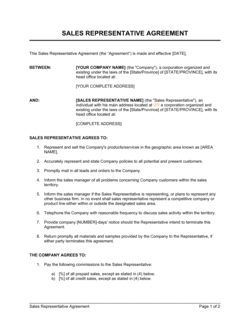
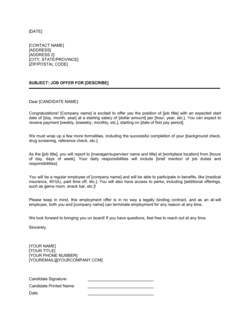
Sales Commission Policy Template

Free Word download β€’ Edit online β€’ Save & share with Drive β€’ Export to PDF

1 pageβ€’20–25 min to fillβ€’Difficulty: Standard
Learn more ↓
FreeSales Commission Policy Template

At a glance

What it is
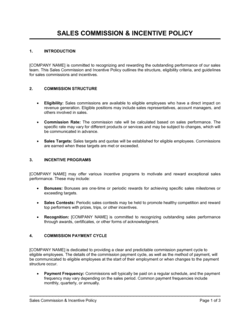
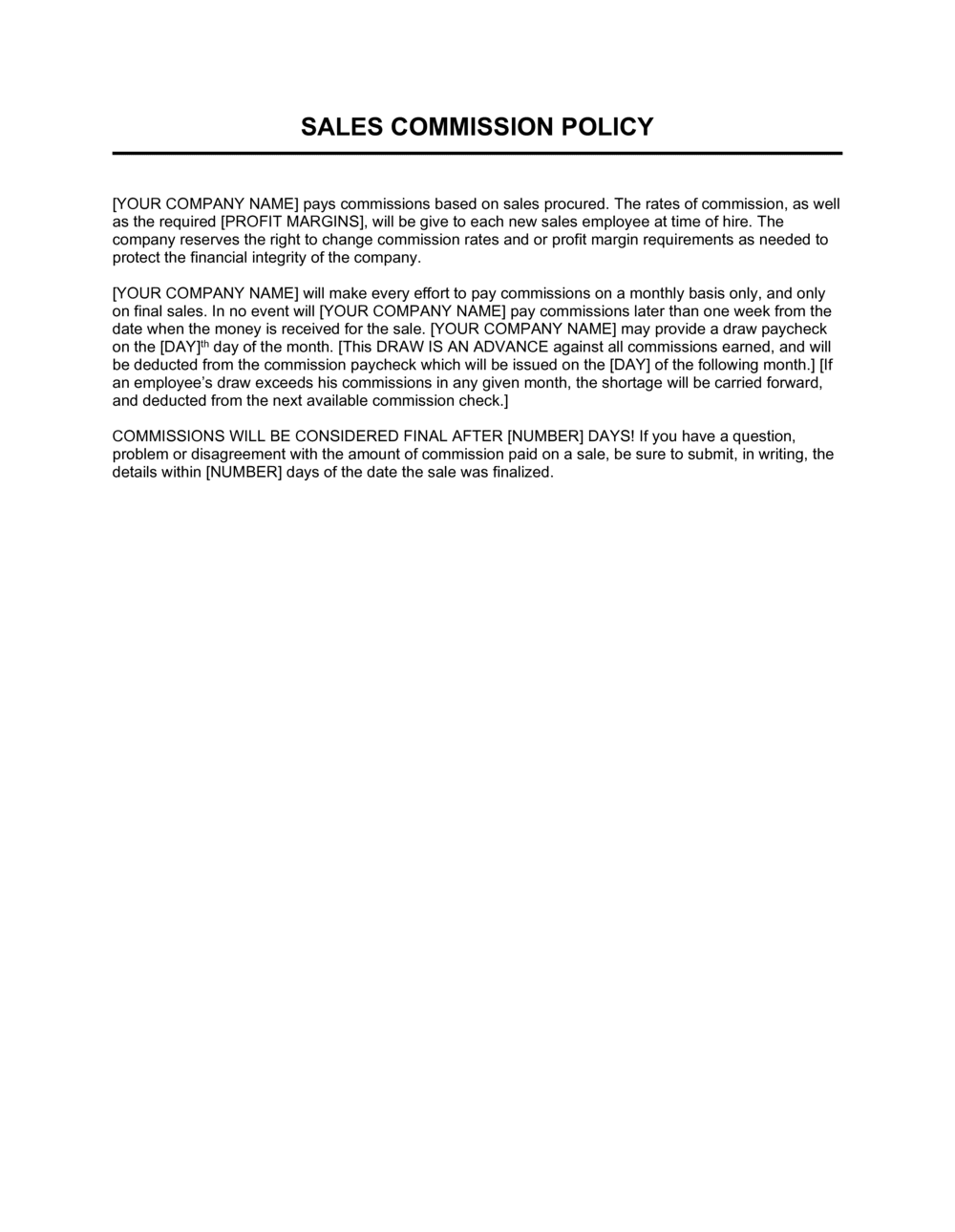
A Sales Commission Policy is an internal policy document that defines how sales representatives and account managers earn commission β€” covering rate structures, quota targets, eligible revenue, payment timing, and dispute procedures. This free Word download gives you a ready-to-edit starting point you can tailor to your team size and compensation model, then export as PDF for distribution and acknowledgment.
When you need it
Use it when onboarding your first commissioned sales hire, when restructuring compensation after a pricing or product change, or when commission disputes arise and no written policy exists to resolve them.
What's inside
Policy scope and eligibility, commission rate tiers, quota setting and tracking methodology, eligible and excluded revenue, commission calculation examples, payment schedule, clawback conditions, and dispute resolution procedures.

What is a Sales Commission Policy?

A Sales Commission Policy is an internal operational document that defines the rules governing how sales representatives earn, calculate, and receive commission compensation. It specifies which roles are eligible, how commission rates are structured across attainment tiers, which revenue qualifies for payout, when payment is triggered, under what conditions previously paid commission can be recovered, and how disputes are resolved. Unlike a casual verbal agreement or a one-line clause in an offer letter, a written policy creates a single authoritative reference that applies consistently across every rep, every deal, and every period.

Why You Need This Document

Without a written commission policy, every unusual deal becomes a negotiation: the heavily discounted contract, the deal split between two reps, the customer who cancels 45 days after the rep was paid. Disputes escalate to management, erode trust, and cost time that should go toward selling. Beyond internal friction, several US states β€” California and Illinois among them β€” treat earned commission as wages, meaning an underpaid commission claim can become a wage-theft allegation with statutory penalties. A clear policy, acknowledged in writing by each eligible employee before the period starts, closes the ambiguity that creates these problems. This template gives you a complete, editable starting point covering every material element of a defensible commission structure β€” so your team knows exactly what they earn, when they earn it, and what happens when something goes wrong.

Which variant fits your situation?

If your situation is…Use this template
Individual contributor with a single flat commission rateSales Commission Policy (Flat Rate)
Tiered commission structure that accelerates above quotaSales Commission Policy (Tiered)
Sales team with a base salary plus commission splitSales Compensation Plan
Independent contractor or outside sales repSales Representative Agreement
Channel or reseller partner commission programReseller Commission Agreement
Recurring SaaS revenue with renewal commission rulesSaaS Sales Commission Policy
Real estate or property sales commission structureReal Estate Commission Agreement

Common mistakes to avoid

❌ Defining 'close' without specifying the triggering event

Why it matters: If the policy says commission is earned 'when a deal closes,' every rep interprets 'close' differently β€” signed contract, booked in CRM, invoiced, or cash received. The difference can be weeks of payment timing and creates disputes at scale.

Fix: Define the exact triggering event in one sentence: 'Commission is earned on the date the customer invoice is generated in [BILLING SYSTEM].'

❌ No clawback clause

Why it matters: Without a clawback provision, the company has no contractual basis to recover commission on deals that cancel, churn, or default shortly after payment β€” a material liability for businesses with subscription or installment revenue.

Fix: Add a clawback section specifying a recovery window (30–90 days), the triggering events, and the exact recovery mechanism before any sales hire receives the policy.

❌ Omitting the accelerator and decelerator bands

Why it matters: A policy that only states the base rate leaves the most motivating and most litigated parts of the commission structure undocumented. Reps will model their own attainment scenarios and act on what they assumed.

Fix: Document every attainment band β€” below 80%, 80–100%, 100–120%, above 120% β€” with the corresponding rate in a table inside the policy.

❌ No amendment clause

Why it matters: Commission structures change almost every fiscal year. Without a written right to amend with notice, prior commission documents may be treated as fixed contractual obligations, limiting your ability to update rates or quotas.

Fix: Include a standard amendment clause: 'The Company reserves the right to modify this policy with [30] days' written notice to eligible employees prior to the start of the affected commission period.'

❌ Distributing the policy without collecting acknowledgment

Why it matters: If a rep disputes their commission and claims they never agreed to the policy terms, the absence of a signed acknowledgment gives that argument traction and complicates resolution.

Fix: Require every covered employee to sign or digitally acknowledge the policy before the commission period begins, and retain the timestamped record in your HR system.

❌ Vague Eligible Revenue definition with no exclusion list

Why it matters: Without an explicit list of excluded revenue β€” taxes, discounts above threshold, pass-through costs, house accounts β€” every unusual deal becomes a negotiation about what counts toward commission.

Fix: List inclusions and exclusions by name with a reference to the specific field in your CRM or billing system so there is a single source of truth for every calculation.

The 10 key sections, explained

Policy scope and eligible roles

Commission rate structure

Quota setting and assignment

Eligible and excluded revenue

Commission calculation method

Payment schedule and triggering events

Clawback conditions

Splits and overlay credits

Dispute resolution

Policy acknowledgment and amendments

How to fill it out

  1. 1

    Define eligible roles and the policy effective date

    List every job title covered by the policy by name, not department. Enter the effective date and confirm it aligns with the start of your next commission period.

    πŸ’‘ If you are replacing a prior informal agreement, state explicitly in the scope section that this document supersedes all prior verbal or written arrangements.

  2. 2

    Set the commission rate tiers

    Enter your base commission rate, then define the attainment thresholds at which accelerators or decelerators kick in. Express both as a percentage of Eligible Revenue.

    πŸ’‘ A simple three-band structure β€” below 80%, 80–100%, above 100% β€” covers most sales teams without creating calculation complexity that erodes trust.

  3. 3

    Define Eligible Revenue precisely

    List every revenue category that counts toward commission and every category that does not. Reference the specific CRM field or billing system line that represents each category.

    πŸ’‘ Ask your finance team to pull a sample of last quarter's deals and test your Eligible Revenue definition against them before publishing the policy.

  4. 4

    Write a worked calculation example

    Take one representative deal value, apply every step of the commission formula β€” discounts, eligible revenue, rate, accelerator if applicable β€” and show the output. Include this example in the policy body.

    πŸ’‘ Use a deal size near the median of your average contract value so the example feels realistic to your team.

  5. 5

    Set the payment trigger and payment date

    Choose your payment trigger (contract signed, invoiced, or cash collected) and the specific calendar date or payroll cycle on which commission is paid. Align this with your payroll system.

    πŸ’‘ Cash-collected triggers protect cash flow but demotivate reps on long payment cycles. Consider a hybrid: 50% on invoice, 50% on cash collected for deals with terms over Net 45.

  6. 6

    Define clawback conditions and recovery method

    Specify the clawback window in days, the triggering events (cancellation, refund, fraud), and how recovery works β€” deduction from future commission or direct invoice.

    πŸ’‘ 90 days is the most common clawback window for SaaS and subscription businesses; 30 days works for transactional product sales with clear delivery events.

  7. 7

    Add the dispute resolution process and timeline

    Name the specific role or team that receives disputes, set a filing deadline (typically 15 business days from the commission statement), and state the escalation path and final decision authority.

    πŸ’‘ Publishing a dispute process reduces disputes by signaling that the company takes calculation accuracy seriously β€” most reps will verify the math before filing.

  8. 8

    Collect signed acknowledgments before the period begins

    Distribute the completed policy to all covered employees and collect a signed acknowledgment before the commission period starts. Store signed copies in your HR system.

    πŸ’‘ Collecting acknowledgment digitally with a timestamp is as valid as a wet signature and takes less than 24 hours for most teams.

Frequently asked questions

What is a sales commission policy?

A sales commission policy is an internal document that defines how sales representatives earn commission β€” including the commission rate or tier structure, qualifying revenue types, quota methodology, payment timing, clawback conditions, and how disputes are resolved. It replaces informal verbal agreements with a written standard that applies consistently across the sales team.

What should a sales commission policy include?

At minimum: eligible roles and effective date, commission rate structure with any accelerators or decelerators, definition of Eligible Revenue and explicit exclusions, quota-setting process, payment trigger and schedule, clawback conditions, split and overlay rules, dispute resolution process, and an acknowledgment and amendment clause. Missing any of these sections creates a gap that typically surfaces at the worst possible moment β€” a disputed payout.

What is the difference between a commission policy and a commission agreement?

A commission policy is an internal document that sets the rules for the entire sales organization β€” it applies to all covered roles and can be updated by the company with notice. A commission agreement is a bilateral contract between the company and a specific individual, negotiated and signed as part of their employment terms. For most businesses, a policy acknowledged in writing by each employee is sufficient; a separate agreement is used for senior reps or independent contractors with individually negotiated rates.

When should commission be triggered β€” at contract signing, invoicing, or cash collection?

The choice depends on your revenue model and cash position. Contract signing motivates rapid deal closure but creates liability if deals frequently cancel before invoicing. Invoicing is the most common trigger for B2B businesses. Cash collection is safest for the company but demotivates reps on deals with long payment terms. A hybrid approach β€” 50% on invoice, 50% on cash collected β€” works well for high-value deals with terms beyond Net 45.

What is a commission clawback and how long should the window be?

A clawback requires a sales representative to return previously paid commission if the underlying deal cancels, is refunded, or the customer defaults within a defined window. Typical windows range from 30 days for transactional product sales to 90 days for SaaS subscriptions or service contracts. The window should match your average deal cancellation pattern β€” if most cancellations happen in the first 60 days, a 90-day window captures the vast majority of clawback events.

How do you handle commission when two reps work on the same deal?

The policy should define a default split rule and require written agreement on the split before the deal closes. Common approaches include equal splits (50/50) for co-selling peers, proportional splits based on documented activity, and overlay credits for specialist roles that do not reduce the primary rep's commission. Without a written split rule, managers adjudicate every collaborative deal individually, which creates inconsistency and discourages teamwork.

Can a company change a sales commission policy mid-year?

Yes, if the policy includes an amendment clause giving the company the right to update terms with advance notice β€” typically 30 days. Without that clause, changes to a commission structure that employees have already worked under may be treated as a modification of their compensation agreement, potentially requiring their consent. Best practice is to time major commission changes to the start of a new fiscal year or quarter and communicate them in writing before the period begins.

Do I need a lawyer to create a sales commission policy?

For most small and mid-size businesses with straightforward commission structures, a well-designed template is sufficient. Engage an employment lawyer when the policy includes unusual clawback provisions, applies to independent contractors in states with strict earned-commission laws (such as California), or when commission represents a significant percentage of total compensation for a large team. A one-hour legal review typically costs $200–$400 and is worthwhile before rolling out a policy to more than 10 commissioned employees.

What is an on-target earnings (OTE) figure and how does it relate to the commission policy?

On-target earnings is the total compensation a sales representative earns when hitting exactly 100% of their quota β€” base salary plus full commission at the standard rate. The commission policy defines the rate structure that produces the commission component of OTE. When recruiting, OTE is quoted as a single number; the policy explains how the commission portion of that number is earned, calculated, and paid.

How this compares to alternatives

vs Sales Compensation Plan

A sales compensation plan is a broader document covering base salary, OTE, equity, benefits, and the overall pay mix for a sales role. A commission policy is the specific section that governs how commission is calculated and paid. The two are often distributed together but serve different functions β€” the plan sets expectations, the policy sets rules.

vs Sales Representative Agreement

A sales representative agreement is a bilateral contract with a specific individual β€” typically an independent contractor β€” that governs the entire commercial relationship including territory, exclusivity, and commission terms. A commission policy is an internal company document that applies to all eligible employees. The agreement is negotiated per person; the policy is set by the company and acknowledged by the employee.

vs Employee Bonus Policy

A bonus policy governs discretionary or performance-based one-time payments tied to company or individual goals. A commission policy governs recurring payments directly tied to individual revenue production on a deal-by-deal basis. Bonuses are typically discretionary; commission, once earned under the policy terms, is generally considered owed compensation in most jurisdictions.

vs Sales Plan

A sales plan outlines go-to-market strategy, target accounts, revenue goals, and tactical initiatives for a defined period. A commission policy defines how individual reps are paid when they execute that plan. The sales plan is a strategic document for the organization; the commission policy is an operational document for the individuals doing the selling.

Industry-specific considerations

SaaS / Technology

Renewal commission rules, ARR expansion credits, and multi-year deal proration are standard additions for subscription-based businesses.

Financial Services

Regulatory restrictions on commission structures (FINRA, FCA) and suitability requirements often constrain rate design and require compliance review before publication.

Real Estate

Commission splits between listing and buyer agents, brokerage fee deductions, and referral fee pass-throughs are industry-specific additions that standard policies omit.

Manufacturing and Distribution

Rep territories, house account carve-outs, and commission on distributor sell-through versus direct sales require distinct eligibility and rate sections.

Template vs pro β€” what fits your needs?

PathBest forCostTime
Use the templateSmall sales teams of 1–10 reps with a straightforward flat or tiered commission structureFree2–4 hours to complete and distribute
Template + professional reviewTeams of 10+ reps, complex multi-product rate structures, or roles with significant clawback exposure$200–$500 for a one-hour employment lawyer or HR consultant review1–3 days
Custom draftedEnterprise sales organizations, regulated industries, or independent contractor networks with state-specific earned-commission compliance requirements$1,000–$3,000 for a custom employment counsel engagement1–2 weeks

Glossary

Commission Rate
The percentage of a qualifying sale's value paid to the sales representative as earned compensation.
Quota
A defined revenue or unit target assigned to a sales representative for a given period, typically a quarter or fiscal year.
On-Target Earnings (OTE)
The total compensation a sales representative earns when hitting exactly 100% of quota, combining base salary and full commission.
Accelerator
An increased commission rate that applies once a representative exceeds quota β€” for example, 10% on deals above 100% of quota versus 7% below.
Clawback
A provision requiring a sales representative to return previously paid commission if a deal is cancelled, refunded, or the customer defaults within a defined period.
Draw Against Commission
A guaranteed advance on future commission earnings, typically used during ramp-up periods, which the representative repays from earned commission.
Eligible Revenue
The subset of closed revenue that counts toward commission calculation β€” typically excluding taxes, discounts beyond a set threshold, and pass-through costs.
Split Commission
A commission shared between two or more sales representatives who jointly contributed to closing a deal β€” for example, a named account rep and an overlay specialist.
Ramp Period
A defined initial period β€” typically 30 to 90 days β€” during which a new hire's quota is reduced while they build their pipeline.
Spiff
A short-term bonus paid for selling a specific product, hitting a time-limited target, or closing a strategically important deal, separate from the standard commission structure.

Part of your Business Operating System

This document is one of 3,000+ business & legal templates included in Business in a Box.

  • Fill-in-the-blanks β€” ready in minutes
  • 100% customizable Word document
  • Compatible with all office suites
  • Export to PDF and share electronically

Create your document in 3 simple steps.

From template to signed document β€” all inside one Business Operating System.
1
Download or open template

Access over 3,000+ business and legal templates for any business task, project or initiative.

2
Edit and fill in the blanks with AI

Customize your ready-made business document template and save it in the cloud.

3
Save, Share, Send, Sign

Share your files and folders with your team. Create a space of seamless collaboration.

Save time, save money, and create top-quality documents.

β˜…β˜…β˜…β˜…β˜…

"Fantastic value! I'm not sure how I'd do without it. It's worth its weight in gold and paid back for itself many times."

Managing Director Β· Mall Farm
Robert Whalley
Managing Director, Mall Farm Proprietary Limited
β˜…β˜…β˜…β˜…β˜…

"I have been using Business in a Box for years. It has been the most useful source of templates I have encountered. I recommend it to anyone."

Business Owner Β· 4+ years
Dr Michael John Freestone
Business Owner
β˜…β˜…β˜…β˜…β˜…

"It has been a life saver so many times I have lost count. Business in a Box has saved me so much time and as you know, time is money."

Owner Β· Upstate Web
David G. Moore Jr.
Owner, Upstate Web

Run your business with a system β€” not scattered tools

Stop downloading documents. Start operating with clarity. Business in a Box gives you the Business Operating System used by over 250,000 companies worldwide to structure, run, and grow their business.

Start freeΒ Β·Β No credit card required