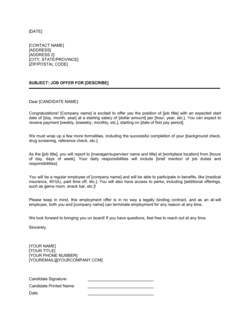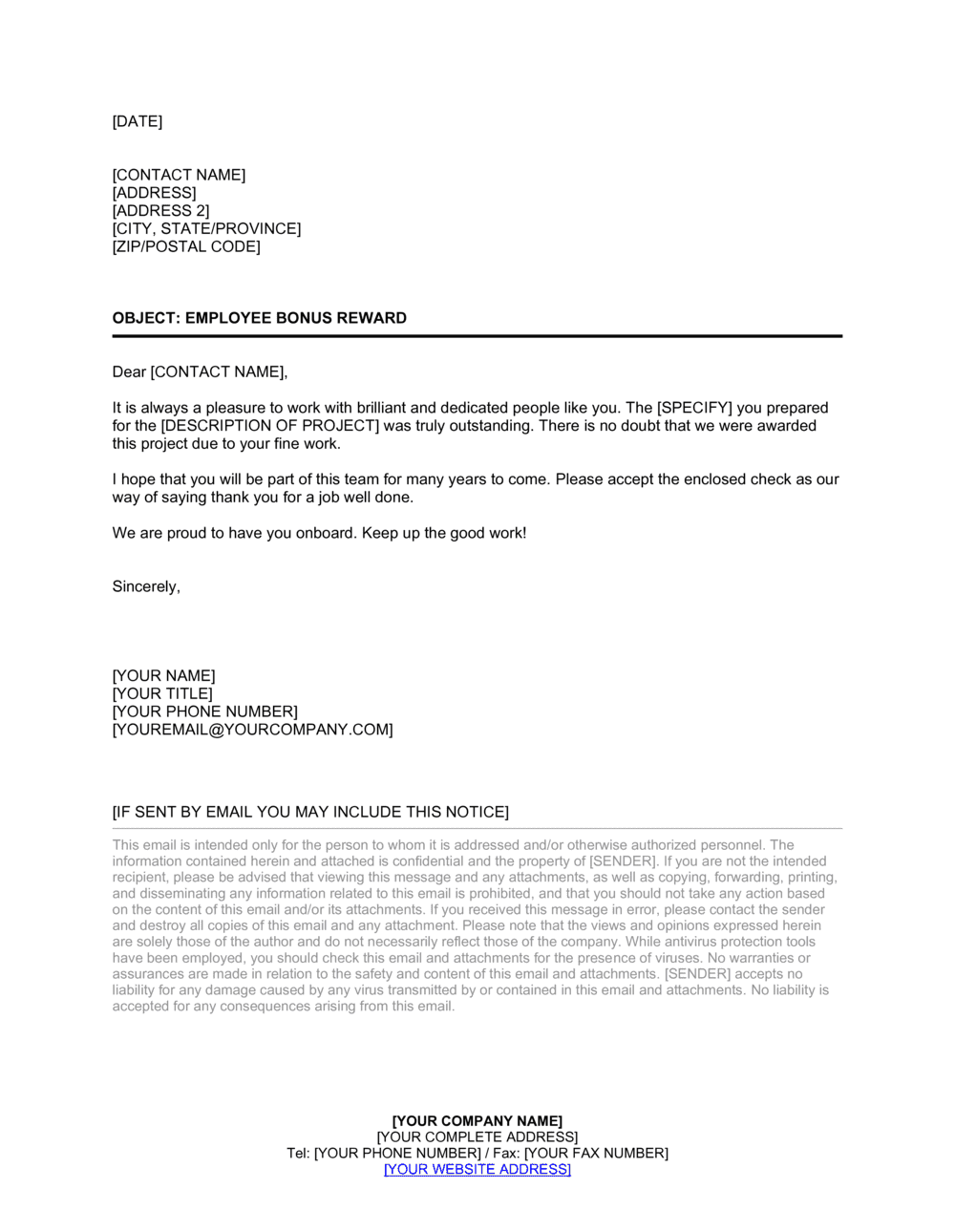
Company Bonus Letter Template

Free Word download β€’ Edit online β€’ Save & share with Drive β€’ Export to PDF

1 pageβ€’15–20 min to fillβ€’Difficulty: Standard
Learn more ↓
FreeCompany Bonus Letter Template

At a glance

What it is
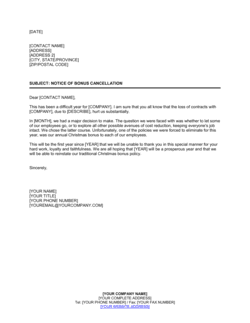
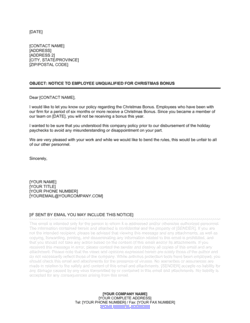
A Company Bonus Letter is a formal written notice from an employer to an employee confirming the award of a bonus β€” including the amount, payment date, and the reason for the award. This free Word download gives you a professionally formatted letter you can edit online, personalize per recipient, and export as PDF in minutes.
When you need it
Use it whenever you need to formally communicate a discretionary bonus, performance-based bonus, or holiday bonus to one or more employees. It serves as a written record for both HR files and employee reference.
What's inside
Date and recipient details, a clear statement of the bonus amount and payment date, the rationale tied to performance or company policy, any applicable conditions (e.g., continued employment), and a closing acknowledgment from the authorized signatory.

What is a Company Bonus Letter?

A Company Bonus Letter is a formal written notice from an employer to an employee that documents the award of a bonus β€” stating the gross payment amount, the scheduled payment date, the reason for the award, and any conditions attached to it. Unlike an informal verbal acknowledgment or a line item on a pay stub, a bonus letter creates a clear written record for both the employer's HR files and the employee's personal documentation. It communicates not just the financial award but the rationale behind it, reinforcing the connection between the employee's actions and the company's recognition of those actions.

Why You Need This Document

Paying a bonus without a written letter leaves both parties exposed. Employees who receive an unexpected deposit with no explanation may misinterpret the amount, dispute the tax withholding, or β€” if conditions were attached β€” claim the award was unconditional. Employers without documentation cannot demonstrate what was promised, to whom, under what conditions, and who authorized it. A properly formatted bonus letter closes those gaps: it sets the correct gross-amount expectation before the payment hits, documents any employment-continuation or clawback conditions in plain language, and creates the paper trail needed for payroll audits and compensation planning. This template gives you a professionally structured letter you can personalize and issue in under 10 minutes β€” consistent across every recipient, defensible in any review, and clear enough that HR never has to field follow-up calls on payday.

Which variant fits your situation?

If your situation is…Use this template
Awarding a bonus tied to individual performance review resultsPerformance Bonus Letter
Distributing a fixed holiday or year-end bonus to all staffHoliday Bonus Letter
Notifying a new hire of a sign-on bonus and retention conditionsSign-On Bonus Letter
Awarding a bonus to a senior executive with equity or deferred componentsExecutive Bonus Agreement
Recognizing a team rather than an individual for a project milestoneTeam Bonus Announcement Letter
Documenting a retention bonus tied to continued employment for a set periodRetention Bonus Letter

Common mistakes to avoid

❌ Stating the net amount instead of the gross

Why it matters: Employees who receive a letter quoting a net figure and then see a different gross on their pay stub feel the company misrepresented the award, creating unnecessary distrust.

Fix: Always state the gross bonus amount and add a sentence confirming that applicable taxes will be withheld β€” this sets the correct expectation before payday.
❌ Vague or missing rationale

Why it matters: A letter that states only an amount with no performance link gives employees no information about what behavior earned the reward, reducing its effect on future motivation.

Fix: Include at least one sentence that names the specific achievement, metric, or policy that triggered the award β€” quantify it wherever possible.

❌ Ambiguous conditions language

Why it matters: Phrases like 'subject to continued good standing' leave the trigger event undefined, making it difficult to enforce or defend a non-payment decision if the employee disputes it.

Fix: State conditions precisely: name the specific date employment must continue through, and define what constitutes a terminating event (voluntary resignation, termination for cause, or both).

❌ No named signatory on the letter

Why it matters: A letter signed by 'Management' or 'Human Resources' creates ambiguity about who authorized the award β€” relevant if the employee later claims the bonus was contractually promised.

Fix: Always include the full name and title of the individual authorized to approve bonus payments, and have them physically or electronically sign each letter.

The 8 key clauses, explained

Date, Sender, and Recipient Header

In plain language: Identifies when the letter was written, who it is from, and who it is addressed to β€” establishing the official record.

Sample language
[DATE] | [COMPANY NAME] | [COMPANY ADDRESS] | To: [EMPLOYEE FULL NAME] | [EMPLOYEE JOB TITLE] | [DEPARTMENT]

Common mistake: Using a nickname or informal name instead of the employee's legal name β€” this can create a mismatch with payroll records and tax documents.

Subject Line

In plain language: A one-line label that identifies the letter's purpose at a glance.

Sample language
Subject: Bonus Award Notification β€” [PERFORMANCE PERIOD / PROGRAM NAME]

Common mistake: Omitting the subject line entirely, which forces the reader to scan the body to understand the letter's purpose β€” unprofessional and adds confusion in HR filing.

Opening Salutation and Recognition Statement

In plain language: Addresses the employee by name and opens with a brief acknowledgment of the reason for the bonus.

Sample language
Dear [EMPLOYEE FIRST NAME], We are pleased to inform you that you have been awarded a bonus in recognition of your [performance during / contributions to] [PERFORMANCE PERIOD / PROJECT NAME].

Common mistake: Opening with generic praise like 'You are a valued employee' without connecting the recognition to a specific achievement β€” employees read this as formulaic and demotivating.

Bonus Amount and Payment Date

In plain language: States the gross bonus amount clearly and confirms the exact date on which payment will be made.

Sample language
Your bonus in the amount of $[AMOUNT] (gross) will be included in your paycheck on [PAYMENT DATE] or deposited directly to your bank account on file.

Common mistake: Stating only the net amount after taxes without clarifying it is post-deduction β€” employees who later see a different gross figure on their pay stub feel misled.

Rationale and Performance Linkage

In plain language: Explains the specific reason for the bonus β€” individual performance, company results, a milestone, or a policy β€” to reinforce the connection between effort and reward.

Sample language
This award reflects your [achievement of X% above quota / successful delivery of PROJECT NAME / contributions during the fiscal year ending DATE] and the Company's recognition of outstanding performance.

Common mistake: Skipping the rationale entirely and stating only the amount. Without context, employees cannot replicate the behavior that earned the award, reducing its motivational impact.

Tax Withholding Notice

In plain language: Informs the employee that standard payroll taxes and withholding will apply to the bonus payment.

Sample language
Please note that your bonus is subject to applicable federal, state, and local income tax withholding, as well as Social Security and Medicare deductions, in accordance with current payroll regulations.

Common mistake: Omitting the tax notice entirely β€” employees who expect to receive the gross amount and later see a significantly lower net deposit often contact HR or payroll unnecessarily.

Conditions or Clawback Terms (if applicable)

In plain language: States any conditions attached to the bonus β€” such as a requirement to remain employed through the payment date or a clawback period.

Sample language
This bonus is contingent upon your continued employment with [COMPANY NAME] through [PAYMENT DATE]. Should your employment end voluntarily or for cause before that date, this award will not be paid.

Common mistake: Adding clawback or employment-continuation conditions in informal language that is ambiguous about the trigger event β€” courts interpret vague conditions against the drafter.

Closing and Signatory Block

In plain language: Closes the letter with a congratulatory note and includes the name, title, and signature of the authorized representative issuing the bonus.

Sample language
Congratulations on this achievement. We look forward to your continued contributions. Sincerely, [AUTHORIZED SIGNATORY NAME] | [TITLE] | [COMPANY NAME]

Common mistake: Signing the letter with a generic title like 'The Management Team' instead of a named individual β€” this reduces accountability and can create disputes about who authorized the award.

How to fill it out

  1. 1

    Enter the date and company header

    Add today's date, your company's full legal name, and your business address at the top of the letter. This establishes the official date of the communication for HR and payroll records.

    πŸ’‘ Use the same date the bonus is formally approved β€” not the payment date β€” so the letter accurately reflects when the award decision was made.

  2. 2

    Add the employee's full name, title, and department

    Enter the employee's legal name as it appears on payroll records, their job title, and department. Use the correct legal name to ensure the letter matches tax documents.

    πŸ’‘ For bulk bonus runs, use a mail-merge to populate name, title, and amount fields β€” this eliminates transcription errors across large recipient lists.

  3. 3

    Write a specific subject line

    Label the letter with a subject line that includes the bonus type and the performance period β€” for example, 'Q4 2025 Performance Bonus Award' or 'Fiscal Year 2025 Holiday Bonus.'

    πŸ’‘ A specific subject line makes the letter easy to locate in an employee's file years later and avoids confusion if multiple bonus rounds occur in the same year.

  4. 4

    State the gross bonus amount and payment date

    Enter the exact gross dollar amount and the specific date the payment will be processed. Confirm the payment date with payroll before sending the letter.

    πŸ’‘ Always state the gross amount, then note that taxes will be withheld β€” do not state only the net figure.

  5. 5

    Tie the award to a specific achievement or policy

    Write one to two sentences connecting the bonus to a concrete result β€” a quota attained, a project delivered, or a company-wide performance threshold met.

    πŸ’‘ Quantify the achievement where possible: '118% of annual sales target' is more motivating and defensible than 'strong performance.'

  6. 6

    Include the tax withholding notice

    Add a sentence confirming that the bonus will be subject to applicable federal, state, and local tax withholding per standard payroll procedures.

    πŸ’‘ If your payroll system applies the supplemental flat rate rather than the employee's regular withholding rate, note that here to preempt payroll inquiries.

  7. 7

    Add any conditions and have an authorized signatory sign

    If the bonus has a continued-employment condition or clawback period, state it plainly in the conditions clause. Then have the appropriate manager, HR director, or executive sign the letter before delivery.

    πŸ’‘ Deliver the signed letter to the employee at least one pay cycle before the payment date so they can review it and ask questions before funds arrive.

Frequently asked questions

What is a company bonus letter?

A company bonus letter is a formal written notice from an employer to an employee that confirms a bonus award, states the gross amount and payment date, explains the reason for the award, and outlines any attached conditions. It creates a documented record for both HR files and the employee's personal records, and it reinforces the connection between performance and reward.

Is a bonus letter legally binding?

A bonus letter is generally not a binding contract on its own unless it explicitly promises a future payment with no discretionary language. Discretionary bonus letters β€” which state that the award was granted at the company's discretion β€” do not typically create a recurring obligation. However, a letter that promises a non-discretionary bonus tied to a measurable condition the employee has already met may be enforceable. Consider consulting an employment lawyer if large sums or complex conditions are involved.

Should the bonus letter state the gross or net amount?

Always state the gross amount β€” the full sum before taxes and deductions. Include a sentence noting that applicable payroll taxes will be withheld. Stating only the net amount can mislead the employee about the total award and creates confusion when the gross figure appears on the pay stub or annual tax document.

What is the difference between a discretionary and a non-discretionary bonus?

A discretionary bonus is paid at the employer's choice β€” the company decides the amount and timing each period, with no prior commitment to pay. A non-discretionary bonus is automatically earned when a pre-defined condition is met, such as reaching a sales quota, and creates a legal obligation to pay once that threshold is crossed. The bonus letter should make clear which type it is to avoid creating unintended entitlements.

Does a bonus letter need to be signed?

No legal requirement mandates a signature on a bonus notification letter in most jurisdictions, but having an authorized signatory sign each letter is strongly recommended. A named signature establishes who approved the award and at what level of authority, which matters if the amount or conditions are later disputed by the employee or audited by regulators.

Can a bonus be clawed back after it is paid?

Yes, if the letter includes a valid clawback provision β€” for example, requiring repayment if the employee resigns within 12 months of receiving the award. To be enforceable, the clawback terms must be clearly stated in the letter, the employee must have received the letter before accepting the payment, and the repayment obligation must comply with applicable wage and salary laws in the governing jurisdiction.

How much lead time should I give before sending a bonus letter?

Send the letter at least one full pay cycle before the payment date β€” two weeks for bi-weekly payroll. This gives employees time to review the letter, ask questions, and verify that their direct-deposit details are current. For larger bonuses or those with conditions attached, sending the letter 30 days in advance is a common HR practice.

Can I use one letter template for all employees, or do I need separate versions?

A single template works well for standard bonus rounds. Use mail-merge to populate each employee's name, title, department, gross amount, and payment date from a payroll spreadsheet. If different employee groups have different conditions, rationale, or bonus types, create a separate template variant for each group rather than adding complex conditional language to a single letter.

Does a bonus letter need to address taxes?

Including a brief tax notice is best practice even though it is not legally required in most jurisdictions. Without it, employees who are surprised by the withholding on their pay stub often contact HR or payroll unnecessarily. A single sentence β€” noting that the bonus is subject to applicable federal, state, and local tax withholding β€” is sufficient and prevents most payroll inquiries.

How this compares to alternatives

vs Salary Increase Letter

A salary increase letter permanently adjusts the employee's base compensation going forward and modifies the employment agreement. A bonus letter communicates a one-time payment with no impact on the ongoing salary structure. Use a bonus letter when you want to reward performance without changing the fixed payroll baseline.

vs Employment Contract

An employment contract governs the entire working relationship and may include bonus eligibility language. A bonus letter is a standalone communication that documents a specific award event. The two documents should be consistent β€” bonus letters issued under a contract should not promise terms that contradict the contract's bonus clause.

vs Commission Agreement

A commission agreement establishes the ongoing formula by which a salesperson earns variable compensation for each deal closed. A bonus letter communicates a discrete, typically non-recurring award. Commissions are non-discretionary and formula-driven; bonus letters typically cover discretionary awards not governed by a commission plan.

vs Employee Recognition Letter

An employee recognition letter acknowledges contributions or behavior without any monetary component. A bonus letter includes a specific payment amount and date. Use a recognition letter when you want to acknowledge effort or values alignment; use a bonus letter when you are authorizing an actual cash award.

Industry-specific considerations

Technology / SaaS

Performance bonuses tied to product launch milestones, annual recurring revenue targets, or sprint-based delivery goals.

Financial Services

Year-end discretionary bonuses that must carefully distinguish between discretionary and non-discretionary language to avoid creating regulatory entitlements.

Retail / Hospitality

Holiday bonuses distributed to large hourly staff populations, often requiring bulk mail-merge processing and careful net-versus-gross communication.

Professional Services

Utilization- or revenue-based performance bonuses tied to individual billable hours achieved above a target threshold during the fiscal year.

Template vs pro β€” what fits your needs?

PathBest forCostTime
Use the templateHR managers, small business owners, and operations teams issuing standard performance or holiday bonusesFree5–10 minutes per letter
Template + professional reviewBonuses with clawback provisions, employment-continuation conditions, or awards above $25,000$100–$300 for a brief HR or legal review1–2 business days
Custom draftedExecutive bonuses with deferred compensation, equity linkage, or complex multi-year clawback structures$500–$2,000+ for employment counsel3–7 business days

Glossary

Discretionary Bonus
A bonus the employer pays at its own discretion, with no prior contractual obligation to do so β€” the amount and timing can vary each period.
Non-Discretionary Bonus
A bonus earned automatically when a measurable condition is met β€” such as hitting a sales quota β€” which creates a legal obligation to pay once that condition is satisfied.
Gross Bonus Amount
The total bonus before income tax withholding and any other payroll deductions are applied.
Net Bonus Amount
The amount the employee actually receives after all applicable taxes and deductions have been withheld.
Supplemental Wage Rate
The flat federal withholding rate β€” 22% in the US as of 2025 β€” that employers may apply to bonus payments instead of using the employee's regular withholding rate.
Clawback Provision
A condition that requires the employee to repay all or part of a bonus if they leave within a set period or if a triggering event β€” such as a restatement of financials β€” occurs.
Payment Date
The specific calendar date on which the bonus funds will be deposited or disbursed to the employee.
Performance Period
The defined timeframe β€” a quarter, a fiscal year, or a project duration β€” during which the employee's performance was measured to determine bonus eligibility.

Part of your Business Operating System

This document is one of 3,000+ business & legal templates included in Business in a Box.

  • Fill-in-the-blanks β€” ready in minutes
  • 100% customizable Word document
  • Compatible with all office suites
  • Export to PDF and share electronically

Create your document in 3 simple steps.

From template to signed document β€” all inside one Business Operating System.
1
Download or open template

Access over 3,000+ business and legal templates for any business task, project or initiative.

2
Edit and fill in the blanks with AI

Customize your ready-made business document template and save it in the cloud.

3
Save, Share, Send, Sign

Share your files and folders with your team. Create a space of seamless collaboration.

Save time, save money, and create top-quality documents.

β˜…β˜…β˜…β˜…β˜…

"Fantastic value! I'm not sure how I'd do without it. It's worth its weight in gold and paid back for itself many times."

Managing Director Β· Mall Farm
Robert Whalley
Managing Director, Mall Farm Proprietary Limited
β˜…β˜…β˜…β˜…β˜…

"I have been using Business in a Box for years. It has been the most useful source of templates I have encountered. I recommend it to anyone."

Business Owner Β· 4+ years
Dr Michael John Freestone
Business Owner
β˜…β˜…β˜…β˜…β˜…

"It has been a life saver so many times I have lost count. Business in a Box has saved me so much time and as you know, time is money."

Owner Β· Upstate Web
David G. Moore Jr.
Owner, Upstate Web

Run your business with a system β€” not scattered tools

Stop downloading documents. Start operating with clarity. Business in a Box gives you the Business Operating System used by over 250,000 companies worldwide to structure, run, and grow their business.

Free Forever PlanΒ Β·Β No credit card required