Car Allowance Policy Template

Free Word download β€’ Edit online β€’ Save & share with Drive β€’ Export to PDF

2 pagesβ€’20–25 min to fillβ€’Difficulty: Standard
Learn more ↓
FreeCar Allowance Policy Template

At a glance

What it is
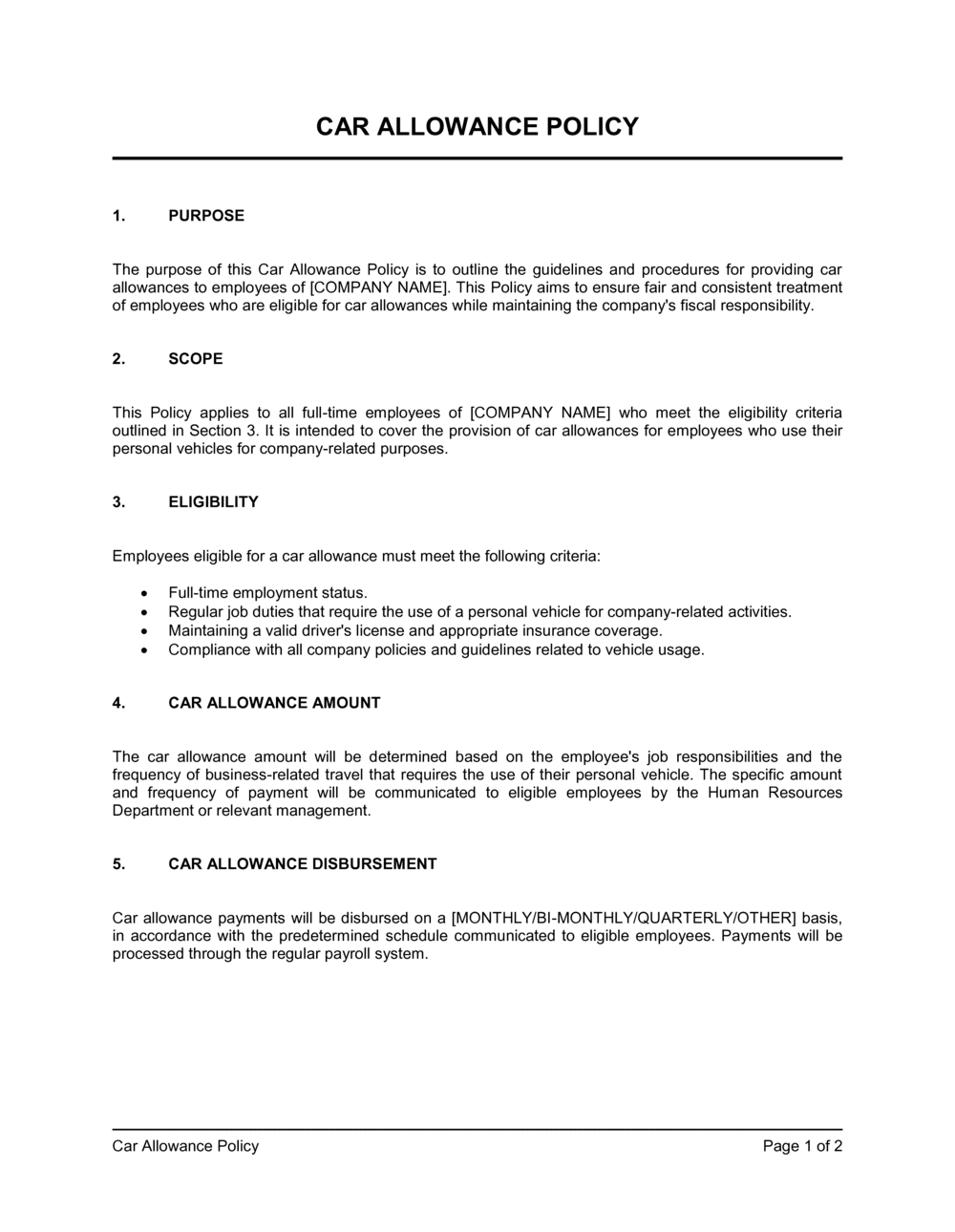
A Car Allowance Policy is an internal HR and operations document that defines the rules under which a company provides employees with a fixed monthly payment to offset the cost of using a personal vehicle for business purposes. This free Word download gives you a structured, editable template you can tailor to your eligibility criteria, allowance amounts, and tax reporting requirements, then distribute to employees and managers as a formal policy.
When you need it
Use it when your organization provides cash car allowances to employees who regularly drive for work β€” sales reps, field service technicians, account managers β€” and you need a written standard that governs who qualifies, how much they receive, and what documentation they must maintain.
What's inside
Eligibility criteria, allowance tier structure, tax treatment and payroll handling, mileage and expense tracking requirements, insurance obligations, policy review schedule, and the process for adjusting or revoking allowances when roles or business needs change.

What is a Car Allowance Policy?

A Car Allowance Policy is an internal HR and operations document that governs the terms under which a company pays employees a fixed monthly sum to offset the cost of using their personal vehicle for business driving. It defines which roles qualify, how allowance amounts are structured by tier, how the payment is handled for payroll tax purposes, what mileage documentation employees must maintain, and what insurance coverage they are required to carry. Unlike ad-hoc arrangements communicated by email or verbal agreement, a written policy creates a consistent, auditable standard that applies equally across departments and is enforceable as part of the employee's terms of employment.

Why You Need This Document

Without a written car allowance policy, companies routinely end up with inconsistent allowance amounts across equivalent roles, undocumented exceptions that create pay-equity exposure, and allowances that continue flowing to employees who no longer drive for work. From a tax standpoint, a flat allowance without supporting documentation cannot qualify as a non-taxable accountable plan β€” the IRS will treat it as ordinary wages, and undisclosed tax treatment generates employee complaints and payroll corrections. A clearly drafted policy eliminates all of these failure points: it tells employees exactly what they receive, why, and what they must do to keep it; it tells payroll how to process the payment correctly from day one; and it gives HR a written basis to adjust or revoke allowances when roles change β€” without dispute.

Which variant fits your situation?

If your situation is…Use this template
Employees use personal vehicles and are reimbursed per mile drivenMileage Reimbursement Policy
Company owns or leases vehicles assigned to specific employeesCompany Vehicle Use Policy
Employees receive a flat monthly cash payment regardless of miles drivenCar Allowance Policy
Field team members need a combined travel and expense policyTravel and Expense Policy
Executive team receives a vehicle benefit as part of a total compensation packageExecutive Compensation Policy
Remote employees occasionally travel to client sites and need ad-hoc reimbursementEmployee Expense Reimbursement Policy

Common mistakes to avoid

❌ Setting eligibility by employee name instead of job title

Why it matters: When the named employee leaves or changes roles, HR must remember to manually update the policy β€” and often doesn't. This creates unintended entitlements and missed eligibility for new hires in the same role.

Fix: Define eligibility by job title, grade level, or function, and maintain a separate Eligible Positions Schedule that HR updates quarterly.

❌ Omitting mileage documentation requirements for flat allowances

Why it matters: Without supporting records, the IRS can reclassify a flat allowance as a non-accountable plan, making it fully taxable and potentially triggering back-tax liability for unpaid payroll taxes.

Fix: Require a monthly mileage log regardless of whether the allowance is flat or per-mile, and audit submissions at least once per quarter.

❌ No revocation trigger for role changes or extended leave

Why it matters: Employees who move to desk-based roles or go on long-term leave continue receiving the allowance by default, resulting in payments for no business purpose and budget leakage that is difficult to recover.

Fix: Include an automatic revocation clause tied to role changes, leave periods exceeding 30 days, and loss of a valid driver's license, effective the first pay period after the triggering event.

❌ Not specifying a minimum insurance coverage amount

Why it matters: If an employee causes an accident while driving on company business with below-standard insurance, the injured party may pursue the employer for damages under a vicarious-liability theory.

Fix: State minimum liability limits (e.g., $100,000/$300,000 bodily injury) in the policy and require annual proof of insurance filed with HR.

❌ Distributing the policy without collecting signed acknowledgments

Why it matters: Without documented evidence that each employee received and agreed to the policy, the company cannot enforce the documentation, insurance, or revocation requirements if a dispute arises.

Fix: Require a dated signature from the employee and their manager before the first allowance payment is processed, and store signed copies in the personnel file.

❌ Allowing verbal exception approvals with no written record

Why it matters: Informal exceptions accumulate over time into a set of undocumented side arrangements that contradict the written policy, create pay-equity exposure, and are impossible to audit.

Fix: Require a written exception request approved by HR leadership or the CFO, filed in the employee's personnel record within five business days of the decision.

The 9 key sections, explained

Policy purpose and scope

Eligibility criteria

Allowance amounts and tier structure

Tax treatment and payroll reporting

Mileage and usage documentation requirements

Insurance and vehicle condition requirements

Allowance review, adjustment, and revocation

Employee responsibilities and acknowledgment

Policy exceptions and approval process

How to fill it out

  1. 1

    Identify eligible positions and driving thresholds

    Review job descriptions and travel records to determine which roles regularly require business driving. Set a minimum monthly mileage or trip-frequency threshold that separates genuine business drivers from occasional travelers.

    πŸ’‘ Pull three months of expense reports and mileage submissions before setting the threshold β€” actual data prevents you from setting a bar that is either too low (everyone qualifies) or too high (no one does).

  2. 2

    Set allowance amounts by tier

    Group eligible roles into two to four tiers based on expected driving volume and territory size. Assign a monthly dollar amount to each tier that reflects realistic costs for fuel, depreciation, insurance, and maintenance in your operating region.

    πŸ’‘ Use the current IRS standard mileage rate multiplied by the average monthly business miles for each tier as a sanity check against your proposed flat amounts.

  3. 3

    Decide on tax treatment and document it

    Confirm with your payroll team whether the allowance will run through the payroll system as taxable wages or as a separate accountable-plan reimbursement. Document the treatment in the policy and reflect it in the payroll configuration before the first payment.

    πŸ’‘ If you want the allowance to be non-taxable, you must require adequate documentation β€” a flat allowance with no mileage log cannot qualify as an accountable plan under IRS rules.

  4. 4

    Define documentation and submission requirements

    Specify the mileage log format, submission deadline, and the manager responsible for review. Attach the log template as an appendix so employees have no ambiguity about what is required.

    πŸ’‘ A log that takes more than five minutes per week to complete will not be filled out consistently β€” keep it to date, destination, purpose, and miles.

  5. 5

    Set minimum insurance requirements

    State the minimum liability coverage levels employees must carry on their personal vehicles and the frequency with which they must provide proof of insurance to HR.

    πŸ’‘ Check your state's minimum liability requirements first, then set your policy minimum at least one tier above the statutory floor to reduce vicarious-liability exposure.

  6. 6

    Draft the review, adjustment, and revocation clauses

    Set an annual review date for allowance amounts, define the triggers that automatically end an allowance (role change, extended leave, loss of driver's license), and specify the notice period before an allowance is discontinued.

    πŸ’‘ Tie the annual review to your compensation review cycle so allowance adjustments and salary changes are communicated together.

  7. 7

    Add an acknowledgment block and distribute

    Include a signature line for the employee and their manager, then distribute the policy through your HRIS or document management system so completed acknowledgments are stored automatically.

    πŸ’‘ Send the policy with a one-paragraph plain-language summary email β€” employees are more likely to read a short explanation than to open and read the full document cold.

Frequently asked questions

What is a car allowance policy?

A car allowance policy is an internal HR document that establishes the rules for paying employees a fixed monthly amount to offset the cost of using their personal vehicle for business purposes. It covers who qualifies, how much they receive, how the allowance is taxed, what records employees must keep, and what insurance they must carry. A written policy ensures consistent treatment across the organization and provides documentation for tax and audit purposes.

Is a car allowance taxable income for the employee?

In most cases, yes. A flat monthly car allowance paid to an employee is generally treated as taxable wages subject to federal and state income tax withholding and FICA taxes, because it does not require the employee to account for actual business expenses. To make all or part of the allowance non-taxable, the employer must structure it as an accountable plan β€” requiring employees to submit mileage logs and returning any amount that exceeds substantiated business expenses. Consult your payroll team or tax advisor for your specific situation.

What is the difference between a car allowance and mileage reimbursement?

A car allowance is a fixed monthly cash payment made regardless of the actual miles driven in a given month. Mileage reimbursement pays a set rate per business mile actually driven, typically pegged to the IRS standard mileage rate. Allowances are simpler to administer but may over- or under-compensate employees depending on driving volume. Mileage reimbursement is more precise but requires detailed trip logs for every business journey.

How do I set the right car allowance amount?

Start by estimating the average monthly business miles for each eligible role, then multiply by the current IRS standard mileage rate to get a baseline. Adjust upward if your region has significantly higher fuel, insurance, or parking costs than the national average. Group similar roles into two to four tiers so that employees with comparable driving demands receive comparable allowances. Review the amounts annually against the updated IRS rate and any changes in regional cost data.

Can a car allowance be revoked?

Yes. A car allowance is a benefit tied to job role and business driving requirements, not a permanent compensation component. A well-drafted policy specifies the conditions under which an allowance is revoked β€” typically a role change to a non-driving position, extended leave, or loss of a valid driver's license β€” and provides a short notice period before the revocation takes effect. Employees should acknowledge these revocation terms in writing when they first receive the policy.

What records do employees need to keep when receiving a car allowance?

Even for a flat allowance, employees should maintain a monthly mileage log recording the date, origin and destination, business purpose, and miles driven for each business trip. These records support the business purpose of the allowance if the IRS or a state tax authority questions the treatment, and they help the company monitor whether allowance tiers remain appropriate as driving patterns change.

What insurance coverage should employees carry to receive a car allowance?

At minimum, employees should carry personal auto liability insurance that meets the legal minimums in their state. Most companies set a policy minimum above the statutory floor β€” commonly $100,000 per person and $300,000 per occurrence for bodily injury β€” to reduce the company's exposure if an employee causes an accident while driving on company business. Employees should provide HR with an updated certificate of insurance annually and whenever their coverage changes.

Does a car allowance policy replace a company vehicle program?

No β€” they serve similar business goals through different mechanisms. A car allowance compensates employees for using their own vehicles, keeping the company out of the fleet management business. A company vehicle program provides employer-owned or leased vehicles, which the company insures, maintains, and eventually disposes of. Car allowances are administratively simpler and preferred by employees who want vehicle choice; company vehicles offer greater employer control over branding, safety standards, and insurance coverage.

How often should a car allowance policy be reviewed?

At least annually, aligned with the fiscal year or compensation review cycle. Key triggers for an off-cycle review include a significant change in fuel prices, an update to the IRS standard mileage rate, a restructuring of the sales or field-service organization, or a tax law change affecting the treatment of vehicle benefits. Documenting the review date and any resulting changes in the policy itself creates an audit trail that supports consistent administration.

How this compares to alternatives

vs Mileage reimbursement policy

A mileage reimbursement policy pays employees a per-mile rate for actual business driving, whereas a car allowance policy pays a flat monthly amount regardless of miles driven. Mileage reimbursement is more equitable for employees with variable driving volumes and is inherently an accountable-plan arrangement. A flat allowance is simpler to administer but typically results in taxable income for the employee unless supported by adequate mileage documentation.

vs Company vehicle use policy

A company vehicle use policy governs employer-owned or leased vehicles assigned to employees, covering usage rules, maintenance responsibilities, and personal use restrictions. A car allowance policy covers employee-owned vehicles and shifts vehicle ownership, maintenance, and insurance responsibility to the employee. Companies choose between the two based on fleet management appetite, employee preference, and cost structure.

vs Travel and expense policy

A travel and expense policy covers the full range of business travel costs β€” flights, hotels, meals, ground transport β€” including incidental mileage. A car allowance policy is narrower, addressing only the regular business driving component and the monthly vehicle-use payment. Organizations typically operate both simultaneously: the car allowance covers routine local driving, while the travel and expense policy governs trips beyond the employee's home territory.

vs Employee expense reimbursement policy

An employee expense reimbursement policy is a general-purpose document covering ad-hoc out-of-pocket business costs, which may include occasional mileage claims. A car allowance policy is a dedicated, proactive benefit for employees who drive regularly for work β€” payment is made monthly in advance rather than after the fact. Employees with car allowances may still submit separate expense claims for tolls, parking, or out-of-territory travel not covered by the allowance.

Industry-specific considerations

Sales and distribution

Territory-based tiering is standard β€” allowance amounts scale with geographic coverage area and expected client-visit frequency.

Field services and facilities management

Technicians often travel multiple job sites per day, making a flat allowance administratively simpler than per-trip mileage logging.

Healthcare and home care

Home-visit nurses and care coordinators require frequent driving; insurance minimums are often set higher than in other sectors given liability exposure.

Professional services

Consultants and account managers in client-facing roles frequently qualify; allowance tiers are commonly aligned to seniority and client-travel expectations.

Template vs pro β€” what fits your needs?

PathBest forCostTime
Use the templateSmall and mid-size businesses establishing a first formal car allowance policy for a clearly defined group of eligible rolesFree1–2 hours to customize and distribute
Template + professional reviewOrganizations with complex tier structures, multi-state payroll obligations, or employees in jurisdictions with specific vehicle-benefit tax rules$200–$600 for an HR consultant or payroll advisor review3–5 business days
Custom draftedLarge enterprises integrating the policy with fleet management systems, union agreements, or executive compensation frameworks$1,000–$3,500 for HR counsel and payroll integration2–4 weeks

Glossary

Car Allowance
A fixed monthly cash payment made by an employer to an employee to offset the cost of using a personal vehicle for business purposes.
Mileage Reimbursement
A per-mile payment to an employee for business driving, calculated against a standard rate such as the IRS standard mileage rate β€” distinct from a flat car allowance.
IRS Standard Mileage Rate
The per-mile rate published annually by the US Internal Revenue Service that employees and employers may use to calculate deductible business driving costs.
Accountable Plan
An IRS-defined reimbursement arrangement where payments are excluded from employee taxable income because they require a business connection, adequate documentation, and return of excess amounts.
Non-Accountable Plan
A reimbursement or allowance arrangement that does not meet IRS accountable-plan rules and is therefore treated as taxable wages subject to income tax and payroll taxes.
Eligible Position
A job role formally designated in the policy as qualifying for a car allowance, typically based on the frequency and nature of required business driving.
Allowance Tier
A defined level of monthly car allowance amount mapped to a specific job grade, driving frequency, or geographic territory.
Proof of Insurance
Documentation the employee must maintain and provide to the employer showing that their personal vehicle carries at least the minimum liability coverage required by the policy.
Fleet Program
An employer-managed arrangement where the company owns, leases, or administers vehicles on behalf of employees, as an alternative to paying a cash car allowance.
Gross-Up
An additional payment made by the employer to cover the employee's tax liability on a taxable benefit, so the employee receives the intended net amount.

Part of your Business Operating System

This document is one of 3,000+ business & legal templates included in Business in a Box.

  • Fill-in-the-blanks β€” ready in minutes
  • 100% customizable Word document
  • Compatible with all office suites
  • Export to PDF and share electronically

Create your document in 3 simple steps.

From template to signed document β€” all inside one Business Operating System.
1
Download or open template

Access over 3,000+ business and legal templates for any business task, project or initiative.

2
Edit and fill in the blanks with AI

Customize your ready-made business document template and save it in the cloud.

3
Save, Share, Send, Sign

Share your files and folders with your team. Create a space of seamless collaboration.

Save time, save money, and create top-quality documents.

β˜…β˜…β˜…β˜…β˜…

"Fantastic value! I'm not sure how I'd do without it. It's worth its weight in gold and paid back for itself many times."

Managing Director Β· Mall Farm
Robert Whalley
Managing Director, Mall Farm Proprietary Limited
β˜…β˜…β˜…β˜…β˜…

"I have been using Business in a Box for years. It has been the most useful source of templates I have encountered. I recommend it to anyone."

Business Owner Β· 4+ years
Dr Michael John Freestone
Business Owner
β˜…β˜…β˜…β˜…β˜…

"It has been a life saver so many times I have lost count. Business in a Box has saved me so much time and as you know, time is money."

Owner Β· Upstate Web
David G. Moore Jr.
Owner, Upstate Web

Run your business with a system β€” not scattered tools

Stop downloading documents. Start operating with clarity. Business in a Box gives you the Business Operating System used by over 250,000 companies worldwide to structure, run, and grow their business.

Free Forever PlanΒ Β·Β No credit card required