How to Manage a Payroll System - USA

Free to read β€’ Save or share with one click

FreeHow to Manage a Payroll System - USA Template

At a glance

What it is
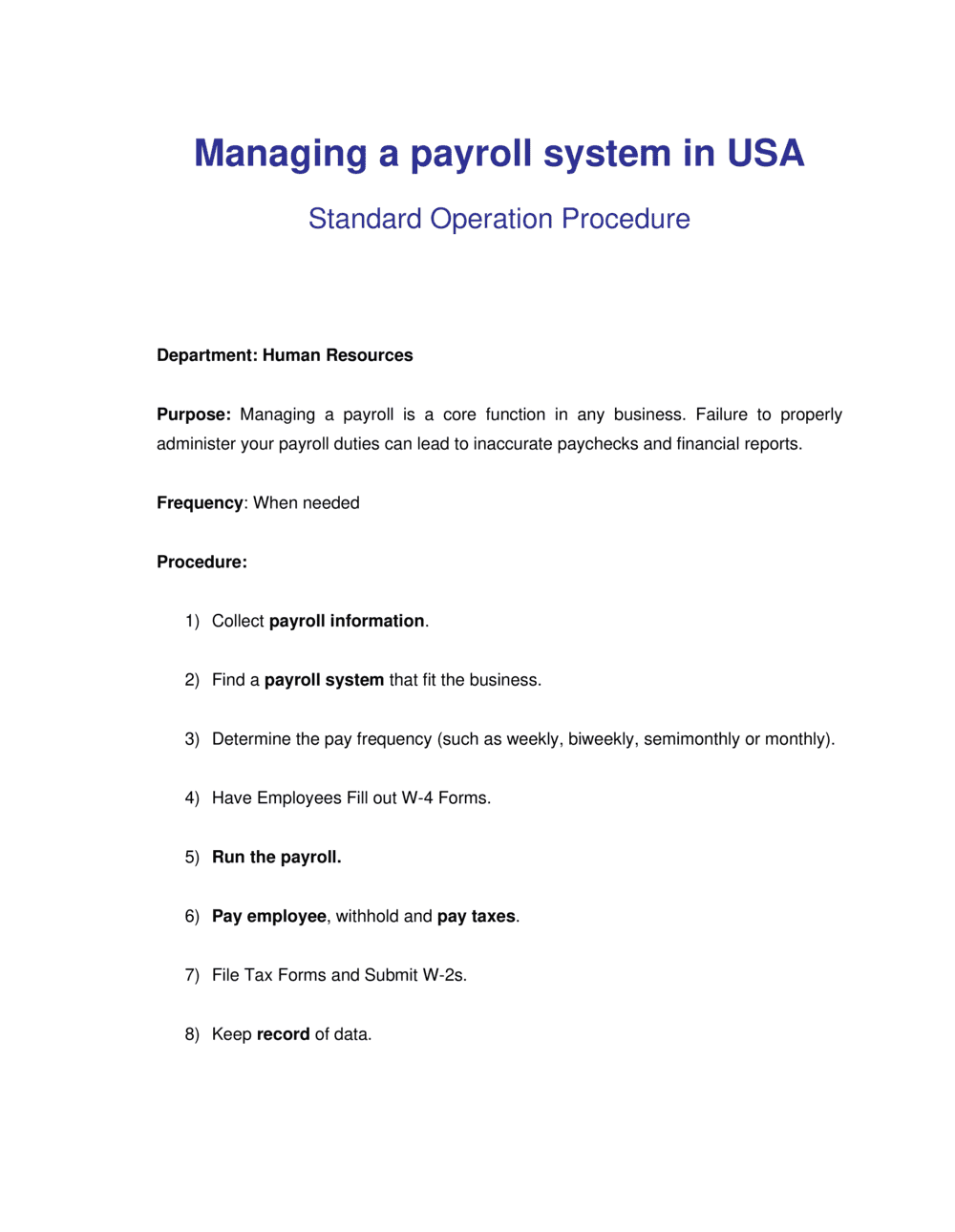
A How to Manage a Payroll System USA guide is a structured operational document that walks business owners and HR administrators through every phase of running US payroll β€” from setting up pay schedules and classifying employees to withholding federal and state taxes, issuing paychecks, and filing quarterly and annual reports. This free Word download gives you a ready-to-customize framework you can edit online and export as PDF for internal use or staff training.
When you need it
Use it when setting up payroll for the first time, onboarding a new HR or accounting staff member, auditing an existing payroll process for compliance gaps, or documenting procedures ahead of an IRS or state agency review.
What's inside
Employee classification rules, pay schedule setup, federal and state withholding procedures, payroll register maintenance, direct deposit and check issuance steps, quarterly and annual tax filing checklists, and recordkeeping requirements β€” all organized as a step-by-step operational reference.

What is a How to Manage a Payroll System USA Guide?

A How to Manage a Payroll System USA guide is a structured operational document that walks business owners and HR administrators through every phase of US payroll administration β€” from registering for a Federal Employer Identification Number and classifying workers correctly, to calculating withholdings, remitting tax deposits, and filing quarterly and annual returns with the IRS and Social Security Administration. Unlike a generic payroll policy, this guide functions as a hands-on procedural reference: each section maps to a specific task in the payroll cycle, with the calculations, deadlines, and form references needed to execute it accurately. It is written for the person actually running payroll, not for employees receiving it.

Why You Need This Document

Payroll errors are among the most expensive operational mistakes a small business can make. The IRS imposes failure-to-deposit penalties of up to 15% of unremitted taxes, and the Trust Fund Recovery Penalty allows the agency to personally assess owners and officers for the employee share of withheld taxes β€” regardless of corporate structure. Without a documented process, payroll depends entirely on institutional memory: when the person who handles it leaves, critical deadlines and calculation methods go with them. A written payroll management guide eliminates that single point of failure, gives new staff a reliable training resource, and creates the documented procedures that demonstrate good-faith compliance if the IRS or a state agency ever comes calling. This template gives you a professionally structured starting point that you can customize to your pay schedule, state registrations, and payroll software in a single afternoon.

Which variant fits your situation?

If your situation is…Use this template
First-time payroll setup for a new small businessHow to Manage a Payroll System USA
Documenting payroll policy for an employee handbookPayroll Policy
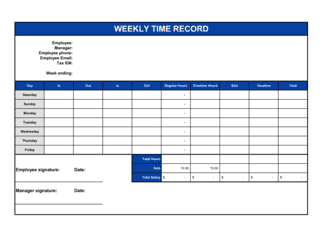
Tracking hours for hourly or overtime-eligible employeesEmployee Timesheet
Summarizing all employee pay data for a pay periodPayroll Register
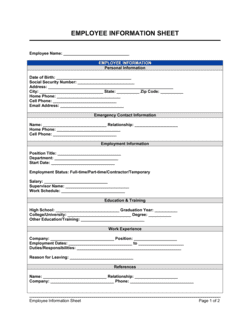
Onboarding a new hire for payroll tax purposesEmployee Information Form
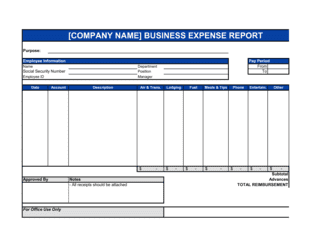
Tracking and reimbursing employee business expensesEmployee Expense Report
Managing contractor payments outside of payrollIndependent Contractor Agreement

Common mistakes to avoid

❌ Misclassifying employees as independent contractors

Why it matters: The IRS and Department of Labor apply strict multi-factor tests for worker classification. Misclassification results in back FICA taxes for all affected periods, failure-to-deposit penalties, and potential civil liability for unpaid benefits.

Fix: Apply the IRS common-law test and the FLSA economic reality test to every worker relationship. When in doubt, classify as an employee and consult an employment attorney before paying anyone as a 1099 contractor.

❌ Depositing federal payroll taxes late

Why it matters: Late federal tax deposits incur tiered penalties β€” 2% for deposits 1–5 days late, up to 15% for amounts still undeposited 10 days after an IRS notice. These penalties apply per deposit event and accumulate quickly.

Fix: Determine your deposit schedule (monthly or semi-weekly) immediately after registering for your FEIN, enroll in EFTPS, and set calendar reminders for every deposit deadline.

❌ Using the wrong pay frequency for non-exempt hourly workers

Why it matters: Most states mandate minimum pay frequency β€” some require weekly pay for manual laborers or non-exempt employees. Paying monthly when the state requires bi-weekly exposes the employer to state labor department complaints and back-pay orders.

Fix: Check the specific pay-frequency requirement in every state where you have employees before finalizing your payroll calendar. Requirements vary significantly by state and worker type.

❌ Failing to reconcile Form 941 filings with W-2 totals at year-end

Why it matters: Discrepancies between total wages reported across four quarterly 941s and total Box 1 wages on W-2s trigger automated IRS notices and can escalate to a payroll tax audit covering multiple years.

Fix: Before filing W-2s with the SSA, run a year-end reconciliation report comparing cumulative 941 wages and taxes to W-2 totals. Correct any errors with an amended 941-X before the January 31 W-2 deadline.

❌ Not updating withholding tables after annual IRS publication revisions

Why it matters: IRS Publication 15-T is updated every January. Payroll software that is not updated or tables that are not refreshed will calculate incorrect federal withholding amounts, leading to under- or over-withholding for all employees.

Fix: Confirm your payroll software provider applies the new Publication 15-T tables at the start of each calendar year. If using manual tables, download the current version from IRS.gov in January before running the first payroll.

❌ Retaining payroll records for fewer than four years

Why it matters: The IRS requires payroll tax records to be kept for at least four years from the date the tax was due or paid. The FLSA requires three years for payroll records and two for supplemental records. Gaps in records during an audit can result in IRS assessments based on estimates.

Fix: Establish a written records-retention schedule that keeps all payroll registers, tax filings, deposit confirmations, and W-4s for a minimum of four years, and store them in a secure, searchable system.

The 9 key sections, explained

Employee classification and setup

Pay schedule and pay period setup

Federal and state tax withholding

Employer payroll tax obligations

Payroll register and recordkeeping

Paycheck issuance and direct deposit

Payroll tax deposits

Quarterly and annual tax filing

Year-end payroll close and audit checklist

How to fill it out

  1. 1

    Obtain your FEIN and register with state agencies

    Apply for a Federal Employer Identification Number at IRS.gov before issuing any paychecks. Register separately with your state's department of revenue and labor agency to obtain state withholding and unemployment tax account numbers.

    πŸ’‘ Keep your FEIN, state withholding account number, and SUTA account number in a secure shared document β€” they are required on every payroll tax form you file.

  2. 2

    Collect new hire paperwork before the first pay date

    Gather a completed W-4, I-9 (with supporting identity documents), direct deposit authorization, and benefits enrollment forms from each new employee before processing their first paycheck.

    πŸ’‘ Incomplete W-4s default to single filing status with no adjustments β€” inform employees that this maximizes withholding and may not reflect their actual tax situation.

  3. 3

    Classify each worker as exempt or non-exempt

    Apply the FLSA salary basis test ($684/week minimum for exempt) and the duties test (executive, administrative, professional) to determine overtime eligibility. Document your classification rationale for each role.

    πŸ’‘ When classification is genuinely borderline, defaulting to non-exempt is the lower-risk choice β€” the cost of tracking overtime is far lower than the cost of a misclassification lawsuit.

  4. 4

    Set up your pay schedule and workweek definition

    Choose a pay frequency that meets your state's minimum pay requirements and define the start and end day of your workweek. Your workweek definition must be consistent and cannot be changed to avoid overtime.

    πŸ’‘ Bi-weekly is the most common US pay schedule and simplifies overtime calculation β€” overtime is based on the 7-day workweek, not the pay period.

  5. 5

    Calculate gross pay, withholdings, and deductions for each employee

    For each pay period, calculate gross pay (hours Γ— rate + overtime), apply federal and state withholding using current tables, calculate employer and employee FICA shares, and subtract any pre-tax benefit deductions before computing net pay.

    πŸ’‘ Pre-tax benefit deductions (health insurance, 401k, FSA) reduce the taxable wage base β€” apply them before calculating income tax withholding to avoid over-withholding.

  6. 6

    Maintain the payroll register and issue paychecks

    Record every line item in the payroll register before releasing pay. Issue direct deposits via ACH on payday and deliver pay stubs β€” electronically or in print β€” that itemize all earnings and deductions.

    πŸ’‘ Several states require paper pay stubs unless the employee affirmatively opts into electronic delivery. Confirm your state's rules before going paperless.

  7. 7

    Remit payroll tax deposits on schedule

    Determine whether you are on a monthly or semi-weekly federal deposit schedule based on your lookback period. Deposit withheld federal taxes via EFTPS and state withholdings to the applicable state agency by each required deadline.

    πŸ’‘ Set EFTPS calendar reminders at least three business days before each deposit deadline β€” same-day ACH through EFTPS is available but requires separate enrollment.

  8. 8

    File quarterly and annual returns and distribute W-2s

    File Form 941 within one month of each quarter's end. File Form 940 by January 31. Distribute W-2s to all employees and submit the W-3 transmittal with copies to the SSA by January 31 of the following year.

    πŸ’‘ Reconcile your four Form 941 filings against your W-2 totals before submitting anything to the SSA β€” catching discrepancies internally takes minutes; responding to an IRS CP2100 notice takes hours.

Frequently asked questions

What is a payroll management guide?

A payroll management guide is a step-by-step operational document that documents every procedure involved in running payroll β€” employee setup, tax withholding, paycheck issuance, tax deposits, and annual filings. It serves as both a training resource for new staff and an internal compliance reference that reduces errors and ensures consistent processing across pay periods.

How often do US employers have to run payroll?

The minimum pay frequency is set by state law and varies by state and worker type. Most states require non-exempt hourly employees to be paid at least bi-weekly or semi-monthly. Weekly pay is required for certain worker types in states like New York and Massachusetts. Monthly payroll is generally acceptable only for exempt salaried employees in most states.

What federal payroll taxes must a US employer pay?

US employers are responsible for the employer share of FICA taxes β€” 6.2% Social Security on wages up to the annual wage base and 1.45% Medicare on all wages β€” plus FUTA at an effective net rate of 0.6% on the first $7,000 of each employee's wages after the standard state tax credit. Employers must also withhold and remit the employee's share of FICA and federal income taxes from each paycheck.

What is the difference between a monthly and semi-weekly federal tax deposit schedule?

Your federal payroll tax deposit schedule is determined by the total taxes reported during a 12-month lookback period ending June 30. If your lookback liability was $50,000 or less, you are a monthly depositor β€” taxes are due by the 15th of the following month. If your liability exceeded $50,000, you are a semi-weekly depositor β€” taxes from Wednesday through Friday paydays are due the following Wednesday, and taxes from Saturday through Tuesday paydays are due the following Friday.

When are Form 941 and Form 940 due?

Form 941 is due one month after the end of each calendar quarter β€” April 30 for Q1, July 31 for Q2, October 31 for Q3, and January 31 for Q4. Form 940 (annual FUTA return) is due January 31 of the following year. If all FUTA tax deposits were made on time, the Form 940 deadline extends to February 10.

When must W-2 forms be distributed to employees?

Employers must furnish W-2 forms to all employees by January 31 of the year following the tax year. The W-3 transmittal and employee copies must also be submitted to the Social Security Administration by January 31. Late W-2s incur IRS penalties of $60 to $310 per form depending on how far past the deadline the filing occurs.

Do I need payroll software to manage payroll, or can I do it manually?

Manual payroll processing is legally permissible but carries significant error risk β€” incorrect withholding calculations, missed deposit deadlines, and arithmetic errors in the payroll register are common without automated checks. For businesses with more than three or four employees, payroll software or a payroll service provider substantially reduces the risk of compliance errors. Manual processing is feasible only for very small operations with a single salaried exempt employee.

What payroll records does an employer need to keep and for how long?

The FLSA requires employers to retain basic payroll records β€” employee name, address, occupation, pay rate, hours worked, and total wages paid β€” for three years, and supplemental records such as timesheets and wage-rate tables for two years. The IRS requires payroll tax records (Forms 941, 940, W-2, W-4, and deposit confirmations) to be kept for at least four years from the date the tax was due or paid.

What happens if payroll taxes are not paid on time?

Late federal payroll tax deposits trigger the IRS failure-to-deposit penalty, which ranges from 2% for deposits 1–5 days late to 15% for amounts still outstanding 10 or more days after the first IRS notice. Trust fund taxes β€” the employee's share of income tax and FICA β€” can be personally assessed against owners and officers through the Trust Fund Recovery Penalty, regardless of the business's corporate structure.

How this compares to alternatives

vs Employee Handbook

An employee handbook communicates company policies to employees β€” including pay dates and deduction policies β€” at a high level. A payroll management guide is an internal operational procedure for the people processing payroll, not for employees. The handbook tells staff when they get paid; this guide tells your payroll administrator how to make it happen.

vs Payroll Register

A payroll register is a per-period data record documenting each employee's gross pay, deductions, and net pay. A payroll management guide is the process document that explains how to produce, verify, and maintain that register correctly. The guide drives the process; the register is the output.

vs Employee Information Form

An employee information form collects the personal and banking data needed to set up a new hire in the payroll system. The payroll management guide explains what to do with that data β€” how to enter it, verify it, and use it to calculate withholdings. One is the input; the other is the procedure.

vs Employee Timesheet

An employee timesheet records hours worked each day for wage calculation and overtime tracking. A payroll management guide incorporates timesheet data as one input into a broader multi-step process that covers taxes, deposits, filings, and recordkeeping. The timesheet feeds one section of the guide.

Industry-specific considerations

Retail and hospitality

High employee turnover, tipped wage calculations under FLSA Section 3(m), variable hours, and multiple state registrations for multi-location operators.

Construction and trades

Prevailing wage requirements on public contracts, certified payroll reporting under the Davis-Bacon Act, and careful contractor vs. employee classification for subcontractors.

Professional services

Mix of exempt salaried professionals and non-exempt support staff, partner draws versus W-2 compensation in partnerships, and multi-state payroll for remote workers.

Manufacturing

Shift differentials, piece-rate overtime calculations under the FLSA fluctuating workweek method, and union-negotiated wage schedules requiring precise payroll register tracking.

Template vs pro β€” what fits your needs?

PathBest forCostTime
Use the templateSmall business owners and HR administrators setting up or documenting a payroll process in-houseFree2–4 hours to customize and implement
Template + professional reviewBusinesses with employees in multiple states, tipped workers, or union wage obligations$200–$600 for a payroll specialist or CPA review1–3 days
Custom draftedEnterprises with complex multi-state payroll, prevailing wage contracts, or ERP-integrated payroll systems$1,000–$5,000 for a payroll consultant or HR operations firm2–4 weeks

Glossary

FEIN (Federal Employer Identification Number)
A unique nine-digit tax ID assigned by the IRS to identify a business entity for payroll tax reporting and payment purposes.
W-4 Form
An IRS form completed by each employee that tells the employer how much federal income tax to withhold from each paycheck.
FICA Taxes
Federal Insurance Contributions Act taxes, covering Social Security (6.2%) and Medicare (1.45%), split equally between employer and employee.
FUTA (Federal Unemployment Tax)
A federal tax paid solely by the employer β€” 6% on the first $7,000 of each employee's wages β€” that funds the federal unemployment insurance program.
SUTA (State Unemployment Tax)
A state-level unemployment tax paid by the employer at a rate that varies by state, industry, and the employer's claims history.
Gross Pay
Total earnings before any deductions β€” including base salary or hourly wages, overtime, commissions, and bonuses.
Net Pay
The amount an employee actually receives after all taxes, benefits premiums, and voluntary deductions are subtracted from gross pay.
Pay Period
The recurring interval over which employee time is tracked and wages are calculated β€” weekly, bi-weekly, semi-monthly, or monthly.
Payroll Register
A running record of all compensation paid to employees in a given pay period, including gross pay, itemized deductions, and net pay.
Form 941
The IRS quarterly employer tax return used to report wages paid and federal income, Social Security, and Medicare taxes withheld.
W-2 Form
An annual IRS form employers send to each employee and the SSA by January 31, summarizing total wages paid and taxes withheld for the prior year.
Exempt vs. Non-Exempt
FLSA classifications: non-exempt employees must receive overtime pay at 1.5Γ— their regular rate for hours exceeding 40 per workweek; exempt employees do not.

Part of your Business Operating System

This document is one of 3,000+ business & legal templates included in Business in a Box.

  • Fill-in-the-blanks β€” ready in minutes
  • Compatible with all office suites
  • Export to PDF and share electronically

Create your document in 3 simple steps.

From template to signed document β€” all inside one Business Operating System.
1
Download or open template

Access over 3,000+ business and legal templates for any business task, project or initiative.

2
Edit and fill in the blanks with AI

Customize your ready-made business document template and save it in the cloud.

3
Save, Share, Send, Sign

Share your files and folders with your team. Create a space of seamless collaboration.

Save time, save money, and create top-quality documents.

β˜…β˜…β˜…β˜…β˜…

"Fantastic value! I'm not sure how I'd do without it. It's worth its weight in gold and paid back for itself many times."

Managing Director Β· Mall Farm
Robert Whalley
Managing Director, Mall Farm Proprietary Limited
β˜…β˜…β˜…β˜…β˜…

"I have been using Business in a Box for years. It has been the most useful source of templates I have encountered. I recommend it to anyone."

Business Owner Β· 4+ years
Dr Michael John Freestone
Business Owner
β˜…β˜…β˜…β˜…β˜…

"It has been a life saver so many times I have lost count. Business in a Box has saved me so much time and as you know, time is money."

Owner Β· Upstate Web
David G. Moore Jr.
Owner, Upstate Web

Run your business with a system β€” not scattered tools

Stop downloading documents. Start operating with clarity. Business in a Box gives you the Business Operating System used by over 250,000 companies worldwide to structure, run, and grow their business.

Start freeΒ Β·Β No credit card required