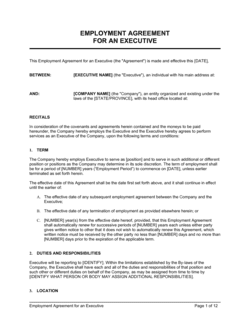
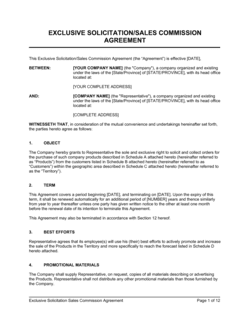
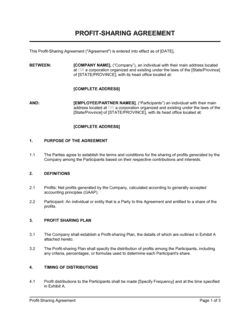
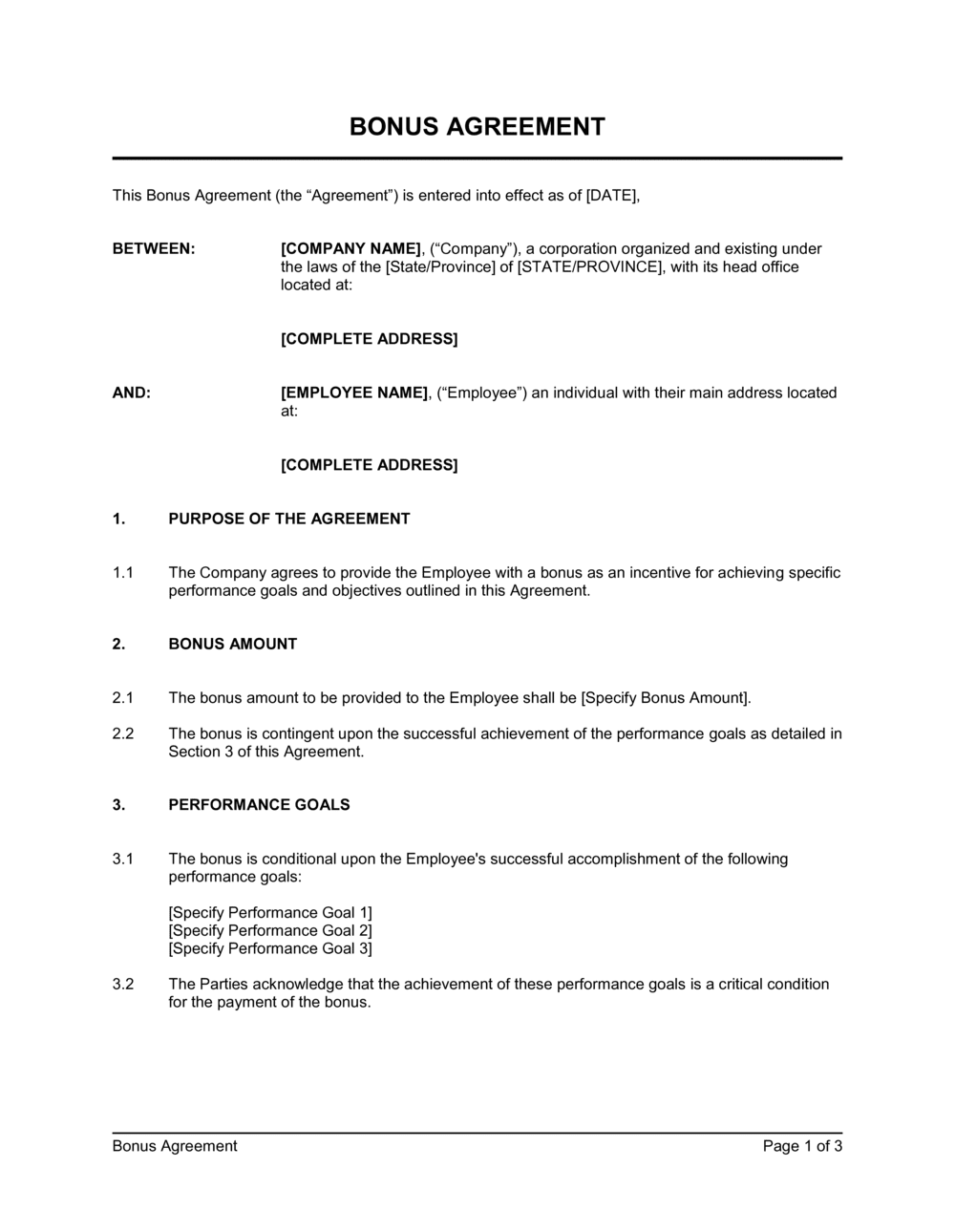
Bonus Agreement Template

Free Word download β€’ Edit online β€’ Save & share with Drive β€’ Export to PDF

3 pagesβ€’25–30 min to fillβ€’Difficulty: Standardβ€’Signature requiredβ€’Legal review recommended
Learn more ↓
FreeBonus Agreement Template

At a glance

What it is
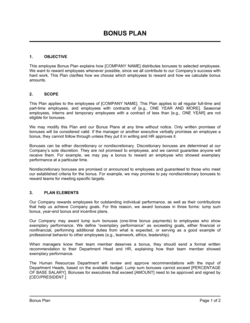
A Bonus Agreement is a legally binding document between an employer and an employee that defines the precise terms under which a bonus will be earned, calculated, and paid. This free Word download covers eligibility criteria, performance targets, payment timing, conditions to earning, and clawback provisions β€” and is structured to function as a standalone agreement or as an addendum to an existing employment contract.
When you need it
Use it when offering a performance-linked or discretionary bonus to a new or existing employee, when formalizing a bonus program that was previously communicated verbally or by email, or when adding bonus terms to a signed employment contract without redrafting the whole agreement.
What's inside
Parties and effective date, bonus type and eligibility conditions, calculation method and performance metrics, payment schedule and currency, employment status conditions, clawback provisions, tax handling, and governing law.

What is a Bonus Agreement?

A Bonus Agreement is a legally binding document between an employer and an employee that defines the precise terms under which a bonus will be earned, calculated, and paid. It specifies whether the bonus is discretionary or performance-linked, the metrics and thresholds that trigger payment, the payment schedule and currency, the employment-status conditions that must be satisfied, and any clawback obligations that apply if the employee leaves shortly after receiving payment. The agreement typically operates as a standalone contract or as a signed addendum incorporated by reference into an existing employment contract β€” keeping compensation terms current without requiring a full contract redraft each year.

Why You Need This Document

Without a written bonus agreement, a verbal promise or emailed figure can become a legally enforceable wage claim the moment an employee reasonably relies on it. Courts in the US, Canada, and the UK have consistently treated regularly paid bonuses β€” even discretionary ones β€” as implied contractual entitlements when no clear written terms exist. The practical consequences are concrete: employees who leave after receiving a sign-on bonus with no clawback clause owe nothing back; employees terminated before a payment date can claim a pro-rata share when the contract is silent; and bonus disputes without a written formula almost always resolve in the employee's favor because the employer drafted the arrangement and ambiguity runs against the drafter. A signed bonus agreement eliminates each of these exposures, documents the performance expectations both parties agreed to, and gives you an enforceable recovery mechanism if a clawback event occurs β€” all for the cost of 20 minutes and a template.

Which variant fits your situation?

If your situation is…Use this template
Tying bonus directly to individual or team sales targetsSales Commission Agreement
Awarding a one-time payment to a new hire contingent on staying a minimum periodSign-On Bonus Agreement
Retaining a key employee through a critical project or transition periodRetention Bonus Agreement
Covering all compensation terms including base, bonus, and equity in one documentExecutive Employment Agreement
Adding bonus terms to an already-signed employment contractEmployment Contract Amendment
Providing profit-sharing distributions rather than individual performance bonusesProfit Sharing Agreement

Common mistakes to avoid

❌ Omitting 'up to' on a discretionary bonus percentage

Why it matters: A stated target percentage without qualifying language has been treated by courts as a guaranteed entitlement, even when the employer intended full discretion to pay less or nothing.

Fix: Use 'eligible for a discretionary bonus of up to [X]%' and add a sentence explicitly stating that payment is at the employer's sole discretion and subject to the conditions in the agreement.

❌ Referencing performance targets that live only in a separate review system

Why it matters: If the targets are not in the agreement or an attached schedule, each party may recall them differently β€” and the employee's version tends to prevail in a wage dispute where the employer drafted the document.

Fix: Attach the specific KPIs, thresholds, and calculation formula as a signed Schedule A. If targets change year to year, require a written amendment before the new performance period starts.

❌ No clawback on sign-on or retention bonuses

Why it matters: Without a repayment clause, an employee who receives a $20,000 sign-on bonus and resigns after 60 days has no legal obligation to return it β€” the employer bears the full cost.

Fix: Add a clawback clause specifying the repayment period (typically 12–24 months), the repayment amount (gross), and the repayment mechanism β€” written authorization to deduct from final pay where local law permits.

❌ Signing the bonus agreement after the performance period has already ended

Why it matters: In common-law jurisdictions, a contract requires fresh consideration. An agreement signed after all conditions have already been met may be unenforceable, particularly the clawback and dispute-resolution clauses.

Fix: Execute the agreement before the performance period begins. For mid-year hires, issue a pro-rata addendum at the time of hire, not at year-end when the bonus is being paid.

❌ Promising a 'net' or 'tax-free' bonus without calculating the gross-up

Why it matters: A $10,000 net bonus can cost the employer $14,000–$17,000 gross depending on the employee's tax bracket β€” an unbudgeted expense that also creates payroll compliance risk.

Fix: Pay all bonuses on a gross basis and include standard withholding language. If a net payment is genuinely intended, calculate and document the gross-up amount before issuing the agreement.

❌ No clause governing pro-rata entitlement for leavers

Why it matters: Employees who resign or are made redundant mid-year frequently claim a proportionate share of the annual bonus β€” and where the contract is silent, courts often award it.

Fix: Explicitly state whether good leavers (redundancy, ill health) receive a pro-rata bonus and bad leavers (voluntary resignation, dismissal for cause) forfeit it entirely. Define both categories in the agreement.

The 10 key clauses, explained

Parties and effective date

In plain language: Identifies the employer and employee as legal entities and states when the agreement takes effect.

Sample language
This Bonus Agreement ('Agreement') is entered into as of [EFFECTIVE DATE] between [EMPLOYER LEGAL NAME], a [STATE/PROVINCE] [ENTITY TYPE] ('Employer'), and [EMPLOYEE FULL NAME] ('Employee').

Common mistake: Using a trade name instead of the employer's registered legal entity name β€” a mismatch between the agreement and payroll records creates enforcement problems if a clawback is ever disputed.

Bonus type and eligibility

In plain language: Specifies whether the bonus is discretionary or performance-linked, who qualifies, and any employment-tenure conditions that must be met before eligibility begins.

Sample language
Employee is eligible for an annual performance bonus of up to [X]% of Employee's base salary ('Bonus'), subject to the conditions set out in this Agreement. Eligibility commences after [90 days] of continuous employment.

Common mistake: Omitting the word 'up to' on discretionary bonuses β€” courts in several jurisdictions have treated a stated percentage without qualification as a guaranteed entitlement.

Performance metrics and calculation method

In plain language: Defines the specific targets or KPIs that determine how much of the bonus is earned, and the formula used to calculate the final amount.

Sample language
The Bonus shall be calculated as follows: [X]% of base salary if [METRIC] achieves [TARGET 1]; [Y]% of base salary if [METRIC] achieves [TARGET 2]. Performance shall be measured for the period [START DATE] to [END DATE].

Common mistake: Referencing external targets (e.g., 'as set out in the performance review') without attaching them as a schedule β€” if the metrics are not in the agreement itself, disputes about what was promised are nearly impossible to resolve.

Payment timing and currency

In plain language: States exactly when the bonus will be paid, in what currency, and through what mechanism β€” payroll, wire transfer, or separate payment.

Sample language
Subject to the conditions herein, the Bonus will be paid no later than [DATE / within 30 days of the end of the performance period] via [Employer's regular payroll / wire transfer] in [USD / CAD / GBP].

Common mistake: Writing 'as soon as practicable' instead of a specific payment date or deadline β€” this creates a constructive obligation that varies by jurisdiction and invites wage-claim disputes.

Employment status condition

In plain language: States that the employee must be actively employed on the payment date and not under notice of termination to receive the bonus.

Sample language
Payment of the Bonus is conditioned on Employee being actively employed by Employer on the Bonus payment date and not having given or received notice of termination as of that date.

Common mistake: Including an employment-status condition without defining what happens on a pro-rata basis for partial-year performers β€” employees who leave before year-end often dispute entitlement to a proportionate share.

Clawback provision

In plain language: Requires the employee to repay all or part of the bonus if they resign or are terminated for cause within a defined period after payment.

Sample language
If Employee voluntarily resigns or is terminated for Cause within [12] months of receiving the Bonus, Employee shall repay to Employer [100% / a pro-rata portion] of the gross Bonus amount within [30] days of separation.

Common mistake: Clawback clauses that do not specify the repayment amount as gross rather than net β€” employees may argue they should only repay the after-tax amount, which is significantly less and harder to recover.

Tax and withholding

In plain language: Clarifies that the bonus is subject to applicable tax withholding and that the employee is responsible for their own tax obligations on the payment.

Sample language
The Bonus is subject to all applicable federal, state/provincial, and local tax withholding. Employer shall withhold taxes as required by law. Employee is solely responsible for any additional tax liability arising from the Bonus payment.

Common mistake: Promising a 'net' or 'tax-free' bonus without understanding the gross-up cost β€” this can double the employer's cash outlay and create payroll compliance violations.

Entire agreement and relationship to employment contract

In plain language: States whether this agreement supersedes or supplements prior bonus arrangements, and how it interacts with the employment contract.

Sample language
This Agreement supplements and is incorporated into Employee's Employment Agreement dated [DATE]. In the event of any conflict between this Agreement and the Employment Agreement with respect to bonus terms, this Agreement shall govern.

Common mistake: No integration clause at all β€” leaving prior offer letters, emails, or verbal promises potentially enforceable alongside the written agreement.

Amendment and discretionary adjustment

In plain language: Reserves the employer's right to adjust or cancel the bonus program prospectively with notice, while clarifying that retrospective adjustments are not permitted once conditions are met.

Sample language
Employer reserves the right to amend, suspend, or discontinue the Bonus program on not less than [30] days' written notice for future performance periods. No amendment shall affect a Bonus already earned for a completed performance period.

Common mistake: Granting unlimited discretion to adjust or cancel bonuses retroactively β€” courts treat unilateral clawbacks of already-earned bonuses as wage theft in many jurisdictions.

Governing law and dispute resolution

In plain language: Specifies which jurisdiction's law governs the agreement and how disputes are resolved β€” arbitration, mediation, or litigation.

Sample language
This Agreement is governed by the laws of [STATE / PROVINCE / COUNTRY], without regard to conflict-of-law principles. Any dispute shall be resolved by binding arbitration in [CITY] under the rules of [AAA / JAMS / applicable body], except claims for injunctive relief.

Common mistake: Choosing a governing law that differs from where the employee physically works β€” several jurisdictions apply local employment law regardless of the contract's choice-of-law clause.

How to fill it out

  1. 1

    Identify the parties and effective date

    Enter the employer's full registered legal name, the employee's legal name, and the date the agreement takes effect. Confirm the legal entity name matches your payroll records.

    πŸ’‘ If this agreement is an addendum to an existing employment contract, reference that contract by its exact title and date in this field.

  2. 2

    Choose the bonus type and state eligibility conditions

    Select whether the bonus is discretionary or performance-linked and specify any minimum tenure or role conditions. Use 'up to X%' language for discretionary bonuses and a fixed formula for performance-linked ones.

    πŸ’‘ If the same agreement covers multiple bonus types (e.g., a sign-on bonus plus an annual performance bonus), use separate numbered sections for each rather than combining them.

  3. 3

    Define the performance metrics and calculation formula

    List the specific KPIs or targets, the measurement period, and the formula that converts performance against those targets into a dollar amount or percentage of base salary. Attach the detailed metrics as Schedule A.

    πŸ’‘ Avoid referencing a separate performance review process as the sole source of targets β€” embed the metrics in the agreement or schedule so both parties have the same written record.

  4. 4

    Set the payment date and currency

    Enter a specific payment date or a deadline measured from the end of the performance period β€” for example, 'within 30 days of the end of the fiscal year.' State the currency explicitly for any international arrangement.

    πŸ’‘ Align the bonus payment date with your payroll cycle to avoid a separate payment run and the additional administrative cost it creates.

  5. 5

    Draft the employment-status and clawback conditions

    State clearly that the employee must be employed on the payment date to receive the bonus. For sign-on or retention bonuses, specify the clawback period, repayment percentage, and whether the gross or net amount is recoverable.

    πŸ’‘ Include a table in the clawback clause showing declining repayment percentages over time β€” for example, 100% in months 1–6, 50% in months 7–12 β€” to make recovery proportionate and more defensible.

  6. 6

    Confirm tax withholding language

    State that the bonus payment is subject to all applicable tax withholding and that the employee bears responsibility for any additional tax. Do not promise a net or tax-free payment without calculating the gross-up cost first.

    πŸ’‘ Check whether your jurisdiction taxes bonuses at a flat supplemental rate or at the employee's marginal rate β€” the difference affects payroll processing and the employee's take-home amount.

  7. 7

    Sign before the performance period begins

    Both parties should execute the agreement before β€” or at the start of β€” the performance period it covers. Post-period signatures raise consideration problems and may void clawback clauses.

    πŸ’‘ Use a timestamped e-signature tool so the execution date is independently verifiable if the agreement is ever disputed.

Frequently asked questions

What is a bonus agreement?

A bonus agreement is a written contract between an employer and employee that formally defines the terms under which a bonus will be earned, calculated, and paid. It specifies whether the bonus is discretionary or performance-linked, the metrics used to calculate it, when it will be paid, and what conditions β€” including clawback β€” apply. It can stand alone or serve as an addendum to an existing employment contract.

Is a bonus agreement legally binding?

Yes, a properly executed bonus agreement is generally enforceable when it identifies both parties, states clear terms, and is signed by both sides before the performance period begins. A performance-linked bonus that meets all defined conditions creates a contractual debt β€” the employer owes payment. A discretionary bonus is harder to enforce unless conditions are met and the employer's conduct has established a pattern of payment.

What is the difference between a discretionary and a performance-linked bonus?

A discretionary bonus is paid at the employer's sole judgment β€” neither the amount nor the decision to pay is contractually guaranteed. A performance- linked bonus is earned automatically when defined targets are met, creating a legal obligation to pay regardless of the employer's preference. Most bonus agreements are one or the other, but some combine elements of both β€” for example, a threshold that must be met plus employer discretion on the final amount above that threshold.

Do I need a bonus agreement if the terms are in the employment contract?

If your employment contract covers bonus eligibility, calculation, timing, and clawback in sufficient detail, a separate agreement is not strictly necessary. In practice, bonus structures change year to year while employment contracts are rarely amended β€” a standalone bonus agreement or annual addendum is the cleaner approach. It also avoids triggering a full contract renegotiation when only the bonus terms need to change.

Can an employer change or cancel a bonus program mid-year?

Prospective changes β€” applied to future performance periods with adequate notice β€” are generally permissible if the agreement reserves that right. Retroactive changes to a bonus already being earned for a current period are much riskier and may constitute a breach of contract or constructive dismissal in many jurisdictions. The agreement should explicitly state that amendments apply only to future periods and cannot reduce a bonus already earned.

What is a clawback clause and is it enforceable?

A clawback clause requires the employee to repay all or part of a bonus if a triggering event occurs after payment β€” typically voluntary resignation or termination for cause within a defined window. Enforceability depends on jurisdiction: US courts generally enforce clearly drafted clawbacks, but some states limit deductions from final pay. UK courts enforce clawbacks when reasonable in scope. Canadian courts scrutinize them for reasonableness and may require independent legal advice for senior employees.

How should a bonus agreement handle taxes?

The agreement should state clearly that the bonus is a gross payment subject to all applicable income tax withholding, and that the employee bears responsibility for any additional tax liability. Never promise a net or tax-free bonus without first calculating and documenting the gross-up amount. In the US, supplemental wages including bonuses are typically withheld at a flat 22% federal rate (37% above $1 million) in addition to state and local taxes.

Should the bonus agreement be signed before the performance period starts?

Yes β€” the agreement should be executed before or at the beginning of the performance period it governs. Signing after all conditions have already been met creates a consideration problem in common-law jurisdictions, which can void clawback and dispute-resolution clauses. For annual bonus programs, issue updated agreements at the start of each fiscal year or attach a revised schedule confirming the new targets and payment terms.

What happens to a bonus if an employee is made redundant before the payment date?

This depends on the agreement and jurisdiction. A well-drafted bonus agreement should classify redundancy as a 'good leaver' event and specify whether the employee receives a pro-rata bonus for the portion of the performance period completed. In the UK, a contractual bonus can be payable even after notice if the conditions are met; in Canada, courts often award pro-rata bonuses to terminated employees unless the contract clearly excludes them. Silence on this point typically favors the employee.

How this compares to alternatives

vs Employment Contract

An employment contract governs the full working relationship β€” duties, base salary, IP, confidentiality, termination, and sometimes bonus eligibility. A bonus agreement focuses exclusively on bonus terms and is typically issued as an addendum. Using a separate bonus agreement lets you update incentive structures year to year without reopening the full employment contract.

vs Sales Commission Agreement

A sales commission agreement governs variable pay tied directly to individual sales activity β€” usually a percentage of closed revenue paid on a defined schedule. A bonus agreement covers broader performance incentives that may include individual, team, or company-level targets not limited to sales. Employees in revenue roles often have both documents.

vs Profit Sharing Agreement

A profit sharing agreement distributes a defined percentage of company profits to eligible employees β€” the pool and individual shares are driven by company-wide financial performance rather than individual KPIs. A bonus agreement can be individual-specific and paid regardless of company profitability. The two structures serve different retention and incentive objectives.

vs Executive Employment Agreement

An executive employment agreement is a comprehensive document covering base pay, bonus, equity, severance, non-compete, and change-of-control provisions in a single contract. For C-suite hires, the bonus terms are typically embedded in the executive agreement rather than handled separately. A standalone bonus agreement is better suited to below-executive employees where the incentive structure needs to be updated annually.

Industry-specific considerations

Technology / SaaS

Bonus metrics tied to ARR growth, product milestones, or customer retention rate β€” with equity and bonus often structured together for senior engineering and product roles.

Financial Services

Regulatory requirements in the UK and EU mandate deferral and clawback provisions for material risk-takers; bonus pools are tied to firm-wide profitability and risk-adjusted returns.

Sales and Distribution

Performance bonuses are quota-based with tiered payout schedules β€” typically separate from base commissions and paid quarterly or annually on closed revenue targets.

Professional Services

Bonuses linked to billable utilization rates, client satisfaction scores, or origination of new business β€” with strong clawback provisions for partners who leave to join competitors.

Jurisdictional notes

United States

No federal law mandates bonus payments, but once earned under a performance-linked agreement, a bonus is generally treated as wages subject to FLSA protections. Clawback enforceability varies by state β€” some states prohibit payroll deductions for clawbacks without a separate written authorization. California and New York have wage-payment statutes that can treat a guaranteed bonus as a final-pay obligation.

Canada

Canadian courts frequently award pro-rata bonuses to employees terminated without cause unless the contract clearly excludes entitlement on termination. Employment standards legislation in most provinces treats earned bonuses as wages, making them payable on termination. Clawback deductions from final pay require explicit written authorization and may be limited by provincial legislation. Quebec requires that any bonus agreement provided to a French-speaking employee be in French.

United Kingdom

A contractual bonus that meets its conditions is a legally enforceable debt regardless of employer discretion. The FCA requires financial services firms to apply deferral and clawback provisions to material risk-takers under the Remuneration Code. Courts have enforced clawback clauses where the terms are clear and the employee had legal advice. Employers should ensure any 'good leaver' and 'bad leaver' definitions align with the Employment Rights Act 1996.

European Union

EU member states vary significantly on bonus enforceability and clawback rules. The Capital Requirements Directive mandates bonus caps and deferral requirements for financial institutions. France and Germany treat an established pattern of bonus payments as a contractual entitlement that cannot be unilaterally withdrawn. GDPR implications apply where performance data used to calculate bonuses is processed β€” a lawful basis and data retention policy are required.

Template vs lawyer β€” what fits your deal?

PathBest forCostTime
Use the templateStandard annual performance or discretionary bonuses for non-executive employees in a single jurisdictionFree20–30 minutes
Template + legal reviewSign-on or retention bonuses with clawback, cross-border arrangements, or employees in heavily regulated industries$200–$5001–2 days
Custom draftedExecutive bonus structures with deferred compensation, equity linkage, or multi-jurisdiction compliance requirements$1,000–$3,500+1–2 weeks

Glossary

Discretionary Bonus
A bonus the employer may pay at its sole discretion, with no contractual obligation to do so β€” the amount and decision to pay are entirely the employer's choice.
Performance-Linked Bonus
A bonus tied to measurable individual, team, or company targets β€” earned automatically when those targets are met, regardless of the employer's discretion.
Clawback Provision
A contractual clause requiring the employee to repay all or part of a bonus if certain events occur after payment, such as voluntary resignation within a defined period or financial restatement.
Earned vs. Accrued Bonus
An earned bonus meets all conditions and is legally owed; an accrued bonus has been recognized as a liability on the books but conditions to payment have not yet been fully met.
KPI (Key Performance Indicator)
A quantifiable measure used to evaluate performance against defined targets β€” commonly used as the basis for calculating a performance-linked bonus.
Bonus Pool
A fixed total amount set aside by the company from which individual bonuses are allocated, meaning individual awards depend partly on overall company performance and partly on each employee's share.
Pro-Rata Bonus
A bonus reduced proportionately to reflect a partial performance period β€” for example, when an employee joins or leaves mid-year.
Employment at Date of Payment
A common condition requiring the employee to be actively employed on the scheduled bonus payment date in order to receive the bonus.
Good Leaver / Bad Leaver
Classifications that determine whether a departing employee retains or forfeits unvested or unpaid bonus entitlements β€” typically good leavers (e.g., redundancy) retain a pro-rata share while bad leavers (e.g., resignation, gross misconduct) forfeit it.
Consideration
Something of value exchanged by each party that makes a contract legally binding β€” in a bonus agreement, the employee's continued service or performance is consideration for the employer's promise to pay.

Part of your Business Operating System

This document is one of 3,000+ business & legal templates included in Business in a Box.

  • Fill-in-the-blanks β€” ready in minutes
  • 100% customizable Word document
  • Compatible with all office suites
  • Export to PDF and share electronically

Create your document in 3 simple steps.

From template to signed document β€” all inside one Business Operating System.
1
Download or open template

Access over 3,000+ business and legal templates for any business task, project or initiative.

2
Edit and fill in the blanks with AI

Customize your ready-made business document template and save it in the cloud.

3
Save, Share, Send, Sign

Share your files and folders with your team. Create a space of seamless collaboration.

Save time, save money, and create top-quality documents.

β˜…β˜…β˜…β˜…β˜…

"Fantastic value! I'm not sure how I'd do without it. It's worth its weight in gold and paid back for itself many times."

Managing Director Β· Mall Farm
Robert Whalley
Managing Director, Mall Farm Proprietary Limited
β˜…β˜…β˜…β˜…β˜…

"I have been using Business in a Box for years. It has been the most useful source of templates I have encountered. I recommend it to anyone."

Business Owner Β· 4+ years
Dr Michael John Freestone
Business Owner
β˜…β˜…β˜…β˜…β˜…

"It has been a life saver so many times I have lost count. Business in a Box has saved me so much time and as you know, time is money."

Owner Β· Upstate Web
David G. Moore Jr.
Owner, Upstate Web

Run your business with a system β€” not scattered tools

Stop downloading documents. Start operating with clarity. Business in a Box gives you the Business Operating System used by over 250,000 companies worldwide to structure, run, and grow their business.

Start freeΒ Β·Β No credit card required