1
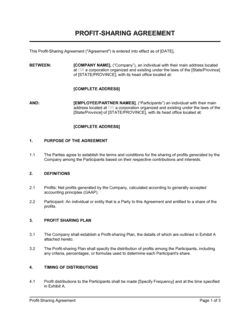
Define the plan's purpose in one or two sentences
Write a concise purpose statement tying the plan directly to a specific business goal — retention, productivity, or shared ownership culture. Avoid generic language that could apply to any incentive plan.
💡 Involve at least one senior manager outside HR in drafting the purpose statement — their buy-in makes implementation much smoother.
2
Set eligibility requirements
Decide on minimum tenure (commonly 6 or 12 months), minimum hours worked (commonly 1,000 per year), and whether part-time or fixed-term employees qualify. State explicitly that participants must be actively employed on the distribution date.
💡 Model your eligibility criteria against your actual workforce before finalizing — rules that exclude 80% of employees signal an executive bonus plan, not a profit-sharing plan.
3
Choose and document the profit calculation base
Select a profit definition — typically audited net profit — and list any specific exclusions such as one-time restructuring charges, acquisition costs, or extraordinary items approved by the board.
💡 Link the profit figure to a line in your audited financial statements by name to eliminate ambiguity and make administration simpler each year.
4
Select and model the allocation formula
Run the formula against your current employee population at two or three different profit pool sizes. Check whether the resulting individual payouts are meaningful enough to influence behavior — amounts under $500 per person rarely move the needle.
💡 A pro-rata-by-salary formula is the easiest to defend and administer; a points-based formula better rewards tenure and performance but requires more annual maintenance.
5
Set the vesting schedule
Choose between immediate vesting (simple to communicate, no retention effect), cliff vesting (strong retention cliff, but employees who leave just before the cliff feel penalized), or graded vesting (balanced retention effect). Add accelerated vesting triggers for change of control and termination without cause.
💡 A four-year graded schedule (0/33/66/100%) is the most commonly accepted structure for private company profit-sharing plans — long enough to retain, short enough to be credible.
6
Define distribution timing tied to audit completion
Set the distribution window as a number of days after the audited financial statements are finalized — typically 45 to 90 days. Specify the payment method (cash, check, direct deposit, or 401(k) deferral election).
💡 Give participants a 30-day deferral election window before the distribution date — it costs nothing and is a meaningful benefit for higher earners managing tax exposure.
7
Name the plan administrator and document their responsibilities
Assign a specific role (e.g., VP of Finance or the HR Committee) and list their annual tasks: calculate allocations, issue participant statements, respond to inquiries, and maintain records for at least seven years.
💡 Build a simple annual administration calendar — four or five dated tasks tied to audit close — and attach it as an internal exhibit. It prevents the plan from being forgotten between plan years.
8
Add amendment, termination, and clawback language
Reserve the right to amend or terminate with at least 30 days' notice. State that no amendment reduces already-vested amounts. Include a clawback provision covering financial restatements within 24 months of distribution.
💡 Have your CFO or outside accountant review the clawback clause — the window and trigger should match any existing executive compensation clawback policy for consistency.