Equity Accumulation Plan Template

Free Word download β€’ Edit online β€’ Save & share with Drive β€’ Export to PDF

11 pagesβ€’30–40 min to fillβ€’Difficulty: Complex
Learn more ↓
FreeEquity Accumulation Plan Template

At a glance

What it is
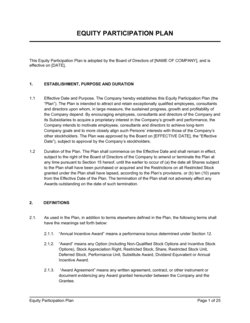
An Equity Accumulation Plan is a structured operational document that defines how equity ownership is granted, earned, and transferred to employees, founders, or key contributors over time. This free Word download gives you a ready-to-edit framework covering grant types, vesting schedules, eligibility criteria, and exit provisions β€” exportable as PDF for board review or employee distribution.
When you need it
Use it when onboarding early employees who will receive equity as part of their compensation, when formalizing a founder vesting arrangement before a funding round, or when establishing a company-wide equity incentive program to attract and retain key talent.
What's inside
Purpose and objectives, eligibility criteria, equity grant types and allocation framework, vesting schedules and cliff periods, performance conditions, dilution and cap table impact, exercise and transfer rules, termination provisions, and plan administration procedures.

What is an Equity Accumulation Plan?

An Equity Accumulation Plan is a structured operational document that defines how equity ownership β€” in the form of stock options, restricted stock units, or other instruments β€” is granted to and earned by employees, founders, or key contributors over time. It establishes the rules governing eligibility, grant types, vesting schedules, performance conditions, and what happens to equity when an employee leaves or the company is acquired. Rather than leaving equity arrangements to individual negotiations or informal understandings, the plan creates a single, consistent framework that applies across the organization and can be presented to employees, investors, and the board as a formal policy.

Why You Need This Document

Without a written equity accumulation plan, equity promises become verbal agreements that are nearly impossible to enforce consistently β€” and nearly impossible to defend when disputes arise. Employees granted equity under no formal framework frequently disagree on the vesting schedule, the percentage of fully diluted shares their grant represents, and their rights upon termination. Investors conducting due diligence before a funding round expect a documented plan; a missing or informal one can delay or derail a close. Regulators and tax authorities require that stock option strike prices be set against a documented fair market valuation, and without a formal plan in place that process has no anchor. This template gives you the structural foundation to issue equity consistently, protect the company from future disputes, and demonstrate to both employees and investors that your equity program is governed with care.

Which variant fits your situation?

If your situation is…Use this template
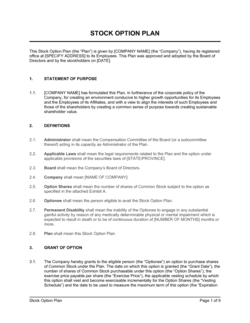
Granting stock options to employees at a startupEmployee Stock Option Plan
Issuing restricted stock to founders with a vesting cliffFounder Vesting Agreement
Sharing profits rather than equity ownershipProfit Sharing Plan
Providing equity-like rewards without actual share issuancePhantom Stock Plan
Granting equity to advisors or board membersAdvisor Equity Agreement
Creating an employee ownership structure for an established businessEmployee Ownership Plan
Documenting deferred compensation tied to equity milestonesDeferred Compensation Plan

Common mistakes to avoid

❌ Using annual post-cliff vesting tranches

Why it matters: Annual tranches create a 12-month retention gap between each vesting event β€” an employee who leaves at month 13 receives the same equity as one who leaves at month 23, removing the incentive to stay.

Fix: Switch to monthly vesting after the cliff: 1/48 of the total grant per month. This makes every additional month of tenure directly valuable to the employee.

❌ Setting a 90-day exercise window for all termination types

Why it matters: Employees terminated without cause or laid off often cannot afford to exercise options within 90 days, effectively forfeiting equity they earned β€” creating legal disputes and reputational damage.

Fix: Differentiate the exercise window by separation type: 90 days for voluntary resignation or termination for cause; 1–5 years for involuntary termination without cause.

❌ Omitting a 409A valuation before setting the strike price

Why it matters: Setting the strike price without a 409A appraisal exposes employees to immediate ordinary income tax on the entire spread at grant β€” not at exercise β€” under IRS Section 409A penalties.

Fix: Commission an independent 409A valuation before issuing any options and update it at least annually or after each funding round.

❌ Granting equity without written grant notices

Why it matters: Verbal or informal equity promises are unenforceable in most jurisdictions and frequently result in costly disputes when an employee departs and claims a larger stake than the cap table shows.

Fix: Issue a written grant notice for every award, signed by both the company and the recipient, specifying grant date, type, quantity, strike price, and vesting schedule.

❌ Single-trigger acceleration for all employees

Why it matters: Single-trigger acceleration β€” where a change of control alone vests all equity β€” eliminates the retention value acquirers pay for, frequently reducing the acquisition price or causing deal abandonment.

Fix: Use double-trigger acceleration as the default: the first trigger is the change of control; the second is involuntary termination within 12–18 months thereafter.

❌ Failing to disclose the fully diluted pool size to participants

Why it matters: An employee told they are receiving 0.5% of the company may not realize that figure is based on issued shares, not fully diluted shares including the option pool and convertible notes β€” leading to disappointment and attrition.

Fix: Always express grants as a percentage of fully diluted shares outstanding and provide participants with a summary cap table at grant time.

The 10 key sections, explained

Purpose and objectives

Eligibility criteria

Equity grant types and allocation framework

Vesting schedule and cliff period

Performance conditions

Dilution and cap table impact

Exercise, transfer, and holding rules

Termination and forfeiture provisions

Acceleration and change-of-control provisions

Plan administration and amendment

How to fill it out

  1. 1

    Define the plan's purpose and link it to company milestones

    Write a purpose statement that connects the equity plan to specific retention goals and ownership culture. Reference the stage of the business (seed, growth, pre-IPO) so participants understand the context.

    πŸ’‘ Founders who articulate why ownership matters β€” not just that it exists β€” get higher acceptance rates when presenting the plan to new hires.

  2. 2

    Set the equity pool size and authorized share count

    Work with your cap table to determine the total pool as a percentage of fully diluted shares. A typical seed-stage pool is 10–15%; growth-stage companies refresh to maintain 5–10%.

    πŸ’‘ Model the pool at three grant scenarios β€” conservative, base, and aggressive hiring β€” to confirm the pool size holds through your next funding round without forcing an early refresh.

  3. 3

    Choose and define the grant instruments

    Decide whether to use ISOs, NSOs, RSUs, or a combination. ISOs offer favorable tax treatment for US employees but have a $100K annual vesting limit. RSUs are simpler to administer but create a tax event at vesting rather than exercise.

    πŸ’‘ For companies with a 409A valuation above $5 per share, RSUs often become more practical than options because the strike price gap narrows and options require significant cash to exercise.

  4. 4

    Configure the vesting schedule and cliff

    Set the standard schedule β€” typically 4 years with a 1-year cliff and monthly vesting thereafter. Add any performance milestones as a separate vesting layer, not a replacement for time-based vesting.

    πŸ’‘ Monthly post-cliff vesting (1/48 per month) provides stronger retention than annual tranches because every month an employee stays adds tangible value.

  5. 5

    Draft termination and forfeiture scenarios

    Address all four separation types explicitly: voluntary resignation, termination for cause, termination without cause, and death or disability. Set the post-termination exercise window in each scenario.

    πŸ’‘ Consider extending the post-termination exercise window to 1–5 years for long-tenured employees β€” the standard 90-day window often forces employees to forfeit valuable options simply because they lack exercise funds.

  6. 6

    Define acceleration and change-of-control terms

    Choose between single-trigger and double-trigger acceleration and specify the percentage of unvested equity that accelerates in each scenario. Document this clearly so it is not subject to negotiation during an acquisition.

    πŸ’‘ Double-trigger acceleration is generally preferred by acquirers and investors because it preserves retention value through the post-acquisition integration period.

  7. 7

    Specify administration procedures and amendment rules

    Name the plan administrator (typically the board or compensation committee), describe the grant approval workflow, and include a participant-protection clause limiting the company's ability to amend provisions that adversely affect existing grantees.

    πŸ’‘ Require written grant notices for every award β€” a verbal promise of equity has no legal standing, and disputes about unwritten grants are costly and damaging to morale.

  8. 8

    Review for internal consistency with the cap table and shareholder agreement

    Cross-check the plan's pool size, dilution language, and transfer restrictions against your shareholder agreement and any existing investor rights agreements to confirm there are no conflicts.

    πŸ’‘ Share the draft with your existing investors before finalizing β€” most term sheets and shareholder agreements require investor consent for equity plan amendments above a defined pool threshold.

Frequently asked questions

What is an equity accumulation plan?

An equity accumulation plan is a structured operational document that defines how equity ownership is granted and earned by employees, founders, or key contributors over time. It specifies the types of equity instruments used (options, RSUs, restricted stock), the vesting schedule, eligibility criteria, and what happens to equity upon termination or a change of control. It functions as both an internal policy document and a reference point for participants during their employment.

What is the difference between an equity accumulation plan and a stock option plan?

A stock option plan is a specific instrument within the broader equity compensation framework β€” it governs the issuance of rights to purchase shares at a fixed price. An equity accumulation plan is the overarching operational policy that may include stock options alongside RSUs, restricted stock, or phantom units. The accumulation plan defines eligibility, pool size, vesting philosophy, and administration; the option plan documents the specific mechanics of the option instrument itself.

What vesting schedule is standard for an equity accumulation plan?

The most widely used standard in venture-backed companies is a 4-year vesting period with a 1-year cliff. After the 12-month cliff, 25% of the grant vests immediately; the remaining 75% vests monthly over the following 36 months (1/48 of the total grant per month). Some companies use 3-year schedules for senior executives, and a small number use performance-based vesting as a supplement or replacement for time-based vesting.

Does an equity accumulation plan require board approval?

Yes, in most corporate structures the board of directors must approve both the equity plan itself and each individual grant made under it. For venture-backed companies, the shareholder agreement or investors' rights agreement typically requires investor consent for any equity plan that exceeds a defined percentage of fully diluted shares. Even for bootstrapped companies, documenting board approval in meeting minutes is considered essential governance practice.

What is the difference between single-trigger and double-trigger acceleration?

Single-trigger acceleration vests all or a portion of unvested equity automatically upon a change of control β€” such as an acquisition β€” regardless of what happens to the employee afterward. Double-trigger acceleration requires two events: the change of control and an involuntary termination within a defined window (typically 12–18 months). Double-trigger is the standard preferred by acquirers and investors because it preserves retention value through the post-acquisition integration period.

What happens to unvested equity when an employee is terminated?

Under most equity accumulation plans, unvested equity is forfeited immediately upon any termination. For voluntary resignation and termination for cause, vested options typically must be exercised within 90 days or they expire. For involuntary termination without cause, some plans provide a longer exercise window or partial acceleration of unvested grants. The exact treatment should be specified clearly in the plan and the individual grant notice.

How does an equity accumulation plan affect the cap table?

Every equity grant issued under the plan increases the fully diluted share count, reducing the ownership percentage of all existing holders. The plan should specify the size of the equity incentive pool as a percentage of fully diluted shares β€” typically 10–15% for early-stage companies β€” and describe the board's process for refreshing the pool. Modeling the dilution impact before issuing grants is essential for maintaining accurate cap table projections ahead of future funding rounds.

Do you need a 409A valuation to issue equity under an accumulation plan?

Yes, if the plan includes stock options for US employees, a 409A independent appraisal is required to set a defensible fair market value strike price. Issuing options without a current 409A exposes employees to immediate ordinary income tax on the entire spread under IRS Section 409A, rather than the favorable capital gains treatment received upon exercise. 409A valuations should be updated at least annually and after any material financing event.

Can an equity accumulation plan be amended after it is issued?

Yes, the plan administrator β€” typically the board or compensation committee β€” generally has authority to amend the plan. However, most well-drafted plans include a participant-protection clause that prohibits amendments that materially and adversely affect the rights of existing grantees without their written consent. Amendments that increase the pool size or adjust vesting for future grants are generally permissible without participant consent.

How this compares to alternatives

vs Profit Sharing Plan

A profit sharing plan distributes a percentage of annual profits in cash or deferred contributions to employees β€” it does not transfer ownership. An equity accumulation plan transfers actual or synthetic ownership, aligning long-term incentives with company value creation. Profit sharing suits mature, profitable businesses; equity accumulation suits growth-stage companies where cash is constrained but upside potential is high.

vs Deferred Compensation Plan

A deferred compensation plan delays the payment of earned salary or bonus to a future date for tax or retention purposes. An equity accumulation plan grants ownership interests rather than deferring cash. Deferred compensation creates a contractual liability on the company's balance sheet; equity grants dilute existing shareholders but do not create a cash obligation until exercise or settlement.

vs Employee Stock Option Plan

A stock option plan is a specific instrument that grants the right to purchase shares at a fixed strike price β€” it is one component that may exist within an equity accumulation plan. The accumulation plan is the governing operational policy covering all equity instruments, eligibility, pool size, and administration. Companies typically need both: the plan as the governing framework and individual option agreements as the instrument-level documents.

vs Phantom Stock Plan

A phantom stock plan awards cash bonuses tied to the company's share value without issuing actual equity β€” participants benefit from value appreciation without becoming shareholders. An equity accumulation plan transfers real ownership, which has voting rights, dilution implications, and 409A obligations. Phantom plans are simpler to administer and preferred when the company wants to reward employees without adding to the cap table.

Industry-specific considerations

SaaS / Technology

Equity is a primary recruitment tool in competitive talent markets; plans typically use ISOs with 4-year monthly vesting and tie a performance tranche to ARR or retention milestones.

Professional Services

Equity grants are structured around partnership-track timelines, with vesting aligned to client retention targets and revenue-per-employee thresholds rather than pure tenure.

Manufacturing

Equity plans often use phantom stock or profit-interest units rather than actual shares to avoid governance complications with non-employee shareholders in closely held companies.

Healthcare / MedTech

Regulatory approval milestones (FDA 510(k), Phase II completion) commonly serve as performance-based vesting triggers alongside standard time-based schedules.

Template vs pro β€” what fits your needs?

PathBest forCostTime
Use the templateEarly-stage founders and small business owners establishing a first equity program for fewer than 10 participantsFree3–6 hours
Template + professional reviewCompanies with venture investors, multiple grant types, or employees in multiple US states or countries$500–$2,000 for a startup attorney or compensation consultant review1–2 weeks
Custom draftedPre-IPO companies, businesses with complex multi-jurisdiction tax requirements, or plans covering 50+ participants$3,000–$10,000+3–6 weeks

Glossary

Equity Grant
The formal award of shares, options, or units to an individual, specifying the type, quantity, and terms of the equity being conveyed.
Vesting Schedule
A timeline that determines when an employee earns the right to own granted equity, typically expressed in monthly or annual increments over 3–4 years.
Cliff Period
An initial period β€” commonly 12 months β€” during which no equity vests; if the employee leaves before the cliff, they receive nothing.
Stock Options
The right to purchase company shares at a fixed price (the strike price) at a future date, typically exercisable after vesting.
Restricted Stock Units (RSUs)
A promise to deliver actual shares to an employee upon satisfying vesting conditions, without requiring the employee to purchase them.
Strike Price
The fixed price at which an option holder may purchase shares, set at fair market value on the grant date.
Cap Table
A spreadsheet or ledger listing all equity owners, their share counts, ownership percentages, and the effect of new grants or funding rounds on dilution.
Dilution
The reduction in each existing shareholder's ownership percentage caused by the issuance of new shares or options.
Acceleration
A provision that triggers full or partial immediate vesting upon a specific event, such as an acquisition or involuntary termination.
Exercise Window
The period during which a vested option holder may purchase shares β€” typically 90 days after leaving the company, though some plans extend this to 10 years.
409A Valuation
An independent appraisal of a private company's fair market value per share, required by US tax law to set a defensible strike price for stock options.

Part of your Business Operating System

This document is one of 3,000+ business & legal templates included in Business in a Box.

  • Fill-in-the-blanks β€” ready in minutes
  • 100% customizable Word document
  • Compatible with all office suites
  • Export to PDF and share electronically

Create your document in 3 simple steps.

From template to signed document β€” all inside one Business Operating System.
1
Download or open template

Access over 3,000+ business and legal templates for any business task, project or initiative.

2
Edit and fill in the blanks with AI

Customize your ready-made business document template and save it in the cloud.

3
Save, Share, Send, Sign

Share your files and folders with your team. Create a space of seamless collaboration.

Save time, save money, and create top-quality documents.

β˜…β˜…β˜…β˜…β˜…

"Fantastic value! I'm not sure how I'd do without it. It's worth its weight in gold and paid back for itself many times."

Managing Director Β· Mall Farm
Robert Whalley
Managing Director, Mall Farm Proprietary Limited
β˜…β˜…β˜…β˜…β˜…

"I have been using Business in a Box for years. It has been the most useful source of templates I have encountered. I recommend it to anyone."

Business Owner Β· 4+ years
Dr Michael John Freestone
Business Owner
β˜…β˜…β˜…β˜…β˜…

"It has been a life saver so many times I have lost count. Business in a Box has saved me so much time and as you know, time is money."

Owner Β· Upstate Web
David G. Moore Jr.
Owner, Upstate Web

Run your business with a system β€” not scattered tools

Stop downloading documents. Start operating with clarity. Business in a Box gives you the Business Operating System used by over 250,000 companies worldwide to structure, run, and grow their business.

Free Forever PlanΒ Β·Β No credit card required