Equity Participation Plan Template

Free Word download β€’ Edit online β€’ Save & share with Drive β€’ Export to PDF

25 pagesβ€’40–55 min to fillβ€’Difficulty: Expert
Learn more ↓
FreeEquity Participation Plan Template

At a glance

What it is
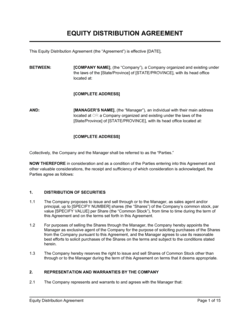
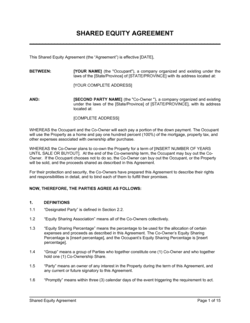
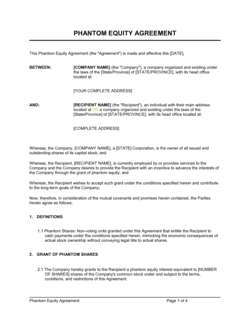
An Equity Participation Plan is a formal policy document that establishes how a company grants equity interests β€” stock options, phantom equity, profit interests, or direct shares β€” to employees, key contractors, or advisors. This free Word download gives you a structured, editable template covering eligibility, grant mechanics, vesting schedules, and exit treatment, which you can adapt and export as PDF for board approval or employee distribution.
When you need it
Use it when you are ready to offer equity as part of compensation to retain key talent, align team incentives with company growth, or replace or supplement cash compensation in a capital-constrained environment. It is also required before issuing any equity grants to ensure all participants operate under consistent, documented terms.
What's inside
Plan purpose and objectives, eligibility criteria, equity pool size and authorization, grant types and mechanics, vesting schedule and cliff provisions, exercise and settlement terms, treatment on termination and exit events, and plan administration rules.

What is an Equity Participation Plan?

An Equity Participation Plan is a formal policy document that establishes the rules under which a company grants equity interests β€” stock options, restricted shares, phantom equity, or profits interests β€” to employees, advisors, or key contractors. It defines who is eligible, what types of grants the company may issue, how vesting works, and what happens to equity when a participant leaves or the company is sold. Rather than leaving each grant to be negotiated individually, the plan creates a consistent, board-authorized framework that every Award Agreement references and incorporates by law.

Why You Need This Document

Without a written equity participation plan, every grant is a standalone transaction with no governing rules β€” leaving the company exposed to disputes over vesting, termination treatment, and exit economics at precisely the moments when those questions matter most. Inconsistent grant terms across employees create legal liability and damage morale when discrepancies surface during due diligence or a company-wide exit. Investors and acquirers routinely require a clean, board-adopted equity plan as a closing condition, and scrambling to create one during a financing process delays timelines and increases legal costs. A well-structured plan, adopted before the first grant is issued, protects the company, gives participants clear expectations, and signals to sophisticated investors that your capitalization table is professionally managed.

Which variant fits your situation?

If your situation is…Use this template
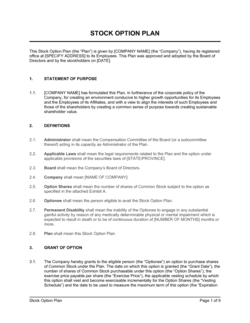
Granting stock options to employees of a C-corp or S-corpStock Option Plan (ISO / NSO)
Sharing a percentage of annual profits without granting ownershipProfit Sharing Plan
Providing equity-like upside to employees without issuing actual sharesPhantom Stock Plan
Granting equity interests in an LLC to key employeesProfits Interest Plan (LLC)
Issuing restricted shares with a vesting schedule to a co-founderRestricted Stock Agreement
Compensating advisors with a small equity stake for servicesAdvisor Equity Agreement
Structuring broad-based employee ownership for a mature companyEmployee Stock Ownership Plan (ESOP) Summary

Common mistakes to avoid

❌ Issuing grants before the plan is formally adopted

Why it matters: Grants made outside a board-authorized plan may be legally invalid, creating disputes over ownership when the company is acquired or goes public.

Fix: Complete the board adoption process and obtain a signed resolution before issuing any Award Agreements to participants.

❌ Setting an equity pool without a fully diluted cap table

Why it matters: A pool sized on issued shares rather than fully diluted shares understates dilution and surprises existing shareholders when new grants are approved.

Fix: Build or update your cap table to reflect all issued shares, options, warrants, and convertible notes before calculating the pool percentage.

❌ Using a 90-day post-termination exercise window for all participants

Why it matters: Employees who cannot afford to exercise within 90 days effectively lose vested equity β€” a fact they will share publicly, damaging your employer brand and future recruiting.

Fix: Extend the post-termination exercise window to 12 months for involuntary terminations and consider a longer window for long-tenured employees with large option packages.

❌ Omitting good leaver and bad leaver definitions

Why it matters: Without defined leaver categories, every departure triggers a negotiation over equity treatment, consuming legal fees and management time at exactly the wrong moment.

Fix: Define at minimum two leaver categories in the plan β€” voluntary resignation or termination for cause (bad leaver, forfeits unvested grants) versus involuntary layoff or retirement (good leaver, retains vested grants).

❌ Skipping the 409A valuation before option grants

Why it matters: Options priced below fair market value are treated as deferred compensation under IRC Section 409A, triggering a 20% penalty tax plus interest for the employee at vesting.

Fix: Commission an independent 409A valuation from a qualified appraiser before the first grant date, and refresh the valuation annually or after any material financing event.

❌ Not updating the plan after a financing round

Why it matters: New investors often require plan amendments β€” pool increases, acceleration changes, or ESPP additions β€” as a closing condition. An outdated plan creates a pre-closing fire drill.

Fix: Review and update the plan as part of every financing process, and include a pool increase resolution in the standard closing checklist.

The 10 key sections, explained

Plan purpose and objectives

Eligibility criteria

Equity pool size and authorization

Grant types and mechanics

Vesting schedule and cliff provisions

Exercise and settlement terms

Treatment on termination and exit events

Tax and regulatory considerations

Plan administration

Plan amendment and termination

How to fill it out

  1. 1

    Define the plan's purpose and link it to business goals

    Write one to two sentences explaining specifically why your company is creating the plan β€” retention, recruitment, replacing cash compensation, or aligning long-term incentives with an exit target.

    πŸ’‘ Tie the purpose to a concrete milestone (e.g., 'reaching Series A' or 'achieving $5M ARR') so the plan remains directionally meaningful as you grow.

  2. 2

    Calculate the fully diluted equity pool

    Work with your cap table to determine what percentage of fully diluted ownership to reserve β€” typically 10–20% for early-stage companies. Convert the percentage to a share count and document the board resolution authorizing it.

    πŸ’‘ Build in a 15–25% buffer above your current grant pipeline β€” re-authorizing the pool mid-cycle is disruptive and signals poor planning to investors.

  3. 3

    Choose the grant types appropriate for your entity and participants

    C-corps can issue ISOs (employees only), NSOs (anyone), or RSUs. LLCs must use profits interests or phantom equity. Select the type that matches your entity, participant class, and tax preference.

    πŸ’‘ If you expect to convert from an LLC to a C-corp before a Series A, design the plan now to accommodate future conversion β€” profits interests do not automatically convert to options.

  4. 4

    Set the standard vesting schedule

    Establish the default vesting terms β€” cliff period and monthly increments β€” that apply to all grants unless an Award Agreement specifies otherwise. The 4-year / 1-year cliff is the market standard for startup equity.

    πŸ’‘ Consider a shorter 3-year schedule for senior hires or advisors where the 4-year timeline exceeds their expected engagement horizon.

  5. 5

    Draft the termination and exit event provisions

    Define good leaver and bad leaver treatment, the post-termination exercise window for options, and whether single-trigger or double-trigger acceleration applies on a change of control.

    πŸ’‘ Double-trigger acceleration (change of control plus involuntary termination) is preferred by acquirers and most investors β€” single-trigger acceleration can reduce your company's attractiveness as an acquisition target.

  6. 6

    Address tax and regulatory compliance requirements

    For C-corps, note ISO eligibility limits ($100K per year rule), 409A valuation obligations, and withholding responsibilities for NSO exercises. For LLCs, document profits interest grant-date valuation to establish the baseline.

    πŸ’‘ Obtain a 409A valuation before issuing your first option grants β€” even if informal pricing feels straightforward, an undocumented fair market value creates IRS exposure for both the company and participants.

  7. 7

    Establish the administration structure

    Designate the plan administrator β€” board, compensation committee, or a named officer β€” and document their specific authorities: approving grants, amending agreements, and resolving participant disputes.

    πŸ’‘ Even if you are a sole founder, designate a compensation committee of at least two people to approve grants. This governance structure reduces fiduciary risk when outside investors conduct due diligence.

  8. 8

    Have the board formally adopt the plan

    Present the completed plan to your board for a formal vote and documented resolution. Attach the resolution to the plan and store both in your company's corporate records.

    πŸ’‘ Circulate a draft to all board members at least five business days before the meeting β€” grants made under an improperly adopted plan may be invalid.

Frequently asked questions

What is an equity participation plan?

An equity participation plan is a formal company policy that governs how equity interests β€” stock options, restricted shares, phantom equity, or profits interests β€” are granted to employees, advisors, or key contractors. It defines eligibility, grant mechanics, vesting schedules, and exit treatment in a single authoritative document, ensuring all participants operate under consistent, board-approved terms.

Who should be included in an equity participation plan?

Most plans cover full-time employees as the primary class, with optional eligibility for part-time employees, advisors, and independent contractors at the administrator's discretion. Founders and executives are typically covered by separate agreements that reference the plan. The eligibility section should define each category clearly to avoid ambiguity when non-standard roles are considered for grants.

What is the standard vesting schedule for an equity participation plan?

The market standard for startup and growth-stage companies is a four-year vesting schedule with a one-year cliff β€” 25% vests after twelve months of continuous service, and the remaining 75% vests in equal monthly installments over the following 36 months. Advisor grants commonly use a two-year schedule with a six-month cliff. Performance-based vesting can be layered on top of time-based vesting for senior roles.

What is the difference between an equity participation plan and a profit sharing plan?

An equity participation plan grants actual or synthetic ownership interests whose value is tied to the company's equity value β€” growing with the company's valuation over time. A profit sharing plan distributes a percentage of annual profits in cash, with no ownership transfer or long-term capital gain treatment. Equity plans create retention through vesting; profit sharing plans reward current-year performance without creating ongoing ownership obligations.

Does a small business need a 409A valuation to issue stock options?

Any US company granting stock options to employees should obtain a 409A valuation to set a defensible exercise price equal to or above fair market value. Without one, the IRS may treat the options as deferred compensation under Section 409A, resulting in a 20% excise tax plus interest on the employee at vesting β€” regardless of whether the options have been exercised. The cost of a 409A valuation typically ranges from $1,500 to $5,000 depending on company complexity.

Can an LLC use an equity participation plan?

Yes, but LLC equity plans use different instruments than C-corp plans. LLCs cannot issue ISOs or traditional stock options. Instead, they typically grant profits interests β€” membership interests that entitle the holder to a share of future appreciation above the company's current value at grant date. Phantom equity plans that pay cash based on equity value appreciation are also common for LLCs that want to avoid the complexity of actual ownership transfers.

What happens to equity when a company is acquired?

The treatment depends on what the plan specifies. Common outcomes include full acceleration of unvested equity (single-trigger), acceleration only if the employee is also terminated without cause within a defined window after closing (double-trigger), assumption of the existing plan by the acquirer, or cash-out of all outstanding grants at the deal price. Acquirers generally prefer double-trigger acceleration because it preserves retention incentives post-close.

How large should the equity pool be?

Early-stage startups typically reserve 10–20% of fully diluted capitalization for employee equity. A standard pre-Series A pool is around 10–15%, with investors often requiring a pool refresh to 15–20% on a post-money basis as a Series A closing condition. The right size depends on your hiring plan β€” model out grants for planned hires over the next 18–24 months and build in a buffer of at least 20% above that figure.

Do participants need to sign a separate agreement for each grant?

Yes. The equity participation plan is the governing policy document that applies to all grants, but each individual grant requires a signed Award Agreement that specifies the grant date, number of shares or units, exercise price, vesting schedule, and any grant-specific terms. The Award Agreement references and incorporates the plan, so both documents together define the participant's full entitlement.

How this compares to alternatives

vs Profit Sharing Plan

A profit sharing plan distributes a percentage of annual net profit to employees in cash, tied to current-year performance with no ownership transfer. An equity participation plan grants ownership interests whose value grows with the company over time. Profit sharing rewards short-term results; equity participation builds long-term retention through vesting and exit upside.

vs Employee Stock Ownership Plan (ESOP)

An ESOP is a qualified retirement plan that holds company shares in a trust for all eligible employees, governed by ERISA and subject to IRS contribution limits. An equity participation plan is a more flexible, non-qualified framework used by growth companies to target grants at specific employees. ESOPs suit mature, profitable businesses; equity participation plans suit startups and growth-stage companies.

vs Phantom Stock Plan

A phantom stock plan grants notional units that track share value and pay out in cash on a trigger event β€” no actual equity is issued. An equity participation plan can include phantom equity as one instrument among several, but also supports real ownership transfers through options or restricted shares. Phantom plans are simpler to administer for LLCs or companies that want to avoid dilution.

vs Stock Option Agreement

A stock option agreement is the individual grant document issued to a specific employee under an existing plan. An equity participation plan is the governing policy document that authorizes, defines, and administers all grants. The plan must exist before any option agreements can be validly issued β€” one without the other is legally incomplete.

Industry-specific considerations

SaaS / Technology

Options and RSUs are the primary retention tool for engineering and product talent; 409A valuations required before every grant cycle as valuations shift rapidly with ARR growth.

Professional Services

Equity participation replaces or supplements partnership track programs; profits interests are common for LLC-structured firms rewarding senior consultants and principals.

Manufacturing

Broad-based equity or phantom plans are used to share value with plant and operations staff without complicating the ownership structure; ESOP structures are common at scale.

Retail / E-commerce

Equity grants are concentrated in corporate and senior buyer roles; phantom equity is preferred to avoid the complexity of option exercises for high-turnover retail management layers.

Template vs pro β€” what fits your needs?

PathBest forCostTime
Use the templateEarly-stage founders establishing a first equity framework before a seed roundFree3–6 hours
Template + professional reviewCompanies preparing for a Series A, issuing grants to more than five participants, or operating in multiple jurisdictions$1,000–$3,000 for a startup attorney review3–7 days
Custom draftedLate-stage companies, regulated industries, ESOP conversions, or plans covering executives with material equity and tax complexity$5,000–$15,000+2–6 weeks

Glossary

Equity Pool
The total number of shares or percentage of ownership set aside by the company for grants under the plan, approved by the board.
Vesting Schedule
The timeline over which an employee earns the right to their granted equity, typically expressed as a cliff period followed by monthly or quarterly increments.
Cliff
A minimum service period β€” commonly 12 months β€” before any equity vests; the employee receives nothing if they leave before this date.
Grant Date
The specific date on which equity is formally awarded to a participant, which starts the vesting clock and determines the exercise price for options.
Exercise Price (Strike Price)
The price per share at which an option holder may purchase shares, set at or above fair market value on the grant date.
Phantom Equity
A cash-based incentive that mirrors the economic value of equity β€” paying out based on share value appreciation β€” without transferring actual ownership.
Profits Interest
An LLC membership interest that entitles the holder to a share of future profits and appreciation above the value of the company at the time of grant.
Dilution
The reduction in each existing shareholder's ownership percentage that occurs when new shares are issued, including grants from the equity pool.
Good Leaver / Bad Leaver
Contractual definitions distinguishing employees who leave voluntarily or for cause (bad leaver, forfeiting unvested and sometimes vested equity) from those who are laid off or retire (good leaver, retaining vested grants).
Acceleration
A provision that causes unvested equity to vest immediately upon a trigger event, such as an acquisition, IPO, or involuntary termination following a change of control.
409A Valuation
An independent appraisal of a private company's common stock fair market value, required by US tax rules to set defensible option exercise prices.

Part of your Business Operating System

This document is one of 3,000+ business & legal templates included in Business in a Box.

  • Fill-in-the-blanks β€” ready in minutes
  • 100% customizable Word document
  • Compatible with all office suites
  • Export to PDF and share electronically

Create your document in 3 simple steps.

From template to signed document β€” all inside one Business Operating System.
1
Download or open template

Access over 3,000+ business and legal templates for any business task, project or initiative.

2
Edit and fill in the blanks with AI

Customize your ready-made business document template and save it in the cloud.

3
Save, Share, Send, Sign

Share your files and folders with your team. Create a space of seamless collaboration.

Save time, save money, and create top-quality documents.

β˜…β˜…β˜…β˜…β˜…

"Fantastic value! I'm not sure how I'd do without it. It's worth its weight in gold and paid back for itself many times."

Managing Director Β· Mall Farm
Robert Whalley
Managing Director, Mall Farm Proprietary Limited
β˜…β˜…β˜…β˜…β˜…

"I have been using Business in a Box for years. It has been the most useful source of templates I have encountered. I recommend it to anyone."

Business Owner Β· 4+ years
Dr Michael John Freestone
Business Owner
β˜…β˜…β˜…β˜…β˜…

"It has been a life saver so many times I have lost count. Business in a Box has saved me so much time and as you know, time is money."

Owner Β· Upstate Web
David G. Moore Jr.
Owner, Upstate Web

Run your business with a system β€” not scattered tools

Stop downloading documents. Start operating with clarity. Business in a Box gives you the Business Operating System used by over 250,000 companies worldwide to structure, run, and grow their business.

Free Forever PlanΒ Β·Β No credit card required