Sales Commission and Incentive Policy Template

Free Word download β€’ Edit online β€’ Save & share with Drive β€’ Export to PDF

3 pagesβ€’20–25 min to fillβ€’Difficulty: Standard
Learn more ↓
FreeSales Commission and Incentive Policy Template

At a glance

What it is
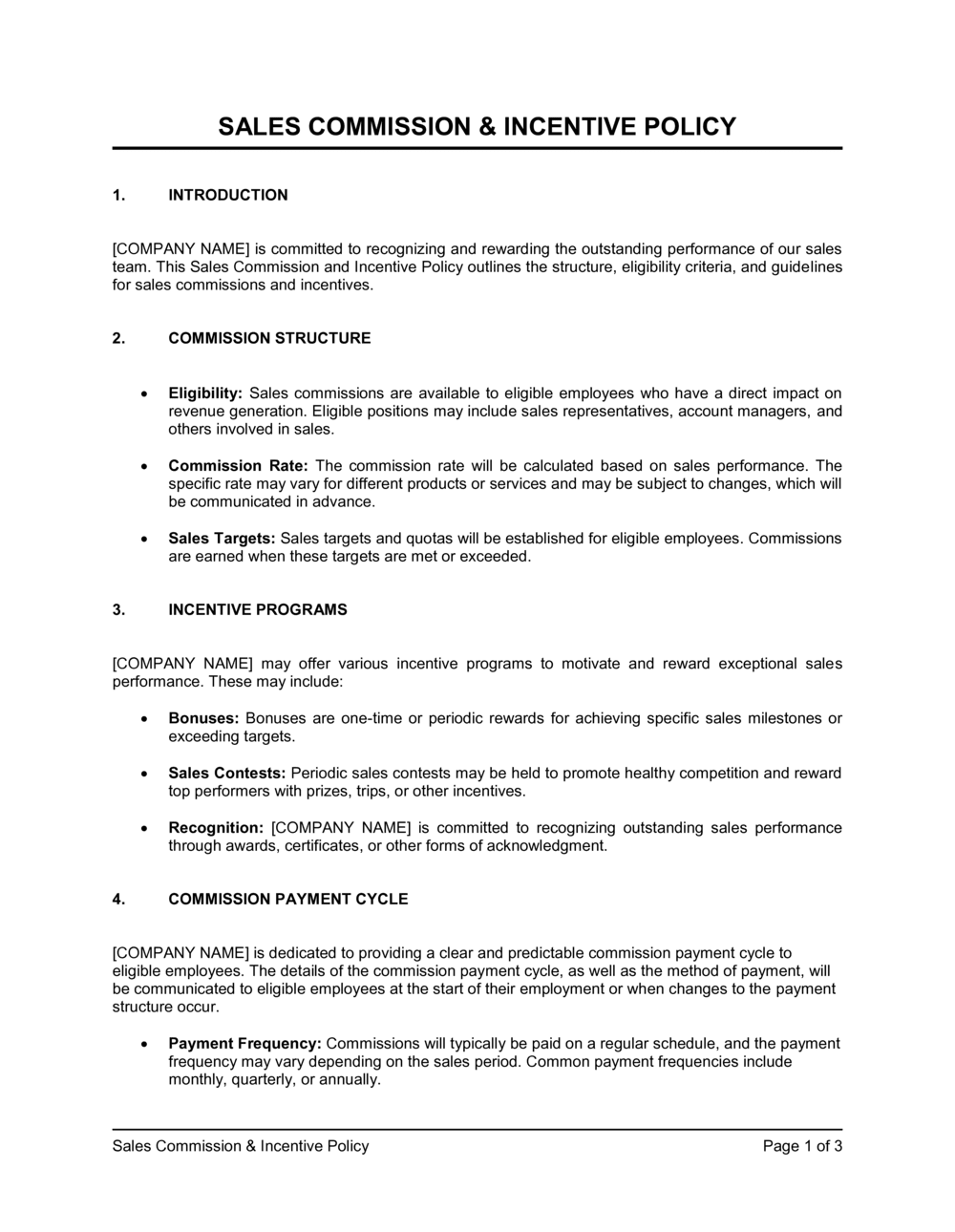
A Sales Commission and Incentive Policy is an internal document that defines exactly how sales employees earn variable compensation β€” commission rates, quota structures, accelerators, payment schedules, and clawback conditions. This free Word download gives you a structured, editable starting point you can tailor to your product lines, territories, and team structure, then export as PDF for distribution to your sales force.
When you need it
Use it when onboarding your first quota-carrying sales rep, restructuring an existing compensation plan, or replacing verbal commission agreements with a written policy before disputes arise.
What's inside
Policy scope and eligibility criteria, quota-setting methodology, base and variable pay structure, commission rate tiers and accelerators, deal crediting rules, payment schedule, clawback provisions, and plan amendment procedures.

What is a Sales Commission and Incentive Policy?

A Sales Commission and Incentive Policy is an internal governance document that defines exactly how variable pay is earned, calculated, and paid to quota-carrying sales employees. It sets out the OTE structure for each covered role, the quota-setting methodology, commission rates at each attainment tier, accelerators for overperformance, deal crediting rules, the payment schedule, clawback conditions, and the process for amending or disputing the plan. Rather than leaving commission mechanics to individual manager discretion or informal agreements, it creates a single written reference that every rep, manager, and finance team member works from.

Why You Need This Document

Operating without a written commission policy is one of the fastest ways to lose your best salespeople and expose the company to wage disputes. When commission terms exist only in emails or verbal agreements, reps calculate what they believe they are owed and finance pays what it believes it owes β€” and those numbers rarely match. The resulting disputes consume management time, damage trust, and often end in attrition or formal wage complaints. A clearly written policy eliminates ambiguity on every material question: what triggers a clawback, how a split deal is credited, and what happens to commission when a rep changes territory mid-year. It also gives new hires a complete picture of their earning potential before their first day, which accelerates ramp time and reduces early attrition. This template gives you the structure to build that policy in a few hours rather than starting from scratch.

Which variant fits your situation?

If your situation is…Use this template
Compensating account executives on new logo acquisitionSales Commission and Incentive Policy
Paying customer success managers on renewal and expansion revenueVariable Compensation Plan β€” Customer Success
Structuring SPIFFs and short-term contest payoutsSales Incentive Bonus Policy
Compensating channel partners or resellers on referred revenueChannel Partner Commission Agreement
Documenting a company-wide profit-sharing or gain-sharing programProfit Sharing Plan
Defining sales rep pay under an employment or contractor agreementIndependent Contractor Agreement
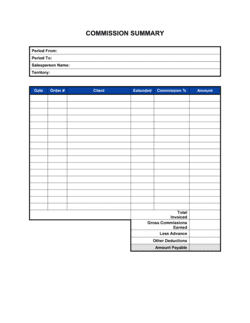
Tracking individual commission calculations and payoutsSales Commission Tracker (Spreadsheet)

Common mistakes to avoid

❌ Paying commission on booking with no clawback

Why it matters: When customers cancel within the first 90 days or fail to pay, the company absorbs both the lost revenue and the commission already paid with no recovery mechanism.

Fix: Tie commission payment to either first invoice payment or a clawback window that covers the customer's standard payment terms.

❌ Omitting deal crediting rules for overlay roles

Why it matters: When pre-sales engineers, solutions consultants, or SDRs contribute to a deal with no written crediting rule, disputes between reps and managers consume significant management time and damage team morale.

Fix: Define a specific percentage or dollar allocation for every role that routinely touches a deal before it closes, and document whether overlay pay comes from the deal commission or a separate budget.

❌ Setting quota mid-year without a documented adjustment methodology

Why it matters: Retroactive quota changes without a defined process feel arbitrary to reps and expose the company to constructive dismissal or wage claims in some jurisdictions.

Fix: Document the criteria that trigger a quota adjustment β€” territory change, role change, leave of absence β€” and the pro-ration formula used in each case.

❌ Using ranges instead of specific commission rates

Why it matters: A policy that states commission is '5–8% depending on deal type' requires a judgment call on every transaction, creates inconsistent payouts, and invites disputes.

Fix: Define a specific rate for each qualifying deal type, product line, or attainment tier β€” remove discretionary ranges entirely.

❌ No dispute submission deadline

Why it matters: Without a time limit, reps can contest commission calculations from prior fiscal years, creating retroactive reconciliation work and unpredictable compensation expense.

Fix: Set a 30-day dispute window from the payout date and state that disputes submitted after the deadline will not be reviewed.

❌ Distributing the policy without requiring written acknowledgment

Why it matters: If a rep later claims they were unaware of a clawback provision or quota threshold, an unacknowledged policy offers little protection in a wage dispute.

Fix: Require every covered rep to sign or electronically acknowledge the policy before their first commission measurement period begins, and retain the record in their HR file.

The 8 key sections, explained

Purpose, scope, and eligibility

Compensation structure and OTE breakdown

Quota-setting methodology

Commission rates and tier structure

Deal crediting and split rules

Payment schedule and processing

Clawback and adjustment provisions

Plan amendments and dispute resolution

How to fill it out

  1. 1

    Define covered roles and eligibility criteria

    List every job title covered by the policy and specify when eligibility begins β€” most companies start commission eligibility at the beginning of the first full month after a rep's ramp period ends.

    πŸ’‘ Match role names exactly to your current org chart and HR system β€” mismatches between the policy and payroll records cause processing delays.

  2. 2

    Set the base-to-variable pay ratio

    Choose an OTE mix appropriate for the role β€” 50/50 is standard for field sales, 60/40 (base-heavy) suits inside sales with shorter cycles, and 40/60 (variable-heavy) suits enterprise hunters. State the specific OTE dollar amount for each role.

    πŸ’‘ Benchmark your OTE against industry salary surveys before publishing β€” an uncompetitive plan will cost you more in turnover than you save in commission expense.

  3. 3

    Document the quota-setting process

    Explain who sets quotas, when they are communicated, and how mid-year adjustments are handled for new hires, territory changes, and leaves of absence.

    πŸ’‘ Publish quotas at least two weeks before the start of the measurement period β€” reps who don't know their number on day one can't be held fully accountable for day-one performance.

  4. 4

    Build the commission rate table

    Enter the attainment threshold below which no commission is paid, the base rate for attainment between threshold and 100%, and the accelerator rate above 100%. Use actual percentages, not ranges.

    πŸ’‘ A two-tier structure (base rate + one accelerator) is easier to administer and communicate than a five-tier table. Complexity past three tiers rarely changes selling behavior.

  5. 5

    Write the deal crediting and split rules

    Define who gets credit on a deal when multiple team members are involved β€” closing rep, overlay, SDR, and renewal owner. Specify whether overlay compensation comes from the deal commission or a separate pool.

    πŸ’‘ Run your crediting rules through three or four real historical deals before publishing. Rules that seem clear in the abstract often break on actual transactions.

  6. 6

    Set the payment schedule and required conditions

    State whether commissions are paid monthly or quarterly, the specific pay date, and what must be true before payment is released β€” signed contract, CRM stage, first payment received.

    πŸ’‘ Monthly payment cycles improve rep cash flow and reduce the churn risk that builds when variable pay accumulates in a quarterly holdback.

  7. 7

    Add clawback terms with a realistic window

    Set the clawback trigger events (cancellation, non-payment, contract reversal) and the recovery window. Ensure the window is at least as long as the customer's standard payment terms.

    πŸ’‘ Limit clawback to the first year of a multi-year deal β€” clawing back commission on Year 3 cancellations destroys rep trust without materially reducing company risk.

  8. 8

    State the amendment process and distribute for acknowledgment

    Include the notice period for plan changes and the dispute submission deadline. Have each covered rep sign or electronically acknowledge the policy before it takes effect.

    πŸ’‘ Store signed acknowledgments in your HR system linked to each rep's employment record β€” you will need them if a commission dispute escalates.

Frequently asked questions

What is a sales commission and incentive policy?

A sales commission and incentive policy is an internal document that defines how variable compensation is calculated and paid to quota-carrying sales employees. It covers commission rates, quota structure, attainment thresholds, accelerators, deal crediting rules, payment schedules, clawback conditions, and the process for amending or disputing the plan. It replaces informal commission agreements with a single authoritative written reference.

What is the difference between a commission plan and an incentive plan?

A commission plan pays a percentage of revenue or a fixed amount per unit sold β€” directly tied to deal value. An incentive plan is broader and can include bonuses for hitting activity metrics, SPIFFs for selling specific products, or team-based rewards. Most sales compensation policies combine both: a commission structure for ongoing quota attainment and incentive provisions for tactical or short-term goals.

What commission rate should I use?

Standard B2B SaaS commission rates run 8–12% of annual contract value for account executives with a 50/50 OTE mix. Transactional or lower-margin businesses typically run 2–5%. The right rate depends on your gross margin, average deal size, sales cycle length, and competitive OTE benchmarks in your market. The rate matters less than whether the plan pays a competitive OTE at 100% quota attainment.

Should commissions be paid on booking or on cash collection?

Both models are common. Paying on booking (signed contract) rewards reps faster and is easier to administer, but requires a clawback policy to recover commission on deals that cancel or go unpaid. Paying on cash collection ties commission to actual revenue but delays payout and can frustrate reps on deals with Net 60 or Net 90 payment terms. Most mid-market companies pay on booking with a 60–90 day clawback window.

What is a clawback provision and when should I include one?

A clawback provision requires a rep to return commission already paid if a customer cancels within a defined window, fails to pay their first invoice, or if a contract is reversed due to error or fraud. Include one any time you pay commission before cash is collected. Set the recovery window to be at least as long as your standard customer payment terms to ensure the provision is practically enforceable.

How do I handle commission splits when multiple reps work a deal?

Define split rules in writing before the deal closes. Common approaches include a 50/50 split between two closing reps, a fixed overlay percentage for solutions engineers paid from a separate pool, and an SDR credit of 5–10% of the commission on sourced deals. The key is specificity β€” rules that say 'managers will decide' create disputes every time a deal involves more than one rep.

Can I change the commission plan mid-year?

Yes, but best practice is to provide at least 30 days' written notice before any change takes effect and to apply changes prospectively β€” not to deals already in the pipeline. Retroactive changes to commission rates or quota expose the company to wage claims in many jurisdictions and significantly damage rep trust. Document the amendment process in the policy itself so reps know what to expect.

Does a sales commission policy need to be signed by the employee?

A signed acknowledgment is strongly advisable. While the policy does not need to be a formal contract, having each rep sign or electronically acknowledge the document before their first commission period creates a clear record that they understood and accepted the terms. This record is valuable if a commission dispute escalates to a formal wage complaint.

How often should a commission plan be updated?

Most companies review the commission plan annually, aligned with fiscal year planning and quota-setting. Significant business changes β€” a new product line, a shift in go-to-market strategy, or a major pricing change β€” may warrant an off-cycle update. Frequent mid-year changes without strong business justification erode rep trust and can increase turnover.

How this compares to alternatives

vs Employment contract (compensation clause)

An employment contract states the existence of variable compensation and references the commission plan but does not define the mechanics. The commission policy is the governing document for rates, quotas, and payment rules. Both documents are needed β€” the contract establishes the entitlement; the policy defines how it works.

vs Profit sharing plan

A profit sharing plan distributes a percentage of company net profit to all eligible employees based on a formula unrelated to individual sales performance. A commission policy pays variable compensation tied directly to each rep's individual revenue contribution. Profit sharing rewards collective results; commissions reward individual selling behavior.

vs Sales quota agreement

A sales quota agreement is a one-page document issued to an individual rep confirming their specific quota for the period. The commission policy is the company-wide governance document that defines the rules. The quota agreement references and operates under the commission policy β€” it does not replace it.

vs Independent contractor agreement

An independent contractor agreement governs the full working relationship with a self-employed sales agent, including commission terms specific to that engagement. An internal commission policy applies to employees and is not a binding contract in itself. Using an internal policy with contractors β€” rather than a signed agreement β€” creates classification risk and leaves commission terms legally ambiguous.

Industry-specific considerations

SaaS / Technology

Annual contract value commission with MRR expansion credit, net revenue retention bonuses, and multi-year deal accelerators.

Financial Services

Regulatory constraints on incentive structures, FCA or SEC suitability requirements, and deferred compensation provisions for senior producers.

Manufacturing and Distribution

Gross margin-based commission to prevent reps from discounting below floor, territory-based quota allocation, and manufacturer rep overlay structures.

Professional Services

Commission on signed statements of work with utilization-rate bonuses, origination credit for partners who source but don't close, and holdback tied to project delivery milestones.

Template vs pro β€” what fits your needs?

PathBest forCostTime
Use the templateSmall sales teams of 1–10 reps with a straightforward product and single commission tierFree2–4 hours to complete and distribute
Template + professional reviewTeams of 10+ reps, multi-product or multi-territory structures, or companies with prior commission disputes$300–$800 for an HR consultant or compensation specialist review1–3 days
Custom draftedEnterprise sales organizations, heavily regulated industries, or companies with complex overlay, channel, and international compensation structures$2,000–$8,000 for a compensation consultant engagement2–6 weeks

Glossary

On-Target Earnings (OTE)
The total expected annual compensation β€” base salary plus variable pay β€” a rep earns when achieving 100% of quota.
Quota
The revenue, unit, or activity target assigned to a sales rep for a defined period, against which commission attainment is measured.
Commission Rate
The percentage of a closed deal's value β€” or the fixed dollar amount per unit β€” paid to the rep as variable compensation.
Accelerator
A higher commission rate that applies once a rep exceeds a defined threshold, typically 100% of quota, rewarding overperformance.
Draw Against Commission
A regular advance payment made to a rep before commissions are earned, which is recovered from future commission earnings.
Clawback
A provision requiring a rep to return commission already paid if a deal cancels, a customer fails to pay, or a contract is reversed within a defined window.
Deal Crediting
The rules that determine which rep β€” or what split between reps β€” receives commission credit when multiple salespeople contribute to a single deal.
Attainment
A rep's commission earnings expressed as a percentage of their quota for the period β€” 100% attainment means the rep hit exactly their target.
SPIFF (Sales Performance Incentive Fund)
A short-term bonus paid for selling a specific product, reaching a campaign target, or achieving a tactical goal outside the standard commission plan.
Holdback
A portion of earned commission withheld until a condition is met β€” such as a customer paying their invoice or completing a project milestone.

Part of your Business Operating System

This document is one of 3,000+ business & legal templates included in Business in a Box.

  • Fill-in-the-blanks β€” ready in minutes
  • 100% customizable Word document
  • Compatible with all office suites
  • Export to PDF and share electronically

Create your document in 3 simple steps.

From template to signed document β€” all inside one Business Operating System.
1
Download or open template

Access over 3,000+ business and legal templates for any business task, project or initiative.

2
Edit and fill in the blanks with AI

Customize your ready-made business document template and save it in the cloud.

3
Save, Share, Send, Sign

Share your files and folders with your team. Create a space of seamless collaboration.

Save time, save money, and create top-quality documents.

β˜…β˜…β˜…β˜…β˜…

"Fantastic value! I'm not sure how I'd do without it. It's worth its weight in gold and paid back for itself many times."

Managing Director Β· Mall Farm
Robert Whalley
Managing Director, Mall Farm Proprietary Limited
β˜…β˜…β˜…β˜…β˜…

"I have been using Business in a Box for years. It has been the most useful source of templates I have encountered. I recommend it to anyone."

Business Owner Β· 4+ years
Dr Michael John Freestone
Business Owner
β˜…β˜…β˜…β˜…β˜…

"It has been a life saver so many times I have lost count. Business in a Box has saved me so much time and as you know, time is money."

Owner Β· Upstate Web
David G. Moore Jr.
Owner, Upstate Web

Run your business with a system β€” not scattered tools

Stop downloading documents. Start operating with clarity. Business in a Box gives you the Business Operating System used by over 250,000 companies worldwide to structure, run, and grow their business.

Free Forever PlanΒ Β·Β No credit card required