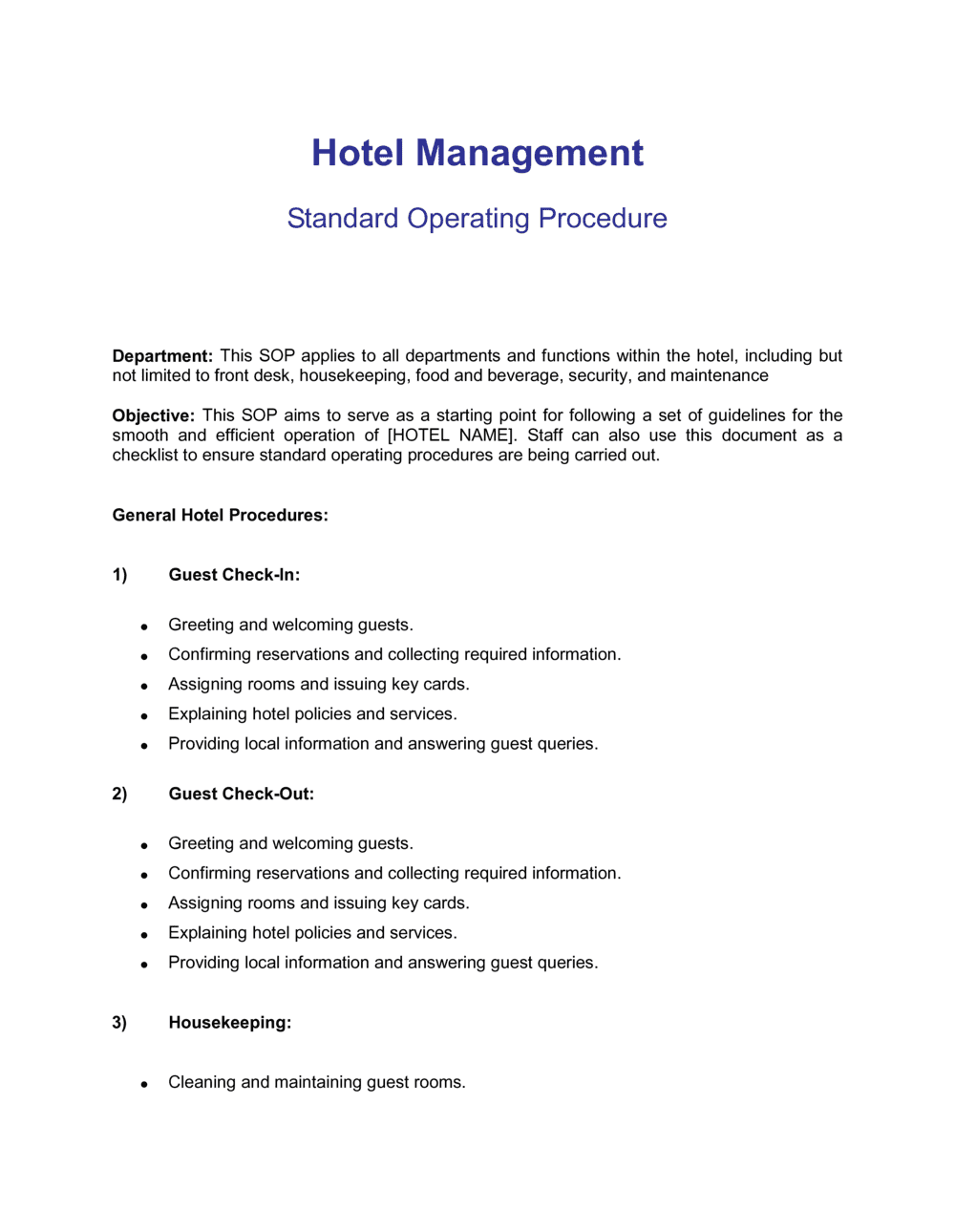
Hotel Standard Operating Procedure

Free Word download β€’ Edit online β€’ Save & share with Drive β€’ Export to PDF

4 pagesβ€’20–25 min to fillβ€’Difficulty: Standard
Learn more ↓
FreeHotel Standard Operating Procedure Template

At a glance

What it is
A Hotel Standard Operating Procedure (SOP) is a step-by-step operational document that defines how a specific task or service process must be performed at a hotel property β€” from guest check-in and room turnover to emergency response and food handling. This free Word download gives managers a structured, editable template they can tailor to any department and export as PDF for staff training binders or digital onboarding systems.
When you need it
Use it when onboarding new staff, rolling out a new service process, addressing recurring service failures, preparing for a brand audit or franchise inspection, or standardizing operations across multiple properties or shifts.
What's inside
Purpose and scope, roles and responsibilities, step-by-step procedure instructions, required materials and equipment, quality standards and checkpoints, escalation and exception handling, health and safety requirements, and a revision history log.

What is a Hotel Standard Operating Procedure?

A Hotel Standard Operating Procedure (SOP) is a step-by-step operational document that defines exactly how a specific hotel task or service process must be performed β€” by whom, in what sequence, to what quality standard, and what to do when something falls outside the expected flow. Unlike a general policy or employee handbook, an SOP is task-specific and actionable: it tells a housekeeper the exact order in which to clean a guest room, tells a front desk agent the precise steps for processing an early check-in, and tells a food and beverage supervisor how to handle an allergen inquiry at the restaurant. SOPs are the operational foundation that allows a hotel to deliver a consistent guest experience across every shift, every employee, and every season.

Why You Need This Document

Without documented SOPs, every task in a hotel depends on institutional memory β€” and institutional memory walks out the door with every staff departure. In an industry with annual turnover rates often exceeding 70%, relying on verbal training means service quality degrades with every new hire cycle. The consequences are direct: inconsistent room cleanliness triggers negative reviews, non-standard food handling creates health code violations, and undefined escalation paths turn resolvable guest complaints into refund requests. For franchise and brand-affiliated properties, undocumented operations are a compliance liability β€” auditors look specifically for written procedures during property inspections, and failing to produce them can jeopardize brand affiliation. This template gives hotel managers a structured, editable starting point to document any process in under three hours, with every required component β€” steps, quality checkpoints, escalation paths, and a revision log β€” built into the format from the first page.

Which variant fits your situation?

If your situation is…Use this template
Creating a step-by-step guide specifically for front desk staffFront Desk SOP
Documenting room-cleaning sequences and inspection standardsHousekeeping SOP
Outlining food handling, service, and sanitation for the restaurant or barF&B Operations SOP
Defining procedures for fire, medical, or security emergenciesEmergency Response SOP
Standardizing the full hotel operations manual across all departmentsHotel Operations Manual
Preparing a staff training curriculum tied to SOPsEmployee Training Plan
Creating shift-handover checklists linked to each SOPShift Handover Report

Common mistakes to avoid

❌ Writing procedures at a management reading level

Why it matters: SOPs written with assumed industry knowledge create inconsistent execution from entry-level or new-hire staff, precisely the people who rely on them most.

Fix: Write every step at a reading level accessible to a first-week employee. Have a new hire attempt the task using only the SOP before it is finalized.

❌ Assigning responsibility to departments instead of roles

Why it matters: Department-level ownership means no individual is accountable. During shift changes or peak occupancy, tasks fall through the gap between 'housekeeping' and 'front desk.'

Fix: Replace every department name with a specific job title. If two roles share a task, define which one initiates and which one confirms.

❌ No measurable quality standard for inspection checkpoints

Why it matters: Supervisors interpreting 'high standard' differently across shifts produces inconsistent guest experience and makes it impossible to coach underperforming staff objectively.

Fix: Replace every subjective quality descriptor with a specific, observable criterion β€” a count, a temperature, a visual benchmark, or a system status code.

❌ Distributing editable Word files as the working copy

Why it matters: Staff or supervisors making informal edits to their own copies creates version divergence within weeks. Incidents get investigated against a version that no longer reflects what staff were actually following.

Fix: Lock the master SOP in a controlled location, issue only read-only PDFs with version numbers printed in the footer, and require manager approval for every update.

The 8 key sections, explained

Purpose and scope

Roles and responsibilities

Materials, equipment, and systems

Step-by-step procedure

Quality standards and inspection checkpoints

Health, safety, and compliance requirements

Escalation and exception handling

Revision history and approval log

How to fill it out

  1. 1

    Define the single process this SOP covers

    Name the exact task β€” 'Guest room turnover for standard double rooms' not 'housekeeping.' A focused scope makes the SOP trainable in a single session.

    πŸ’‘ If you need more than 12 numbered steps to describe the process, it probably contains two SOPs. Split it.

  2. 2

    Identify every role involved and assign clear ownership

    List each job title that touches the process, and write one sentence per role defining their specific accountability. Avoid department-level assignments.

    πŸ’‘ Walk through one real execution of the process and note every person who picks something up, approves something, or updates a system β€” those are your roles.

  3. 3

    List all required materials, chemicals, and system access

    Open the supply closet (or the software) and document every item needed before the task begins. Include chemical dilution ratios, equipment settings, and login roles.

    πŸ’‘ Cross-check the materials list against your current purchase orders β€” if a listed item is no longer stocked, the SOP is already out of date.

  4. 4

    Write numbered, single-action steps

    Draft each step as a single physical or system action starting with a verb: 'Knock three times,' 'Enter room status as VAC,' 'Replace all amenities.' Avoid combining two actions in one step.

    πŸ’‘ Read the steps aloud while physically miming the task. Any step you cannot mime is too abstract to train against.

  5. 5

    Define measurable quality checkpoints

    After every major block of steps, insert a checkpoint with a specific, observable pass/fail criterion. Assign a role to conduct the check and document the outcome.

    πŸ’‘ Use photos or diagrams for visual standards β€” a picture of a correctly made bed is more consistent than any written description.

  6. 6

    Add the escalation path for every exception scenario

    Brainstorm the three to five most common situations where the standard steps break down, and write a named contact and time limit for each.

    πŸ’‘ Review incident logs or complaint records from the past 90 days to identify which exceptions actually occur β€” don't rely on intuition alone.

  7. 7

    Complete the approval and revision log before distributing

    Enter the version number, effective date, and approving manager before the SOP is shared. This creates the starting point for all future updates.

    πŸ’‘ Store the approved master in a shared drive with edit permissions restricted to department heads. Distribute read-only PDFs to staff to prevent unauthorized edits.

  8. 8

    Train staff against the SOP before declaring it live

    Run at least one supervised walk-through with frontline staff and incorporate any questions or confusion into a final revision before the SOP is formally active.

    πŸ’‘ If three or more staff members ask the same question during training, that step needs to be rewritten β€” the gap is in the document, not the staff.

Frequently asked questions

What is a hotel standard operating procedure?

A hotel standard operating procedure (SOP) is a written, step-by-step document that defines exactly how a specific hotel task or service process must be performed. It covers who does what, in what sequence, to what standard, and what to do when something goes wrong. SOPs ensure that every guest receives a consistent experience regardless of which staff member or shift is on duty.

What departments in a hotel need SOPs?

Every guest-facing and operational department benefits from SOPs: front desk and reservations, housekeeping and laundry, food and beverage, maintenance and engineering, security, concierge and guest services, and revenue management. Back-office functions like accounting and HR also use SOPs for payroll processing, incident reporting, and onboarding. Priority typically goes to high-frequency, high-impact processes first β€” check-in, room turnover, and food safety.

How is a hotel SOP different from a policy?

A policy states what must or must not happen and why β€” for example, 'All guests must present a valid ID at check-in.' An SOP defines the exact steps for how that policy is implemented: which staff member requests ID, which system they update, what to do if a guest refuses. Policies set the rule; SOPs explain how to follow it. Both are needed, but they should be kept in separate documents.

How long should a hotel SOP be?

A focused SOP for a single process typically runs 1–4 pages. If it exceeds 4 pages, it likely covers more than one distinct procedure and should be split. An SOP that is too long does not get read during actual task performance. Aim for 6–12 numbered steps for most operational tasks; complex processes like emergency response or equipment maintenance may run slightly longer with justified sub-steps.

How often should hotel SOPs be reviewed and updated?

Operational SOPs should be reviewed at a minimum once per year, and immediately after any of the following: a brand audit finding, a guest complaint pattern, a change in equipment or software, a regulatory update affecting food safety or safety procedures, or a significant change in staffing structure. Every update must be logged in the revision history with a new version number and approval date.

Can one SOP template be used across all hotel departments?

Yes β€” a single SOP template structure works for every department because the framework (purpose, roles, materials, steps, quality checkpoints, escalation, revision log) is universal. The content within each section changes by department and task. Using one template structure across all departments makes it easier to train staff who move between roles and simplifies the manager review and approval process.

How do hotel SOPs support franchise and brand compliance?

Franchise and brand agreements require properties to operate according to the franchisor's service and quality standards. Written SOPs document that those standards are embedded in daily operations and provide the audit trail inspectors look for during property reviews. Hotels without documented SOPs struggle to demonstrate compliance consistently β€” a verbal culture of 'we always do it that way' fails a brand audit.

What is the best way to train staff using hotel SOPs?

The most effective approach is a three-step method: first, the supervisor explains the SOP verbally while the employee reads along; second, the employee performs the task step-by-step while the supervisor observes and corrects in real time; third, the employee performs the task independently and is assessed against the quality checkpoints in the SOP. Avoid distributing an SOP without a supervised walk-through β€” reading alone does not transfer procedural skills.

Should guest-facing procedures and back-of-house procedures use the same SOP format?

Yes, using the same format for both creates consistency in how staff are trained and how managers conduct audits. The main difference is in the quality standards section: guest-facing SOPs emphasize service tone, response time, and guest experience metrics, while back-of-house SOPs focus on safety, sanitation, and equipment operation criteria. The structure β€” purpose, roles, steps, checkpoints, escalation β€” remains the same.

How this compares to alternatives

vs Hotel Operations Manual

A hotel operations manual is the master reference document covering the entire property β€” organizational structure, brand standards, policies, and an index of all SOPs. An individual SOP is a single procedure document that lives within the operations manual. Write SOPs first, then compile them into the manual.

vs Employee Training Plan

A training plan defines the schedule, curriculum, and learning objectives for onboarding or upskilling staff. An SOP is the source material the training is built from. The SOP tells you what to do; the training plan tells you how and when to teach it. Both are needed β€” one without the other produces either untrained staff or undertrained SOPs.

vs Workplace Policy

A policy states a rule and the rationale behind it β€” for example, a no-show charging policy or a guest privacy policy. An SOP defines the steps to implement that policy in daily operations. Policies are typically one to two paragraphs; SOPs are multi-step procedural documents. They should be cross-referenced but kept separate.

vs Shift Handover Report

A shift handover report captures the status of open tasks, guest issues, and room conditions at the end of each shift. An SOP defines the repeatable process that each shift executes. The handover report is a record of what happened; the SOP is the instruction for what should happen. SOPs should specify when and how the handover report is completed as one of their final steps.

Industry-specific considerations

Luxury and boutique hotels

SOPs govern personalized service sequences, butler protocols, and turndown rituals that define the brand and justify premium pricing.

Franchise and chain hotels

Brand standards require documented SOPs for every guest-touchpoint process, with revision logs available for annual franchisor property inspections.

Food and beverage / hospitality groups

Food safety SOPs must align with HACCP critical control points, local health codes, and allergen management protocols to pass health inspections.

Resort and extended-stay properties

Higher complexity operations β€” spa, pools, activities programming, and long-stay housekeeping schedules β€” require distinct SOPs for each service line.

Template vs pro β€” what fits your needs?

PathBest forCostTime
Use the templateIndependent hotels, boutique properties, and managers building SOPs for the first timeFree1–3 hours per SOP
Template + professional reviewFranchise properties preparing for a brand audit or multi-department SOP rollout$500–$2,000 for an operations consultant review1–2 weeks
Custom draftedLarge multi-property groups building a full operations manual with integrated SOPs across all departments$5,000–$20,000 for a hospitality operations firm4–12 weeks

Glossary

Standard Operating Procedure (SOP)
A documented, step-by-step set of instructions for how a specific routine task must be performed to achieve a consistent, expected result.
Scope
The boundaries of an SOP β€” defining which departments, roles, locations, or situations the procedure applies to and which it explicitly excludes.
Turn Time
The time allowed to clean and reset a guest room between checkout and the next check-in, typically 20–45 minutes depending on room category.
Escalation Path
The defined chain of contacts and actions a staff member must follow when a situation falls outside the scope of their role or the standard procedure.
Brand Standard
A hotel chain's or franchise's prescribed service, design, or operational requirement that every property in the network must meet.
Property Management System (PMS)
The software platform hotels use to manage reservations, room assignments, billing, and guest profiles β€” referenced in many front-desk and housekeeping SOPs.
Revision History
A log at the end of an SOP recording every version update β€” including the date, nature of the change, and the name of the person who approved it.
Critical Control Point (CCP)
A step in a food-handling or safety process where a specific action must be taken to prevent, eliminate, or reduce a hazard to an acceptable level.
Yield Management
A revenue strategy that adjusts room pricing dynamically based on demand, occupancy, and booking lead time β€” referenced in front-desk and reservations SOPs.
Room Status Codes
Standardized shorthand used by housekeeping and front desk to communicate the condition of each room β€” such as OCC (Occupied), VAC (Vacant Clean), or OOO (Out of Order).

Part of your Business Operating System

This document is one of 3,000+ business & legal templates included in Business in a Box.

  • Fill-in-the-blanks β€” ready in minutes
  • 100% customizable Word document
  • Compatible with all office suites
  • Export to PDF and share electronically

Create your document in 3 simple steps.

From template to signed document β€” all inside one Business Operating System.
1
Download or open template

Access over 3,000+ business and legal templates for any business task, project or initiative.

2
Edit and fill in the blanks with AI

Customize your ready-made business document template and save it in the cloud.

3
Save, Share, Send, Sign

Share your files and folders with your team. Create a space of seamless collaboration.

Save time, save money, and create top-quality documents.

β˜…β˜…β˜…β˜…β˜…

"Fantastic value! I'm not sure how I'd do without it. It's worth its weight in gold and paid back for itself many times."

Managing Director Β· Mall Farm
Robert Whalley
Managing Director, Mall Farm Proprietary Limited
β˜…β˜…β˜…β˜…β˜…

"I have been using Business in a Box for years. It has been the most useful source of templates I have encountered. I recommend it to anyone."

Business Owner Β· 4+ years
Dr Michael John Freestone
Business Owner
β˜…β˜…β˜…β˜…β˜…

"It has been a life saver so many times I have lost count. Business in a Box has saved me so much time and as you know, time is money."

Owner Β· Upstate Web
David G. Moore Jr.
Owner, Upstate Web

Run your business with a system β€” not scattered tools

Stop downloading documents. Start operating with clarity. Business in a Box gives you the Business Operating System used by over 250,000 companies worldwide to structure, run, and grow their business.

Start freeΒ Β·Β No credit card required