Notice of Assignment Template

Free Word download β€’ Edit online β€’ Save & share with Drive β€’ Export to PDF

1 pageβ€’15–20 min to fillβ€’Difficulty: Standard
Learn more ↓
FreeNotice of Assignment Template

At a glance

What it is
A Notice of Assignment is a formal letter sent by an assignor (the party transferring rights) to an obligor (the party who owes the performance or payment) informing them that specified rights, obligations, or receivables under an existing contract have been transferred to a new party β€” the assignee. This free Word download lets you fill in the relevant contract details and deliver a compliant, professional notice in minutes.
When you need it
Use it whenever an assignment of contract rights has occurred and the obligor must be informed β€” including invoice or receivables factoring, business acquisitions, loan transfers, lease assignments, and IP licensing deals. In many jurisdictions, notice to the obligor is required to make the assignment effective and to protect the assignee's priority position.
What's inside
Identifying details for the assignor, assignee, and obligor; a reference to the original contract being assigned; a clear statement of what rights or obligations are transferred; the effective date; payment redirection instructions where applicable; and a contact block for the assignee.

What is a Notice of Assignment?

A Notice of Assignment is a formal written letter sent by an assignor to an obligor informing them that specific rights, obligations, or receivables under an existing contract have been transferred to a new party β€” the assignee. It is the operative step that makes an assignment binding on the obligor: without notice, the obligor can continue performing in favor of the original party and validly discharge their obligations, leaving the assignee with no enforceable claim against them. This free Word download gives you a professionally structured notice you can complete in minutes and send immediately.

Why You Need This Document

Failing to send a formal, well-structured notice of assignment can undermine an otherwise valid transfer entirely. If an obligor is never properly notified, payments continue flowing to the assignor, creating disputes between assignor and assignee over funds already received. In jurisdictions that apply a priority-by-notification rule, a competing assignee who notifies the obligor first β€” even if their assignment came later β€” can claim superior rights to the receivable. A clear, complete notice delivered promptly closes these gaps: it redirects payment, establishes your priority date, and gives the obligor everything they need to update their records without confusion or delay. This template ensures your notice includes every required element β€” parties, contract reference, scope of assignment, effective date, and payment instructions β€” in a format that any accounts payable or contracts team can process immediately.

Which variant fits your situation?

If your situation is…Use this template
Assigning invoice receivables to a factoring companyNotice of Assignment of Receivables
Transferring a commercial lease to a new tenant or buyerLease Assignment Agreement
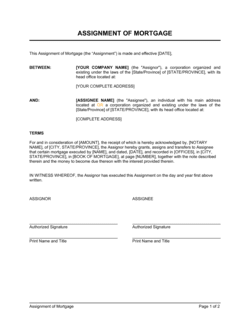
Notifying a borrower that their loan has been sold to a new lenderNotice of Assignment of Mortgage
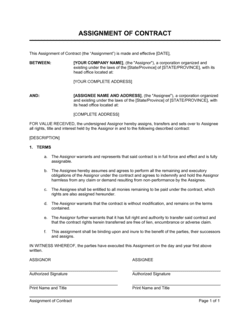
Assigning all contracts as part of a full business acquisitionAssignment Agreement
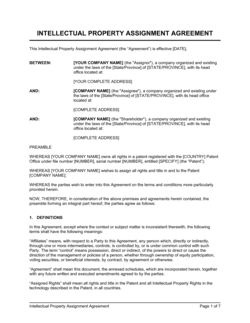
Transferring intellectual property rights to a new ownerIP Assignment Agreement
Notifying a service provider that the client entity has changedNotice of Assignment of Contract
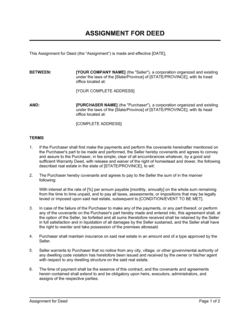
Documenting the underlying transfer before issuing the noticeDeed of Assignment

Common mistakes to avoid

❌ Using vague scope language

Why it matters: A notice that says 'certain rights have been assigned' without specifying which rights leaves the obligor unable to determine what they must do differently, and may not be legally effective.

Fix: State the exact rights being assigned β€” all payment obligations, specific invoice numbers, the entirety of the contract, etc. β€” in plain, unambiguous terms.
❌ Ignoring the original contract's anti-assignment clause

Why it matters: Sending a notice without first obtaining required consent from the obligor can make the assignment void or voidable, exposing the assignor to breach-of-contract liability.

Fix: Review the original agreement for anti-assignment language before issuing the notice. Obtain written consent from the obligor and reference it in the notice.

❌ Delaying delivery of the notice after the assignment

Why it matters: In jurisdictions that apply a 'first to notify' priority rule, a second assignee who notifies the obligor before the first assignee has priority over the receivable β€” even if the first assignment occurred earlier.

Fix: Issue the notice on or before the assignment effective date, and use a delivery method that creates a timestamped record of receipt.

❌ Omitting the assignee's complete contact and payment details

Why it matters: Without full remittance details, the obligor cannot redirect payments and may continue paying the assignor β€” creating a dispute between assignor and assignee over funds already received.

Fix: Include the assignee's name, address, phone, email, and complete banking details directly in the notice body, not just in a covering email.

The 8 key clauses, explained

Header and parties block

In plain language: Identifies the date, the assignor's full legal name and address, and the obligor's full legal name and address at the top of the letter.

Sample language
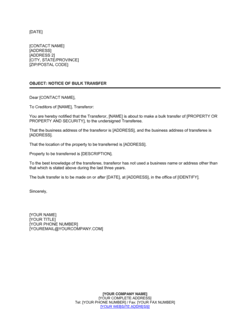
[DATE] [ASSIGNOR LEGAL NAME] [ASSIGNOR ADDRESS] To: [OBLIGOR LEGAL NAME] [OBLIGOR ADDRESS]

Common mistake: Using a trade name instead of the registered legal entity name. If the entity name on the notice doesn't match the contract, the obligor's accounts payable team may reject or delay acting on it.

Subject line referencing the original contract

In plain language: A brief subject line pinpointing the exact agreement being assigned β€” including its date and any reference number β€” so the obligor can locate it immediately.

Sample language
Re: Notice of Assignment β€” [AGREEMENT NAME] dated [DATE], Reference No. [CONTRACT NUMBER]

Common mistake: Omitting the original contract date or reference number. Without this, the obligor cannot confirm which agreement the notice relates to, delaying acknowledgment.

Statement of assignment

In plain language: The core paragraph that clearly declares the assignment β€” who assigned what, to whom, and as of what date.

Sample language
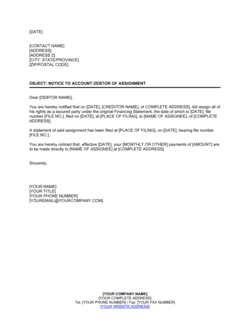
Please be advised that [ASSIGNOR LEGAL NAME] ('Assignor') has assigned all of its rights, title, and interest in and to the above-referenced agreement to [ASSIGNEE LEGAL NAME] ('Assignee'), effective [EFFECTIVE DATE].

Common mistake: Using vague language such as 'transferred certain rights.' The notice must specify whether all rights, a defined subset, or specific receivables are assigned β€” ambiguity can defeat the assignment's effectiveness against the obligor.

Payment redirection instructions

In plain language: Directs the obligor to make all future payments or perform all future obligations in favor of the assignee, including updated banking or remittance details.

Sample language
Effective [EFFECTIVE DATE], all payments due under the Agreement shall be made payable to [ASSIGNEE LEGAL NAME] and remitted to: [BANK NAME], Account No. [ACCOUNT NUMBER], Routing No. [ROUTING NUMBER], Reference: [CONTRACT/INVOICE NUMBER].

Common mistake: Leaving payment instructions in the body of an email rather than in the notice itself. The notice is the operative document β€” payment details embedded only in a covering email are routinely overlooked or separated from the file.

Confirmation that prior payments remain valid

In plain language: Confirms that any payments the obligor made to the assignor before the effective date of this notice are valid and will not need to be repeated to the assignee.

Sample language
Payments made to Assignor prior to the date of this Notice shall be deemed valid satisfaction of the corresponding obligations to the extent received before this Notice.

Common mistake: Omitting this clause entirely. Without it, the obligor may worry about double-payment liability, slowing their processing of the notice.

Assignor's warranty of authority

In plain language: A brief statement by the assignor confirming they have the right to make the assignment and that the original agreement is in good standing.

Sample language
Assignor represents that (i) it has full authority to make this assignment, (ii) the Agreement is in full force and effect, and (iii) no event of default exists as of the date of this Notice.

Common mistake: Skipping this clause when the original contract contains an anti-assignment provision. The notice should reference any consent already obtained to prevent the obligor from disputing the validity of the assignment.

Request for acknowledgment

In plain language: Asks the obligor to confirm receipt of the notice and, if required, to countersign the notice or return a signed consent form.

Sample language
Please acknowledge receipt of this Notice by signing and returning the enclosed copy or by written confirmation to [ASSIGNEE CONTACT NAME] at [EMAIL ADDRESS] within [X] business days.

Common mistake: Not specifying a deadline or response format. Without a clear instruction, acknowledgment is often delayed indefinitely, creating uncertainty about whether the notice was received.

Assignee contact information

In plain language: Provides the assignee's full contact details β€” name, address, phone, and email β€” so the obligor knows exactly who to deal with going forward.

Sample language
For all inquiries relating to the Agreement after the Effective Date, please contact: [ASSIGNEE CONTACT NAME], [TITLE], [COMPANY], [ADDRESS], [PHONE], [EMAIL].

Common mistake: Listing only an email address. Obligors processing invoices or payments often require a physical address and phone number for their vendor records before they will update payment routing.

How to fill it out

  1. 1

    Identify all three parties with their legal names

    Enter the full registered legal names and addresses of the assignor, assignee, and obligor. Check the original contract to confirm exact entity names match.

    πŸ’‘ Mismatched entity names between the notice and the original contract are the single most common reason obligors refuse to act on an assignment notice without further verification.

  2. 2

    Reference the original contract precisely

    Fill in the agreement title, execution date, and any internal reference or contract number in the subject line and opening paragraph. If the contract was amended, note the most recent amendment date too.

    πŸ’‘ If you are assigning only specific invoices rather than the entire contract, list each invoice number and amount in a schedule attached to the notice.

  3. 3

    State the scope of the assignment clearly

    Specify whether you are assigning all rights, only payment rights, specific receivables, or a defined subset of obligations. Do not use 'certain rights' or other vague language.

    πŸ’‘ If the original contract has an anti-assignment clause, attach a copy of the written consent you obtained from the obligor before issuing this notice.

  4. 4

    Set and confirm the effective date

    Enter the date the assignment takes effect. This is typically the date the underlying assignment agreement was signed, not the date the notice is sent.

    πŸ’‘ Send the notice as close to the effective date as possible β€” a long gap between the assignment date and the notice date can create priority disputes if the assignor also assigns the same rights to a second party.

  5. 5

    Add complete payment redirection details

    If the assignment involves payment obligations, include the assignee's full banking details β€” bank name, account number, routing or sort code, and any required payment reference.

    πŸ’‘ For international payments, include SWIFT/BIC and IBAN codes in addition to domestic routing numbers.

  6. 6

    Send via a trackable delivery method and retain proof

    Deliver the notice by email with read-receipt enabled, registered mail, or courier β€” whichever the original contract specifies for formal notices. Keep a timestamped copy of the transmission.

    πŸ’‘ Check the original contract's 'notices' clause for required delivery methods. Sending by email when the contract requires registered mail can invalidate the notice in a dispute.

Frequently asked questions

What is a notice of assignment?

A notice of assignment is a formal written communication sent by an assignor to an obligor informing them that rights, obligations, or receivables under an existing contract have been transferred to a new party β€” the assignee. It is the mechanism that makes the obligor aware of the transfer and legally obligates them to perform in favor of the assignee rather than the original contracting party.

When is a notice of assignment required?

A notice of assignment is typically required whenever an assignment of contractual rights needs to be binding on the obligor β€” including accounts receivable factoring, business sales involving contract transfer, loan assignments, lease transfers, and IP licensing deals. In many jurisdictions, an assignment not communicated to the obligor is ineffective against them, meaning they can continue paying the assignor and discharge their obligation validly.

Does a notice of assignment need to be signed?

A notice of assignment does not typically require a signature to be legally effective β€” it is a notification, not a contract. However, including an authorized signatory from the assignor adds credibility and makes it easier for the obligor to process internally. Some industries and jurisdictions may require a countersignature from the obligor as confirmation of receipt and acknowledgment.

What is the difference between an assignment and a novation?

An assignment transfers rights (and sometimes obligations) from one party to another without necessarily releasing the assignor from liability. A novation is a three-party agreement that substitutes a new party for an original party entirely, extinguishing the original party's obligations. If you need the original party fully released from the contract, you need a novation agreement β€” not just an assignment notice.

What happens if the original contract has an anti-assignment clause?

If the original contract prohibits assignment without consent, issuing a notice of assignment without first obtaining that consent may make the assignment void or voidable and expose the assignor to a breach of contract claim. You should review the original contract, obtain the obligor's written consent, and reference that consent in the notice before sending it.

Can I assign only part of a contract's rights?

Yes. Partial assignments are common β€” particularly in receivables financing where only specific invoices are assigned rather than the entire contractual relationship. The notice must clearly identify which rights or receivables are being assigned, ideally by listing invoice numbers, amounts, and due dates in an attached schedule.

What delivery method should I use when sending a notice of assignment?

The original contract's 'notices' clause typically specifies acceptable delivery methods β€” registered mail, courier, email, or a combination. If the contract is silent, use a method that creates a timestamped record of delivery: registered mail with return receipt, or email with a read-receipt and a follow-up confirmation. Proof of delivery date matters when priority between competing assignments is disputed.

Do I need a lawyer to prepare a notice of assignment?

For straightforward commercial assignments β€” invoice factoring, standard contract transfers β€” a well-structured template is generally sufficient. Engage a lawyer when the original contract contains complex anti-assignment provisions, the assignment involves regulated receivables such as healthcare claims or government contracts, or the transaction is part of a larger acquisition where multiple contracts are being assigned simultaneously.

How this compares to alternatives

vs Assignment Agreement

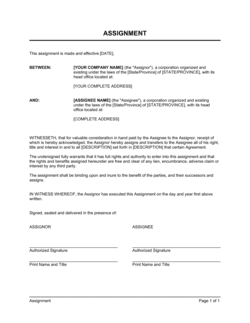
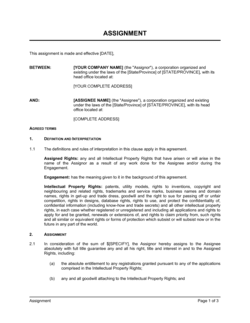
An assignment agreement is the binding contract between assignor and assignee that creates the transfer. A notice of assignment is the subsequent letter that informs the obligor of the transfer. You need the assignment agreement first to document the deal, then the notice to make it effective against the obligor. Both documents are typically required.

vs Novation Agreement

A novation agreement is a three-party contract that fully substitutes one contracting party for another, releasing the original party from all obligations. A notice of assignment transfers rights to a new party but may leave the assignor secondarily liable. Use novation when the original party needs a complete release; use assignment when only rights need to transfer.

vs Deed of Assignment

A deed of assignment is a formal executed document that transfers title to specific assets β€” commonly IP rights or real property β€” under seal. A notice of assignment is the notification step that informs the obligor after the transfer. For asset-level transfers requiring a deed, both documents are used: the deed creates the transfer, the notice enforces it against third parties.

vs Consent to Assignment

A consent to assignment is a document signed by the obligor acknowledging the assignment and agreeing to perform in favor of the assignee. A notice of assignment is sent unilaterally by the assignor and does not require the obligor's agreement β€” only their acknowledgment. Where the original contract requires consent, the consent to assignment must be obtained before the notice is sent.

Industry-specific considerations

Financial Services

Loan sales, mortgage transfers, and receivables factoring routinely require formal assignment notices to obligors to perfect the assignee's security interest.

Real Estate

Lease assignments and mortgage transfers require written notice to tenants and borrowers so they know where to direct rent payments and mortgage instalments.

Professional Services

Firms transferring client retainer agreements or vendor contracts during mergers or practice sales must notify clients and suppliers before the assignment is effective.

Technology / SaaS

Software licensing agreements and SaaS contracts assigned during acquisitions require notices to customers specifying the new billing entity and support contact.

Template vs pro β€” what fits your needs?

PathBest forCostTime
Use the templateStandard commercial assignments β€” invoice factoring, contract transfers in business sales, straightforward lease assignmentsFree10–15 minutes
Template + professional reviewAssignments involving anti-assignment clauses, regulated receivables, or multiple contracts being transferred simultaneously$150–$400 for a lawyer or contracts specialist review1–2 days
Custom draftedComplex acquisitions, financial institution loan transfers, or assignments subject to specific regulatory notification requirements$500–$2,000+3–7 days

Glossary

Assignor
The original party to a contract who transfers their rights or obligations to a third party.
Assignee
The third party who receives the transferred rights or obligations from the assignor.
Obligor
The party who owes performance or payment under the original contract and must be notified of the assignment.
Assignment
The transfer of contractual rights, benefits, or receivables from one party to another, with or without the transfer of obligations.
Accounts Receivable Factoring
A financing arrangement where a business sells its outstanding invoices to a third party at a discount in exchange for immediate cash.
Anti-Assignment Clause
A contract provision that prohibits or restricts one or both parties from assigning their rights without the other party's prior written consent.
Novation
A three-party agreement that replaces one party to a contract with a new party, extinguishing the original party's obligations entirely β€” unlike an assignment, which may leave the assignor secondarily liable.
Effective Date of Assignment
The specific date on which the transfer of rights becomes operative and the obligor must begin performing in favor of the assignee.
Priority
In the context of competing assignments, the principle determining which assignee has the superior claim β€” often resolved by who gave notice to the obligor first.
Consent to Assignment
Written acknowledgment from the obligor confirming receipt of the assignment notice and agreement to perform in favor of the assignee.

Part of your Business Operating System

This document is one of 3,000+ business & legal templates included in Business in a Box.

  • Fill-in-the-blanks β€” ready in minutes
  • 100% customizable Word document
  • Compatible with all office suites
  • Export to PDF and share electronically

Create your document in 3 simple steps.

From template to signed document β€” all inside one Business Operating System.
1
Download or open template

Access over 3,000+ business and legal templates for any business task, project or initiative.

2
Edit and fill in the blanks with AI

Customize your ready-made business document template and save it in the cloud.

3
Save, Share, Send, Sign

Share your files and folders with your team. Create a space of seamless collaboration.

Save time, save money, and create top-quality documents.

β˜…β˜…β˜…β˜…β˜…

"Fantastic value! I'm not sure how I'd do without it. It's worth its weight in gold and paid back for itself many times."

Managing Director Β· Mall Farm
Robert Whalley
Managing Director, Mall Farm Proprietary Limited
β˜…β˜…β˜…β˜…β˜…

"I have been using Business in a Box for years. It has been the most useful source of templates I have encountered. I recommend it to anyone."

Business Owner Β· 4+ years
Dr Michael John Freestone
Business Owner
β˜…β˜…β˜…β˜…β˜…

"It has been a life saver so many times I have lost count. Business in a Box has saved me so much time and as you know, time is money."

Owner Β· Upstate Web
David G. Moore Jr.
Owner, Upstate Web

Run your business with a system β€” not scattered tools

Stop downloading documents. Start operating with clarity. Business in a Box gives you the Business Operating System used by over 250,000 companies worldwide to structure, run, and grow their business.

Free Forever PlanΒ Β·Β No credit card required