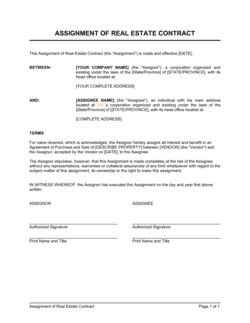
Intellectual Property Assignment Template

Free Word download • Edit online • Save & share with Drive • Export to PDF

7 pages25–35 min to fillDifficulty: ComplexSignature requiredLegal review recommended
Learn more ↓
FreeIntellectual Property Assignment Template

At a glance

What it is
An Intellectual Property Assignment is a legally binding agreement that permanently transfers ownership of IP — patents, copyrights, trademarks, trade secrets, or software — from an assignor to an assignee. This free Word download gives you a structured, attorney-ready starting point you can edit online and export as PDF to formalize any IP transfer in a single enforceable document.
When you need it
Use it when acquiring a business and taking ownership of its IP assets, when a founder or employee transfers IP to a company at formation, when a contractor delivers work product that must vest in the client, or when selling or licensing a patent, copyright, or brand to a third party.
What's inside
Identification of the parties and a precise description of the IP being transferred, consideration and payment terms, warranties on ownership and non-infringement, representations on freedom to assign, a recordation and further-assurances clause, and governing law with dispute resolution.

What is an Intellectual Property Assignment?

An Intellectual Property Assignment is a legally binding agreement that permanently transfers full ownership of intellectual property rights — patents, copyrights, trademarks, trade secrets, or proprietary software — from the original owner (the assignor) to a new owner (the assignee). Unlike a license, which permits use while the creator retains title, an assignment extinguishes the assignor's ownership entirely. Once executed and recorded, the assignee holds all rights to use, sell, sublicense, and enforce the IP as if they had created it themselves. The agreement must be in writing and signed by the assignor to be enforceable under IP law in virtually every major jurisdiction.

Why You Need This Document

Without a signed IP assignment, the company you are building — or acquiring — may not legally own its most valuable assets. Investors routinely terminate term sheets when due diligence reveals that a founder's code, a contractor's design, or a co-developer's patent is not formally held by the entity. Under US copyright law, an independent contractor who writes software or creates designs retains ownership by default unless a written agreement explicitly transfers it; a handshake deal or a payment receipt is not enough. The same gap appears in founder situations: IP developed personally before incorporation stays in the founder's name until a signed assignment moves it into the company. A properly executed and recorded IP assignment closes these title defects before they become deal-breakers, protects the assignee's ability to enforce rights against infringers, and creates the clean chain of title that banks, investors, and acquirers require at every stage of a company's growth.

Which variant fits your situation?

If your situation is…Use this template
Transferring IP from a founder to a newly incorporated companyFounder IP Assignment Agreement
Contractor delivering custom software, designs, or creative assetsWork-for-Hire and IP Assignment Clause (Contractor Agreement)
Selling a patent to a third party for a lump-sum purchase pricePatent Assignment Agreement
Transferring a registered trademark as part of a brand acquisitionTrademark Assignment Agreement
Assigning copyright in written, artistic, or musical worksCopyright Assignment Agreement
Granting rights to use IP without transferring full ownershipIntellectual Property License Agreement
Assigning all IP assets as part of a full business acquisitionAsset Purchase Agreement

Common mistakes to avoid

❌ Vague IP description with no schedule

Why it matters: An assignment that refers to 'all IP related to the company' without a specific schedule is routinely challenged in disputes and cannot be recorded at a patent or trademark office.

Fix: Attach a Schedule A that lists every IP asset by its official registration number, filing number, or a precise written description. Update the schedule before signing.

❌ Omitting consideration in founder-to-company transfers

Why it matters: An assignment with no stated consideration may be treated as an unenforceable gift, particularly if the founder later disputes ownership or becomes a creditor in insolvency proceedings.

Fix: Recite at minimum a nominal sum of $1 and have the assignor acknowledge receipt. For material IP, use equity or a documented purchase price.

❌ No further-assurances obligation

Why it matters: Without this clause, a founder or contractor who falls out with the company can refuse to sign the USPTO recordation papers, leaving the assignee with unrecorded title for years.

Fix: Include a specific further-assurances clause requiring the assignor to sign all documents and cooperate with recordation at the assignee's request and expense, even after closing.

❌ Failing to record the assignment with the relevant IP office

Why it matters: In the US, an unrecorded patent assignment is void against a subsequent good-faith purchaser who records first. Investors and acquirers conducting due diligence also treat unrecorded assignments as unresolved title defects.

Fix: File the executed assignment with the USPTO, CIPO, or relevant national registry within 3 months of signing. Keep the recordation certificate on file as proof of perfected title.

❌ Ignoring moral rights in international assignments

Why it matters: Acquiring full ownership under US law does not automatically extinguish the creator's moral rights under French, German, or Canadian law, which can prevent modifications or require attribution indefinitely.

Fix: Add a moral rights waiver clause and, for EU and Canadian counterparties, obtain the broadest consent to modification that local law permits in writing.

❌ Warranty cap set at nominal consideration

Why it matters: If the consideration is $1 and the indemnification cap matches, the assignee bears the full cost of any title dispute — which can reach six figures in patent litigation.

Fix: Set the indemnification cap at a commercially meaningful level — a multiple of actual consideration or the fair market value of the IP — separate from the nominal recitation of consideration.

The 10 key clauses, explained

Parties and recitals

In plain language: Identifies the assignor and assignee by their full legal names and describes the background context — why the transfer is occurring.

Sample language
This Intellectual Property Assignment Agreement ('Agreement') is entered into as of [DATE] between [ASSIGNOR FULL LEGAL NAME], a [ENTITY TYPE] organized under the laws of [JURISDICTION] ('Assignor'), and [ASSIGNEE FULL LEGAL NAME], a [ENTITY TYPE] ('Assignee').

Common mistake: Using trade names or personal nicknames instead of registered legal entity names. If the assignor's legal name doesn't match the name on the IP registration, the transfer cannot be recorded at the relevant IP office.

Description and schedule of assigned IP

In plain language: Precisely identifies every IP right being transferred — patent numbers, trademark registrations, copyright registrations, software titles, and trade secret descriptions — typically in an attached schedule.

Sample language
Assignor hereby assigns to Assignee all right, title, and interest in and to the intellectual property listed in Schedule A, including Patent No. [NUMBER], Trademark Registration No. [NUMBER], and the software codebase identified as [PRODUCT NAME], Version [X.X].

Common mistake: Using a catch-all description like 'all IP related to the business' without a detailed Schedule A. Vague descriptions create disputes over what was actually transferred and make recordation with IP offices impossible.

Consideration

In plain language: States what the assignee pays or provides in exchange for the transfer — a purchase price, equity grant, or nominal amount — making the agreement contractually binding.

Sample language
In consideration of the sum of [PURCHASE PRICE / $1.00 and other good and valuable consideration], the receipt and sufficiency of which Assignor hereby acknowledges, Assignor agrees to the assignment set forth herein.

Common mistake: Omitting consideration entirely in founder-to-company assignments on the assumption the transfer is voluntary. Even a nominal $1 recitation is required to make the assignment enforceable as a contract rather than an unenforceable gift.

Scope and breadth of assignment

In plain language: Confirms the transfer covers all rights in the IP — including the right to sue for past infringement, the right to sublicense, and all derivative works — worldwide and in perpetuity.

Sample language
The assignment includes all causes of action for past, present, and future infringement, the right to apply for registrations in any jurisdiction, and all rights to prepare derivative works, with full authority to sublicense and enforce the assigned IP globally.

Common mistake: Limiting the assignment to 'current use' or a specific territory. A narrow scope leaves the assignor holding residual rights that can surface in future litigation or block the assignee from exploiting the IP internationally.

Assignor representations and warranties

In plain language: The assignor confirms they own the IP free and clear, have not previously assigned or encumbered it, and are not aware of any third-party infringement claims.

Sample language
Assignor represents and warrants that: (a) Assignor is the sole and exclusive owner of the Assigned IP; (b) the Assigned IP is free and clear of all liens, licenses, and encumbrances; (c) Assignor has full authority to enter into and perform this Agreement; and (d) Assignor is not aware of any pending or threatened claim of infringement.

Common mistake: Accepting generic warranties without requiring the assignor to disclose existing licenses or third-party claims. An undisclosed license to a prior client can survive the assignment and limit the new owner's ability to exploit the IP.

Moral rights waiver

In plain language: Where applicable law allows, the assignor waives any moral rights — such as the right to attribution or to object to modifications — so the assignee can freely use and adapt the IP.

Sample language
To the extent permitted by applicable law, Assignor irrevocably waives all moral rights, rights of attribution, and rights of integrity in and to the Assigned IP, and consents to any modification, adaptation, or use by Assignee without attribution.

Common mistake: Omitting this clause when acquiring creative or software IP from individuals. In Canada, France, and Germany, moral rights survive even a full ownership transfer unless explicitly waived, which can restrict the new owner from modifying the work.

Recordation and further assurances

In plain language: Obligates the assignor to cooperate with filing the assignment at patent and trademark offices, sign supplemental documents, and take all other steps needed to perfect the assignee's title.

Sample language
Assignor agrees to execute and deliver to Assignee, at Assignee's reasonable request and expense, any additional documents, instruments of transfer, and consents necessary to record this assignment with the [USPTO / CIPO / IPO / EUIPO] and to perfect Assignee's title to the Assigned IP.

Common mistake: No further-assurances clause at all. Without it, an assignor who becomes uncooperative after closing can frustrate or indefinitely delay USPTO recordation, leaving the assignee with unrecorded title that is vulnerable to bona fide purchasers.

Indemnification

In plain language: Requires the assignor to compensate the assignee for losses arising from a breach of any warranty — for example, a third-party ownership claim that surfaces after the transfer.

Sample language
Assignor shall indemnify, defend, and hold harmless Assignee from and against any claims, damages, costs, and expenses (including reasonable legal fees) arising out of or related to any breach of Assignor's representations and warranties in this Agreement.

Common mistake: Capping indemnification at the nominal consideration amount (e.g., $1) in founder assignments. If a third party later claims ownership and the cap is $1, the assignee bears the full cost of defending title — which can run into six figures.

Governing law and dispute resolution

In plain language: Specifies which jurisdiction's law governs interpretation of the agreement and how disputes are resolved — through arbitration, mediation, or litigation in a named court.

Sample language
This Agreement is governed by the laws of the State of [STATE], without regard to conflict-of-law principles. Any dispute arising hereunder shall be resolved by binding arbitration administered by [AAA / JAMS] in [CITY, STATE], except that either party may seek injunctive relief in any court of competent jurisdiction.

Common mistake: Selecting a governing law that has no connection to either party's jurisdiction. Courts occasionally decline to apply a foreign governing-law clause in IP disputes, defaulting to local law — which may produce very different results.

Entire agreement and severability

In plain language: Confirms this document supersedes all prior understandings about the IP transfer, and that if one clause is unenforceable, the rest of the agreement survives.

Sample language
This Agreement constitutes the entire agreement between the parties with respect to the subject matter hereof and supersedes all prior negotiations, representations, and agreements. If any provision is held invalid or unenforceable, the remaining provisions shall continue in full force.

Common mistake: No integration clause when prior emails or term sheets described different assignment scope or payment terms. Without it, a court may admit extrinsic evidence that redefines what was actually transferred.

How to fill it out

  1. 1

    Identify both parties using full legal names

    Enter the assignor's and assignee's complete registered legal names — not trade names or personal names unless the assignor is an unincorporated individual. Confirm the names match any existing IP registrations.

    💡 Run a USPTO or national IP office search on the assignor's name before drafting to confirm they are the registered owner of the IP you are acquiring.

  2. 2

    Build a detailed Schedule A listing every IP asset

    List each IP right separately with its official identifiers — patent number, trademark registration number, copyright registration number, or a precise description of the trade secret or software. Attach Schedule A to the signed agreement.

    💡 For unregistered IP such as trade secrets or unpublished software, use a functional description ('the machine-learning recommendation algorithm used in [PRODUCT NAME], as described in Exhibit B') rather than a vague label.

  3. 3

    State the consideration clearly

    Enter the purchase price, equity amount, or nominal consideration. Even if the transfer is between a founder and their own company, recite a specific amount — $1 is legally sufficient — and have the assignor acknowledge receipt.

    💡 For assignments tied to an acquisition, link the consideration to the broader purchase agreement by cross-reference rather than restating the full price, to avoid inconsistency between documents.

  4. 4

    Define the scope of the assignment

    Confirm the transfer is worldwide, perpetual, and includes the right to sue for past infringement and to file for registrations in any jurisdiction. Remove any unintended geographic or temporal limitations.

    💡 If the assignor is retaining any rights — such as a license back for personal portfolio use — document that carve-out explicitly in the agreement rather than leaving it implied.

  5. 5

    Complete the representations and warranties section

    Have the assignor confirm sole ownership, absence of encumbrances, no pending infringement claims, and full authority to transfer. Request supporting documentation — prior assignment agreements, license agreements — to verify each warranty.

    💡 Ask the assignor to attach a list of all existing licenses or permissions granted to third parties, even informal ones. This becomes an exhibit and limits future warranty-breach claims.

  6. 6

    Add the moral rights waiver if creative or software IP is involved

    Include the moral rights waiver clause for any work created by an individual — software, design, writing, or music — especially if the assignor is located in Canada, France, Germany, or another jurisdiction recognizing moral rights.

    💡 In jurisdictions where moral rights cannot be waived (e.g., France for personal-nature works), obtain the broadest consent to modification permitted by local law instead.

  7. 7

    Set governing law and dispute resolution

    Choose a jurisdiction with a meaningful connection to at least one party — typically the assignee's place of incorporation or the state where the IP was developed. Specify arbitration or court venue.

    💡 Delaware is a common choice for US company-to-company assignments because its courts have extensive IP and contract law precedent, even if neither party operates there.

  8. 8

    Execute and file with the relevant IP registry

    Both parties must sign and date the agreement. File the executed assignment with the USPTO, CIPO, IPO, or EUIPO within 3 months of signing to preserve priority against subsequent transferees and creditors.

    💡 The USPTO charges a recordation fee per assignment document, not per patent — bundle multiple patent assignments in one filing where possible to reduce costs.

Frequently asked questions

What is an intellectual property assignment?

An intellectual property assignment is a written legal agreement that permanently transfers full ownership of IP rights — patents, copyrights, trademarks, trade secrets, or software — from one party (the assignor) to another (the assignee). Unlike a license, which grants permission to use IP while the original owner retains title, an assignment extinguishes the assignor's ownership entirely and vests all rights in the assignee. The agreement must be in writing and signed to be enforceable for most categories of IP under US, UK, Canadian, and EU law.

What is the difference between an IP assignment and a license?

An assignment permanently transfers ownership — after signing, the assignor no longer owns the IP and cannot use it without the new owner's permission. A license grants a right to use the IP for a defined purpose, territory, or time period while the licensor retains ownership. If you are acquiring a business or need to control how IP is used and monetized, an assignment is typically the right instrument. If you want to generate royalty income while keeping title, a license agreement is more appropriate.

Does an IP assignment need to be recorded with a government registry?

Recording is not mandatory to create a valid assignment between the parties, but it is strongly recommended. In the United States, an unrecorded patent assignment is void against a subsequent good-faith purchaser or creditor who records first under 35 U.S.C. § 261. Recording with the USPTO, CIPO, IPO, or EUIPO also provides public notice of ownership and is required before the new owner can sue for infringement in some jurisdictions. Most IP counsel recommend filing within 3 months of execution.

Can a contractor or freelancer keep rights to work they created for a client?

In the absence of a written assignment or a qualifying work-for-hire agreement, the answer in most common-law jurisdictions is yes. Under US copyright law, independent contractors — as opposed to employees — retain ownership of creative works unless a written work-for-hire agreement is signed and the work falls within one of the nine statutory categories, or unless a separate written assignment transfers ownership. This is a frequent and costly surprise for startups and businesses that commission software, design, or content without an IP assignment clause in their contractor agreements.

What IP should founders assign to their company at formation?

Founders should assign any IP developed before incorporation that is related to the company's intended business — including prototype code, product designs, algorithms, branding, and domain names. Investors conducting due diligence will verify that all material IP is held by the company entity, not by individual founders. An unassigned patent or codebase sitting in a founder's personal name is a deal-stopper in most venture financings and M&A transactions. Execute the assignment at or before formation, and record it with the relevant IP office if the IP is registered.

Is a nominal $1 consideration sufficient for an IP assignment to be binding?

Yes, in most common-law jurisdictions including the US, Canada, and the UK, nominal consideration of $1 — paired with an acknowledgment of receipt — is legally sufficient to support a binding contract. Courts generally do not evaluate the adequacy of consideration. However, for assignments made in connection with a broader transaction (acquisition, employment, or contractor engagement), using a commercially meaningful amount or referencing the broader deal consideration is prudent and reduces the risk of a future challenge on unconscionability grounds.

What happens if an IP assignment is signed after an employee starts work?

In common-law jurisdictions, a promise made to an existing employee without new consideration may be unenforceable for lack of consideration — the same problem that affects employment contracts signed after the start date. For IP assignments from current employees, provide a documented benefit (bonus, salary increase, or additional equity) as fresh consideration at the time of signing. Assignments executed before employment or at the start of a new role avoid this problem entirely.

Do moral rights affect an IP assignment?

Yes, particularly in France, Germany, Canada, and other civil-law jurisdictions. Moral rights — including the right to attribution and the right to object to distortion of a work — belong to the creator personally and typically cannot be transferred, only waived. A full ownership assignment under US law does not automatically extinguish moral rights under French or German law if the creator is based there. Including a broad moral-rights waiver clause in the assignment, and obtaining the widest consent permitted by local law for EU and Canadian counterparties, is standard practice for international IP acquisitions.

What IP registrations require a recorded assignment to enforce rights?

US patent law under 35 U.S.C. § 261 requires recordation for the assignment to be effective against subsequent purchasers and creditors. For trademarks, recording an assignment with the USPTO or national registry is required to maintain the trademark's validity — an unrecorded trademark assignment that lacks a transfer of the associated goodwill can void the trademark entirely. Copyright assignments in the US need not be recorded to be valid between parties, but recordation creates a presumption of ownership in disputes. Best practice is to record all IP assignments within 3 months of execution.

How this compares to alternatives

vs Intellectual Property License Agreement

A license grants the right to use IP for a specific purpose, territory, or time period while the licensor retains ownership. An assignment permanently transfers full title to the assignee. Use a license when you want to generate ongoing royalty income or retain control over how the IP is used; use an assignment when the acquirer needs complete, unencumbered ownership — as required in most M&A and venture financing transactions.

vs Independent Contractor Agreement

A contractor agreement governs the engagement terms — deliverables, payment, and scope — but does not automatically transfer IP ownership in most jurisdictions. An IP assignment (or a work-for-hire clause embedded in the contractor agreement) is the instrument that actually vests ownership in the client. Both documents are typically needed when commissioning custom creative or technical work.

vs Asset Purchase Agreement

An asset purchase agreement covers the acquisition of an entire bundle of business assets — equipment, inventory, contracts, and IP — at a transaction level. An IP assignment is the standalone instrument used to transfer a specific IP asset, and is often executed as a closing document under a broader asset purchase agreement. For IP-only transactions, the IP assignment alone is sufficient.

vs Non-Disclosure Agreement

An NDA protects confidential information by restricting disclosure during negotiations or a working relationship — it does not transfer any ownership rights. An IP assignment is executed after the parties agree to transfer ownership and is the document that actually effects the change in title. NDAs are typically signed first, during due diligence; the IP assignment closes the transaction.

Industry-specific considerations

Technology / SaaS

Software code, algorithms, and proprietary datasets transferred from founding engineers to the company entity at incorporation, and from contractors delivering product features under development agreements.

Life Sciences and Biotech

Patent assignments arising from university research collaborations, inventor assignments required to maintain USPTO ownership chains, and transfer of compound libraries in pharma asset deals.

Creative and Media

Copyright assignments for commissioned content, music, video, and brand design — critical because independent creators retain copyright by default unless a written assignment is executed.

Manufacturing and Engineering

Patent and trade secret assignments covering manufacturing processes, product designs, and tooling — typically executed as part of an asset purchase or joint-venture dissolution.

Professional Services

Assignment of client-facing deliverables — custom software, reports, and methodologies — where the engagement contract must include an explicit IP assignment to transfer ownership from the firm to the client.

Retail and E-commerce

Trademark and brand assignments executed during business acquisitions or rebranding, and copyright assignments for product photography, packaging design, and proprietary software tools.

Jurisdictional notes

United States

Under 35 U.S.C. § 261, a patent assignment must be in writing and should be recorded with the USPTO within 3 months of execution to be effective against subsequent good-faith purchasers. Copyright assignments under 17 U.S.C. § 204 must be in writing and signed by the assignor. Work-for-hire doctrine applies to employees but not independent contractors for most creative works unless a signed written agreement exists. Moral rights are limited under US law to works of visual art under 17 U.S.C. § 106A.

Canada

The Patent Act requires patent assignments to be in writing; registration with the Canadian Intellectual Property Office (CIPO) is strongly recommended. Copyright assignments under the Copyright Act must be in writing and signed. Unlike the US, Canadian law recognizes broad moral rights for authors — including software developers — which survive assignment and must be expressly waived in the agreement. Quebec's Civil Code may impose additional formalities for assignments involving Quebec-based assignors.

United Kingdom

Under the Copyright, Designs and Patents Act 1988, copyright assignments must be in writing and signed by or on behalf of the assignor. Patent assignments should be registered with the UK Intellectual Property Office (IPO) within 6 months to avoid loss of costs in infringement proceedings. Post-Brexit, UK and EU trademark and design registrations are separate; an assignment of an EU trademark does not automatically transfer the parallel UK registration. Employees in the UK own their own inventions unless made in the normal course of duties, making written assignment clauses in employment contracts essential.

European Union

EU trademark assignments must be recorded with the EUIPO to be effective against third parties; the same applies to EU design rights. Copyright assignment formality requirements vary by member state — France requires assignments to specifically identify each right transferred, each territory, and the duration. French and German law recognizes strong moral rights that cannot be assigned and can only be partially waived; creators retain the right to object to distortion of their works. The EU Software Directive treats employer-owned software as a work-for-hire equivalent, but written assignment agreements are still advisable for contractor-developed software.

Template vs lawyer — what fits your deal?

PathBest forCostTime
Use the templateFounder-to-company assignments at incorporation, straightforward contractor IP transfers, and single-asset copyright or trademark assignments with clear ownershipFree30–60 minutes
Template + legal reviewAssignments involving registered patents, cross-border transfers with moral-rights implications, or IP tied to an acquisition or fundraising round$400–$1,000 (IP attorney review)2–5 days
Custom draftedComplex patent portfolios, university technology transfers, M&A IP schedules, or assignments with royalty-back or license-back arrangements$2,000–$8,000+1–4 weeks

Glossary

Assignor
The party transferring ownership of the intellectual property rights to another party.
Assignee
The party receiving and taking full legal ownership of the intellectual property rights.
Work for Hire
A US copyright doctrine under which work created by an employee within the scope of employment, or by a contractor under a qualifying written agreement, is owned by the employer or commissioning party from the moment of creation.
Moral Rights
Rights retained by creators in many jurisdictions — particularly France and Canada — to be credited as the author and to object to distortion of their work, separate from economic ownership.
Recordation
The formal filing of an IP assignment with a government registry — such as the USPTO for patents and trademarks — to provide public notice of the ownership change.
Consideration
The value exchanged in return for the IP transfer — which may be a cash payment, equity, a nominal sum of $1, or mutual promises — required for the assignment to be legally binding.
Representation and Warranty
A factual statement made by a party that is true at the time of signing and on which the other party may rely — if false, it can give rise to indemnification or rescission.
Chain of Title
A documented sequence of transfers showing every prior assignment of an IP asset, establishing that the current owner has unbroken and legitimate title.
Encumbrance
Any existing lien, license, security interest, or claim on an IP asset that limits or burdens the new owner's ability to use or transfer it freely.
Further Assurances
A clause obligating the assignor to sign additional documents, cooperate with recordation, and take other reasonable steps needed to perfect the assignee's ownership after closing.
Indemnification
A contractual obligation requiring one party to compensate the other for losses, costs, or claims arising from a breach of warranty or misrepresentation.
Severability
A standard clause providing that if one provision of the agreement is found unenforceable, the remainder of the contract continues in full force.

Part of your Business Operating System

This document is one of 3,000+ business & legal templates included in Business in a Box.

  • Fill-in-the-blanks — ready in minutes
  • 100% customizable Word document
  • Compatible with all office suites
  • Export to PDF and share electronically

Create your document in 3 simple steps.

From template to signed document — all inside one Business Operating System.
1
Download or open template

Access over 3,000+ business and legal templates for any business task, project or initiative.

2
Edit and fill in the blanks with AI

Customize your ready-made business document template and save it in the cloud.

3
Save, Share, Send, Sign

Share your files and folders with your team. Create a space of seamless collaboration.

Save time, save money, and create top-quality documents.

★★★★★

"Fantastic value! I'm not sure how I'd do without it. It's worth its weight in gold and paid back for itself many times."

Managing Director · Mall Farm
Robert Whalley
Managing Director, Mall Farm Proprietary Limited
★★★★★

"I have been using Business in a Box for years. It has been the most useful source of templates I have encountered. I recommend it to anyone."

Business Owner · 4+ years
Dr Michael John Freestone
Business Owner
★★★★★

"It has been a life saver so many times I have lost count. Business in a Box has saved me so much time and as you know, time is money."

Owner · Upstate Web
David G. Moore Jr.
Owner, Upstate Web

Run your business with a system — not scattered tools

Stop downloading documents. Start operating with clarity. Business in a Box gives you the Business Operating System used by over 250,000 companies worldwide to structure, run, and grow their business.

Free Forever Plan · No credit card required