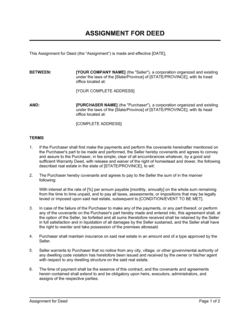
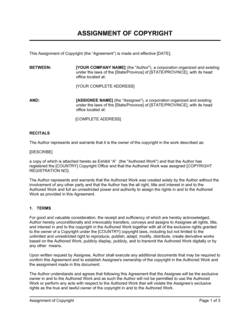
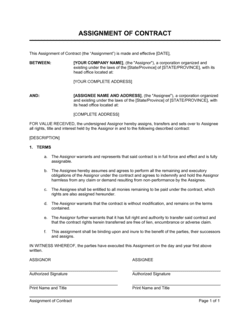
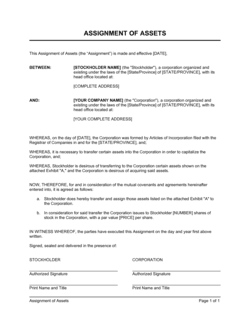
Assignment of Lien Template

Free Word download • Edit online • Save & share with Drive • Export to PDF

1 page20–30 min to fillDifficulty: StandardSignature requiredLegal review recommended
Learn more ↓
FreeAssignment of Lien Template

At a glance

What it is
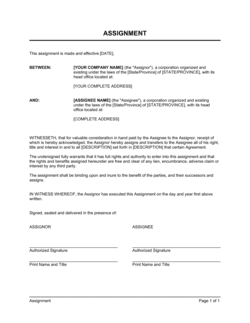
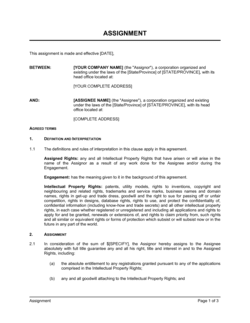
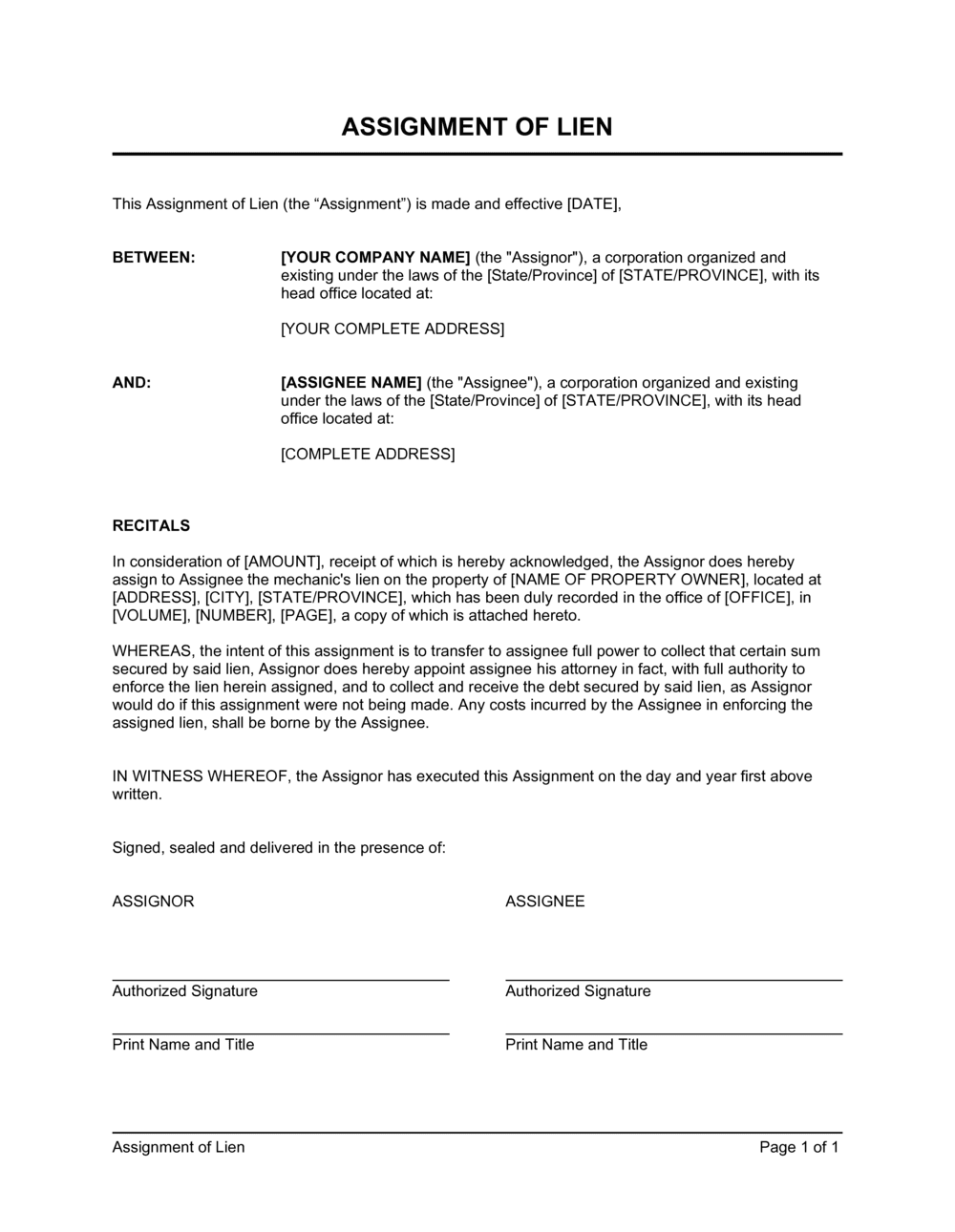
An Assignment of Lien is a legally binding document by which a lienholder (the assignor) transfers their lien rights against a debtor's property to a third party (the assignee). This template is a free Word download you can edit online and export as PDF, covering all essential elements including lien identification, consideration, warranties of title, and governing law.
When you need it
Use it when a lienholder wants to sell, transfer, or otherwise convey their lien interest to another party — common in construction, real estate, and debt-collection contexts where lien rights have monetary value that can be monetized or restructured.
What's inside
Parties and recitals identifying the assignor and assignee, a precise description of the original lien, the consideration paid for the transfer, warranties and representations by the assignor, assumption of rights and obligations by the assignee, and the governing law and execution block.

What is an Assignment of Lien?

An Assignment of Lien is a legally binding document through which a lienholder — the assignor — formally transfers their lien rights against a debtor's property to a third party known as the assignee. Once executed and properly recorded, the assignee steps into the assignor's legal position and holds all the rights to enforce, release, or otherwise deal with the lien as if they were the original claimant. Liens that are commonly assigned include mechanic's and materialman's liens in construction, tax lien certificates, judgment liens, and assessment liens held by homeowners' associations. The document must precisely identify the original lien by its recording information, state the consideration exchanged, include the assignor's warranties on lien validity and outstanding balance, and be notarized and filed in the applicable public registry to bind third parties.

Why You Need This Document

Without a properly drafted and recorded assignment of lien, the transfer of lien rights creates a gap in the public record that can have serious financial consequences. An assignee who fails to record the assignment risks losing priority to a subsequent buyer or creditor who has no notice of their interest — potentially rendering a paid-for lien worthless. Without express warranties from the assignor, the assignee may discover after closing that the lien was already partially satisfied, improperly perfected, or subject to challenge, with limited contractual recourse. Debtors who are never formally notified of the assignment can continue paying the original lienholder, extinguishing the debt and leaving the assignee empty-handed. This template closes each of these gaps by providing a complete, jurisdiction-aware framework — covering recording obligations, debtor notice, warranties, indemnification, and enforcement — so that lien rights transfer cleanly, completely, and with the legal protections both parties need.

Which variant fits your situation?

If your situation is…Use this template
Transferring a mechanic's or materialman's lien from a subcontractorAssignment of Mechanic's Lien
Assigning a tax lien certificate purchased at a county auctionAssignment of Tax Lien Certificate
Transferring a judgment lien to a collection agencyAssignment of Judgment
Releasing rather than transferring lien rights upon paymentLien Release / Waiver
Partially transferring lien rights while retaining a sharePartial Assignment of Lien
Assigning a mortgage lien as part of a loan saleAssignment of Mortgage
Granting a security interest in lien proceeds without full transferCollateral Assignment of Lien

Common mistakes to avoid

❌ Failing to record the assignment

Why it matters: An unrecorded assignment is valid between the parties but invisible to the world. A subsequent buyer or encumbrancer who has no notice of the transfer can legally take priority over an unrecorded assignee's interest.

Fix: Record the assignment in the applicable county or jurisdiction registry as soon as possible after execution — never more than the deadline stated in the agreement.

❌ Mismatching entity names with the original lien filing

Why it matters: If the assignor's name in the assignment does not match the name on the original lien filing, the chain of title is broken and title companies will flag the defect, potentially blocking future sales or refinancing of the property.

Fix: Pull a certified copy of the original lien before drafting and transcribe the recorded name character-for-character, including punctuation and entity designator.

❌ Skipping debtor notice after execution

Why it matters: In most jurisdictions, a debtor who pays the original lienholder after the lien has been assigned — but before receiving notice — obtains a valid discharge. The assignee loses the payment and may have limited recourse against an insolvent assignor.

Fix: Deliver written notice to the debtor on the same day the assignment is executed, by certified mail, and retain the delivery confirmation.

❌ Choosing a governing law that conflicts with the property's situs

Why it matters: Lien rights in real property are fundamentally governed by the law of the state or country where the property is located. A governing-law clause selecting a different state does not override the situs rule and creates conflicts that complicate enforcement.

Fix: Set the governing law to match the jurisdiction where the property or secured asset is located unless advised otherwise by counsel familiar with cross-border lien enforcement.

❌ Omitting warranties on lien validity and outstanding balance

Why it matters: Without express warranties, the assignee takes the lien 'as is' — including any defects in perfection, prior partial satisfactions, or challenges to the lien's validity. Discovering these problems post-closing leaves the assignee with a devalued or worthless asset.

Fix: Include specific representations that the lien is valid, perfected, unencumbered, and that the stated balance is accurate as of a confirmed date — backed by an indemnity for breach.

❌ Ignoring approaching enforcement deadlines

Why it matters: Mechanic's liens and other statutory liens expire if not enforced within the applicable statute-of-limitations period — often 1 to 2 years from the lien filing date. A lien assigned shortly before expiry gives the assignee no practical time to act.

Fix: Before executing the assignment, verify the lien's filing date and the applicable enforcement deadline. Build adequate lead time into the closing timeline or have counsel file a protective suit before assignment.

The 10 key clauses, explained

Parties and recitals

In plain language: Identifies the assignor (original lienholder) and the assignee (recipient of lien rights) by full legal name and address, and states the background context for the assignment.

Sample language
This Assignment of Lien ('Agreement') is entered into as of [DATE] by and between [ASSIGNOR LEGAL NAME], a [STATE] [ENTITY TYPE] with its principal place of business at [ADDRESS] ('Assignor'), and [ASSIGNEE LEGAL NAME], a [STATE] [ENTITY TYPE] with its principal place of business at [ADDRESS] ('Assignee').

Common mistake: Using trade names rather than full registered legal entity names — if the assignor's entity name doesn't match the original lien filing, recording offices and courts may reject the assignment or challenge its validity.

Description of the original lien

In plain language: Precisely identifies the lien being transferred, including type of lien, recording information, the property or asset it encumbers, and the original debt it secures.

Sample language
Assignor hereby assigns to Assignee all right, title, and interest in and to that certain [TYPE] Lien recorded on [DATE] in [COUNTY/JURISDICTION] at Book [X], Page [X] (Instrument No. [X]), against the real property located at [PROPERTY ADDRESS], legally described as [LEGAL DESCRIPTION], securing a debt of $[ORIGINAL AMOUNT] owed by [DEBTOR NAME].

Common mistake: Omitting the recording book, page, and instrument number — without these, the assignment cannot be matched to the original lien in public records, leaving the assignee's interest unperfected.

Consideration

In plain language: States the purchase price or other value the assignee pays to the assignor in exchange for the lien transfer, confirming mutual exchange of value.

Sample language
In consideration of the sum of $[AMOUNT] (the 'Purchase Price'), paid by Assignee to Assignor, the receipt and sufficiency of which are hereby acknowledged, Assignor does hereby assign, transfer, and convey to Assignee all lien rights described herein.

Common mistake: Using a nominal consideration of '$1 and other good and valuable consideration' without documenting the actual amount — this can create tax and accounting ambiguity and may be challenged in insolvency proceedings as a below-market transfer.

Assignor's warranties and representations

In plain language: The assignor confirms they are the lawful owner of the lien, the lien is valid and perfected, the outstanding balance is accurately stated, and the lien has not been previously transferred or encumbered.

Sample language
Assignor represents and warrants that: (a) Assignor is the sole owner of the Lien and has full authority to assign it; (b) the Lien is valid, subsisting, and duly perfected; (c) the outstanding balance secured by the Lien is $[AMOUNT] as of [DATE]; and (d) Assignor has not previously assigned, pledged, or encumbered the Lien.

Common mistake: Omitting a warranty on the outstanding balance — if the actual debt differs from what is represented, the assignee may overpay and have limited recourse against a dissolved or insolvent assignor.

Assignment of rights and assumption of obligations

In plain language: Transfers all of the assignor's rights, powers, and remedies under the lien to the assignee, while clarifying which obligations (if any) the assignee assumes.

Sample language
Assignee hereby accepts the assignment of all rights, remedies, and powers of enforcement associated with the Lien, including the right to foreclose, release, or otherwise enforce the Lien. Assignee assumes [all / no] obligations of Assignor arising after the effective date of this Assignment.

Common mistake: Failing to specify whether the assignee assumes pre-assignment liabilities — leaving this ambiguous exposes the assignee to claims for costs or obligations the assignor incurred before the transfer.

Notice to debtor

In plain language: Requires the assignor or assignee to provide written notice of the transfer to the debtor, directing future payments to the assignee and preventing the debtor from validly paying the wrong party.

Sample language
Assignor shall deliver written notice of this Assignment to [DEBTOR NAME] within [X] business days of execution, substantially in the form attached hereto as Exhibit A. Following such notice, [DEBTOR NAME] is directed to make all payments and correspondence related to the Lien solely to Assignee at [ADDRESS].

Common mistake: Skipping or delaying notice to the debtor — in most jurisdictions, a debtor who pays the assignor after a proper assignment has been made may still have a valid discharge of debt, leaving the assignee unpaid.

Recording and perfection of assignment

In plain language: Obliges the assignee to record the assignment in the applicable public registry to perfect their interest and establish priority over subsequent claimants.

Sample language
Assignee shall, at its sole cost and expense, record this Assignment in the [COUNTY / JURISDICTION] land records or applicable registry within [X] days of execution. Assignor agrees to cooperate and execute any additional documents reasonably required to complete such recording.

Common mistake: Assuming recordation is optional — an unrecorded assignment may be defeated by a subsequent bona fide purchaser or encumbrancer who has no notice of the transfer.

Indemnification

In plain language: Allocates risk between the parties: the assignor typically indemnifies the assignee for claims arising from the pre-assignment period; the assignee indemnifies for post-assignment conduct.

Sample language
Assignor shall indemnify, defend, and hold harmless Assignee from any claims, losses, or liabilities arising out of Assignor's ownership or management of the Lien prior to the Assignment Date. Assignee shall indemnify Assignor from any claims arising out of Assignee's actions after the Assignment Date.

Common mistake: Using a one-sided indemnity that only protects the assignee — courts in several jurisdictions will imply a reciprocal indemnity obligation regardless, and a clearly drafted mutual clause avoids uncertainty.

Governing law and dispute resolution

In plain language: Specifies which state or country's laws govern the assignment and how disputes will be resolved — arbitration, mediation, or litigation in a named court.

Sample language
This Agreement shall be governed by the laws of the State of [STATE], without regard to conflicts-of-law principles. Any dispute arising under this Agreement shall be resolved by [binding arbitration / litigation] in [CITY, STATE], and each party submits to the exclusive jurisdiction of the courts of [COUNTY], [STATE].

Common mistake: Choosing a governing law that differs from the jurisdiction where the underlying property is located — real property lien rights are governed by the law of the situs (where the property sits), so a conflicting governing-law clause can create unenforceable expectations.

Execution block and notarization

In plain language: Provides signature lines for both parties with date, title, and — where required for recording — acknowledgment before a notary public.

Sample language
IN WITNESS WHEREOF, the parties have executed this Assignment of Lien as of the date first written above. ASSIGNOR: [ASSIGNOR LEGAL NAME] By: ___________________________ Name: [NAME] Title: [TITLE] Date: [DATE] ASSIGNEE: [ASSIGNEE LEGAL NAME] By: ___________________________ Name: [NAME] Title: [TITLE] Date: [DATE]

Common mistake: Failing to notarize when the assignment is to be recorded in land records — most county recording offices require notarized acknowledgment for any document affecting real property interests, and an unacknowledged instrument will be rejected at the counter.

How to fill it out

  1. 1

    Identify both parties with full legal entity names

    Enter the assignor's and assignee's complete registered legal names, entity types, states of organization, and mailing addresses. Cross-reference the assignor's name against the original lien filing to ensure they match exactly.

    💡 Even a minor name variation — 'Inc.' vs. 'Incorporated' — can cause a recording office to reject the assignment or trigger a title dispute.

  2. 2

    Pull and transcribe the original lien recording details

    Obtain a certified copy of the original lien from the county recorder or applicable registry. Transcribe the recording date, book, page, instrument number, property legal description, and original debt amount precisely.

    💡 Order a title search on the property before completing this section to confirm no intervening transfers or encumbrances have been filed since the original lien was recorded.

  3. 3

    State the consideration accurately

    Enter the actual purchase price the assignee is paying — not a nominal amount. If the lien is being transferred as part of a larger transaction, state the allocated value for the lien specifically.

    💡 Document consideration at fair market value when the assignor is a company — below-market transfers to related parties can be unwound as fraudulent conveyances if the assignor later enters insolvency.

  4. 4

    Complete the warranties and confirm the outstanding balance

    Verify the current outstanding balance on the lien with the debtor's payment history and any prior releases or partial satisfactions. Enter the confirmed balance in the warranties clause.

    💡 Request an estoppel certificate from the debtor before signing — it locks in the acknowledged balance and prevents the debtor from later claiming a lower amount.

  5. 5

    Specify which obligations the assignee assumes

    Decide whether the assignee takes on any pre-assignment obligations — such as filing obligations, notice requirements, or pending enforcement actions — and state this explicitly in the assumption clause.

    💡 For mechanic's liens, confirm whether any enforcement deadlines (suit-filing deadlines) are approaching and build time into the assignment timeline to avoid expiry.

  6. 6

    Draft and send the debtor notice

    Prepare a written notice to the debtor identifying the assignee and directing future payments to the assignee's account. Send it via certified mail with return receipt and retain proof of delivery.

    💡 Send debtor notice the same day as execution — delay creates a window in which the debtor could validly pay the assignor and extinguish the lien.

  7. 7

    Have both parties sign before a notary

    Execute the assignment with authorized signatories for both entities. Where the assignment affects real property and will be recorded, both signatures must be acknowledged before a notary public.

    💡 Use a notary in the state where the property is located if at all possible — some recording offices require in-state notarization or apostilles for out-of-state acknowledgments.

  8. 8

    Record the assignment in the applicable registry

    Submit the executed and notarized assignment to the county recorder or appropriate registry within the time frame stated in the agreement. Retain the recorded, stamped copy as your evidence of perfection.

    💡 Track the recording deadline in your contract management system — an unrecorded assignment can be defeated by a subsequent lien or purchaser with no actual notice of your interest.

Frequently asked questions

What is an assignment of lien?

An assignment of lien is a legal document that transfers a lienholder's rights against a debtor's property to a third party. The assignor gives up their claim; the assignee steps into the assignor's legal shoes and can enforce, release, or otherwise deal with the lien as if they were the original lienholder. It is commonly used in construction, real estate, and commercial debt transactions.

Why would someone assign a lien instead of enforcing it?

Lienholders assign liens to convert a contingent future recovery into immediate cash. A contractor owed $80,000 under a mechanic's lien may sell that lien to a debt buyer for $60,000 today rather than waiting 12–24 months for foreclosure proceedings to conclude. Lenders also assign lien interests as part of loan sales, securitizations, or portfolio restructurings where the originating lender no longer wants to hold the position.

Does an assignment of lien need to be recorded?

For liens on real property, recording is essential. An unrecorded assignment is valid between the assignor and assignee but can be defeated by a subsequent purchaser or encumbrancer who has no notice of the transfer. Most county recording offices require notarized acknowledgment before accepting the document. For personal property liens governed by the UCC, an amendment to the original financing statement is typically required to reflect the new secured party.

What is the difference between an assignment of lien and a lien release?

An assignment of lien transfers the lien rights to a new party — the debt remains outstanding, just owed to someone else. A lien release extinguishes the lien entirely, confirming the debt has been satisfied. These documents have opposite effects: an assignment preserves the claim in new hands; a release removes it from the public record entirely.

Can a mechanic's lien be assigned?

In most US states, mechanic's and materialman's liens are assignable because they are a form of chose in action — a transferable legal right. However, some states impose statutory restrictions or require specific language for the assignment to be effective. A handful of jurisdictions treat mechanic's lien rights as personal to the original claimant and prohibit or limit assignment. Always verify the applicable state statute before executing an assignment of a mechanic's lien.

Who is responsible for notifying the debtor of the assignment?

The agreement should specify which party bears this obligation — typically the assignor, since they have an existing relationship with the debtor. Regardless of who sends it, the notice must clearly identify the assignee, provide the assignee's payment address, and direct the debtor to cease all payments to the assignor effective immediately. The notifying party should send the notice by certified mail and retain proof of delivery.

What happens to the lien if the assignee fails to record the assignment?

The assignment remains valid between the parties but creates a gap in the public record. A subsequent bona fide purchaser of the property or a junior lienholder who records their interest without actual knowledge of the unrecorded assignment may take priority over the assignee in most jurisdictions. The assignee's failure to record is a curable defect, but only if corrected before a competing interest arises.

How does an assignment of lien affect lien priority?

The assignee inherits the same priority position the assignor held — no more, no less. Priority is determined by the original recording date of the lien, not the assignment date. If the original lien had first-priority status, the assignee holds first priority. If it was subordinate to a mortgage, the assignee's position is equally subordinate. The assignment itself does not improve or worsen the lien's rank relative to other encumbrances on the same property.

How this compares to alternatives

vs Lien Release

A lien release extinguishes the lien entirely upon satisfaction of the underlying debt, removing the claim from the public record. An assignment of lien keeps the lien alive but moves it to a new owner. Use a release when the debt has been paid; use an assignment when you want to transfer — not eliminate — the claim.

vs Assignment of Mortgage

An assignment of mortgage transfers the lender's interest in a mortgage loan — both the note and the security interest — to a new lender or investor. An assignment of lien is broader and covers statutory liens such as mechanic's liens, tax liens, and judgment liens that arise by operation of law rather than by contract. The legal formalities and recording requirements differ between the two.

vs Subordination Agreement

A subordination agreement changes the priority ranking of an existing lien relative to another — the lienholder stays the same but accepts a lower position. An assignment of lien changes who holds the lien without altering its priority. These documents address different problems: use subordination when a lender requires first-priority status; use assignment when ownership of the lien itself is changing hands.

vs UCC Financing Statement Amendment

A UCC financing statement amendment updates the public record for personal property security interests under Article 9, including a change of secured party following an assignment. An assignment of lien document is the underlying agreement between assignor and assignee; the UCC amendment is the public-record filing that perfects it for personal property. Both are often needed when the lien covers business assets rather than real property.

Industry-specific considerations

Construction

Subcontractors and suppliers routinely assign unpaid mechanic's liens to factoring companies or investors to recover working capital without waiting for foreclosure.

Real Estate

Tax lien certificates, HOA assessment liens, and judgment liens are regularly assigned among investors as income-producing assets secured by real property.

Financial Services

Commercial lenders assign lien portfolios during loan sales, securitizations, and distressed-debt transactions, requiring clean assignment documentation to pass due diligence.

Professional Services

Law firms and accounting practices that hold charging liens or retaining liens on client files may assign those interests as part of firm dissolution or practice-group acquisitions.

Jurisdictional notes

United States

Lien law is entirely state-specific in the US — there is no federal lien assignment statute. Mechanic's lien assignability, enforcement deadlines (typically 1–2 years from filing), and recording requirements vary by state. California, Texas, and Florida impose particularly detailed procedural requirements. Several states require the assignment to be recorded in the same county where the original lien was filed within a specified number of days to maintain priority.

Canada

Construction and builder's liens in Canada are governed by provincial Construction Act statutes — Ontario's Construction Act (2018) significantly reformed lien assignment rules. Most provinces allow assignment but require written notice to the property owner and general contractor. Quebec civil law treats lien-equivalent rights (hypothecs) differently from common-law provinces; legal review is strongly recommended for any Quebec property. Assignment must typically be registered in the applicable provincial land registry to bind third parties.

United Kingdom

English law recognizes assignment of choses in action — including contractual and statutory liens — under the Law of Property Act 1925, s.136, which requires written notice to the debtor for a legal (as opposed to equitable) assignment. In Scotland, separate rules under Scots property law apply. Construction-related liens are less common in the UK than in North America; retention of title clauses and contractual charging provisions more commonly serve the same function.

European Union

EU member states have no uniform lien assignment law — each country's domestic property and security interest rules apply. Germany's Sicherungsübereignung (security transfer of ownership) and France's nantissement (pledge) differ significantly from common-law lien concepts. GDPR implications arise if lien-related debtor personal data is transferred to the assignee alongside the lien itself; a data processing or transfer agreement may be required in parallel. Cross-border EU assignments involving real property must comply with the lex situs rule under Rome I Regulation.

Template vs lawyer — what fits your deal?

PathBest forCostTime
Use the templateStraightforward single-lien assignments between sophisticated parties in a single jurisdiction where the lien type and recording requirements are well-understoodFree30–60 minutes
Template + legal reviewMechanic's lien assignments approaching enforcement deadlines, multi-state property portfolios, or transactions involving distressed or insolvent assignors$400–$9002–5 days
Custom draftedBulk lien portfolio transfers, securitization-related assignments, cross-border lien interests, or assignments with complex indemnity and rep-and-warranty structures$1,500–$6,000+1–3 weeks

Glossary

Lien
A legal claim or security interest against a debtor's property, giving the lienholder the right to force sale or retain proceeds until a debt is satisfied.
Assignor
The original lienholder who transfers their lien rights to another party under the assignment agreement.
Assignee
The party who receives the lien rights from the assignor and steps into the assignor's legal position against the debtor's property.
Mechanic's Lien
A statutory lien available to contractors, subcontractors, and suppliers who have provided labor or materials to improve real property and have not been paid.
Consideration
The payment or value exchanged by the assignee to the assignor in return for the transfer of lien rights — a required element for the assignment to be enforceable.
Perfected Lien
A lien that has been properly filed or recorded in the applicable public registry, giving it priority and enforceability against third parties.
Priority
The rank of a lien relative to other claims against the same property, determining who gets paid first upon sale or foreclosure.
Subordination
A voluntary agreement by a lienholder to accept a lower priority position relative to another lien on the same property.
Foreclosure
The legal process by which a lienholder forces the sale of a debtor's property to satisfy an unpaid debt secured by the lien.
Warranty of Title
A representation by the assignor that they legally own and have the right to transfer the lien, and that the lien is free of undisclosed encumbrances.
Estoppel Certificate
A signed statement by the debtor confirming the outstanding balance and status of a lien, used to prevent the debtor from later claiming a different amount.
Statute of Limitations
The deadline by which a lien must be enforced or foreclosed before it expires — typically 1 to 6 years depending on lien type and jurisdiction.

Part of your Business Operating System

This document is one of 3,000+ business & legal templates included in Business in a Box.

  • Fill-in-the-blanks — ready in minutes
  • 100% customizable Word document
  • Compatible with all office suites
  • Export to PDF and share electronically

Create your document in 3 simple steps.

From template to signed document — all inside one Business Operating System.
1
Download or open template

Access over 3,000+ business and legal templates for any business task, project or initiative.

2
Edit and fill in the blanks with AI

Customize your ready-made business document template and save it in the cloud.

3
Save, Share, Send, Sign

Share your files and folders with your team. Create a space of seamless collaboration.

Save time, save money, and create top-quality documents.

★★★★★

"Fantastic value! I'm not sure how I'd do without it. It's worth its weight in gold and paid back for itself many times."

Managing Director · Mall Farm
Robert Whalley
Managing Director, Mall Farm Proprietary Limited
★★★★★

"I have been using Business in a Box for years. It has been the most useful source of templates I have encountered. I recommend it to anyone."

Business Owner · 4+ years
Dr Michael John Freestone
Business Owner
★★★★★

"It has been a life saver so many times I have lost count. Business in a Box has saved me so much time and as you know, time is money."

Owner · Upstate Web
David G. Moore Jr.
Owner, Upstate Web

Run your business with a system — not scattered tools

Stop downloading documents. Start operating with clarity. Business in a Box gives you the Business Operating System used by over 250,000 companies worldwide to structure, run, and grow their business.

Start free · No credit card required