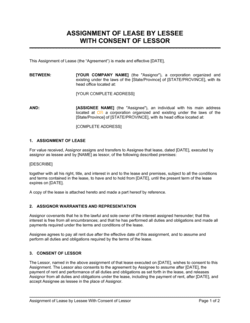
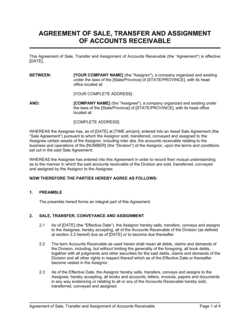
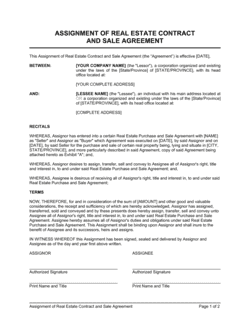
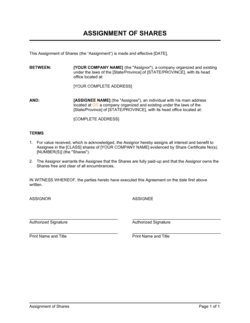
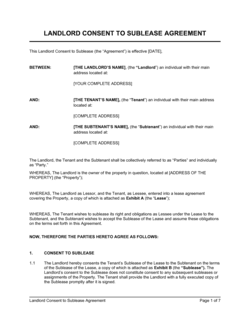
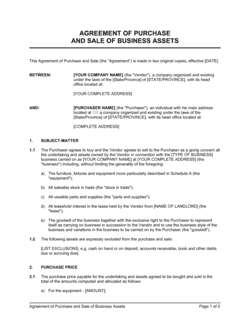
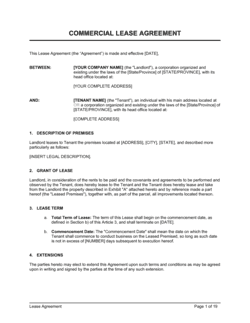
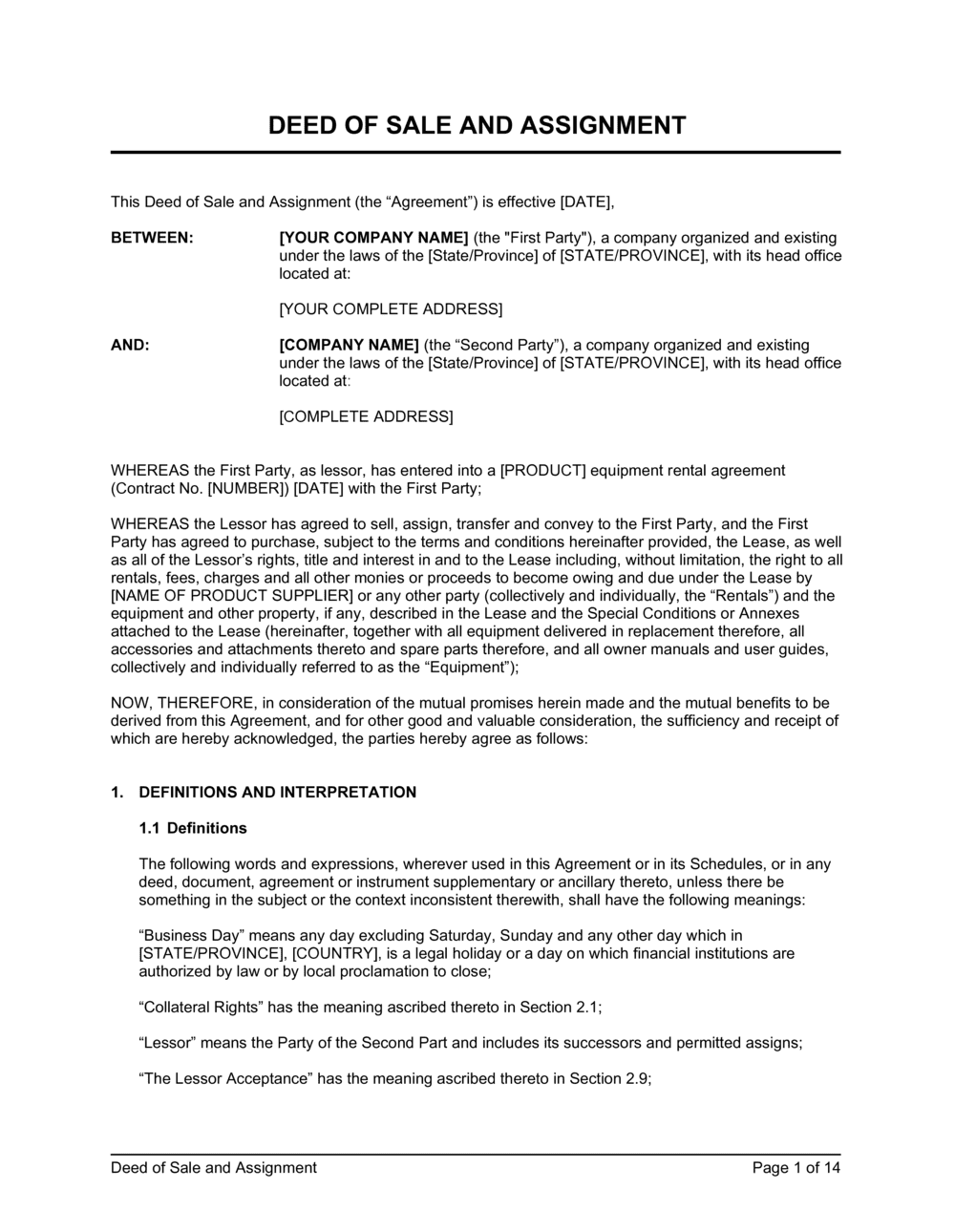
Deed of Sale and Assignment Lease Template

Free Word download • Edit online • Save & share with Drive • Export to PDF

14 pages30–40 min to fillDifficulty: ComplexSignature requiredLegal review recommended
Learn more ↓
FreeDeed of Sale and Assignment Lease Template

At a glance

What it is
A Deed of Sale and Assignment Lease is a binding legal instrument that simultaneously transfers ownership of a leasehold interest and assigns all rights, obligations, and benefits under an existing lease from one party to another. This free Word download gives you a structured, professionally drafted starting point you can edit online and export as PDF for execution before a notary or solicitor.
When you need it
Use it when a business or individual sells their leasehold interest in a property — such as a commercial unit, retail space, or industrial premises — and needs to formally transfer both the sale and the unexpired lease term to a buyer or assignee. It is also used in business acquisitions where the outgoing tenant sells the business and transfers the premises lease as part of the same transaction.
What's inside
Identified parties and property description, consideration and sale terms, assignment of the existing lease, representations and warranties, landlord consent provisions, obligations of the assignor and assignee, indemnities, and governing law and execution clauses.

What is a Deed of Sale and Assignment Lease?

A Deed of Sale and Assignment Lease is a formal legal instrument that simultaneously records the sale of a leasehold interest and formally transfers all rights, obligations, and benefits under an existing lease from the current tenant (the assignor) to an incoming party (the assignee). Unlike a simple assignment agreement, it is executed as a deed — meaning it carries heightened legal formality, requires witness attestation, and in many jurisdictions must be notarized and registered at a land registry to bind third parties. The document identifies the parties, describes the leased premises by title reference, states the consideration paid for the leasehold interest, incorporates the original lease by reference, and records the landlord's consent as a condition of the transfer taking effect.

This type of deed is most commonly used in commercial property transactions where a tenant is selling a business and the premises lease forms part of the sale, or where a tenant with a valuable below-market-rent lease sells that leasehold advantage to an investor. Because the deed functions as both a sale instrument and a conveyancing document, it must satisfy the formal execution requirements of the governing jurisdiction — typically signed, witnessed, notarized, and registered within a prescribed period after completion.

Why You Need This Document

Transferring a leasehold interest without a properly executed deed exposes both the assignor and the assignee to serious legal and financial risk. Without a formal deed, the assignment may not be registrable at the land registry, leaving the assignee without legal title to the leasehold interest and vulnerable to competing claims. The assignor, meanwhile, may remain fully liable for rent and dilapidations caused by the incoming party — because without a valid assignment, the original tenancy never legally transferred. Landlords can forfeit a lease where an assignment has been made without consent or without the correct formalities, potentially destroying the entire transaction.

A well-drafted deed of sale and assignment lease closes all of these gaps: it provides a clear operative assignment clause, captures the assignee's covenant to observe all lease obligations, includes an indemnity protecting the assignor from the assignee's future defaults, and records landlord consent in a form that satisfies both the original lease requirements and the land registry's execution standards. For any business sale that includes commercial premises, or any standalone disposal of a leasehold interest, this deed is the document that makes the transaction legally complete and the transfer enforceable against the world.

Which variant fits your situation?

If your situation is…Use this template
Assigning a residential lease from one tenant to anotherResidential Lease Assignment Agreement
Subletting part of a commercial space without full assignmentSublease Agreement
Transferring ownership of a freehold property with no existing leaseDeed of Sale (Real Property)
Assigning a commercial lease without a concurrent sale of business assetsCommercial Lease Assignment Agreement
Formally documenting landlord consent to an assignmentLandlord Consent to Assignment
Novating a lease to substitute a new tenant and release the original oneLease Novation Agreement
Selling a business and transferring all assets including a leaseBusiness Sale Agreement

Common mistakes to avoid

❌ Proceeding without written landlord consent

Why it matters: Most commercial leases prohibit assignment without prior written consent. Assigning without it constitutes a breach of lease, entitling the landlord to forfeit the lease and pursue both assignor and assignee for losses.

Fix: Obtain formal written consent — signed by the landlord or their solicitor — and attach it to the deed before execution. Never exchange or complete on the basis of a verbal or informal email approval.

❌ Signing as a contract rather than as a deed

Why it matters: A deed requires specific execution formalities including attestation by an independent witness. A document that merely says 'signed by the parties' without deed execution language is a contract, not a deed, and will be rejected by the land registry.

Fix: Include the words 'executed as a deed' above each signature block, have each signatory sign in the presence of an independent witness, and follow any additional notarization requirements for the governing jurisdiction.

❌ Omitting the assignee's indemnity in favour of the assignor

Why it matters: In many jurisdictions, the original tenant remains contractually liable to the landlord even after assignment. Without an indemnity from the assignee, the assignor has no contractual recourse if the assignee defaults on rent or causes dilapidations.

Fix: Include an express indemnity clause requiring the assignee to indemnify the assignor against all losses arising from the assignee's post-assignment breach of lease covenants.

❌ Failing to apportion and pay stamp duty correctly

Why it matters: Tax authorities in the US, UK, Canada, and Australia charge stamp duty or land transfer tax on leasehold assignments. Understating consideration or missing the filing deadline triggers penalties, interest, and potential reassessment at market value.

Fix: Obtain a stamp duty calculation from a tax adviser before completion, apportion consideration properly where the assignment is bundled with a business sale, and register and pay within the statutory deadline.

❌ Not attaching the original lease as a schedule

Why it matters: The assignee's covenant to observe 'the tenant's obligations under the Original Lease' is unenforceable in practical terms if the lease itself is not incorporated by reference and attached — parties dispute which obligations were transferred.

Fix: Attach a certified copy of the original lease and all supplemental agreements as Schedule 1 to the deed. Have both parties initial each page of the schedule at execution.

❌ Ignoring rent arrears or outstanding dilapidations at the assignment date

Why it matters: If rent arrears exist at completion, the landlord can pursue the assignee for those pre-assignment arrears in some jurisdictions, and the assignor may face an indemnity claim if not disclosed and settled before completion.

Fix: Conduct a rent and service-charge account reconciliation before the completion date. Any arrears must be paid by the assignor, and a statement of account should be exhibited to the deed as a schedule.

The 10 key clauses, explained

Parties and recitals

In plain language: Identifies the assignor, assignee, and landlord by full legal name and address, and sets out the background — the original lease date, demised premises, and the parties' intention to sell and assign.

Sample language
This Deed of Sale and Assignment of Lease is made on [DATE] between [ASSIGNOR FULL NAME] of [ADDRESS] ('Assignor'), [ASSIGNEE FULL NAME] of [ADDRESS] ('Assignee'), with the consent of [LANDLORD FULL NAME] of [ADDRESS] ('Landlord').

Common mistake: Using a trading name instead of the registered legal entity name for the assignor. If the legal entity does not match the name on the original lease, the assignment may be void or require court rectification.

Description of demised premises

In plain language: Precisely identifies the property being assigned — address, title or lot number, and any included fixtures, fittings, or improvements that transfer with the leasehold.

Sample language
The premises known as [FULL ADDRESS], being the property described in [LEASE DATE] between [ORIGINAL LANDLORD] and [ORIGINAL TENANT], registered under Title No. [TITLE NUMBER] ('the Premises').

Common mistake: Describing the premises by street address only. Missing lot or title references can cause registration rejection at the land registry.

Consideration and payment terms

In plain language: States the purchase price the assignee pays to the assignor for the leasehold interest, the payment method, and the timing of completion.

Sample language
In consideration of the sum of [AMOUNT] ([WRITTEN AMOUNT]) paid by the Assignee to the Assignor (receipt of which the Assignor hereby acknowledges), the Assignor assigns to the Assignee all of the Assignor's right, title, and interest in the Premises.

Common mistake: Leaving consideration as 'nominal' or $1 without confirming this is tax-permissible in the jurisdiction. Understated consideration can trigger stamp duty reassessment based on market value.

Assignment of lease and transfer of interest

In plain language: The operative clause that formally transfers the unexpired lease term, and all rights and benefits under it, from the assignor to the assignee with effect from the completion date.

Sample language
With full title guarantee, the Assignor hereby assigns to the Assignee all of the Assignor's leasehold interest in the Premises for the residual term of [X] years commencing [DATE], subject to the rent of [AMOUNT] per [period] and the covenants in the Original Lease.

Common mistake: Omitting the phrase 'with full title guarantee' or an equivalent warranty of title. Without it, the assignee receives no implied assurance that the assignor has the right to assign and that the lease is free from undisclosed encumbrances.

Assignee's covenant to observe lease obligations

In plain language: Requires the assignee to perform all tenant obligations under the original lease from the assignment date — paying rent, maintaining the premises, and complying with use restrictions.

Sample language
The Assignee covenants with the Assignor and the Landlord to observe and perform all the tenant's covenants and conditions in the Original Lease from [COMPLETION DATE], including payment of rent of [AMOUNT] on the [DAY] of each [MONTH/QUARTER].

Common mistake: Referencing the assignee's obligations in general terms without incorporating the original lease by schedule. Courts have found ambiguity where the original lease terms were not attached, leading to disputes over which obligations transferred.

Assignor's indemnity

In plain language: Protects the assignor against claims arising from the assignee's failure to meet lease obligations after the completion date — since the assignor may retain residual liability to the landlord under privity of contract.

Sample language
The Assignee shall indemnify and keep indemnified the Assignor against all claims, losses, costs, and expenses arising from any breach by the Assignee of the tenant's covenants in the Original Lease occurring on or after [COMPLETION DATE].

Common mistake: Omitting the indemnity clause entirely. In jurisdictions where privity of contract survives assignment, the original tenant remains exposed to landlord claims for arrears or dilapidations caused by the assignee.

Landlord consent and conditions

In plain language: Records the landlord's consent to the assignment, sets out any conditions attached to that consent (e.g., rent deposit, guarantor requirement), and confirms the landlord releases no rights under the lease.

Sample language
The Landlord, as evidenced by signature below, consents to this assignment pursuant to clause [X] of the Original Lease. Such consent is given on condition that [CONDITIONS, e.g., 'the Assignee provides a rent deposit of [AMOUNT] held by the Landlord for [DURATION]'].

Common mistake: Treating the landlord's consent email as sufficient without a formal signed consent annexed to the deed. Most leases require written consent in a prescribed form — an email may not satisfy this requirement.

Representations and warranties

In plain language: Statements by the assignor confirming the lease is current, rent is paid up to the completion date, no notices of breach or default have been received, and the assignor has full authority to assign.

Sample language
The Assignor warrants that: (a) the Original Lease is valid and subsisting; (b) rent has been paid to [DATE] with no arrears; (c) no notice of breach or forfeiture has been served; and (d) the Assignor has not charged or encumbered the leasehold interest.

Common mistake: Providing warranties only as of the signing date without an obligation to disclose changes between signing and completion. A material change — such as a rent default — occurring in that gap creates undisclosed risk for the assignee.

Completion mechanics and vacant possession

In plain language: Sets the completion date, the condition in which the premises must be handed over (typically with vacant possession and free of the assignor's belongings), and the process for key handover.

Sample language
Completion shall take place on [DATE] at [TIME] at the offices of [SOLICITOR]. On completion, the Assignor shall deliver vacant possession of the Premises together with all keys, access codes, and copies of all documents relating to the Premises.

Common mistake: Not specifying what happens if completion is delayed by the landlord's failure to sign the consent. Include a long-stop date after which either party may rescind without penalty.

Governing law and execution

In plain language: States the jurisdiction whose law governs the deed, confirms the document is executed as a deed (not a simple contract), and sets out the signature, witness, and notarization requirements.

Sample language
This Deed is governed by the laws of [STATE/COUNTRY]. Executed as a Deed by the parties on the date written above. Signed by [ASSIGNOR NAME] in the presence of [WITNESS NAME, ADDRESS, OCCUPATION]. Signed by [ASSIGNEE NAME] in the presence of [WITNESS NAME, ADDRESS, OCCUPATION].

Common mistake: Signing the document as a simple contract rather than as a deed. A deed requires specific execution formalities — attestation by a witness, and in many jurisdictions a notary seal — and failing to meet them can render the assignment unregistrable.

How to fill it out

  1. 1

    Obtain and review the original lease

    Before drafting, secure a copy of the original lease and review the assignment provisions — specifically the assignment clause, any consent requirements, and conditions precedent. Note the residual term, current rent, and any rent-review dates.

    💡 Check whether the lease requires the landlord to act reasonably in granting consent. If it does and the landlord unreasonably refuses, you may have a statutory remedy in most common-law jurisdictions.

  2. 2

    Identify all parties by full legal name

    Enter the assignor's and assignee's registered legal entity names or full personal names exactly as they appear on government ID or corporate registration. Include the landlord as a consenting party.

    💡 If the assignor is a company, verify the registered name against the corporate registry — a dissolved or incorrectly named entity cannot validly assign.

  3. 3

    Describe the premises precisely

    Include the full street address, title or lot number, and any reference number from the original lease. Attach a copy of the lease plan or title plan as a schedule if the premises are part of a larger building.

    💡 Land registry offices in the UK, Australia, and most Canadian provinces will reject registration without a proper title reference — confirm the correct number before drafting.

  4. 4

    State the consideration accurately

    Enter the agreed purchase price in numerals and in writing. If the assignment is part of a broader business sale, apportion the total consideration between the lease and other assets to satisfy stamp duty requirements.

    💡 Understating consideration to reduce stamp duty is a tax offense in all major jurisdictions — declare the true market value and take proper tax advice.

  5. 5

    Attach the original lease as a schedule

    Incorporate the full original lease (or a certified copy) as Schedule 1 so the assignee's covenant to observe lease obligations has a precise reference document.

    💡 If the original lease has been amended by side letters or supplemental deeds, attach those too — the assignee takes the lease in its current form, not as originally drafted.

  6. 6

    Obtain landlord consent in writing

    Send the draft deed to the landlord for formal consent before execution. Many leases require the landlord's solicitor to issue a formal consent letter or to countersign the deed itself.

    💡 Start the landlord consent process at least 4–6 weeks before your target completion date — delays here are the single biggest cause of assignment transactions falling over.

  7. 7

    Execute the deed with proper formalities

    All parties must sign in the presence of an independent witness who also signs and provides their name, address, and occupation. In jurisdictions requiring notarization, arrange a notary appointment before the completion date.

    💡 Never backdate a deed. Backdating is fraud in all jurisdictions and renders the document void and potentially criminal.

  8. 8

    Register the assignment and pay stamp duty

    After completion, submit the executed deed to the relevant land registry and pay any applicable stamp duty or land transfer tax within the statutory deadline — typically 14–30 days depending on jurisdiction.

    💡 Missing the stamp duty deadline triggers automatic penalties and interest in most jurisdictions. Calendar the deadline on the day of completion.

Frequently asked questions

What is a deed of sale and assignment lease?

A deed of sale and assignment lease is a formal legal instrument that simultaneously transfers the sale of a leasehold interest and assigns all rights and obligations under an existing lease from one party (the assignor) to another (the assignee). It is used when a tenant sells their remaining lease term to a buyer, most commonly as part of a business sale or commercial property transaction. Because it is executed as a deed, it carries greater formality and enforceability than a simple contract.

What is the difference between an assignment of lease and a sublease?

An assignment transfers the entire remaining leasehold interest to the assignee, who steps into the original tenant's position for the rest of the lease term. The assignor typically drops out of the tenancy entirely, though residual liability to the landlord may remain in some jurisdictions. A sublease creates a new, subordinate tenancy below the original lease — the original tenant remains the landlord's tenant and takes on a new role as sublandlord. Use assignment when you want to exit the premises completely; use a sublease when you want to retain the lease but share or vacate the space temporarily.

Do I need the landlord's permission to assign a lease?

In almost all commercial leases, yes. Most leases contain a covenant against assignment without the landlord's prior written consent. In the UK, the Landlord and Tenant Act 1988 requires the landlord to respond to an application for consent within a reasonable time and not to withhold consent unreasonably. Similar obligations exist under statute in many Canadian provinces and Australian states. In the US, the lease terms govern — some leases require consent, others permit assignment freely. Always review the original lease before proceeding.

Is the original tenant still liable after assigning a lease?

It depends on the jurisdiction and when the original lease was granted. In the UK, leases granted before 1996 bind the original tenant under privity of contract for the entire lease term, even after assignment. For leases granted after 1 January 1996, the Landlord and Tenant (Covenants) Act 1995 typically releases the assignor on a valid assignment. In common-law jurisdictions generally, the assignor may retain liability unless the landlord formally releases them by novation. An indemnity from the assignee to the assignor is essential in all cases.

What stamp duty or tax is payable on an assignment of lease?

Tax treatment varies by jurisdiction and transaction value. In the UK, Stamp Duty Land Tax (SDLT) applies to the consideration paid for the assignment, with rates varying by whether the property is residential or commercial. In Canada, provincial land transfer taxes apply in most provinces. In Australia, stamp duty is payable in each state at rates based on the dutiable value. In the US, some states impose transfer taxes on the assignment of leasehold interests. Always obtain tax advice specific to the property's location before completing.

What is the difference between an assignment and a novation of lease?

An assignment transfers the leasehold interest but may leave the original tenant with residual liability to the landlord. A novation goes further — it extinguishes the original contract and creates a new one between the landlord and the incoming tenant, fully releasing the outgoing tenant from all future and in some cases past obligations. Novation requires the active agreement of all three parties including the landlord. Assignment requires landlord consent but does not require the landlord to release the original tenant.

Can a deed of sale and assignment lease be used for residential properties?

Yes, but the legal framework differs significantly. Residential leasehold assignments — particularly in the UK, where long residential leases of 125 or 999 years are common — involve different statutory protections, service charge disclosure requirements, and in some cases a landlord's right of first refusal. In most other jurisdictions, residential tenancy assignments are governed by residential tenancies legislation rather than commercial property law, and the terms are far more restricted. Seek specific advice before using a commercial assignment form for a residential property.

How long does a lease assignment transaction typically take?

A straightforward commercial lease assignment typically takes 4–8 weeks from instruction to completion. The main variable is the time required to obtain landlord consent — some landlords respond within days; others take several weeks, particularly if they require satisfactory references or financial information from the incoming assignee. Allowing 6 weeks is prudent for planning purposes. Business sale transactions involving lease assignments as one component of a larger deal typically take 8–12 weeks.

Does a deed of sale and assignment lease need to be notarized?

Notarization requirements depend on the jurisdiction. In the US, deeds conveying real property interests — including leaseholds — typically require notarization for recording at the county recorder's office. In the UK, execution before a witness (but not a notary) is generally sufficient for domestic assignments, though overseas parties may require notarization. In civil law jurisdictions in Europe, a notaire or notary public must authenticate the deed before it can be registered. Always confirm the execution requirements for the specific jurisdiction before the completion date.

How this compares to alternatives

vs Sublease Agreement

A sublease creates a new tenancy below the original lease, leaving the original tenant as sublandlord and still bound to the head landlord. A deed of sale and assignment transfers the entire leasehold interest to the assignee, who steps directly into the original tenant's position. Use assignment when you want to exit the premises entirely; use a sublease when you want to retain the head lease but vacate or share the space.

vs Commercial Lease Assignment Agreement

A standalone lease assignment agreement transfers the leasehold interest but does not include a sale of other business assets or capture a purchase price consideration structure. A deed of sale and assignment lease combines both elements — it is the appropriate document when the assignment is bundled with a business sale and a price is being paid for the leasehold interest itself. Use the combined deed when a sale price accompanies the transfer.

vs Business Sale Agreement

A business sale agreement covers the transfer of all business assets — goodwill, stock, equipment, contracts, and employees — but may only reference the lease assignment rather than completing it. A deed of sale and assignment lease is the operative transfer instrument for the leasehold interest specifically. In a full business sale, both documents are typically needed: the sale agreement governs the overall deal, and the deed of assignment formally transfers the lease.

vs Lease Novation Agreement

A lease novation agreement extinguishes the original lease and creates a new one directly between the landlord and the incoming tenant, fully releasing the outgoing tenant from all obligations. An assignment transfers the leasehold interest but may leave the original tenant with residual liability. Novation requires the landlord's active participation and agreement to release the original tenant — assignment only requires consent. Novation is the cleaner exit; assignment is more commonly available.

Industry-specific considerations

Retail and hospitality

Retail tenants selling leasehold shops or restaurant premises as going concerns assign the lease to the buyer as a core component of the business sale, preserving the trading location and existing fit-out.

Professional services

Law firms, accountancy practices, and consulting firms use lease assignments when merging with or being acquired by a larger firm, transferring office leases to the surviving entity as part of the transaction.

Manufacturing and industrial

Industrial tenants assigning warehouse or factory leases must address assignment of landlord consents for hazardous materials storage, bespoke fit-out improvements, and heavy-plant access rights that form part of the leasehold interest.

Real estate investment

Investors holding below-market-rent leaseholds assign those interests at a premium to capture the value of the rent differential, using the deed to document both the purchase price and the transfer of the lease advantage.

Jurisdictional notes

United States

Assignment of commercial leases is governed primarily by the terms of the original lease and state property law — there is no uniform federal statute. Most states require a deed of assignment to be notarized and recorded at the county recorder's office to protect the assignee's interest against third parties. Some states, including California and New York, impose transfer taxes on the assignment of leasehold interests valued above statutory thresholds. Anti-assignment clauses are strictly enforced in most jurisdictions.

Canada

Commercial lease assignments in Canada are governed by provincial property and commercial tenancy legislation. Land transfer tax is payable in most provinces, with Ontario and British Columbia applying significant rates based on the fair market value of the leasehold interest. Quebec requires a notarized deed published before a notary for registration purposes. Quebec contracts must be in French for provincially-regulated matters, and a certified French version may be required alongside an English original.

United Kingdom

The Landlord and Tenant Act 1988 requires landlords to respond to assignment consent applications reasonably and promptly. For leases granted after 1 January 1996, the Landlord and Tenant (Covenants) Act 1995 releases the outgoing tenant from future liability on a valid assignment, though an Authorised Guarantee Agreement (AGA) may be required as a condition of consent. Stamp Duty Land Tax (SDLT) is payable on the consideration for the assignment within 14 days of completion. The deed must be executed as a deed with independent witness attestation and registered at HM Land Registry.

European Union

EU member states apply divergent rules to commercial lease assignments. In France and Germany, lease assignment typically requires the landlord's consent and is authenticated before a notaire or Notar — without notarial authentication the deed cannot be registered. In the Netherlands, assignment of commercial leases is permitted subject to landlord consent and requires registration at the Kadaster. GDPR obligations apply where the assignment involves transfer of personal data relating to customers or employees as part of a business sale alongside the lease. Always obtain local legal advice for EU assignments.

Template vs lawyer — what fits your deal?

PathBest forCostTime
Use the templateStraightforward commercial lease assignments where the original lease is simple, the landlord is cooperative, and the consideration is modestFree2–4 hours to draft; 4–8 weeks to complete (including landlord consent)
Template + legal reviewAssignments involving a business sale, multiple parties, rent arrears, or any departure from standard lease terms$500–$1,500 for a solicitor or conveyancer review1–2 weeks for legal review; 4–8 weeks overall
Custom draftedHigh-value leasehold assignments, complex commercial properties, multi-jurisdiction transactions, or assignments where the original tenant retains significant liability$2,000–$8,000+ depending on complexity and jurisdiction4–12 weeks

Glossary

Assignor
The existing tenant or leaseholder who is transferring their leasehold interest and rights under the lease to the assignee.
Assignee
The incoming party who takes over the leasehold interest, steps into the assignor's shoes, and assumes all obligations under the original lease.
Leasehold Interest
The right to occupy and use a property for the remaining term of a lease, held by the tenant rather than the freehold owner.
Consideration
The price paid by the assignee to the assignor in exchange for the transfer of the leasehold interest — may be expressed as a lump sum or as nominal consideration.
Landlord Consent
Written approval from the property owner permitting the assignment of the lease to the incoming tenant, typically required by the original lease terms.
Novation
A separate legal process that replaces one party with another in a contract, fully releasing the original party — distinct from assignment, which may leave the assignor with residual liability.
Privity of Contract
The legal principle that only the original parties to a contract bear rights and obligations under it — relevant because assignment transfers benefits but may not automatically release the assignor from liability.
Indemnity Clause
A provision requiring the assignee to reimburse the assignor for any claims, losses, or costs arising from the assignee's failure to meet lease obligations after the assignment date.
Stamp Duty / Transfer Tax
A government tax payable on the transfer of a leasehold interest, the rate and threshold of which vary by jurisdiction and transaction value.
Residual Term
The unexpired portion of the original lease that the assignee acquires as part of the assignment — e.g., 4 years remaining on a 10-year lease.
Representations and Warranties
Factual statements made by the assignor confirming the lease is in good standing, no defaults exist, and the assignor has authority to assign — breach of which can trigger damages claims.

Part of your Business Operating System

This document is one of 3,000+ business & legal templates included in Business in a Box.

  • Fill-in-the-blanks — ready in minutes
  • 100% customizable Word document
  • Compatible with all office suites
  • Export to PDF and share electronically

Create your document in 3 simple steps.

From template to signed document — all inside one Business Operating System.
1
Download or open template

Access over 3,000+ business and legal templates for any business task, project or initiative.

2
Edit and fill in the blanks with AI

Customize your ready-made business document template and save it in the cloud.

3
Save, Share, Send, Sign

Share your files and folders with your team. Create a space of seamless collaboration.

Save time, save money, and create top-quality documents.

★★★★★

"Fantastic value! I'm not sure how I'd do without it. It's worth its weight in gold and paid back for itself many times."

Managing Director · Mall Farm
Robert Whalley
Managing Director, Mall Farm Proprietary Limited
★★★★★

"I have been using Business in a Box for years. It has been the most useful source of templates I have encountered. I recommend it to anyone."

Business Owner · 4+ years
Dr Michael John Freestone
Business Owner
★★★★★

"It has been a life saver so many times I have lost count. Business in a Box has saved me so much time and as you know, time is money."

Owner · Upstate Web
David G. Moore Jr.
Owner, Upstate Web

Run your business with a system — not scattered tools

Stop downloading documents. Start operating with clarity. Business in a Box gives you the Business Operating System used by over 250,000 companies worldwide to structure, run, and grow their business.

Start free · No credit card required