IP Sale Agreement Template

Free Word download β€’ Edit online β€’ Save & share with Drive β€’ Export to PDF

7 pagesβ€’25–35 min to fillβ€’Difficulty: Complexβ€’Signature requiredβ€’Legal review recommended
Learn more ↓
FreeIP Sale Agreement Template

At a glance

What it is
An IP Sale Agreement is a legally binding contract that permanently transfers ownership of intellectual property β€” patents, trademarks, copyrights, trade secrets, or software β€” from a seller to a buyer for an agreed purchase price. This free Word download gives you a structured, attorney-reviewed starting point you can edit online and export as PDF for execution by both parties.
When you need it
Use it when a founder is selling IP assets to an acquirer, when a business divests a product line that includes registered IP, or when an individual creator sells ownership of a work outright to a company. It is also used in M&A transactions where IP is carved out and transferred separately from the main business purchase.
What's inside
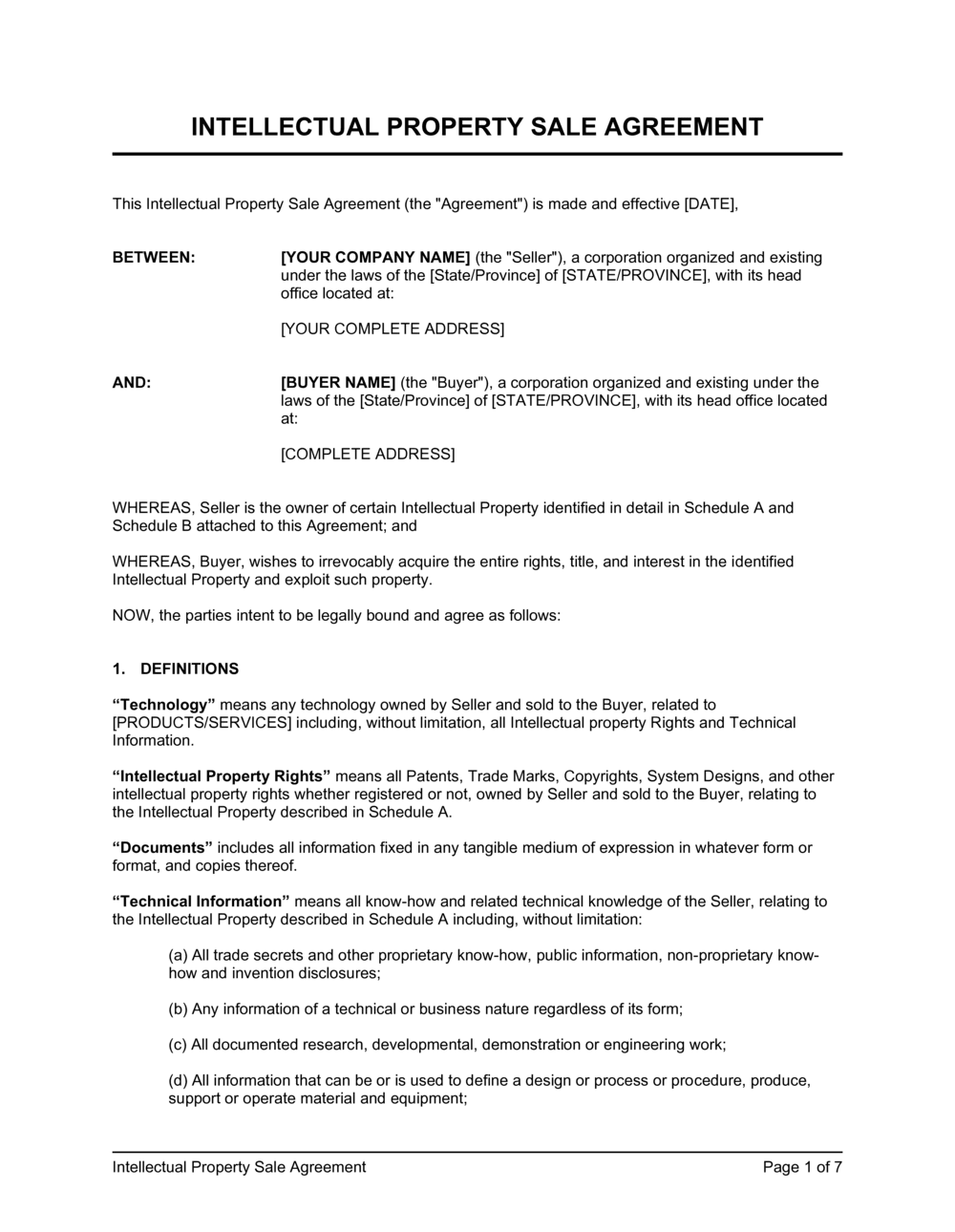
The agreement covers the parties and a precise description of the IP being sold, the purchase price and payment structure, seller representations and warranties about ownership and freedom from encumbrances, assignment and recordal obligations, transition assistance, indemnification, and governing law. Together these clauses create a complete, enforceable record of the transfer.

What is an IP Sale Agreement?

An IP Sale Agreement is a legally binding contract that permanently transfers full ownership of intellectual property β€” including patents, trademarks, copyrights, trade secrets, and software β€” from a seller to a buyer in exchange for an agreed purchase price. Unlike a license, which grants temporary permission to use IP while the original owner retains title, an IP sale agreement extinguishes the seller's rights entirely and vests them in the buyer from the closing date forward. The agreement defines precisely which assets are being transferred, the consideration and payment structure, the seller's representations about clear title, and the obligations both parties must fulfil to record the change of ownership at every relevant government registry.

Why You Need This Document

Without a written IP sale agreement, a transfer of intellectual property has no legal force β€” in most jurisdictions, an oral or implied assignment of a patent or copyright is ineffective and unenforceable. A buyer who pays for IP without a signed agreement has no documented basis to claim ownership, record the transfer at the USPTO or EUIPO, or defend against a future competing claim from the seller's creditors. Equally, a seller without a formal agreement retains ongoing exposure to infringement liability for the buyer's use of the IP after payment is made. Undisclosed licenses, co-inventor claims, and unpaid maintenance fees routinely surface after informal transfers and destroy the commercial value of the acquired assets. This template provides the complete contractual framework β€” asset schedule, representations, recordal obligations, transition assistance, and indemnification β€” that turns an informal handshake into a defensible, registry-backed transfer of ownership.

Which variant fits your situation?

If your situation is…Use this template
Permanently transferring all IP rights to a buyer for a fixed priceIP Sale Agreement
Granting permission to use IP without transferring ownershipIP License Agreement
Assigning IP created by an employee to the employerIP Assignment Agreement (Employee)
Assigning IP created by a contractor to the hiring companyIntellectual Property Assignment Agreement
Transferring IP as part of the sale of an entire businessAsset Purchase Agreement
Collaboratively developing IP with a defined ownership splitJoint Development Agreement
Licensing IP to a franchisee under a franchise systemFranchise Agreement

Common mistakes to avoid

❌ Vague IP description with no schedule

Why it matters: A clause transferring 'all intellectual property related to the product' without a schedule is unenforceable as written β€” courts require sufficient certainty to identify what was transferred, and registry officials will reject an assignment without specific registration numbers.

Fix: Attach a numbered Schedule A listing every asset by registration number, jurisdiction, filing date, and status. Update it during due diligence if new assets are identified.

❌ Paying the full purchase price before recordal

Why it matters: If the seller delays or refuses to file the assignment at the patent office after receiving full payment, the buyer is the beneficial owner but not the legal owner of record β€” exposing the buyer to challenges from the seller's creditors or future claimants.

Fix: Structure at least 20–30% of the purchase price as a post-recordal payment or use an escrow that releases automatically upon confirmation of all registry filings.

❌ No disclosure schedule for existing licenses

Why it matters: A non-exclusive license granted before the sale survives the transfer and binds the buyer β€” if the seller does not disclose it and the buyer discovers it post-closing, the IP is worth materially less than the buyer paid.

Fix: Require the seller to attach a disclosure schedule listing every license, sublicense, covenant not to sue, and security interest affecting the IP assets before signing.

❌ Omitting transition assistance for technical IP

Why it matters: Patents, trade secrets, and software often carry embedded know-how that is not fully captured in the registered documentation β€” without a post-closing assistance obligation, the buyer may acquire assets they cannot practically use.

Fix: Include a transition assistance clause specifying minimum hours of support, documentation delivery requirements, and a clear end date for the seller's obligations.

❌ Choosing an inappropriate governing law

Why it matters: An IP sale agreement governed by a jurisdiction with no connection to the parties or the registered IP can lead to courts refusing to apply the chosen law and substituting local mandatory rules, invalidating key provisions.

Fix: Use the law of the jurisdiction where the buyer is headquartered, or where the primary IP assets are registered, and confirm with counsel that the chosen law does not conflict with mandatory statutory rules at either party's location.

❌ No survival clause for representations and warranties

Why it matters: Without a survival clause, representations expire on closing β€” meaning a buyer who discovers an undisclosed encumbrance six months after signing has no contractual remedy against the seller.

Fix: Include a survival clause specifying that representations and warranties survive for at least 18–36 months post-closing, with a longer period (or indefinite survival) for fundamental representations such as ownership and authority.

The 10 key clauses, explained

Parties and recitals

In plain language: Identifies the seller and buyer as legal entities, states the date of the agreement, and provides brief background on why the transfer is taking place.

Sample language
This IP Sale Agreement ('Agreement') is entered into as of [DATE] between [SELLER LEGAL NAME], a [STATE/COUNTRY] [ENTITY TYPE] ('Seller'), and [BUYER LEGAL NAME], a [STATE/COUNTRY] [ENTITY TYPE] ('Buyer').

Common mistake: Using a trade name or personal name instead of the registered legal entity β€” if the named party does not legally own the IP, the transfer has no effect on official registry records.

Description and schedule of IP assets

In plain language: Defines precisely which IP is being sold by listing each asset β€” patent numbers, trademark registration numbers, copyright registration numbers, and any unregistered IP β€” in a schedule attached to the agreement.

Sample language
Seller hereby sells and assigns to Buyer all right, title, and interest in and to the intellectual property assets listed in Schedule A, including without limitation: Patent No. [NUMBER], registered trademark '[MARK]' (Reg. No. [NUMBER]), and all associated goodwill.

Common mistake: Describing IP broadly as 'all software and related IP' without a specific schedule β€” vague descriptions lead to disputes about what was actually transferred and create chain-of-title problems during future due diligence.

Purchase price and payment terms

In plain language: States the total consideration, whether it is paid as a lump sum or in installments, the currency, and any conditions that must be met before payment is released.

Sample language
Buyer shall pay Seller a total purchase price of $[AMOUNT] USD, payable as follows: (a) $[AMOUNT] upon execution of this Agreement; (b) $[AMOUNT] upon completion of all recordal filings set out in Section [X].

Common mistake: Failing to tie payment milestones to recordal completion β€” if the full price is paid upfront and the seller later delays filing the assignment at the patent office, the buyer has no leverage to compel action.

Representations and warranties of seller

In plain language: The seller confirms it owns the IP outright, has authority to sell, has not granted conflicting licenses, is not aware of third-party infringement claims, and knows of no prior art that would invalidate the assets.

Sample language
Seller represents and warrants that: (a) Seller is the sole and exclusive owner of the IP Assets; (b) the IP Assets are free and clear of all encumbrances; (c) Seller has not granted any license, sublicense, or other rights in the IP Assets to any third party; and (d) Seller is not aware of any pending or threatened claim challenging the validity or ownership of the IP Assets.

Common mistake: Accepting bare 'as-is' representations for a high-value patent portfolio without requiring the seller to warrant freedom from encumbrances β€” undisclosed licenses survive the transfer and bind the buyer.

Representations and warranties of buyer

In plain language: The buyer confirms it has authority to enter the agreement and has the financial capacity to pay the purchase price.

Sample language
Buyer represents and warrants that: (a) Buyer has full legal authority to enter into and perform this Agreement; and (b) Buyer has the financial resources to pay the purchase price in accordance with the payment schedule.

Common mistake: Omitting buyer warranties entirely β€” while seller reps are more critical, a buyer warranty of authority protects against scenarios where the buyer's signatory lacked corporate authorization.

Assignment, recordal, and further assurances

In plain language: Obligates the seller to execute all documents needed to record the ownership change at every relevant IP registry and to cooperate with future filings the buyer may need.

Sample language
Seller shall, promptly following execution of this Agreement and at Buyer's expense, execute and deliver all documents and take all actions reasonably required to record the assignment of the IP Assets with the United States Patent and Trademark Office, the Copyright Office, and any other applicable registry.

Common mistake: No deadline or cost-allocation for recordal β€” sellers who are not responsible for costs or subject to a deadline routinely delay filings for months, leaving the buyer as the unrecognized legal owner in official records.

Transition assistance and know-how transfer

In plain language: Requires the seller to provide documentation, technical knowledge, source code, or training for a defined period to help the buyer effectively use the transferred IP.

Sample language
For a period of [X] days following Closing, Seller shall provide up to [X] hours of technical assistance per week to assist Buyer in understanding and implementing the IP Assets, including delivery of all documentation, source code, design files, and technical specifications in Seller's possession.

Common mistake: No transition assistance clause for technology or software IP β€” buyers often find the IP unusable without the seller's tacit technical knowledge, and there is no contractual mechanism to compel help after closing.

Indemnification

In plain language: Each party agrees to compensate the other for losses arising from a breach of their respective representations, warranties, or obligations β€” including third-party IP infringement claims triggered by the seller's prior use.

Sample language
Seller shall indemnify, defend, and hold harmless Buyer from and against any claims, damages, losses, and expenses (including reasonable attorneys' fees) arising out of or relating to: (a) any breach of Seller's representations or warranties; or (b) any claim that Seller's use of the IP Assets prior to Closing infringed any third party's intellectual property rights.

Common mistake: Capping indemnification at the purchase price without carving out fraud or willful misrepresentation β€” a seller who knowingly conceals an encumbrance should not benefit from a contractual liability cap.

Confidentiality

In plain language: Prohibits both parties from disclosing the terms of the transaction and any confidential information exchanged during due diligence, for a defined period after closing.

Sample language
Each party agrees to keep the terms of this Agreement and all Confidential Information disclosed during negotiation or due diligence strictly confidential for a period of [X] years following Closing, except as required by law or with the prior written consent of the other party.

Common mistake: No confidentiality clause at all β€” a seller who publicizes the sale price can trigger competitor awareness of the buyer's technology strategy or alert third parties to make competing claims against the IP.

Governing law and dispute resolution

In plain language: Specifies which jurisdiction's law governs the agreement and how disputes are resolved β€” arbitration, mediation, or litigation in a named court.

Sample language
This Agreement is governed by the laws of the State of [STATE], without regard to its conflict-of-law principles. Any dispute arising under this Agreement shall be resolved by binding arbitration administered by [AAA / JAMS] in [CITY, STATE], except that either party may seek injunctive relief in any court of competent jurisdiction.

Common mistake: Choosing a governing law jurisdiction with no connection to where either party is located or where the IP is registered β€” some jurisdictions have mandatory rules that apply regardless of the contract's choice-of-law clause.

How to fill it out

  1. 1

    Identify the parties using their registered legal entity names

    Enter the full registered corporate or legal name for both seller and buyer β€” not a brand name or personal name. Confirm that the named entity is the one that actually holds ownership of record at the relevant IP registry.

    πŸ’‘ Run a USPTO or EUIPO ownership search before completing this section β€” the registered owner may differ from the company you are negotiating with if an assignment was never recorded.

  2. 2

    Build Schedule A with a complete IP asset list

    List every asset being transferred: patent numbers and jurisdiction, trademark registration numbers and class, copyright registration numbers, and a plain-language description of any unregistered trade secrets or know-how included in the sale.

    πŸ’‘ If the deal includes pending applications, list them separately and specify what happens if a pending application is refused after closing.

  3. 3

    Set the purchase price and payment milestones

    Enter the total consideration, currency, and payment schedule. Tie installment payments to verifiable events β€” execution, recordal at the USPTO, and delivery of source code or documentation β€” rather than calendar dates.

    πŸ’‘ For high-value transfers, consider an escrow arrangement where the final payment is released only upon confirmed recordal of the assignment.

  4. 4

    Tailor the seller representations to the IP type

    Review each representation in the seller warranty section and confirm accuracy for every asset in Schedule A. Add specific disclosures for any known limitations β€” existing non-exclusive licenses, co-inventor claims, or prior art issues β€” in a disclosure schedule.

    πŸ’‘ A disclosure schedule that accurately lists known exceptions protects the seller from breach-of-warranty claims while giving the buyer a clear picture of what they are acquiring.

  5. 5

    Specify recordal obligations and deadlines

    Name the specific registries where assignment filings are required (USPTO, Copyright Office, CIPO, EUIPO, national trademark offices) and set a deadline of no more than 30 days from closing for each filing.

    πŸ’‘ Assign responsibility for filing costs explicitly β€” buyers typically bear recordal fees, but leaving this ambiguous creates delays.

  6. 6

    Define the scope and duration of transition assistance

    If the IP includes software, manufacturing processes, or technical know-how, set the number of hours of post-closing assistance, the delivery format (documentation, code repository, or calls), and a specific end date.

    πŸ’‘ Cap the seller's obligation at a fixed number of hours to avoid open-ended support requests that the seller did not price into the transaction.

  7. 7

    Review indemnification caps and carve-outs

    Set the overall indemnification cap as a percentage of the purchase price. Carve out fraud, willful misrepresentation, and third-party infringement claims from the cap so these are subject to full liability.

    πŸ’‘ An indemnification survival period of 18–36 months is standard for most IP sale transactions; patent warranty claims often survive longer given the complexity of validity challenges.

  8. 8

    Execute before recording and confirm notarization requirements

    Both parties must sign and date the agreement before any registry filing is made. Some jurisdictions (including the USPTO for certain filings) require notarization or a declaration under penalty of perjury.

    πŸ’‘ Use a timestamped e-signature platform and retain execution copies centrally β€” chain-of-title disputes in future M&A due diligence are common when execution records are missing.

Frequently asked questions

What is an IP sale agreement?

An IP sale agreement is a legally binding contract that permanently transfers ownership of intellectual property β€” patents, trademarks, copyrights, trade secrets, or software β€” from a seller to a buyer in exchange for a purchase price. Unlike a license, which grants temporary permission to use IP while ownership stays with the original owner, a sale agreement extinguishes all of the seller's ownership rights and vests them fully in the buyer. The agreement is typically followed by formal assignment filings at the relevant IP registries.

What is the difference between an IP sale agreement and an IP license agreement?

A sale agreement permanently transfers ownership β€” the seller retains no rights after closing. A license agreement allows the licensee to use the IP for a defined period, territory, and purpose while the licensor keeps ownership. An IP sale is the equivalent of selling a house; a license is renting it. If you want to monetize IP while keeping future options open, license it. If you are exiting a product line or technology area entirely, sell it.

Does an IP sale agreement need to be recorded at a government registry?

Yes, in most jurisdictions a patent or trademark assignment must be recorded with the relevant national registry to be effective against third parties. In the US, patent assignments should be recorded with the USPTO within three months of execution to establish priority over subsequent claims. Trademark assignments should be recorded with the USPTO to update the chain of title. Copyright assignments do not require registration but benefit from recordal with the US Copyright Office to provide constructive notice.

What IP can be sold under an IP sale agreement?

Any form of intellectual property can be sold: utility and design patents, pending patent applications, registered and unregistered trademarks, copyright in software, creative works, and databases, trade secrets and proprietary know-how, domain names, and mask works. The agreement should specifically identify each asset type in a schedule and confirm whether associated goodwill (for trademarks) and documentation (for trade secrets) are included.

Can I sell IP that is jointly owned with another inventor or creator?

Jointly owned IP generally requires the consent of all co-owners before a full transfer can be made. In the US, a joint patent owner can license their interest without the other owner's consent but cannot assign the entire patent without all owners joining the transfer. Before entering an IP sale agreement, confirm that the seller is either the sole owner or has obtained written consent from all co-owners for the transfer.

What representations should a seller make in an IP sale agreement?

A seller should typically represent that it is the sole and exclusive owner of the IP, the assets are free from liens and encumbrances, no conflicting licenses have been granted, there are no pending or threatened infringement or invalidity claims, the IP does not infringe any third party's rights to the seller's knowledge, and all maintenance fees and renewal fees have been paid. Any known exceptions should be disclosed in a separate disclosure schedule attached to the agreement.

How is the purchase price structured in an IP sale agreement?

Purchase price structures vary widely. Common approaches include a single lump-sum payment at closing, installment payments tied to recordal milestones or delivery obligations, an upfront payment plus royalties on future revenue generated from the IP, or an earnout tied to the buyer's commercialization results. For most small-business and founder transactions, a lump-sum payment with a portion held in escrow pending recordal is the most practical structure.

Do I need a lawyer to complete an IP sale agreement?

For a straightforward transfer of a single trademark or copyright between domestic parties at a modest purchase price, a well-drafted template is typically sufficient. Legal review is strongly recommended when the transfer involves patents, trade secrets with significant commercial value, cross-border parties, or a high purchase price with complex indemnification. The cost of a 2–4 hour attorney review ($600–$1,500) is small relative to the risk of an undisclosed encumbrance or a failed recordal on a six-figure IP portfolio.

What happens to existing licenses after an IP sale is completed?

Licenses granted by the seller before the closing date generally survive the transfer and bind the buyer. The buyer steps into the seller's position as licensor. This is why it is critical for the seller to disclose all existing licenses in the agreement β€” undisclosed licenses can significantly reduce the practical value of the IP acquired and may constitute a breach of the seller's representations and warranties.

How this compares to alternatives

vs IP License Agreement

A license agreement grants the buyer permission to use the IP for a defined scope, territory, and period β€” ownership stays with the licensor. An IP sale agreement permanently transfers full ownership to the buyer. Use a license when you want recurring royalty income or to retain future rights; use a sale when you are exiting the IP entirely and want a clean break.

vs Intellectual Property Assignment Agreement

An IP assignment agreement is typically used to transfer IP created by an employee or contractor to the hiring company, often for nominal or no consideration as part of an employment or services relationship. An IP sale agreement is a commercial transaction between independent parties, with a negotiated purchase price, full due diligence representations, and transition assistance obligations.

vs Asset Purchase Agreement

An asset purchase agreement transfers a broad set of business assets β€” inventory, equipment, contracts, and IP β€” as a bundle. An IP sale agreement covers only the intellectual property assets and is the appropriate document when IP is being sold separately from an ongoing business, or when IP is carved out of a broader M&A transaction for a standalone transfer.

vs Non-Disclosure Agreement

An NDA protects confidential information exchanged during negotiations but does not transfer any ownership rights. It is typically signed before an IP sale agreement to govern the due diligence process. Both documents are often used together: the NDA covers the negotiation phase, and the IP sale agreement executes the transfer once terms are agreed.

Industry-specific considerations

Technology / SaaS

Software copyright, patent portfolios covering algorithms or architectures, and domain assets are routinely sold as part of acqui-hires, pivots, or technology divestitures.

Consumer Products and Retail

Trademark and trade dress transfers are common when a brand or product line is sold to a new owner, requiring goodwill assignment alongside the registered mark.

Life Sciences and Medtech

Patent portfolios covering drug compounds, medical devices, or diagnostic methods are sold with extensive representations about freedom to operate and regulatory filing history.

Creative and Media

Copyright in music, film, photography, and literary works is transferred outright by independent creators to publishers, studios, or brand licensors under IP sale structures.

Jurisdictional notes

United States

Patent assignments must be recorded with the USPTO within three months of execution to establish priority over subsequent bona fide purchasers for value. Trademark assignments must include a transfer of the goodwill associated with the mark to be valid. Copyright assignments must be in writing and signed by the assignor under 17 U.S.C. Β§ 204. Purchase price allocation across assets is required for tax purposes under IRC Β§ 1060.

Canada

Patent assignments must be registered with the Canadian Intellectual Property Office (CIPO) to be effective against subsequent purchasers. Trademark assignments under the Trademarks Act must be recorded with CIPO. Quebec transactions involving IP may be subject to Civil Code of Quebec rules on transfer of rights, which differ from common-law assignment principles. GST/HST implications should be reviewed for asset transfers.

United Kingdom

Under the Patents Act 1977, a patent assignment must be in writing and signed by the assignor to be effective. UK Intellectual Property Office registration of the assignment is not mandatory but is strongly recommended to protect against third-party claims. Post-Brexit, assignments affecting both UK and EU trademarks require separate filings with the UK IPO and the EUIPO. Stamp Duty Land Tax does not apply to IP transfers, but VAT treatment should be reviewed.

European Union

EU trademark and design assignments must be recorded with the EUIPO to be effective against third parties; the EUIPO charges a recordal fee per mark. In most EU member states, written form is required for patent and copyright assignments. GDPR considerations arise if the IP being transferred includes personal data sets or training data. Some member states β€” including Germany and France β€” impose mandatory moral rights protections for authors that cannot be fully waived or transferred even in an outright sale.

Template vs lawyer β€” what fits your deal?

PathBest forCostTime
Use the templateTransfers of a single trademark, domain name, or copyright between domestic parties at a purchase price under $25,000Free1–2 hours
Template + legal reviewPatent transfers, multi-asset portfolios, cross-border transactions, or deals with installment payments and escrow$600–$1,500 for a 2–4 hour attorney review3–5 business days
Custom draftedHigh-value patent portfolios, life-sciences IP with regulatory filing history, or IP transfers embedded in complex M&A transactions$3,000–$10,000+ depending on complexity and jurisdiction2–4 weeks

Glossary

Intellectual Property (IP)
Creations of the mind β€” inventions, literary works, designs, symbols, and trade secrets β€” protected by law through patents, copyrights, trademarks, or trade secret statutes.
Assignment
The permanent, outright transfer of ownership of IP rights from one party (the assignor) to another (the assignee), as opposed to a license, which is temporary permission to use.
Encumbrance
Any lien, security interest, license grant, or third-party claim that limits the seller's ability to freely transfer full ownership of the IP.
Representations and Warranties
Factual statements made by each party at the time of signing β€” for example, that the seller actually owns the IP and has not already licensed it exclusively to a third party.
Recordal
The formal filing with a government registry (USPTO, EUIPO, CIPO, or IPO) to update official ownership records to reflect the new owner after an IP transfer.
Freedom to Operate
A legal determination that using, selling, or transferring a piece of IP will not infringe the valid rights of any third party.
Goodwill
The commercial value associated with a trademark or brand β€” including customer recognition and reputation β€” which typically transfers together with the mark in a sale.
Indemnification
A contractual obligation by one party to compensate the other for losses, damages, or legal costs arising from a specified event, such as a third-party IP infringement claim.
Purchase Price Allocation
The breakdown of the total consideration paid across individual IP assets, required for tax reporting and accounting treatment in most jurisdictions.
Prior Art
Any existing public disclosure, publication, or prior patent that may limit the scope or validity of a patent being sold β€” material information a seller is typically required to disclose.
Transition Assistance
Post-closing support provided by the seller to help the buyer understand, register, or begin using the transferred IP, such as providing documentation, source code, or technical know-how.

Part of your Business Operating System

This document is one of 3,000+ business & legal templates included in Business in a Box.

  • Fill-in-the-blanks β€” ready in minutes
  • 100% customizable Word document
  • Compatible with all office suites
  • Export to PDF and share electronically

Create your document in 3 simple steps.

From template to signed document β€” all inside one Business Operating System.
1
Download or open template

Access over 3,000+ business and legal templates for any business task, project or initiative.

2
Edit and fill in the blanks with AI

Customize your ready-made business document template and save it in the cloud.

3
Save, Share, Send, Sign

Share your files and folders with your team. Create a space of seamless collaboration.

Save time, save money, and create top-quality documents.

β˜…β˜…β˜…β˜…β˜…

"Fantastic value! I'm not sure how I'd do without it. It's worth its weight in gold and paid back for itself many times."

Managing Director Β· Mall Farm
Robert Whalley
Managing Director, Mall Farm Proprietary Limited
β˜…β˜…β˜…β˜…β˜…

"I have been using Business in a Box for years. It has been the most useful source of templates I have encountered. I recommend it to anyone."

Business Owner Β· 4+ years
Dr Michael John Freestone
Business Owner
β˜…β˜…β˜…β˜…β˜…

"It has been a life saver so many times I have lost count. Business in a Box has saved me so much time and as you know, time is money."

Owner Β· Upstate Web
David G. Moore Jr.
Owner, Upstate Web

Run your business with a system β€” not scattered tools

Stop downloading documents. Start operating with clarity. Business in a Box gives you the Business Operating System used by over 250,000 companies worldwide to structure, run, and grow their business.

Start freeΒ Β·Β No credit card required