Assignment of Assets Template

Free Word download β€’ Edit online β€’ Save & share with Drive β€’ Export to PDF

1 pageβ€’20–30 min to fillβ€’Difficulty: Standardβ€’Signature requiredβ€’Legal review recommended
Learn more ↓
FreeAssignment of Assets Template

At a glance

What it is
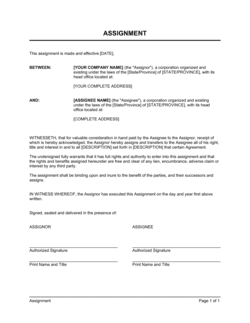
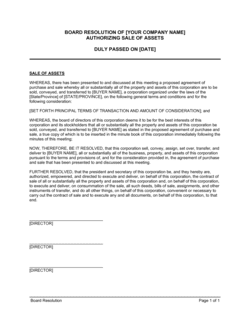
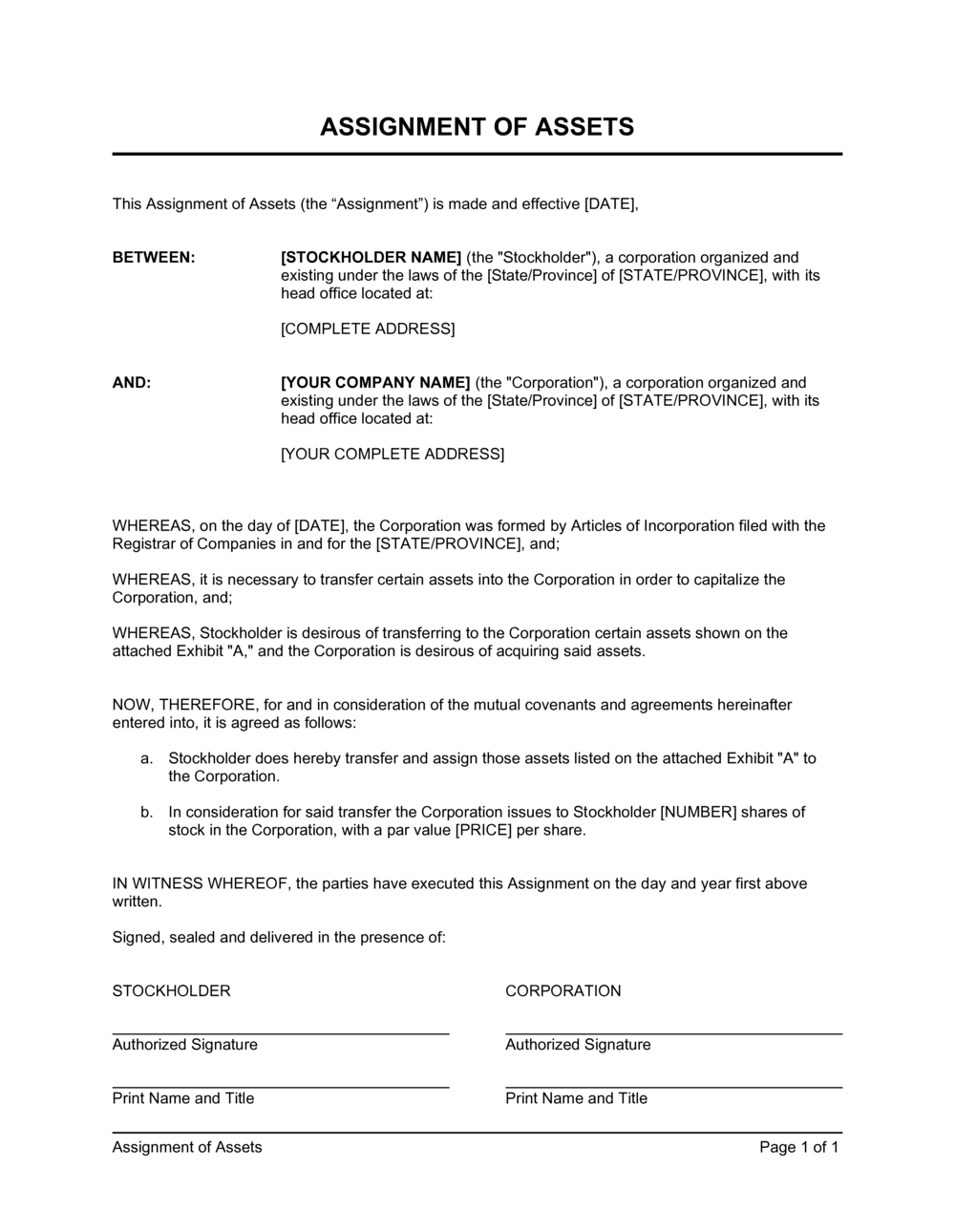
An Assignment of Assets is a legally binding document that transfers ownership or rights to specified assets from one party (the Assignor) to another (the Assignee). This free Word download covers the full structure of a standard asset assignment β€” parties, asset schedule, consideration, representations, and closing conditions β€” ready to edit online and export as PDF for execution.
When you need it
Use it when selling a business, restructuring a company, transferring IP or contracts to a new entity, or satisfying a creditor's claim against specific assets. It is also commonly used when a sole proprietor incorporates and needs to move personal business assets into the new corporate entity.
What's inside
Identification of both parties, a detailed schedule of assigned assets, the purchase price or consideration, representations and warranties from both sides, conditions to closing, and post-closing obligations. The document creates a clear chain of title and reduces the risk of future ownership disputes.

What is an Assignment of Assets?

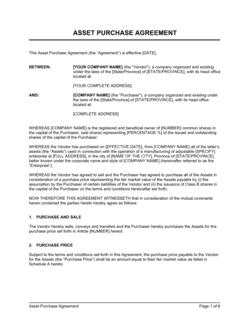
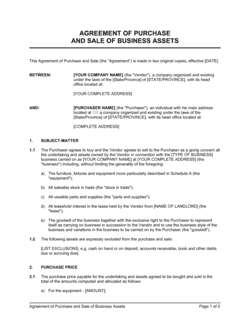
An Assignment of Assets is a legally binding agreement through which one party β€” the Assignor β€” transfers ownership of or rights to a defined portfolio of assets to another party β€” the Assignee β€” in exchange for agreed consideration. The agreement identifies each transferred asset with specificity, records the purchase price or assumed liabilities that constitute the exchange, and includes representations by both parties confirming their authority and the condition of the assets. It functions as the primary governing document for a business asset sale or restructuring and creates a clear chain of title that reduces the risk of post-closing ownership disputes.

Why You Need This Document

Without a written Assignment of Assets, neither party has a documented record of what was transferred, at what price, or under what conditions β€” leaving both exposed to costly disputes the moment a disagreement arises. An asset transferred without a formal agreement has no clear chain of title, which can block the Assignee from registering ownership with government agencies, enforcing contracts against third parties, or pledging the asset as collateral. Creditors of the Assignor can challenge informal transfers as fraudulent conveyances and potentially recover the assets even years after the transaction. For the Assignor, an undocumented transfer creates lingering liability for assets they no longer control. A properly executed Assignment of Assets, supported by detailed schedules and companion filing documents, closes all of these gaps β€” providing both parties with an enforceable record of the transaction and a defensible basis for every aspect of the transfer.

Which variant fits your situation?

If your situation is…Use this template
Transferring all assets of a business to a buyerAssignment of Assets (Business Sale)
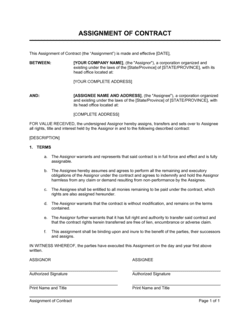
Assigning a specific contract's rights and obligations to a third partyAssignment of Contract
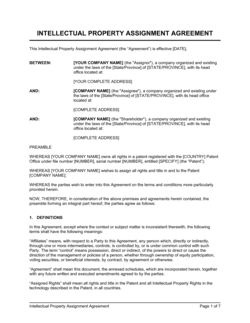
Transferring intellectual property rights separatelyIntellectual Property Assignment Agreement
Moving assets between related entities in a corporate restructureIntercompany Asset Transfer Agreement
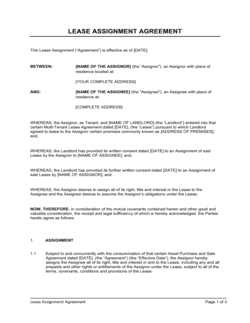
Assigning a commercial lease alongside business assetsAssignment of Lease
Gifting or donating business assets without monetary considerationDeed of Gift
Transferring a domain name and associated digital assets onlyDomain Name Transfer Agreement

Common mistakes to avoid

❌ Vague asset descriptions without a detailed schedule

Why it matters: An agreement that transfers 'all business assets' with no itemized schedule leaves both parties without a clear record of what was conveyed, making post-closing disputes over specific items almost inevitable.

Fix: Attach a Schedule A that identifies every asset with sufficient detail to distinguish it β€” serial numbers, registration numbers, contract counterparties, and account numbers as applicable.

❌ Transferring non-assignable assets without third-party consent

Why it matters: Assigning a contract, license, or permit that contains an anti-assignment clause without obtaining the counterparty's consent can void the transfer and expose both parties to breach-of-contract claims.

Fix: Review every contract, license, and permit on the asset schedule for assignment restrictions before closing, and obtain written consent in advance for any that require it.

❌ No stated consideration on related-party transfers

Why it matters: A transfer with no documented consideration is legally vulnerable β€” creditors or bankruptcy trustees can challenge it as a fraudulent conveyance and potentially unwind the transfer.

Fix: Document a fair-market-value purchase price or, at minimum, record nominal consideration of $1.00 with an acknowledgment of receipt. For material transactions, obtain an independent valuation.

❌ Omitting an indemnification survival period and liability cap

Why it matters: Without a survival clause, indemnity claims can theoretically arise indefinitely after closing; without a cap, a technical warranty breach can generate uncapped liability disproportionate to the deal value.

Fix: Include a survival period of 12–24 months for general representations and a longer period for fundamental warranties (title, authority). Set an indemnity cap equal to the purchase price or a negotiated percentage of it.

The 10 key clauses, explained

Parties and recitals

In plain language: Identifies the Assignor and Assignee by their full legal names and entity types, and provides brief background context explaining why the transfer is occurring.

Sample language
This Assignment of Assets Agreement (the 'Agreement') is entered into as of [EFFECTIVE DATE] by and between [ASSIGNOR LEGAL NAME], a [STATE/PROVINCE] [ENTITY TYPE] ('Assignor'), and [ASSIGNEE LEGAL NAME], a [STATE/PROVINCE] [ENTITY TYPE] ('Assignee').

Common mistake: Using a trade name or brand name instead of the registered legal entity name. If the Assignor entity on the agreement doesn't match the title records for each asset, a separate corrective transfer may be required.

Assignment and asset schedule

In plain language: The operative clause that transfers ownership of the listed assets and attaches a schedule enumerating every item being assigned, with enough detail to identify each one uniquely.

Sample language
Assignor hereby assigns, transfers, and conveys to Assignee all of Assignor's right, title, and interest in and to the assets listed in Schedule A attached hereto (the 'Assigned Assets'), free and clear of all encumbrances except as disclosed in Schedule B.

Common mistake: Describing assets too broadly β€” writing 'all business assets' without an itemized schedule leaves the scope undefined and creates post-closing disputes about what was and was not included.

Consideration

In plain language: States what the Assignee pays or provides in exchange for the assets, whether cash, assumption of liabilities, equity, or nominal consideration such as one dollar.

Sample language
In consideration of the sum of $[PURCHASE PRICE] (the 'Purchase Price'), receipt of which is hereby acknowledged, and the Assignee's assumption of the Assumed Liabilities set out in Schedule C, Assignor agrees to the assignment herein.

Common mistake: Stating no consideration at all on a transfer between related parties. Even a nominal amount must be documented β€” agreements with no stated consideration are more vulnerable to challenge by creditors or courts as fraudulent transfers.

Representations and warranties of the Assignor

In plain language: The Assignor confirms it has legal authority to transfer the assets, owns them outright, and has not concealed any liens, claims, or legal proceedings affecting the assets.

Sample language
Assignor represents and warrants that: (a) it has full legal right and authority to execute this Agreement and transfer the Assigned Assets; (b) Assignor holds good and marketable title to the Assigned Assets free and clear of all encumbrances except as disclosed; and (c) no litigation or governmental proceeding is pending or threatened against the Assigned Assets.

Common mistake: Omitting a warranty of good title. Without it, the Assignee has no contractual remedy if a creditor later asserts a prior lien against an assigned asset.

Representations and warranties of the Assignee

In plain language: The Assignee confirms it has authority to enter the agreement and the financial capacity to fulfill its payment and assumption-of-liabilities obligations.

Sample language
Assignee represents and warrants that: (a) it is duly organized and has full authority to execute this Agreement; (b) this Agreement constitutes a legal, valid, and binding obligation of Assignee; and (c) Assignee has the financial capacity to pay the Purchase Price and assume the Assumed Liabilities.

Common mistake: Skipping Assignee warranties entirely. If the Assignee later lacks authority or capacity, the Assignor may have no contractual basis to unwind the transfer or recover assets.

Assumption of liabilities

In plain language: Specifies which debts, obligations, or contractual commitments associated with the assets the Assignee agrees to take on, and which remain with the Assignor.

Sample language
Assignee hereby assumes and agrees to pay, perform, and discharge only those liabilities of Assignor set forth in Schedule C (the 'Assumed Liabilities'). Assignor retains all other liabilities not expressly listed in Schedule C.

Common mistake: Using vague language like 'all liabilities associated with the assets' without a defined list. This can unintentionally transfer unknown obligations β€” including litigation exposure β€” that the Assignee never intended to accept.

Conditions to closing

In plain language: Lists the specific actions each party must complete before the transfer becomes effective β€” for example, obtaining third-party consents, releasing existing security interests, or delivering specific documents.

Sample language
The obligations of each party to close are subject to: (a) delivery by Assignor of executed bills of sale and consent letters for all Assigned Assets requiring third-party consent; (b) payment by Assignee of the Purchase Price; and (c) release by [LENDER NAME] of its security interest over the Assigned Assets.

Common mistake: Failing to identify assets that require third-party consent to assign β€” such as software licenses, supplier contracts, or government permits. Transferring a non-assignable asset without consent can void the transfer and expose both parties to breach claims.

Indemnification

In plain language: Each party agrees to compensate the other for losses caused by a breach of their own representations, warranties, or obligations under the agreement.

Sample language
Assignor shall indemnify, defend, and hold harmless Assignee from any losses arising from: (a) a breach of Assignor's representations or warranties; or (b) any liability of Assignor not included in the Assumed Liabilities. Assignee shall indemnify Assignor from any losses arising from Assignee's breach of this Agreement or its failure to pay any Assumed Liability.

Common mistake: No indemnification cap or survival period. Without a cap, a minor warranty breach can generate disproportionate liability; without a survival period, indemnity claims can arise years after closing.

Governing law and dispute resolution

In plain language: Specifies which jurisdiction's law governs interpretation and enforcement of the agreement, and how disputes will be resolved β€” litigation, arbitration, or mediation.

Sample language
This Agreement is governed by the laws of [STATE/PROVINCE/COUNTRY], without regard to its conflict-of-laws provisions. Any dispute arising under this Agreement shall be resolved by binding arbitration in [CITY] under the rules of [AAA/JAMS/ADR INSTITUTION], except that either party may seek injunctive relief in a court of competent jurisdiction.

Common mistake: Choosing a governing law with no connection to the parties or the assets. Some jurisdictions β€” notably California β€” apply local law regardless of a contrary choice-of-law clause, particularly for assets physically located there.

Entire agreement and amendment

In plain language: Confirms that this document is the complete agreement between the parties on the subject matter and can only be modified in writing signed by both parties.

Sample language
This Agreement, together with its Schedules, constitutes the entire agreement of the parties with respect to the assignment of the Assigned Assets and supersedes all prior representations, negotiations, and understandings. No amendment to this Agreement is effective unless made in writing and signed by both parties.

Common mistake: Omitting this clause when the parties exchanged a letter of intent or term sheet. Without an entire-agreement clause, those prior documents may be introduced as evidence of additional terms not in the final agreement.

How to fill it out

  1. 1

    Identify both parties with their full legal names

    Enter the Assignor's and Assignee's registered legal entity names, entity types, and states or provinces of formation. If either party is an individual, use their full legal name as it appears on government-issued ID.

    πŸ’‘ Pull entity names directly from the applicable corporate registry β€” a mismatch between the agreement and title records can require a corrective deed or re-execution.

  2. 2

    Set the effective date separately from the signing date

    Decide whether ownership transfers on the signing date or on a future closing date, and enter that date clearly in the header. The effective date controls when risk, title, and responsibility shift to the Assignee.

    πŸ’‘ If closing is contingent on conditions such as lender consent or permit transfer, set the effective date as 'the date all conditions in Section [X] are satisfied' rather than a fixed calendar date.

  3. 3

    Build Schedule A β€” the asset list

    List every asset being transferred with enough specificity to identify it uniquely: equipment serial numbers, domain names, patent registration numbers, contract names and counterparties, vehicle VINs, and bank account numbers where relevant.

    πŸ’‘ If any asset is registered with a government agency β€” vehicle, real property, trademark β€” confirm the exact title description used in that registry before drafting Schedule A.

  4. 4

    State the consideration clearly

    Enter the cash purchase price, the agreed value of assumed liabilities, or both. If consideration is nominal for an intra-company transfer, state the amount explicitly β€” even $1.00 β€” and acknowledge receipt.

    πŸ’‘ For transfers between related entities, document that the consideration reflects fair market value, or obtain an independent valuation. Below-market transfers can be challenged as fraudulent conveyances by creditors.

  5. 5

    Build Schedule C β€” the assumed liabilities list

    List every obligation the Assignee is taking on: outstanding invoices tied to the business, equipment financing balances, lease obligations, and ongoing service contract commitments. Be specific about amounts and counterparties.

    πŸ’‘ Everything not on Schedule C stays with the Assignor. Ambiguity in the liabilities schedule is the single most common source of post-closing disputes β€” resolve it in the document, not later.

  6. 6

    Identify assets requiring third-party consent and obtain it before closing

    Review the asset schedule for software licenses, supplier agreements, customer contracts, and government permits that contain anti-assignment clauses. Obtain written consent from the relevant counterparty before or at closing.

    πŸ’‘ Many SaaS and enterprise software licenses are non-transferable. Check each license agreement before assuming it transfers β€” a silent assignment can void the license on day one of new ownership.

  7. 7

    Execute with appropriate formalities for each asset class

    The main agreement requires signatures from authorized signatories of both parties. Specific asset classes require companion documents: a bill of sale for tangible personal property, an IP assignment for patents and trademarks, and a lease assignment for real property interests.

    πŸ’‘ For assets registered with a government agency, file the companion transfer document with the relevant registry promptly after signing β€” in many jurisdictions, registration determines priority against third-party claims.

  8. 8

    Retain fully executed originals and update your asset records

    Both parties should retain a fully executed copy of the agreement and all schedules. The Assignee should immediately update internal asset registries, insurance policies, and accounting records to reflect new ownership.

    πŸ’‘ Notify your business insurer of the transfer on the effective date β€” coverage gaps between old and new ownership records are a common and avoidable problem after asset transactions.

Frequently asked questions

What is an assignment of assets?

An assignment of assets is a legal agreement through which one party β€” the Assignor β€” transfers ownership or rights to specified assets to another party β€” the Assignee β€” in exchange for consideration. It creates a documented chain of title and defines what is being transferred, at what price, and under what conditions. It is commonly used in business sales, corporate restructurings, incorporations, and secured lending transactions.

What types of assets can be assigned?

Most categories of business property can be assigned, including tangible assets such as equipment, inventory, and vehicles; intangible assets such as intellectual property, domain names, software, and goodwill; contractual rights under customer and supplier agreements; accounts receivable; and financial accounts. Some assets β€” particularly contracts containing anti-assignment clauses, government-issued licenses, and certain regulated permits β€” require third-party consent before they can be validly transferred.

What is the difference between an assignment of assets and a bill of sale?

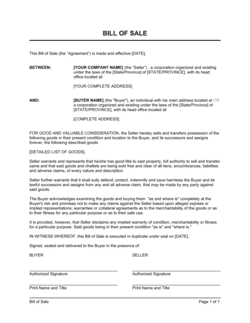
An assignment of assets is a comprehensive legal agreement governing the transfer of a defined group of assets, including representations, warranties, indemnification, and post-closing obligations. A bill of sale is a shorter companion document that serves as formal evidence of transfer for tangible personal property and is often filed with a government registry. In a business asset transaction, both documents are typically used together β€” the assignment governs the deal; the bill of sale perfects title for individual physical items.

Does an assignment of assets transfer liabilities?

Only if the agreement expressly says so. By default, an asset assignment transfers specified assets, not the Assignor's obligations. However, the parties can agree that the Assignee will assume specific liabilities β€” such as outstanding payables or equipment financing β€” and document them in an assumed liabilities schedule. Anything not listed remains with the Assignor. Buyers should audit potential hidden liabilities before agreeing to any broad assumption language.

When do I need an assignment of assets instead of a share purchase agreement?

Use an assignment of assets when you want to acquire specific business assets without taking on the selling entity's full legal history, unknown liabilities, or regulatory exposure. Use a share purchase agreement when you are acquiring the entire company β€” including its corporate structure, contracts, liabilities, and tax history. Asset deals require more detailed transfer documentation for each asset class but give the buyer greater control over what obligations they assume.

Does an assignment of assets need to be notarized?

Notarization is not typically required for a standard assignment of assets agreement. However, certain asset classes β€” real property interests in some US states, and vehicle titles in many jurisdictions β€” do require notarization of companion transfer documents such as deeds or title applications. Check the specific registration requirements for each asset category in the relevant jurisdiction before closing.

Can I assign assets between two entities I own without paying fair market value?

Technically yes, but below-market transfers between related entities carry legal risk. Creditors of the transferring entity can challenge a transfer at below fair market value as a fraudulent conveyance β€” particularly if the Assignor was insolvent or became insolvent as a result of the transfer. Tax authorities in the US, Canada, and the UK also have transfer-pricing rules that require related-party transactions to be documented at arm's-length value. Obtain a valuation and document it before closing any related-party transfer.

How is an assignment of assets different from an assignment of contract?

An assignment of contract transfers only the rights and obligations under a specific contract β€” for example, a customer supply agreement or a software development contract β€” to a new party. An assignment of assets is broader: it transfers a defined portfolio of property, which may include contracts as one category among many. If you are transferring only contractual rights, use an assignment of contract; if you are transferring a bundle of business property that includes contracts alongside physical and intangible assets, use an assignment of assets agreement.

Do I need a lawyer to draft an assignment of assets?

For straightforward single-asset or intra-company transfers at low dollar values, a well-structured template is often sufficient. Legal review is strongly recommended when the transaction involves a significant purchase price, multiple asset classes with separate registration requirements, assumed liabilities, regulated assets such as professional licenses or permits, or cross-border elements. A lawyer can identify non-assignable assets, structure the consideration to minimize tax exposure, and ensure that the companion filing documents are completed correctly for each asset class.

How this compares to alternatives

vs Assignment of Contract

An assignment of contract transfers rights and obligations under a single, named contract to a new party. An assignment of assets is broader β€” it transfers a defined bundle of property that may include contracts alongside physical equipment, IP, and financial assets. Use an assignment of contract when only one agreement is changing hands; use an assignment of assets for a multi-item business transfer.

vs Bill of Sale

A bill of sale is a short document that evidences the transfer of specific tangible personal property and is often filed with a government registry to perfect title. An assignment of assets is the governing commercial agreement that includes representations, warranties, indemnification, and conditions to closing. In most business asset transactions, both documents are used: the assignment governs the deal and the bill of sale perfects title for physical items.

vs Share Purchase Agreement

A share purchase agreement transfers ownership of a company by conveying its shares, including all assets and liabilities of the entity. An assignment of assets transfers only specified property without transferring the corporate entity or its history. Buyers choose an asset deal to limit liability exposure; sellers often prefer share deals for cleaner exits and potentially favorable tax treatment.

vs Intellectual Property Assignment Agreement

An IP assignment agreement is a specialized document that transfers patents, trademarks, copyrights, or trade secrets with the formalities required for each IP category, including registration with the relevant IP office. An assignment of assets can include IP as one line item in the schedule, but complex or high-value IP portfolios warrant a dedicated IP assignment agreement to meet recordation requirements and protect priority against third-party claims.

Industry-specific considerations

Technology / SaaS

IP assignment for source code, patents, and domain names is typically the core of the schedule; software licenses require individual consent review before transfer.

Professional Services

Client contracts, work-in-progress, and goodwill are the primary transferred assets; many professional service agreements contain explicit anti-assignment clauses requiring client consent.

Manufacturing

Equipment with serial numbers, inventory at stated cost, supplier contracts, and any registered patents or process IP each require separate identification and companion transfer documentation.

Retail / E-commerce

Inventory valuation at the effective date, assignment of supplier agreements, transfer of e-commerce platform accounts, and any registered trademarks or brand assets are typical schedule items.

Healthcare / MedTech

Regulatory approvals, device registrations, and professional licenses are often non-assignable; patient data transfers must comply with HIPAA in the US and equivalent privacy laws in other jurisdictions.

Financial Services

Regulatory licenses are rarely transferable and must be reapplied for by the Assignee; loan portfolios and receivables assignments have specific perfection requirements under the UCC or equivalent statute.

Jurisdictional notes

United States

Article 9 of the UCC governs perfection of security interests in personal property β€” if assigned assets are subject to a lien, a UCC-3 termination statement must be filed before or at closing to release it. Certain asset classes, including motor vehicles, real property, and professional licenses, require state-specific transfer documents and filings. Fraudulent transfer laws under state statutes and the federal Bankruptcy Code can unwind below-market asset transfers within two to four years of a bankruptcy filing.

Canada

Personal property security legislation in each province (PPSA) governs perfection of security interests in transferred assets β€” search the relevant PPSA registry before closing and discharge any registered interests. Ontario and Quebec have additional bulk sales notification requirements for transfers of business assets outside the ordinary course of business, though several provinces have repealed bulk sales acts. Quebec asset transfers involving immovable property must be notarized and published in the Land Register.

United Kingdom

Business asset transfers in the UK may qualify as a Transfer of a Going Concern (TOGC) for VAT purposes, which can eliminate VAT on the transaction if specific HMRC conditions are met. Employees associated with the transferred business may transfer automatically under TUPE regulations β€” asset purchasers should assess TUPE exposure before closing. Intellectual property registered with the UK IPO and Companies House filings may require separate update notices after the effective date.

European Union

The EU Acquired Rights Directive (implemented nationally as TUPE equivalents across member states) may require automatic transfer of employees whose work is principally associated with the transferred assets. GDPR imposes strict requirements on any transfer of personal data held within an asset portfolio β€” a data processing agreement or impact assessment may be required. VAT treatment of asset transfers varies by member state; many jurisdictions offer a going-concern exemption similar to the UK TOGC regime when all conditions are satisfied.

Template vs lawyer β€” what fits your deal?

PathBest forCostTime
Use the templateSimple asset transfers between known parties at low dollar values, or intra-company transfers with straightforward asset schedulesFree1–3 hours
Template + legal reviewBusiness asset sales involving multiple asset classes, assumed liabilities, or assets registered with government agencies$500–$1,5003–5 business days
Custom draftedHigh-value transactions, regulated asset classes, cross-border transfers, or complex liability assumptions where enforceability is critical$2,000–$10,000+1–4 weeks

Glossary

Assignor
The party who currently owns the assets and is transferring them to the other party under the agreement.
Assignee
The party receiving ownership or rights to the assets under the assignment.
Consideration
The value exchanged for the transfer β€” typically a cash payment, assumption of liabilities, or other agreed benefit that makes the contract legally binding.
Asset Schedule
An attached list identifying every specific asset being transferred, including descriptions, serial numbers, or registration details sufficient to distinguish each item.
Representations and Warranties
Factual statements made by each party that are true as of the signing date β€” for example, that the Assignor owns the assets free and clear of undisclosed encumbrances.
Encumbrance
Any lien, mortgage, security interest, or claim held by a third party against an asset that limits the Assignor's ability to transfer clean title.
Good Title
Ownership of an asset that is free from any undisclosed claims, liens, or disputes, giving the Assignee full rights upon transfer.
Bill of Sale
A companion document that formally evidences the transfer of tangible personal property and is often recorded or filed with a government registry.
Assumption of Liabilities
A clause where the Assignee agrees to take on specified debts or obligations associated with the transferred assets.
Effective Date
The specific date on which ownership of the assets legally transfers from the Assignor to the Assignee, which may differ from the date the document is signed.
Indemnification
A contractual obligation by one party to compensate the other for losses arising from a breach of a representation, warranty, or obligation in the agreement.
Closing
The point at which all conditions are satisfied, documents are exchanged, consideration is paid, and the asset transfer becomes legally effective.

Part of your Business Operating System

This document is one of 3,000+ business & legal templates included in Business in a Box.

  • Fill-in-the-blanks β€” ready in minutes
  • 100% customizable Word document
  • Compatible with all office suites
  • Export to PDF and share electronically

Create your document in 3 simple steps.

From template to signed document β€” all inside one Business Operating System.
1
Download or open template

Access over 3,000+ business and legal templates for any business task, project or initiative.

2
Edit and fill in the blanks with AI

Customize your ready-made business document template and save it in the cloud.

3
Save, Share, Send, Sign

Share your files and folders with your team. Create a space of seamless collaboration.

Save time, save money, and create top-quality documents.

β˜…β˜…β˜…β˜…β˜…

"Fantastic value! I'm not sure how I'd do without it. It's worth its weight in gold and paid back for itself many times."

Managing Director Β· Mall Farm
Robert Whalley
Managing Director, Mall Farm Proprietary Limited
β˜…β˜…β˜…β˜…β˜…

"I have been using Business in a Box for years. It has been the most useful source of templates I have encountered. I recommend it to anyone."

Business Owner Β· 4+ years
Dr Michael John Freestone
Business Owner
β˜…β˜…β˜…β˜…β˜…

"It has been a life saver so many times I have lost count. Business in a Box has saved me so much time and as you know, time is money."

Owner Β· Upstate Web
David G. Moore Jr.
Owner, Upstate Web

Run your business with a system β€” not scattered tools

Stop downloading documents. Start operating with clarity. Business in a Box gives you the Business Operating System used by over 250,000 companies worldwide to structure, run, and grow their business.

Start freeΒ Β·Β No credit card required