1
Confirm the original lease permits assignment
Review the original lease for an assignment restriction clause. Most commercial leases require landlord consent; some prohibit assignment altogether. Identify any conditions — financial qualification of the assignee, notice periods, or assignment fees — before drafting.
💡 Request a copy of all lease amendments and side letters, not just the original lease — conditions on assignment are sometimes added by amendment years after signing.
2
Identify all three parties by legal entity name
Enter the assignor's, assignee's, and landlord's full registered legal names — not trade names or abbreviations. Include entity type (LLC, Inc., LP) and state or province of formation for each.
💡 Run a quick business registry search to confirm the exact legal name before drafting — a mismatch between the agreement and the registry creates enforcement risk.
3
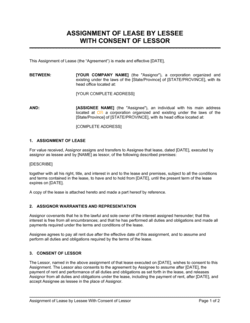
Describe the original lease and property in detail
Enter the original lease date, the full property address including unit number, square footage, and the exact remaining lease term from the effective date of assignment through expiry.
💡 Attach the original lease (with all amendments) as Exhibit A and reference the exhibit in this clause — the assignee should have the full document, not just a summary.
4
Set the effective date of assignment
Enter the specific calendar date on which the assignee takes over the lease. This date typically aligns with a rent payment cycle — the first of the month — to avoid prorated rent disputes.
💡 Coordinate the effective date with the landlord's consent timeline. If landlord consent takes two weeks, don't set the effective date to start in ten days.
5
Resolve the security deposit
Decide whether the deposit transfers directly from landlord to assignee, the assignee pays the assignor directly and the existing deposit rolls over, or the assignor's deposit is returned and the assignee posts a fresh one. Document the chosen approach clearly with dollar amounts.
💡 Confirm the landlord's preferred method in writing before finalizing this clause — some landlords require a fresh deposit from every incoming tenant regardless of the original arrangement.
6
Negotiate and document assignor liability
Determine whether the assignor is fully released (novation) or remains secondarily liable. If a release is agreed, prepare a separate written release signed by the landlord and attach it as an exhibit.
💡 Landlords routinely refuse to fully release the original tenant on long commercial leases with creditworthy tenants. If the landlord insists on ongoing liability, negotiate a sunset date — e.g., the original tenant is released after 12 months of the assignee's timely payment.
7
Obtain all signatures before the effective date
All three parties — assignor, assignee, and landlord — must sign before the effective date. An assignment executed after the effective date may require fresh consideration to be enforceable, and any occupancy before signing puts the assignee in an unauthorized possession situation.
💡 Use a signature block that captures each signatory's name, title, date, and entity to avoid ambiguity about whether an individual signed personally or in a representative capacity.
8
Distribute fully executed copies to all parties
Once signed, provide a complete copy of the executed agreement — including all exhibits — to the assignor, assignee, and landlord. Store a copy in your records as the controlling document for the remainder of the tenancy.
💡 If the original lease was registered or recorded with a government authority, check whether the assignment must also be recorded to be effective against third parties.