1
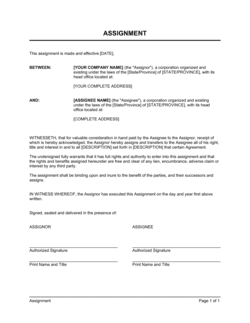
Identify all parties with full legal names
Enter the assignor's and assignee's full legal names exactly as they appear on government-issued identification or corporate formation documents. If either party is an entity, include the state of formation and entity type.
💡 Cross-reference the assignor's name against the original contract to confirm an exact match — any discrepancy requires a name-correction affidavit before recording.
2
Insert the full legal property description
Copy the complete legal description from the original land contract or the county property records — not just the street address. Include the parcel identification number.
💡 Obtain the legal description directly from the county assessor's website or the original deed in the public record; do not rely on tax bills or MLS listings, which sometimes contain errors.
3
Reference and attach the original contract
Identify the original land contract or purchase agreement by its execution date, parties, and recording information if it has been recorded. Attach a complete copy as Exhibit A.
💡 If the original contract was never recorded, note that fact explicitly and include the full executed copy — not just a signature page — as the exhibit.
4
State the consideration accurately
Enter the actual assignment fee being paid from assignee to assignor. If no separate fee is being charged — for example, in an estate transfer — state the legal consideration used in your jurisdiction (e.g., 'love and affection and other good and valuable consideration').
💡 Several states impose a transfer tax or document stamp based on stated consideration. Understating the amount to reduce tax exposure is tax fraud and can void the document.
5
Define the scope of the assumption
Specify whether the assignee assumes all obligations from the assignment date forward and whether the assignor is released or remains secondarily liable. If the seller's consent is required, obtain it before execution.
💡 If the original seller will not execute a formal release of the assignor, add language in the assumption clause confirming the assignee will indemnify the assignor against any claims under the original contract.
6
Complete the representations and warranties
The assignor should confirm in writing that the original contract is current, has not been previously assigned, and that no undisclosed defaults or encumbrances exist. Customize the warranty list to reflect any known exceptions.
💡 Known exceptions — such as a pending mechanic's lien or a default cure in progress — must be disclosed in writing to the assignee before signing. Undisclosed material facts can give the assignee grounds to rescind the assignment.
7
Execute before a notary public
Both the assignor and the assignee — and the seller if their consent is included — must sign before a notary public. The notary must complete the acknowledgment block in full for the document to be eligible for recording.
💡 Some counties require two witnesses in addition to notarization. Check the recording requirements for the specific county where the property is located before the signing appointment.
8
Record the assignment with the county register of deeds
Submit the original notarized assignment, the required recording fee, and any applicable transfer tax forms to the county register of deeds or recorder's office. Obtain a stamped, recorded copy for each party's files.
💡 Recording turnaround times vary from same-day to several weeks depending on the county. If the underlying closing is time-sensitive, ask whether the county offers expedited recording.