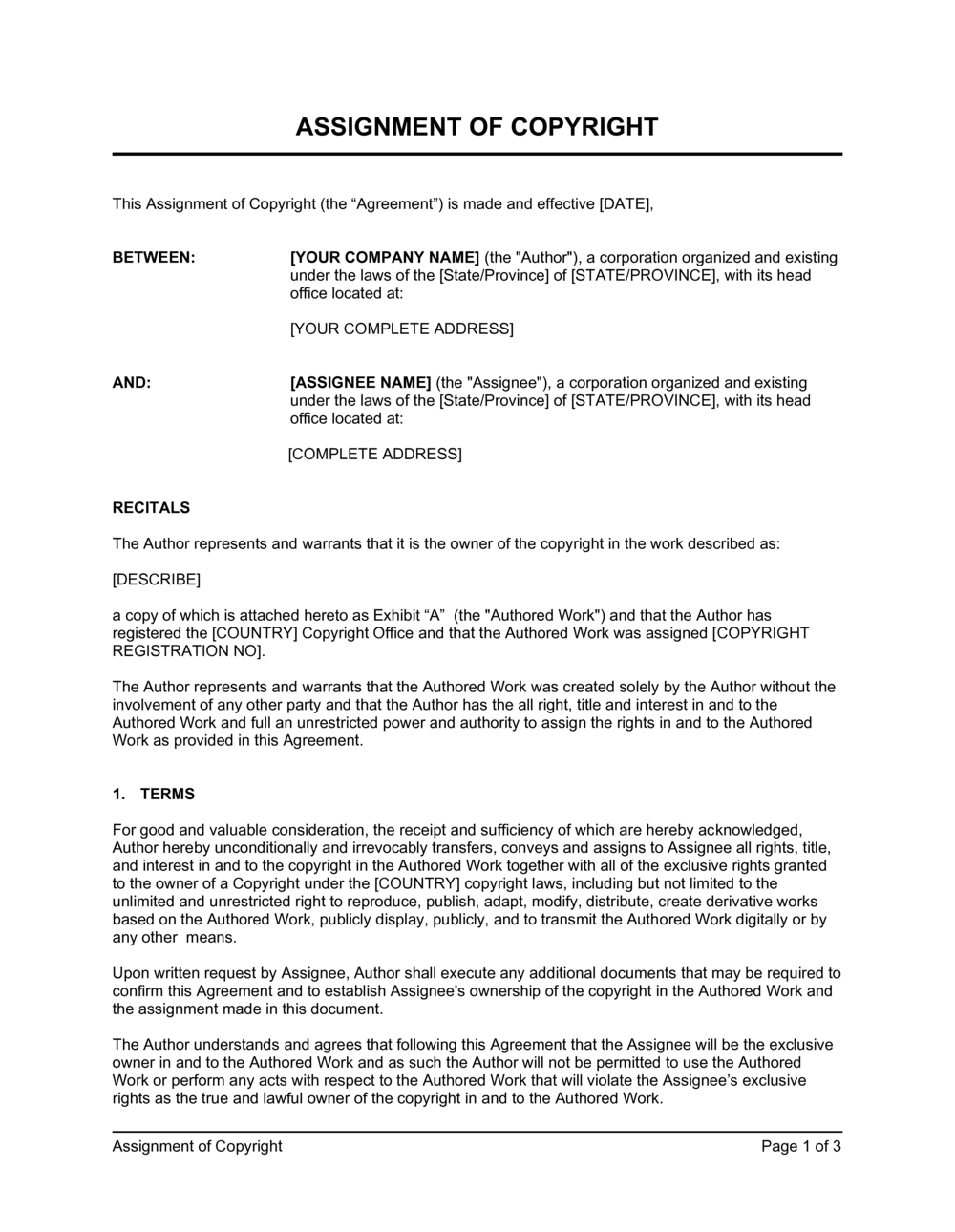
Assignment of Copyright Template

Free Word download β€’ Edit online β€’ Save & share with Drive β€’ Export to PDF

3 pagesβ€’25–30 min to fillβ€’Difficulty: Standardβ€’Signature requiredβ€’Legal review recommended
Learn more ↓
FreeAssignment of Copyright Template

At a glance

What it is
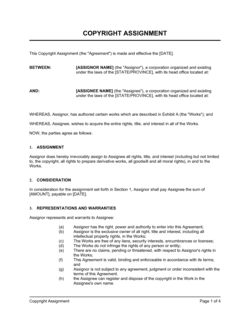
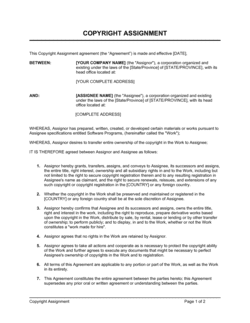
An Assignment of Copyright is a legally binding agreement in which the original copyright owner (the assignor) permanently transfers all or a defined portion of their copyright ownership to another party (the assignee). This free Word download covers the full transfer of rights, consideration, warranties of ownership, moral rights waivers, and representations β€” giving you an enforceable, signed record of the transfer you can export as PDF in minutes.
When you need it
Use it whenever a business acquires creative work β€” software code, website content, graphic design, photographs, music, or written materials β€” from a freelancer, contractor, or co-founder, and needs to hold unambiguous legal title to the resulting intellectual property. It is also essential when buying an existing creative asset, brand, or product from another business.
What's inside
Identification of the assignor and assignee, a precise description of the copyrighted work being transferred, the consideration paid, a full assignment of all rights of exploitation, warranties that the assignor holds clear title, a moral rights waiver where applicable, representations and indemnities, and governing law.

What is an Assignment of Copyright?

An Assignment of Copyright is a legally binding agreement in which the original copyright owner β€” the assignor β€” permanently transfers their ownership rights in a creative work to another party, the assignee. Unlike a license, which grants permission to use a work while leaving title with the creator, a copyright assignment moves legal ownership itself: after signing, the assignee controls all rights to reproduce, distribute, adapt, display, and sublicense the work. The agreement identifies the work with precision, states the consideration exchanged, confirms the assignor holds clear title, and β€” in international transactions β€” includes a waiver of the creator's moral rights. Most jurisdictions require the assignment to be in writing and signed to be enforceable; a verbal agreement or unsigned document does not transfer copyright in any major legal system.

Why You Need This Document

Paying a contractor for creative work does not automatically make you the copyright owner β€” in every major jurisdiction, copyright vests in the creator unless a written assignment says otherwise. Without a signed assignment, a freelance developer retains ownership of code you commissioned, a graphic designer retains title to your brand identity, and a content writer retains rights to copy published on your website. This gap surfaces at the worst possible moments: during investor due diligence, in an acquisition that requires clean IP chain of title, or when a contractor demands additional payment to transfer rights after the relationship has soured. Beyond contractor relationships, missing assignments from co-founders are among the most common IP defects that delay or kill early-stage funding rounds. This template closes that gap with a single signed document β€” establishing clear, recorded, permanent ownership of every creative asset your business depends on.

Which variant fits your situation?

If your situation is…Use this template
Transferring all rights in a creative work permanently to a clientAssignment of Copyright (Full Transfer)
Granting limited usage rights without giving up ownershipCopyright License Agreement
Assigning all IP created by an employee or contractor during engagementIntellectual Property Assignment Agreement
Transferring software source code and related IP to a buyerSoftware Assignment Agreement
Commissioning original creative work with automatic ownership transferWork for Hire Agreement
Transferring trademark rights alongside copyright in a brand saleTrademark Assignment Agreement
Protecting confidential IP disclosures before assignment negotiationsNon-Disclosure Agreement (NDA)

Common mistakes to avoid

❌ Relying on a work-for-hire clause instead of an explicit assignment

Why it matters: In the US, work-for-hire status applies automatically only to employees and to nine specific categories of commissioned works with a written agreement. All other contractor-created work belongs to the contractor by default β€” even if you paid for it.

Fix: Use an Assignment of Copyright whenever engaging a contractor, regardless of what the services agreement says. An explicit assignment eliminates any ambiguity about who holds title.

❌ Vague description of the assigned work

Why it matters: Courts interpret ambiguous scope against the assignee, meaning an unclear description can leave the original creator retaining rights in the very deliverable you paid for.

Fix: Attach the work as a signed exhibit and reference it by title, creation date, and medium. For software, include the repository name, version, and commit hash if available.

❌ Omitting the moral rights waiver in international agreements

Why it matters: In the EU, Canada, and many other jurisdictions, unwaived moral rights allow the creator to object to modifications or demand attribution β€” blocking the assignee from freely using, adapting, or rebranding the work.

Fix: Include a moral rights waiver clause covering all applicable jurisdictions, and ensure the waiver language references local statutes where required.

❌ No further-assurances clause

Why it matters: Without it, an assignor who later becomes uncooperative β€” or who is acquired, dissolves, or dies β€” can leave the assignee unable to record the transfer or obtain a registration that requires the assignor's signature.

Fix: Include a further-assurances obligation requiring the assignor to execute any additional documents needed to perfect the assignee's title, at no additional cost.

❌ Capping indemnification at the contract price for high-value IP

Why it matters: If a third party claims ownership of software or creative assets worth significantly more than the original contract price, a low indemnification cap leaves the assignee exposed to losses far exceeding the consideration paid.

Fix: For material IP acquisitions, negotiate uncapped indemnification for third-party ownership claims, or require the assignor to obtain representations and warranties insurance.

❌ Failing to record the assignment with the copyright office

Why it matters: In the US, an unrecorded assignment loses priority to a later bona fide purchaser who records first β€” even if your assignment came first in time.

Fix: Record the executed assignment with the US Copyright Office (or equivalent) within one month of signing. The recordation fee is nominal and the protection is significant.

The 10 key clauses, explained

Parties and recitals

In plain language: Identifies the assignor and assignee by full legal name and entity type, and provides brief background on why the assignment is being made.

Sample language
This Assignment of Copyright ('Agreement') is made on [DATE] between [ASSIGNOR FULL LEGAL NAME], a [STATE/COUNTRY] [ENTITY TYPE] ('Assignor'), and [ASSIGNEE FULL LEGAL NAME], a [STATE/COUNTRY] [ENTITY TYPE] ('Assignee').

Common mistake: Using a trade name or personal nickname instead of the registered legal entity name β€” if the assignor entity name doesn't match the copyright registration or prior contract, establishing clean chain of title becomes complicated.

Description of the assigned work

In plain language: Precisely identifies the copyrighted work being transferred β€” title, medium, date of creation, and any registration numbers β€” so there is no ambiguity about what is and is not included.

Sample language
Assignor hereby assigns to Assignee all copyright in and to the work described as: [TITLE OR DESCRIPTION OF WORK], created on or about [DATE], in the medium of [WRITTEN / SOFTWARE / VISUAL / AUDIO], [registered under US Copyright Registration No. XXXX / unregistered as of the date hereof].

Common mistake: Using a vague description such as 'the website project' or 'the marketing materials.' If the scope is disputed, courts interpret ambiguity against the assignee β€” meaning ownership may remain with the creator.

Scope of rights assigned

In plain language: States which rights within the copyright bundle are being transferred β€” typically all rights of reproduction, adaptation, distribution, public performance, display, and digital transmission β€” and whether the assignment is worldwide and in perpetuity.

Sample language
Assignor assigns to Assignee, throughout the world, in perpetuity, all rights, title, and interest in the Work, including all rights of reproduction, adaptation, distribution, public performance, public display, and digital transmission, in all media now known or hereafter invented.

Common mistake: Failing to include future-media language β€” an assignment limited to 'current media' may leave digital or streaming rights with the assignor when new platforms emerge.

Consideration

In plain language: States the payment or other value exchanged for the assignment, making the contract binding under contract law.

Sample language
In consideration of the sum of [AMOUNT] ([CURRENCY]), receipt of which the Assignor hereby acknowledges, and other good and valuable consideration, the Assignor agrees to the terms of this Agreement.

Common mistake: Stating consideration as '$1 and other good and valuable consideration' without specifying the actual payment amount when a real payment is made β€” this creates ambiguity and may complicate enforcement if the payment is later disputed.

Moral rights waiver

In plain language: Where permitted by applicable law, the assignor waives their moral rights β€” including the right to attribution and the right to object to modifications β€” allowing the assignee to alter, adapt, or publish the work without crediting the original creator.

Sample language
To the fullest extent permitted by applicable law, Assignor irrevocably waives all moral rights in the Work, including the right to be identified as author and any right to object to derogatory treatment of the Work.

Common mistake: Omitting the moral rights waiver entirely in international agreements β€” in France, Germany, and Canada, unwaived moral rights can allow the original creator to block publication of modified versions of the work.

Warranties and representations

In plain language: The assignor confirms they are the sole owner of the copyright, the work is original, no third-party rights encumber it, and no prior conflicting assignments have been made.

Sample language
Assignor warrants and represents that: (a) Assignor is the sole legal and beneficial owner of the Work; (b) the Work is original and does not infringe any third-party rights; (c) no prior assignment, license, or encumbrance of the copyright in the Work has been granted; and (d) Assignor has full authority to enter into this Agreement.

Common mistake: Narrowing warranties to 'best of Assignor's knowledge' for standard commercial assignments β€” this reduces the assignee's protection and makes the indemnity clause harder to invoke if a third-party claim arises.

Indemnification

In plain language: Requires the assignor to defend the assignee and cover losses if any warranty proves false β€” for example, if a third party later claims they own rights in the same work.

Sample language
Assignor shall indemnify, defend, and hold harmless Assignee from and against any claims, losses, damages, costs, and expenses (including reasonable attorneys' fees) arising from any breach of Assignor's warranties and representations under this Agreement.

Common mistake: Capping indemnification at the consideration amount for assignments involving valuable IP β€” a $500 cap on a $200,000 software assignment provides essentially no protection to the assignee if a serious ownership dispute emerges.

Further assurances

In plain language: Obliges the assignor to sign any additional documents β€” copyright registration forms, recordation filings, statutory declarations β€” needed to perfect the assignee's title after signing.

Sample language
Assignor agrees to execute and deliver any additional documents, instruments, or filings that Assignee reasonably requests to register, record, or otherwise perfect the assignment of copyright in any jurisdiction.

Common mistake: Omitting this clause entirely β€” without it, an assignor who becomes uncooperative or unreachable after signing can block the assignee from recording the transfer with the US Copyright Office or an equivalent registry.

Governing law and dispute resolution

In plain language: Specifies which jurisdiction's law governs the agreement and how disputes are resolved β€” litigation, arbitration, or mediation β€” and in which venue.

Sample language
This Agreement is governed by the laws of [STATE / PROVINCE / COUNTRY], without regard to conflict-of-law principles. Any dispute arising under this Agreement shall be resolved by [binding arbitration in [CITY] / the courts of [JURISDICTION]].

Common mistake: Choosing a governing law with no connection to where either party is located or where the work will be used β€” courts in the assignee's jurisdiction may apply local copyright law regardless of a contradictory governing-law clause.

Entire agreement and amendment

In plain language: Confirms that this document is the complete agreement on copyright ownership, superseding all prior conversations, emails, and proposals, and that any changes must be in writing.

Sample language
This Agreement constitutes the entire agreement between the parties regarding the subject matter herein and supersedes all prior negotiations, representations, or agreements. Any amendment must be in writing and signed by both parties.

Common mistake: No integration clause at all β€” prior emails promising 'you will own everything' or informal agreements can then be introduced as contractual terms in a dispute, overriding the written assignment.

How to fill it out

  1. 1

    Identify both parties with their legal entity names

    Enter the full registered name of the assignor and assignee β€” company name as it appears in the corporate registry, or full legal name for individuals. Include entity type (LLC, corporation, sole proprietor) and jurisdiction of formation.

    πŸ’‘ Cross-check the assignor's name against any prior freelance contract or invoice to ensure the names match β€” a discrepancy breaks chain of title.

  2. 2

    Describe the copyrighted work precisely

    Name the work, specify the medium (software code, written content, graphic design, photograph, music composition), state the approximate creation date, and include any copyright registration numbers if the work has been registered.

    πŸ’‘ Attach the work itself as Exhibit A β€” referencing an attachment eliminates any future dispute about what was actually transferred.

  3. 3

    Confirm the scope of the assignment

    Decide whether you are transferring all rights worldwide and in perpetuity, or limiting the transfer by geography, duration, or medium. Full-scope assignments are standard for most commercial transactions; partial assignments suit licensing-style arrangements.

    πŸ’‘ For software, explicitly include the right to modify, create derivative works, and sublicense β€” these are separate rights that a generic 'all rights' clause may not cover in every jurisdiction.

  4. 4

    State the consideration clearly

    Enter the actual payment amount and currency. If no cash changes hands β€” for example, in an inter-company transfer β€” state the non-monetary consideration or confirm the assignment is made for nominal consideration of $1 with supporting documentation of the relationship.

    πŸ’‘ In the UK, a deed executed as a deed can be valid without consideration β€” if no payment is involved, consider executing as a deed rather than a simple contract.

  5. 5

    Include and tailor the moral rights waiver

    Retain the moral rights waiver clause and ensure it references applicable law. For assignors based in France, Germany, or Quebec, note that moral rights cannot be fully waived β€” the clause should state 'to the fullest extent permitted by law.'

    πŸ’‘ Even in jurisdictions where moral rights cannot be waived, an express consent to modification and non-attribution is better than silence β€” it may reduce the practical risk of a moral rights claim.

  6. 6

    Review the warranties and calibrate indemnification

    Confirm the assignor's warranties are unqualified for standard commercial assignments. Set the indemnification scope to cover attorneys' fees and all losses arising from warranty breach. If the IP is high-value, consider uncapped indemnification or require the assignor to maintain IP insurance.

    πŸ’‘ Ask the assignor to confirm in writing β€” before signing β€” that no third-party tools, open-source code, or licensed assets are embedded in the work.

  7. 7

    Sign before the work is put to commercial use

    Both parties must sign the agreement before the assignee begins distributing, selling, or licensing the work. Post-use execution creates a gap in chain of title that can complicate copyright registration and downstream transactions.

    πŸ’‘ Use a timestamped electronic signature to create a clear, dated record of execution β€” important if the assignment is later recorded with the US Copyright Office.

  8. 8

    Record the assignment with the relevant copyright office

    In the US, record the assignment with the US Copyright Office within one month of execution (for domestic works) to establish priority over any subsequent conflicting transfer. In other jurisdictions, follow local recordation requirements.

    πŸ’‘ The US Copyright Office recordation fee is under $100 β€” a small cost compared to losing priority if the assignor later attempts a conflicting transfer to a third party.

Frequently asked questions

How this compares to alternatives

vs Copyright License Agreement

A copyright license grants permission to use a work under defined conditions while the original creator retains ownership. An assignment transfers ownership itself β€” the assignee becomes the new title holder. Use a license when you want ongoing royalties or to retain creative control; use an assignment when the acquiring party needs unencumbered ownership for resale, further licensing, or investor due diligence.

vs Work for Hire Agreement

A work-for-hire agreement establishes that copyright in a commissioned work vests in the client from the moment of creation β€” the creator never owns it. An assignment transfers copyright the creator already owns. Work-for-hire applies to a narrow set of categories under US law; for all other contractor work, an explicit assignment is the reliable mechanism to achieve the same outcome.

vs Intellectual Property Assignment Agreement

An IP assignment agreement covers the full spectrum of intellectual property β€” patents, trademarks, trade secrets, and copyright β€” in a single document. An assignment of copyright covers only copyright. Use the broader IP assignment for technology acquisitions or co-founder buyouts where multiple IP types are involved; use the copyright-specific form for clean, targeted transfers of creative works.

vs Non-Disclosure Agreement (NDA)

An NDA protects confidential information shared during negotiation β€” it does not transfer any ownership. An assignment of copyright transfers legal title. The two documents serve different functions and are often used sequentially: the NDA governs pre-assignment discussions and due diligence; the assignment formalizes the transfer once terms are agreed.

Industry-specific considerations

Technology / Software

Assigning source code, algorithms, and software documentation from freelance developers; required by investors to confirm clean IP ownership before funding closes.

Creative and Marketing Agencies

Transferring ownership of campaign assets, brand visuals, and copy to clients upon final payment β€” distinguishing full ownership from a use license in client service agreements.

Publishing and Media

Acquiring manuscript, article, photograph, and editorial rights from freelance contributors; chain of title documentation required for content syndication and adaptation rights.

E-commerce and Consumer Brands

Securing copyright in product photography, packaging design, and branded content from external creators to support trademark and trade dress protection.

Jurisdictional notes

United States

Under 17 U.S.C. Β§204, a copyright assignment must be in writing and signed by the owner to be valid. Recording with the US Copyright Office within one month of execution establishes priority over later conflicting transfers under Β§205. Authors retain a statutory termination right under Β§203, allowing them to reclaim assigned copyrights 35 years after transfer β€” this right cannot be contractually waived. Moral rights in the US are narrow and apply only to works of visual art under VARA.

Canada

The Copyright Act (R.S.C. 1985, c. C-42) requires assignments to be in writing and signed by the copyright owner. Canada recognizes both economic rights and moral rights; moral rights can be waived but not assigned, so a waiver clause is essential. Quebec's civil law tradition requires careful drafting for agreements involving Quebec-domiciled creators. Canada does not have a mandatory recordation system equivalent to the US Copyright Office, but written assignments serve as evidence of transfer in disputes.

United Kingdom

Under the Copyright, Designs and Patents Act 1988, a copyright assignment must be in writing and signed by or on behalf of the assignor to be effective. Moral rights exist in the UK for literary, dramatic, musical, and artistic works, and must be expressly waived in writing β€” they cannot be assigned. An assignment executed as a deed is valid even without monetary consideration. UK law distinguishes between present assignments (of existing works) and agreements to assign future works, which may require additional formalities.

European Union

EU member states implement copyright through national legislation transposing EU directives, so formality requirements vary. Moral rights are strongly protected across the EU β€” in France and Germany they are inalienable and cannot be fully waived, meaning assignees must exercise rights respectfully even after transfer. The EU Copyright Directive (2019/790) introduced new rules on creator remuneration and contract transparency that may affect commercial assignment terms for certain content categories. Always confirm local law for the assignor's country of residence.

Template vs lawyer β€” what fits your deal?

PathBest forCostTime
Use the templateStandard commercial transfers of creative deliverables β€” websites, copy, graphics, photography β€” from freelancers to clientsFree15–20 minutes
Template + legal reviewSoftware assignments, cross-border transfers involving EU or Canadian moral rights, or assignments connected to a funding round or asset sale$200–$6001–3 days
Custom draftedM&A transactions, assignments of high-value IP portfolios, or complex multi-party transfers where chain of title is uncertain$1,500–$5,000+1–3 weeks

Glossary

Assignor
The original copyright owner who transfers their rights to another party under the assignment agreement.
Assignee
The party who receives ownership of the copyright under the assignment β€” the new legal title holder.
Copyright
An automatic legal right that protects original creative works β€” text, code, music, images, and more β€” giving the owner exclusive control over reproduction, distribution, and adaptation.
Moral Rights
Personal rights that allow creators to claim authorship and object to derogatory treatment of their work, recognized in most jurisdictions outside the US β€” typically waived in a commercial assignment.
Consideration
The payment or other value exchanged to make the assignment contract legally binding β€” without it, the transfer may be unenforceable in common-law jurisdictions.
Work Made for Hire
A category of copyright law under which an employer automatically owns work created by an employee in the scope of their job β€” contractors do not qualify automatically and require an assignment.
Chain of Title
The documented history of copyright ownership from the original creator through every subsequent transfer, essential for verifying clear title before acquisition.
Indemnification
A contractual obligation by the assignor to compensate the assignee for losses arising from a breach of the assignor's warranties β€” for example, if a third party claims ownership of the same work.
All Rights Reserved
A declaration that the copyright owner retains all exclusive rights β€” used to signal that no implied license is granted and that any use requires express permission.
Reversionary Right
In some jurisdictions, a statutory right allowing original authors to reclaim assigned copyrights after a defined period β€” for example, 35 years after transfer under US Copyright Act Β§203.
Exclusive vs. Non-Exclusive Rights
An exclusive assignment gives the assignee the sole right to exploit the work; a non-exclusive arrangement allows the assignor to grant the same rights to others simultaneously.

Part of your Business Operating System

This document is one of 3,000+ business & legal templates included in Business in a Box.

  • Fill-in-the-blanks β€” ready in minutes
  • 100% customizable Word document
  • Compatible with all office suites
  • Export to PDF and share electronically

Create your document in 3 simple steps.

From template to signed document β€” all inside one Business Operating System.
1
Download or open template

Access over 3,000+ business and legal templates for any business task, project or initiative.

2
Edit and fill in the blanks with AI

Customize your ready-made business document template and save it in the cloud.

3
Save, Share, Send, Sign

Share your files and folders with your team. Create a space of seamless collaboration.

Save time, save money, and create top-quality documents.

β˜…β˜…β˜…β˜…β˜…

"Fantastic value! I'm not sure how I'd do without it. It's worth its weight in gold and paid back for itself many times."

Managing Director Β· Mall Farm
Robert Whalley
Managing Director, Mall Farm Proprietary Limited
β˜…β˜…β˜…β˜…β˜…

"I have been using Business in a Box for years. It has been the most useful source of templates I have encountered. I recommend it to anyone."

Business Owner Β· 4+ years
Dr Michael John Freestone
Business Owner
β˜…β˜…β˜…β˜…β˜…

"It has been a life saver so many times I have lost count. Business in a Box has saved me so much time and as you know, time is money."

Owner Β· Upstate Web
David G. Moore Jr.
Owner, Upstate Web

Run your business with a system β€” not scattered tools

Stop downloading documents. Start operating with clarity. Business in a Box gives you the Business Operating System used by over 250,000 companies worldwide to structure, run, and grow their business.

Start freeΒ Β·Β No credit card required