Assignment of Contract Template

Free Word download β€’ Edit online β€’ Save & share with Drive β€’ Export to PDF

1 pageβ€’20–30 min to fillβ€’Difficulty: Standardβ€’Signature requiredβ€’Legal review recommended
Learn more ↓
FreeAssignment of Contract Template

At a glance

What it is
An Assignment of Contract is a legally binding document that transfers one party's rights and obligations under an existing agreement to a third party called the assignee. This free Word download gives you a structured, attorney-reviewed starting point you can edit online and export as PDF β€” covering consent, representations, indemnification, and governing law in a single concise document.
When you need it
Use it when a business is sold and the buyer needs to step into existing customer or supplier contracts, when a contractor delegates project work to a subcontractor, or when a real estate investor transfers a purchase agreement to another buyer before closing.
What's inside
Identification of the assignor, assignee, and original contract parties; a description of the rights and obligations being transferred; consent and notice provisions; representations and warranties; indemnification; and governing law with a full signature block.

What is an Assignment of Contract?

An Assignment of Contract is a legally binding document that transfers one party's rights, benefits, and obligations under an existing agreement to a new party β€” the assignee β€” who steps into the original party's position from a specified effective date. The original contracting party, called the assignor, either remains secondarily liable or is formally released, depending on whether the counterparty (the obligor) grants an express discharge. Unlike a novation, which extinguishes and replaces the original party's role entirely, an assignment preserves the original contract's terms while simply substituting who must perform and who is entitled to receive performance.

Why You Need This Document

Without a written assignment of contract, transferring a contractual relationship is legally unenforceable in most jurisdictions β€” meaning the assignee has no standing to demand performance, collect payment, or enforce the original agreement's protections. In a business acquisition, that gap leaves the buyer unable to enforce inherited customer contracts or supplier agreements. In a real estate wholesale deal, the investor cannot close a transaction that depends on transferring the purchase agreement to the end buyer. In a contractor-to-subcontractor delegation, the scope of transferred obligations is disputed from day one. A properly executed assignment, with obligor consent where required and a clear effective date splitting pre- and post-transfer liability, resolves all of these exposures in a single document β€” and this template gives you a defensible starting point without drafting from scratch.

Which variant fits your situation?

If your situation is…Use this template
Transferring rights and obligations under a services agreementAssignment of Contract (Services)
Assigning a real estate purchase agreement to a new buyerAssignment of Purchase Agreement
Transferring a lease from one tenant to anotherAssignment of Lease
Transferring intellectual property rights separately from a contractIP Assignment Agreement
Transferring only the right to receive payments under a contractAssignment of Receivables
Moving contract obligations between parent and subsidiary entitiesNovation Agreement
Assigning a franchise agreement to a new franchiseeAssignment of Franchise Agreement

Common mistakes to avoid

❌ Assigning without checking the anti-assignment clause

Why it matters: Most commercial contracts contain a clause prohibiting assignment without prior written consent. An unconsented assignment is void or voidable in most jurisdictions, and the assignor may be in breach of the original contract.

Fix: Read the original contract's anti-assignment clause before drafting the assignment. Obtain written consent from the obligor or negotiate a waiver if the clause is triggered.

❌ Failing to specify the effective date clearly

Why it matters: Without a precise effective date, it is impossible to determine which party β€” assignor or assignee β€” is liable for a performance failure that straddles the assignment date.

Fix: State a specific calendar date as the effective date and ensure all indemnification, liability, and performance obligations are expressly split on that date.

❌ Treating obligor consent as a release of the assignor

Why it matters: The obligor's signature consenting to the assignment does not automatically release the assignor from secondary liability. If the assignee defaults, the obligor may still pursue the assignor under the original contract.

Fix: Include an explicit release clause signed by the obligor if the intent is to fully discharge the assignor. Without it, the assignor retains residual liability.

❌ Using vague descriptions of the assigned rights

Why it matters: Assigning 'all rights under the contract' without specifying carve-outs can inadvertently transfer pre-assignment liabilities, pending claims, or obligations the assignee did not agree to assume.

Fix: List the specific rights and obligations being assigned and explicitly exclude any pre-effective-date liabilities or disputed obligations that are to remain with the assignor.

❌ Omitting consideration

Why it matters: An assignment of obligations without stated consideration may be unenforceable as a gratuitous promise, particularly in common-law jurisdictions where contracts require mutual exchange of value.

Fix: State the consideration explicitly β€” whether a cash payment, mutual release, or even nominal consideration of $1 β€” and include a receipt-and-sufficiency acknowledgment.

❌ Ignoring governing-law conflicts between the assignment and the original contract

Why it matters: If the assignment selects a different governing jurisdiction than the original contract, disputes about the scope or validity of the assignment may be litigated in two different courts under two different legal standards.

Fix: Default to the same governing law as the original contract unless there is a compelling reason to change it, and check that the forum selection clause in the original contract is not exclusive.

The 10 key clauses, explained

Recitals and identification of parties

In plain language: Names the assignor, assignee, and obligor; identifies the original contract being assigned; and summarizes the background of the transaction.

Sample language
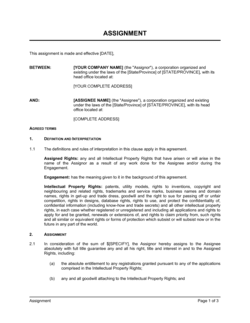
This Assignment of Contract ('Assignment') is entered into as of [EFFECTIVE DATE] by and between [ASSIGNOR LEGAL NAME] ('Assignor') and [ASSIGNEE LEGAL NAME] ('Assignee'). The Assignor is a party to that certain [AGREEMENT NAME] dated [DATE] with [OBLIGOR LEGAL NAME] ('Obligor') (the 'Original Contract').

Common mistake: Using trade names instead of registered legal entity names. A mismatch between the assignment and the original contract's named party creates an ambiguity about whether the assignment is valid at all.

Description of assigned rights and obligations

In plain language: Precisely defines which rights, benefits, and obligations are being transferred β€” whether the full contract or only specific provisions β€” and excludes anything not being assigned.

Sample language
Effective as of the Effective Date, Assignor hereby assigns, transfers, and conveys to Assignee all of Assignor's rights, title, interest, and obligations under the Original Contract, including but not limited to [SPECIFIC RIGHTS / OBLIGATIONS], but excluding [ANY EXCLUDED PROVISIONS].

Common mistake: Assigning 'all rights and obligations' without listing carve-outs. If certain obligations are meant to stay with the assignor β€” such as pre-assignment liabilities β€” failing to exclude them transfers those too.

Consent of the obligor

In plain language: Records the obligor's written consent to the assignment, which is typically required by the anti-assignment clause in the original contract and triggers the assignee's direct relationship with the obligor.

Sample language
The Obligor, by signing below, hereby consents to the assignment set forth herein and agrees to accept performance from and render performance to Assignee from and after the Effective Date, in lieu of Assignor.

Common mistake: Proceeding with assignment without obtaining written consent when the original contract requires it. An unconsented assignment is void in most jurisdictions, exposing both the assignor and assignee to breach-of-contract liability.

Consideration

In plain language: States the value the assignee provides to the assignor in exchange for the assignment, confirming the transfer is supported by legally sufficient consideration.

Sample language
In consideration of [PAYMENT AMOUNT / RELEASE OF LIABILITY / OTHER CONSIDERATION], the receipt and sufficiency of which is hereby acknowledged, Assignee agrees to assume all rights and obligations under the Original Contract.

Common mistake: Omitting any consideration recital. Courts in several jurisdictions will not enforce a gratuitous assignment of obligations β€” stating even nominal consideration ($1) prevents a later enforceability challenge.

Assumption of obligations

In plain language: The assignee expressly agrees to be bound by and perform all obligations under the original contract from the effective date forward.

Sample language
Assignee hereby accepts the assignment and assumes, agrees to be bound by, and undertakes to perform all obligations, duties, and liabilities of Assignor under the Original Contract arising on or after the Effective Date.

Common mistake: Confusing assignment with novation. Without a separate release, the assignor typically remains secondarily liable β€” the assumption clause binds the assignee but does not automatically release the assignor.

Representations and warranties

In plain language: Both parties represent that they have the authority to enter the assignment, that the original contract is in good standing, and that no breaches or defaults exist as of the effective date.

Sample language
Assignor represents and warrants that: (a) the Original Contract is in full force and effect; (b) Assignor is not in breach or default thereunder; (c) Assignor has full authority to enter into this Assignment; and (d) no other assignment or encumbrance of the Original Contract rights exists.

Common mistake: Omitting a representation that the original contract is in good standing. If the assignor is already in default, the assignee steps into a position they cannot cure, and the assignment may be immediately worthless.

Indemnification

In plain language: Allocates liability between the parties β€” the assignor indemnifies the assignee for pre-assignment claims, and the assignee indemnifies the assignor for post-assignment performance failures.

Sample language
Assignor shall indemnify and hold harmless Assignee from any claims, losses, or liabilities arising from Assignor's obligations under the Original Contract prior to the Effective Date. Assignee shall indemnify and hold harmless Assignor from any claims arising from Assignee's obligations after the Effective Date.

Common mistake: Using a one-sided indemnification clause that only protects one party. Without a reciprocal split keyed to the effective date, each party can be held liable for the other's period of performance.

Release of assignor (if applicable)

In plain language: If the obligor agrees to release the assignor from further liability under the original contract, this clause documents that release explicitly β€” converting the transaction from an assignment into a novation.

Sample language
The Obligor, by countersigning this Assignment, hereby releases and discharges Assignor from any further obligations, duties, or liabilities under the Original Contract arising on or after the Effective Date.

Common mistake: Treating a simple consent-to-assign from the obligor as a full release of the assignor. Consent and release are two separate acts β€” without explicit release language, the assignor remains liable if the assignee defaults.

Governing law and dispute resolution

In plain language: Specifies which jurisdiction's law governs the assignment and how any disputes will be resolved β€” through litigation, arbitration, or mediation.

Sample language
This Assignment shall be governed by and construed in accordance with the laws of [STATE / PROVINCE / COUNTRY], without regard to conflicts-of-law principles. Any dispute arising hereunder shall be resolved by [binding arbitration / litigation in the courts of [JURISDICTION]].

Common mistake: Selecting a governing law different from the original contract without checking whether the original contract requires disputes to be resolved in a specific forum. Conflicting forum selection clauses create procedural uncertainty and additional legal cost.

Entire agreement and amendment

In plain language: Confirms that this assignment, together with the original contract, constitutes the complete agreement between the parties and can only be amended in a signed writing.

Sample language
This Assignment, together with the Original Contract, constitutes the entire agreement between the parties with respect to the subject matter hereof and supersedes all prior agreements, representations, and understandings. No amendment shall be effective unless signed by all parties.

Common mistake: Omitting the integration clause. Without it, prior email exchanges or verbal discussions about the scope of the assignment can be introduced as evidence of additional terms.

How to fill it out

  1. 1

    Review the original contract for assignment restrictions

    Before completing any fields, locate and read the anti-assignment clause in the original contract. Determine whether consent is required, whether assignment is prohibited entirely, or whether it is freely permitted.

    πŸ’‘ A prohibited assignment clause does not always block a sale-of-business transaction β€” many clauses carve out assignments to acquirers. Check for this exception before assuming you need a waiver.

  2. 2

    Identify and enter all party names correctly

    Enter the assignor's and assignee's full registered legal entity names β€” not trade names or DBAs. If the obligor's consent is required, include their legal name in the parties block as well.

    πŸ’‘ Cross-reference the original contract's signature block to confirm the exact legal name of the obligor β€” a name mismatch is the most common reason consent requests are rejected.

  3. 3

    Describe the assigned rights and obligations precisely

    List the specific sections or obligations of the original contract being transferred. If only rights (not obligations) are being assigned, state that clearly. If certain pre-assignment liabilities are being excluded, list them explicitly.

    πŸ’‘ When assigning a services contract, separately confirm whether ongoing work in progress is included or whether only future performance obligations transfer.

  4. 4

    State the effective date and consideration

    Enter the specific date the assignment takes effect β€” this triggers the shift in liability between the parties. Document the agreed consideration, even if nominal, to avoid enforceability challenges.

    πŸ’‘ The effective date should align with any closing date, project milestone, or consent deadline in the original contract β€” using an arbitrary date creates a gap in accountability.

  5. 5

    Obtain the obligor's written consent

    Send the draft assignment to the obligor for review and signature if the original contract requires consent. Allow sufficient time β€” most commercial counterparties require 5–15 business days to process a consent request internally.

    πŸ’‘ Include a brief cover letter explaining the business reason for the assignment and confirming there will be no change in the level of service or performance. Obligors who understand the context consent faster.

  6. 6

    Complete the representations and indemnification sections

    Confirm the status of the original contract β€” no defaults, no pending disputes, no prior assignments β€” and ensure the indemnification clause clearly splits pre- and post-effective-date liability between assignor and assignee.

    πŸ’‘ If the assignor is aware of any open disputes or potential claims under the original contract, disclose them in a schedule rather than representing clean status β€” undisclosed issues become fraudulent misrepresentations.

  7. 7

    Sign before the effective date with all required parties

    Collect signatures from assignor, assignee, and β€” where required β€” the obligor before or on the effective date. Execution after the stated effective date creates retroactive ambiguity that courts may not accept.

    πŸ’‘ Use a digital signature tool with timestamped execution records to create a defensible paper trail, especially for assignments connected to larger transactions.

  8. 8

    Distribute fully executed copies and update contract records

    Send a fully signed copy to each party β€” assignor, assignee, and obligor β€” and update your contract management system to reflect the new counterparty relationship.

    πŸ’‘ Notify any third parties (insurers, sureties, subcontractors) who deal with the original contract of the assignment β€” failure to notify them can create performance gaps and coverage disputes.

Frequently asked questions

What is an assignment of contract?

An assignment of contract is a legal document that transfers one party's rights and obligations under an existing agreement to a new party, called the assignee. The original contracting party β€” the assignor β€” steps out of the relationship (or remains secondarily liable), and the assignee steps in. Assignments are commonly used in business sales, real estate transactions, and contractor-to-subcontractor arrangements.

When is an assignment of contract required?

An assignment is required any time a party to an existing contract wants to transfer their position to a third party β€” whether because a business is being sold, a project is being delegated, a lease is being transferred, or an IP license is being moved into a new entity. Many contracts include anti-assignment clauses that make the assignment mandatory rather than informal, meaning a written document with obligor consent is the only legally valid way to proceed.

What is the difference between an assignment and a novation?

An assignment transfers rights and obligations to a new party but typically leaves the assignor with secondary liability if the assignee defaults. A novation goes further β€” the original party is completely released and replaced by the new party, with the obligor's agreement. If full release of the assignor is the goal, a novation agreement is the appropriate document; a simple assignment will not achieve it.

Does assigning a contract release the original party from liability?

Not automatically. In most jurisdictions, the assignor remains secondarily liable under the original contract unless the obligor expressly releases them in writing. The assignment transfers obligations to the assignee, but if the assignee fails to perform, the obligor may still pursue the assignor. A formal release clause β€” or a separate novation β€” is required to completely extinguish the assignor's liability.

Can all contracts be assigned?

No. Personal services contracts β€” agreements that rely on the unique skills, judgment, or identity of a specific party β€” are generally non-assignable because performance by a substitute does not satisfy the original bargain. Examples include contracts with specific professionals, artists, or executives hired for their personal expertise. Beyond personal services, some contracts are non-assignable by statute or explicit contractual prohibition.

Is an assignment of contract enforceable without consideration?

An assignment of rights alone is generally enforceable without consideration in many jurisdictions. However, an assignment that also delegates obligations β€” requiring the assignee to perform β€” typically needs consideration to be enforceable as a binding promise. Including at least nominal consideration and an acknowledgment of its receipt removes any enforceability risk and is best practice in all cases.

What happens to the original contract after assignment?

The original contract remains in effect β€” its terms, conditions, and obligations are unchanged. Only the identity of one of the parties changes. The assignee steps into the assignor's shoes and must perform under the same terms. Any rights the assignor had to enforce the contract β€” such as the right to payment or the right to demand performance β€” also transfer to the assignee as of the effective date.

Do I need a lawyer to prepare an assignment of contract?

For straightforward assignments in low-stakes contexts β€” such as transferring a simple services agreement β€” a well-drafted template is often sufficient. Legal review is advisable when the original contract is complex or high-value, when the assignment is part of a larger acquisition or financing transaction, when the governing jurisdiction has specific formal requirements, or when the assignor wants a full release from ongoing liability. A lawyer review typically costs $300–$800 and is proportionate to the risk for most commercial assignments.

How this compares to alternatives

vs Novation Agreement

A novation replaces the original contracting party entirely with a new party and releases the original party from all future obligations β€” it requires the consent and signature of all three parties. An assignment transfers rights and obligations but typically leaves the assignor secondarily liable unless a release is expressly granted. Use a novation when the assignor must be fully discharged; use an assignment when secondary liability is acceptable or the obligor will not grant a full release.

vs Assignment of Lease

An assignment of lease is a specialized form of contract assignment that transfers a tenant's rights and obligations under a real estate lease to a new tenant. It includes lease-specific provisions β€” landlord consent procedures, security deposit transfers, and permitted-use confirmations β€” that a general assignment of contract does not address. Use the lease-specific template when the subject agreement is a real property lease.

vs IP Assignment Agreement

An IP assignment agreement transfers ownership of intellectual property β€” patents, trademarks, copyrights, or trade secrets β€” rather than the rights under a contract. While an assignment of contract can transfer a license or IP-related contract, it does not convey underlying IP ownership. When the goal is to transfer the IP asset itself, an IP assignment agreement is required.

vs Subcontractor Agreement

A subcontractor agreement creates a new direct contract between a contractor and a subcontractor for a defined scope of work. It does not transfer the prime contract or bring the subcontractor into a direct relationship with the original client. An assignment of contract, by contrast, substitutes the assignee into the original agreement. Use a subcontractor agreement when you want to delegate work while retaining your own client relationship; use assignment when you want to transfer the contract relationship itself.

Industry-specific considerations

Real estate

Wholesale investors assign purchase agreements to end buyers before closing, transferring the right to purchase without taking title, often with a simultaneous closing or double-close structure.

Construction

General contractors assign portions of a prime contract to subcontractors, transferring specific work-scope obligations while typically retaining primary liability to the project owner.

Technology / SaaS

Startups assign founder IP agreements, software licenses, or customer contracts into a new operating entity during incorporation or when restructuring ahead of a funding round.

Professional services

Consulting and staffing firms assign client service agreements when acquiring or merging with competitors, requiring careful obligor consent management to avoid client relationship disruption.

Manufacturing

Businesses transferring supplier or distribution contracts during asset sales or divestitures use assignment agreements to maintain continuity of supply without renegotiating each agreement from scratch.

Finance and lending

Lenders routinely assign loan agreements and receivables to secondary market buyers or securitization vehicles, making precise assignment language and notice provisions critical to the chain of title.

Jurisdictional notes

United States

Under the UCC (Article 2 and Article 9), assignments of rights are generally valid even without anti-assignment clause consent, but delegation of duties requires the obligor's agreement. California and New York courts scrutinize anti-assignment clauses differently β€” California construes them strictly against the party seeking to block assignment, while New York enforces them broadly. Assignments of government contracts are governed separately by the Assignment of Claims Act, which imposes specific notice and form requirements.

Canada

Common-law provinces follow English contract law principles: assignments of rights are valid without consent unless prohibited, but delegation of obligations requires the obligor's agreement. Quebec's Civil Code (Article 1637–1646) has distinct rules requiring notice to the obligor to make the assignment effective against third parties. Anti-assignment clauses are generally enforced, and consent requirements must be strictly followed. Corporate reorganization assignments within related companies may be treated differently depending on the province.

United Kingdom

Under the Law of Property Act 1925, a legal assignment of a debt or other chose in action must be in writing, absolute (not conditional), and accompanied by written notice to the obligor to be effective at law. Equitable assignments are valid without these formalities but are harder to enforce against third parties. Anti-assignment clauses are enforced by English courts, and recent case law (Linden Gardens, Barbados case series) has confirmed that contractually prohibited assignments are wholly ineffective as against the obligor.

European Union

Assignment rules vary significantly across EU member states. France distinguishes between assignment of receivables (cession de crΓ©ance) and assignment of contract (cession de contrat), the latter requiring the obligor's express consent under the 2016 Civil Code reform. Germany permits assignment of claims freely but requires the obligor's consent to transfer obligations. GDPR may apply if the assigned contract involves the processing of personal data, requiring the obligor's updated data processing arrangements and potentially a new data processing agreement.

Template vs lawyer β€” what fits your deal?

PathBest forCostTime
Use the templateStraightforward assignments of low-to-mid-value service or vendor contracts where the obligor's consent is readily obtainableFree30–60 minutes
Template + legal reviewAssignments connected to a business sale, financing transaction, or contracts with complex indemnification or IP provisions$300–$8002–5 business days
Custom draftedHigh-value or multi-contract assignments, cross-border transactions, full novation with assignor release, or regulated-industry contracts$1,500–$5,000+1–3 weeks

Glossary

Assignor
The original contracting party who transfers their rights and obligations under an existing agreement to a third party.
Assignee
The third party who receives the transferred rights and obligations and steps into the assignor's position under the original contract.
Obligor
The counterparty to the original contract whose performance obligations are unaffected by the assignment but who must deal with the new assignee.
Assignment
The legal transfer of one party's contractual rights, benefits, or obligations to another party, subject to any restrictions in the original agreement.
Anti-Assignment Clause
A provision in the original contract that prohibits or restricts either party from transferring their rights or obligations without prior written consent.
Novation
A three-party agreement that replaces the original contracting party entirely with a new party, releasing the original party from all obligations β€” distinct from an assignment, where the assignor may remain secondarily liable.
Consent to Assignment
Written approval from the non-assigning counterparty (the obligor) acknowledging and agreeing to the transfer of rights and obligations.
Delegation
The transfer of duties or performance obligations under a contract, as distinct from the transfer of rights β€” both may occur together in a full assignment.
Secondary Liability
The assignor's ongoing legal responsibility for performance under the original contract if the assignee fails to perform, unless the assignor is expressly released.
Consideration
The value exchanged between assignor and assignee to make the assignment enforceable β€” may be monetary payment, a release of liability, or another agreed benefit.
Effective Date
The specific date on which the assignment takes effect and the assignee formally assumes the transferred rights and obligations.

Part of your Business Operating System

This document is one of 3,000+ business & legal templates included in Business in a Box.

  • Fill-in-the-blanks β€” ready in minutes
  • 100% customizable Word document
  • Compatible with all office suites
  • Export to PDF and share electronically

Create your document in 3 simple steps.

From template to signed document β€” all inside one Business Operating System.
1
Download or open template

Access over 3,000+ business and legal templates for any business task, project or initiative.

2
Edit and fill in the blanks with AI

Customize your ready-made business document template and save it in the cloud.

3
Save, Share, Send, Sign

Share your files and folders with your team. Create a space of seamless collaboration.

Save time, save money, and create top-quality documents.

β˜…β˜…β˜…β˜…β˜…

"Fantastic value! I'm not sure how I'd do without it. It's worth its weight in gold and paid back for itself many times."

Managing Director Β· Mall Farm
Robert Whalley
Managing Director, Mall Farm Proprietary Limited
β˜…β˜…β˜…β˜…β˜…

"I have been using Business in a Box for years. It has been the most useful source of templates I have encountered. I recommend it to anyone."

Business Owner Β· 4+ years
Dr Michael John Freestone
Business Owner
β˜…β˜…β˜…β˜…β˜…

"It has been a life saver so many times I have lost count. Business in a Box has saved me so much time and as you know, time is money."

Owner Β· Upstate Web
David G. Moore Jr.
Owner, Upstate Web

Run your business with a system β€” not scattered tools

Stop downloading documents. Start operating with clarity. Business in a Box gives you the Business Operating System used by over 250,000 companies worldwide to structure, run, and grow their business.

Start freeΒ Β·Β No credit card required