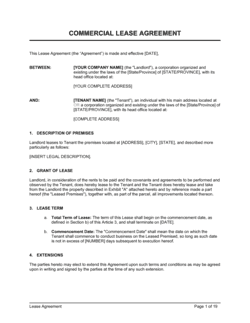
Assignment of Sublease Template

Free Word download • Edit online • Save & share with Drive • Export to PDF

2 pages20–30 min to fillDifficulty: StandardSignature requiredLegal review recommended
Learn more ↓
FreeAssignment of Sublease Template

At a glance

What it is
An Assignment of Sublease is a legally binding agreement in which an existing subtenant (the assignor) transfers all of their remaining rights, interests, and obligations under an existing sublease to a new party (the assignee). This free Word download gives you a structured, attorney-reviewed starting point you can edit online and export as PDF — covering consent, liability, representations, and governing law in a single document.
When you need it
Use it when a subtenant needs to exit a subleased premises before the sublease term ends and wants to transfer their position to another party. Common triggers include business relocation, company sale or merger, downsizing, or a subtenant ceasing operations entirely.
What's inside
Identification of all parties (sublandlord, assignor, and assignee), description of the original sublease being assigned, effective date of assignment, landlord or sublandlord consent provisions, representations and warranties, assumption of obligations, indemnification, and governing law and signature blocks.

What is an Assignment of Sublease?

An Assignment of Sublease is a legally binding agreement in which an existing subtenant — the assignor — transfers all of their remaining rights, interests, and obligations under an existing sublease to a new incoming party — the assignee. Unlike simply vacating or subletting again, an assignment substitutes the assignee entirely into the subtenant's position from the agreed effective date, binding them to every obligation in the original sublease as though they had signed it themselves. Three parties are essential to the document: the sublandlord (the original tenant who created the sublease), the assignor (the departing subtenant), and the assignee (the incoming subtenant). Because the assignment touches a chain of at least two lease agreements — the sublease and the master lease above it — written consent at each level is typically required before the document becomes effective.

Why You Need This Document

Without a written assignment of sublease, a subtenant who vacates and hands the space to a third party remains fully exposed to rent and lease obligations for the entire remaining term — regardless of who is actually occupying the premises. Sublandlords who do not document the transfer risk being unable to enforce lease covenants against the new occupant, leaving them holding liability under a master lease with no recourse against the party actually in possession. The assignee, without a signed assumption agreement, has no documented right to occupy the space and no enforceable claim against the sublandlord for services, repairs, or deposit return. A properly executed assignment closes all three gaps: it documents the sublandlord's consent, records the assignee's assumption of all obligations, and establishes a clear line between pre-assignment liabilities belonging to the assignor and post-assignment liabilities belonging to the assignee. This template gives you a professionally structured starting point that covers every material clause — from representations and security deposit disposition to governing law — so none of these gaps are left to chance.

Which variant fits your situation?

If your situation is…Use this template
Subtenant transferring all remaining lease rights to a new partyAssignment of Sublease
Tenant assigning their primary lease directly to a new occupantAssignment of Lease
Tenant subleasing part of their space to a new subtenantSublease Agreement
Landlord formally consenting in writing to an assignment or subleaseLandlord Consent to Assignment
Transferring lease rights as part of a broader business asset saleBusiness Asset Purchase Agreement
New occupant taking over a residential sublease from a departing subtenantResidential Sublease Agreement
Parties documenting the end of a sublease before the term expiresLease Termination Agreement

Common mistakes to avoid

❌ Skipping master landlord consent

Why it matters: Most master leases require the landlord's written approval for any further assignment or subletting. An assignment that bypasses this requirement may be void, triggering a default under the master lease and exposing all parties to eviction.

Fix: Before drafting the assignment, pull the master lease and the sublease and identify every consent provision. Obtain all required written approvals before the effective date.

❌ Omitting the assignor's release or retention of liability

Why it matters: Without an explicit clause, courts in many jurisdictions presume the assignor remains liable under privity of contract — but some courts presume release. This ambiguity creates litigation over who owes what when the assignee defaults.

Fix: Negotiate and include a clear, unambiguous clause stating exactly whether the assignor is released or remains secondarily liable, and under what conditions.

❌ Not attaching the original sublease as an exhibit

Why it matters: The assignee assumes obligations they cannot fully understand if the original sublease is not incorporated by reference and attached. Gaps in the assignee's knowledge of sublease terms lead to unintentional breaches.

Fix: Always attach the complete original sublease — including all amendments — as Exhibit A and reference it specifically in the assignment and assumption clause.

❌ Using trade names instead of registered legal entity names

Why it matters: If a party's name in the assignment does not match their name in the original sublease or their corporate registration, the document's enforceability is compromised and consent obtained under the wrong name may be challenged.

Fix: Verify each party's exact registered legal name through the applicable state, provincial, or companies registry before drafting, and use that name consistently throughout.

❌ Failing to address the security deposit

Why it matters: An assignment that ignores the existing security deposit creates a three-way dispute at lease end: the assignor believes it will be returned, the assignee believes it applies to their tenancy, and the sublandlord may claim it against outstanding obligations.

Fix: Include a dedicated security deposit clause specifying the current amount held, how it is transferred or replaced, and who holds it through the end of the sublease term.

❌ Signing the assignment without verifying there are no existing defaults

Why it matters: An assignee who assumes a sublease with undisclosed rent arrears or lease violations inherits those liabilities from the effective date and may have no recourse against the sublandlord who approved the assignment.

Fix: Require the assignor to provide a current rent ledger and a written representation of no defaults as conditions of signing, and include a corresponding indemnification clause covering pre-assignment liabilities.

The 10 key clauses, explained

Parties and recitals

In plain language: Identifies all parties by legal name — the sublandlord, the assignor (departing subtenant), and the assignee (incoming subtenant) — and sets out the background facts of the existing sublease.

Sample language
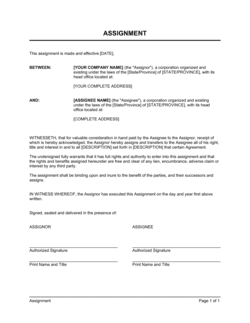
This Assignment of Sublease ('Assignment') is entered into as of [EFFECTIVE DATE] by and among [SUBLANDLORD LEGAL NAME] ('Sublandlord'), [ASSIGNOR LEGAL NAME] ('Assignor'), and [ASSIGNEE LEGAL NAME] ('Assignee'). WHEREAS, Sublandlord and Assignor entered into that certain Sublease Agreement dated [SUBLEASE DATE] for the premises located at [ADDRESS] (the 'Premises').

Common mistake: Naming a trade name instead of the registered legal entity for any of the three parties. A mismatch between the party names and the original sublease makes the assignment difficult to enforce and can void consent already obtained.

Description of the sublease and premises

In plain language: Incorporates the original sublease by reference, describes the physical premises being assigned, and confirms the remaining term being transferred.

Sample language
Assignor hereby assigns to Assignee all of Assignor's right, title, and interest in and to the Sublease Agreement attached hereto as Exhibit A, covering approximately [SQUARE FOOTAGE] square feet located at [PREMISES ADDRESS], for the remaining sublease term commencing [START DATE] and expiring [END DATE].

Common mistake: Failing to attach the original sublease as an exhibit. Without it, the assignee cannot verify the precise obligations they are assuming, and disputes about the scope of the assignment are much harder to resolve.

Assignment and assumption of obligations

In plain language: States that the assignor transfers all rights to the assignee and that the assignee formally agrees to perform every obligation under the sublease from the effective date forward.

Sample language
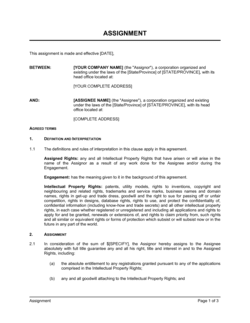
Effective as of [EFFECTIVE DATE], Assignor hereby assigns, transfers, and conveys to Assignee all rights, benefits, and interests of Assignor under the Sublease. Assignee hereby accepts such assignment and assumes and agrees to perform all obligations of Assignor under the Sublease arising on or after the Effective Date.

Common mistake: Limiting assumption language to 'financial obligations only.' Courts have found that narrowly worded assumption clauses leave the assignee free to breach non-monetary covenants (e.g., permitted use, maintenance) while the assignor remains liable for them.

Sublandlord consent

In plain language: Records the sublandlord's written approval of the assignment, which is almost always required under the original sublease and may trigger the master landlord's consent as well.

Sample language
Sublandlord hereby consents to the assignment described herein, subject to the terms of this Agreement. This consent is limited to the assignment described herein and shall not be construed as a waiver of Sublandlord's right to approve any future assignment or subletting.

Common mistake: Treating sublandlord consent as sufficient without checking whether the master lease also requires the master landlord's written approval. A sublandlord cannot grant rights they do not have, and an assignment made without master landlord consent where required may be void.

Release of assignor (or retention of liability)

In plain language: Specifies whether the assignor is fully discharged from future obligations under the sublease after the effective date, or whether they remain secondarily liable if the assignee defaults.

Sample language
Effective as of the Effective Date, Sublandlord hereby releases Assignor from all obligations arising under the Sublease on or after the Effective Date. / Notwithstanding the foregoing, Assignor shall remain secondarily liable for Assignor's obligations under the Sublease in the event of a default by Assignee.

Common mistake: Omitting this clause entirely. Without an explicit release or retention of liability provision, the parties — and courts — are left to guess at the assignor's continuing exposure, often resulting in litigation.

Representations and warranties

In plain language: Each party represents that the sublease is in good standing, no uncured defaults exist, they have authority to enter this agreement, and the sublease has not been previously amended or assigned without the other parties' knowledge.

Sample language
Assignor represents and warrants that (a) the Sublease is in full force and effect and has not been amended except as set forth in Exhibit A; (b) no default or event of default exists under the Sublease as of the date of this Assignment; (c) Assignor has full authority to execute and perform this Assignment.

Common mistake: Assignor failing to disclose existing defaults or rent arrears before signing. If the assignee discovers an undisclosed default after the effective date, they inherit the exposure and may have a fraud or misrepresentation claim against the assignor.

Security deposit transfer

In plain language: Addresses the existing security deposit held under the sublease — whether it is transferred to the assignee, returned to the assignor, or retained by the sublandlord pending new funds from the assignee.

Sample language
The Security Deposit in the amount of $[AMOUNT] currently held by Sublandlord shall [be transferred to Assignee's account / be returned to Assignor upon receipt of a replacement deposit of $[AMOUNT] from Assignee / remain held by Sublandlord and credited to Assignee's account].

Common mistake: Not addressing the security deposit at all. If the agreement is silent, both the assignor and assignee may claim entitlement to the deposit at lease end, creating a three-way dispute with the sublandlord.

Indemnification

In plain language: Sets out each party's obligation to indemnify the others for losses arising from their own breach, misrepresentation, or acts occurring before or after the effective date.

Sample language
Assignor shall indemnify, defend, and hold harmless Assignee and Sublandlord from any claims, damages, or costs arising from Assignor's obligations or acts under the Sublease prior to the Effective Date. Assignee shall indemnify, defend, and hold harmless Assignor and Sublandlord from any such claims arising on or after the Effective Date.

Common mistake: Drafting one-sided indemnification that only protects the sublandlord. This leaves the assignor exposed to claims from Assignee for pre-assignment conditions (e.g., deferred maintenance, prior rent disputes) that the assignor should have disclosed.

Governing law and dispute resolution

In plain language: States which jurisdiction's laws govern the assignment and how disputes between the parties will be resolved — litigation, mediation, or arbitration.

Sample language
This Assignment shall be governed by and construed in accordance with the laws of the State of [STATE], without regard to its conflict-of-law principles. Any dispute arising under this Assignment shall be resolved by [binding arbitration in [CITY] / litigation in the courts of [COUNTY], [STATE]].

Common mistake: Selecting a governing law that differs from the jurisdiction in which the premises are located. Most courts apply the law of the premises' location to real property disputes regardless of a contrary contractual choice.

Entire agreement and amendment

In plain language: Confirms this document — together with the incorporated sublease — constitutes the complete agreement among the parties, superseding prior negotiations, and that amendments require written consent of all parties.

Sample language
This Assignment, together with the Sublease attached as Exhibit A, constitutes the entire agreement of the parties with respect to the subject matter hereof. No amendment to this Assignment shall be effective unless in writing and signed by all parties hereto.

Common mistake: Omitting reference to the original sublease in the entire-agreement clause. Without it, prior email negotiations or side letters about sublease terms can be introduced as binding obligations that contradict the written assignment.

How to fill it out

  1. 1

    Identify all three parties by their legal entity names

    Enter the registered legal names of the sublandlord, the assignor, and the assignee. Cross-reference each party's corporate registration documents to confirm the exact name.

    💡 If any party is an individual rather than a business entity, include their full legal name and address as it appears on government-issued ID.

  2. 2

    Attach and reference the original sublease

    Attach the complete original sublease (including any amendments) as Exhibit A. Reference it specifically in the description-of-premises clause so the scope of what is being assigned is unambiguous.

    💡 If the sublease has been verbally amended, document those changes in a written amendment before execution — verbal modifications are typically unenforceable once a written assignment is signed.

  3. 3

    Confirm the remaining term and effective date

    Calculate the exact remaining sublease term from the desired assignment effective date to the sublease expiry date. Enter both dates explicitly in the assignment clause.

    💡 Allow at least 10–15 business days between signing the assignment and the intended effective date to secure master landlord consent if required.

  4. 4

    Address consent requirements under both the sublease and master lease

    Review the original sublease for consent requirements, then trace back to the master lease to check whether the master landlord's approval is also needed. Obtain all required consents in writing before the effective date.

    💡 Request consent in writing and keep all correspondence — an email confirmation is useful but a signed consent addendum is far more defensible if a dispute arises later.

  5. 5

    Decide whether to release or retain the assignor's liability

    Negotiate and clearly state whether the assignor is fully discharged or remains secondarily liable after the effective date. This is often the most negotiated point — sublandlords frequently insist on retention of assignor liability for the remainder of the term.

    💡 If the assignor is retained as a secondary guarantor, include a notice requirement obligating the sublandlord to notify the assignor promptly if the assignee defaults, so the assignor can cure before a larger liability accrues.

  6. 6

    Resolve the security deposit

    Specify in writing whether the existing security deposit is transferred, replaced, or retained. Confirm the amount currently held and the disposition in the security-deposit clause.

    💡 If the assignee is providing a fresh deposit, have both the old and new deposits addressed at the same time to avoid a gap period during which the sublandlord holds no security.

  7. 7

    Complete the representations and warranties section

    Have the assignor confirm in writing that no uncured defaults exist, all rent is current, and the sublease has not been previously assigned. Cross-check rent payment records before signing.

    💡 A rent ledger printout from the sublandlord attached at signing removes any ambiguity about arrears and protects the assignee from inheriting undisclosed liabilities.

  8. 8

    Execute with all required signatures before the effective date

    All three parties — sublandlord, assignor, and assignee — must sign before or on the effective date. In some jurisdictions, a notarized signature or corporate officer attestation may be required for recording purposes.

    💡 Use a timestamped eSign platform to document the exact time each party executed and store the fully executed copy alongside the original sublease.

Frequently asked questions

What is an assignment of sublease?

An assignment of sublease is a legal agreement in which an existing subtenant (the assignor) transfers all of their remaining rights and obligations under a sublease to a new party (the assignee). Unlike a new sublease, an assignment replaces the original subtenant entirely from the agreed effective date, rather than creating a new layer of tenancy. All three parties — the sublandlord, the assignor, and the assignee — are typically required to sign the document for it to be effective.

What is the difference between an assignment of sublease and a sublease agreement?

A sublease agreement creates a new tenancy relationship between an existing tenant (who becomes a sublandlord) and a new subtenant, while the original tenant remains bound by the master lease. An assignment of sublease transfers the existing subtenant's entire remaining position to a new party, effectively replacing the departing subtenant. A sublease adds a party; an assignment substitutes one party for another.

Is the assignor still liable after an assignment of sublease?

It depends entirely on what the assignment document says. If the assignment includes an explicit release of liability, the assignor is discharged from future obligations once the assignee assumes them. If the assignment is silent or includes a retention-of-liability clause, the assignor typically remains secondarily liable under common-law privity of contract principles. Sublandlords often insist on retaining assignor liability as a condition of granting consent.

What happens to the security deposit when a sublease is assigned?

The security deposit must be explicitly addressed in the assignment agreement. Common approaches include transferring the existing deposit to the assignee's account, returning it to the assignor upon receipt of a replacement deposit from the assignee, or retaining it with the sublandlord and crediting it to the assignee's account for the remainder of the term. Silence on this point routinely leads to three-way disputes at lease end.

Can a subtenant assign their sublease without the sublandlord's consent?

Only if the original sublease explicitly permits assignment without consent — which is rare in commercial leases. Most sublease agreements prohibit assignment without prior written approval, and the master lease may impose its own consent requirement on top of that. Attempting an assignment without required consent exposes the assignor to breach of sublease claims and may entitle the sublandlord to terminate the sublease entirely.

Do I need a lawyer for an assignment of sublease?

For straightforward domestic commercial assignments with no existing disputes, a high-quality template is a reasonable starting point. Legal review is strongly recommended when the master lease has complex consent provisions, the premises are in a jurisdiction with strict commercial tenancy regulations, the assignee is assuming a lease with high remaining liability, or the assignment is part of a broader business acquisition. A 1–2 hour review typically costs $300–$800 and is almost always worthwhile given the financial exposure involved.

What should I check before signing an assignment of sublease as the assignee?

Before signing, obtain and review the original sublease and the master lease in full, verify that no rent arrears or defaults exist by requesting a current ledger, confirm that all required consents have been obtained in writing, clarify the security deposit position, and confirm the exact obligations you are assuming — particularly use restrictions, maintenance obligations, and any personal guarantee provisions in the original sublease.

How does an assignment of sublease differ from a lease termination agreement?

A lease termination agreement ends the sublease relationship entirely, releasing the subtenant from all future obligations in exchange for agreed terms (e.g., a termination fee or early surrender). An assignment of sublease keeps the sublease alive but substitutes a new subtenant for the departing one. Use a termination agreement when no suitable assignee exists; use an assignment when a replacement tenant is available and the sublandlord prefers continuity over a vacant premises.

How this compares to alternatives

vs Sublease Agreement

A sublease agreement creates a new secondary tenancy between an existing tenant and a subtenant, with the original tenant remaining fully bound by the master lease. An assignment of sublease transfers the subtenant's entire position to a new party, replacing the departing subtenant rather than adding another layer. Use a sublease to bring in a new occupant while retaining control; use an assignment to exit a subleased position entirely.

vs Assignment of Lease Agreement

An assignment of lease transfers a primary tenant's position under a master lease directly to a new tenant. An assignment of sublease operates one level below — transferring a subtenant's position under a sublease to a new party. The key distinction is the layer of tenancy being assigned; both documents follow similar structures but involve different underlying agreements and different parties whose consent is required.

vs Lease Termination Agreement

A lease termination agreement ends the sublease relationship entirely and releases the subtenant from all future obligations, typically in exchange for a termination fee or agreed surrender conditions. An assignment of sublease keeps the sublease active but substitutes a new subtenant. Choose termination when no assignee is available; choose assignment when a replacement tenant exists and the sublandlord prefers uninterrupted occupancy.

vs Landlord Consent to Assignment

A landlord consent to assignment is a standalone document recording the property owner's or sublandlord's written approval of a specific assignment. It is a prerequisite to — not a substitute for — the assignment agreement itself. The two documents work together: the consent authorizes the transfer, and the assignment agreement executes it and binds all three parties to the new arrangement.

Industry-specific considerations

Commercial Real Estate

Subtenants in office, retail, or industrial spaces routinely assign sublease positions during corporate restructuring, downsizing, or when exiting a market mid-term.

Technology / SaaS

Fast-growing and fast-contracting tech companies frequently need to offload subleased office space; assignment is preferred over termination when a subtenant can be found quickly to avoid paying double rent.

Retail

Retail subtenants in shared shopping center subleases assign their positions during brand exits, store closures, or when selling the retail business as a going concern to a buyer who requires continuity of the lease.

Professional Services

Law firms, accounting practices, and consulting firms that sublease portions of their offices frequently use assignments when a subleasing client firm is acquired or merges with another entity that will occupy a different location.

Jurisdictional notes

United States

Assignment rights and consent requirements are governed by state contract and property law, which varies significantly. California, New York, and Texas each have distinct rules on landlord reasonableness standards for withholding consent. Some states require landlords to act reasonably when evaluating assignment requests; others impose no such duty. Review the master lease and the sublease for anti-assignment clauses and confirm whether the governing state imposes a reasonableness standard on consent.

Canada

Provincial commercial tenancy legislation governs assignment rights in Canada, with significant variation between Ontario, British Columbia, and Alberta. Ontario's Commercial Tenancies Act addresses assignment rights but is often overridden by detailed lease provisions. Quebec commercial leases, governed by the Civil Code of Quebec, must consider the Civil Code's rules on assignment of contracts alongside lease-specific provisions. Sublandlord consent requirements and the assignor's residual liability depend heavily on the specific lease language.

United Kingdom

In England and Wales, the Landlord and Tenant (Covenants) Act 1995 governs the release of outgoing tenants on assignment of leases granted after 1 January 1996, and authorized guarantee agreements (AGAs) are commonly required as a condition of landlord consent. Scottish commercial property law operates under a separate legal framework. Assignment of a sublease in the UK typically requires the superior landlord's consent under the alienation provisions of the head lease, and unreasonable withholding of consent may give rise to a damages claim.

European Union

Commercial lease assignment rules vary substantially across EU member states and are primarily governed by national property and contract law rather than EU-wide regulation. France, Germany, and the Netherlands each impose distinct consent and notice requirements on sublease assignments. In France, the cession de bail commercial is a structured process with specific formalities. GDPR considerations may arise when assignee due diligence involves processing tenant personal data, requiring a data-sharing agreement or appropriate consent mechanisms.

Template vs lawyer — what fits your deal?

PathBest forCostTime
Use the templateStraightforward commercial sublease assignments with no existing defaults, disputes, or complex consent chainsFree30–60 minutes
Template + legal reviewAssignments involving significant remaining lease liability, complex master lease consent requirements, or part of a business sale$300–$8002–5 business days
Custom draftedHigh-value commercial assignments, multi-jurisdiction premises, assignments involving personal guarantees, or contentious sublandlord consent negotiations$1,500–$5,000+1–3 weeks

Glossary

Assignor
The existing subtenant who is transferring their rights and obligations under the sublease to a new party.
Assignee
The incoming party who receives and assumes the assignor's rights and obligations under the sublease from the effective date forward.
Sublandlord
The original tenant under the master lease who subleased the premises and whose consent is typically required to approve any further assignment.
Master Lease
The primary lease agreement between the property owner (landlord) and the tenant (sublandlord), which governs the sublease relationship.
Sublease
An agreement in which a tenant re-rents all or part of their leased premises to a third party (the subtenant) for a term no longer than their own lease term.
Assignment
The complete transfer of one party's contractual rights and obligations to another party, replacing the transferring party entirely from the agreed effective date.
Assumption of Obligations
The assignee's formal agreement to take on all duties, liabilities, and responsibilities under the original sublease as if they were the original subtenant.
Privity of Contract
The legal relationship between contracting parties that creates mutual enforceable obligations — relevant here because assignment may or may not release the assignor from liability to the sublandlord.
Release of Liability
A clause explicitly discharging the assignor from future obligations under the sublease once the assignee has assumed those obligations.
Consent Clause
A provision in the master lease or sublease requiring the landlord or sublandlord to approve any assignment in writing before it becomes effective.
Effective Date
The specific calendar date on which the assignment takes legal effect and the assignee assumes all rights and obligations of the assignor.
Indemnification
A contractual obligation by one party to compensate another for specified losses, damages, or legal claims arising from the indemnifying party's actions or breach.

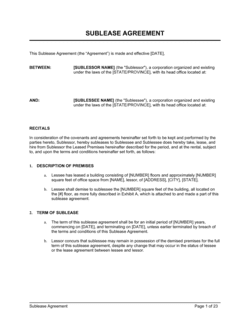
Part of your Business Operating System

This document is one of 3,000+ business & legal templates included in Business in a Box.

  • Fill-in-the-blanks — ready in minutes
  • 100% customizable Word document
  • Compatible with all office suites
  • Export to PDF and share electronically

Create your document in 3 simple steps.

From template to signed document — all inside one Business Operating System.
1
Download or open template

Access over 3,000+ business and legal templates for any business task, project or initiative.

2
Edit and fill in the blanks with AI

Customize your ready-made business document template and save it in the cloud.

3
Save, Share, Send, Sign

Share your files and folders with your team. Create a space of seamless collaboration.

Save time, save money, and create top-quality documents.

★★★★★

"Fantastic value! I'm not sure how I'd do without it. It's worth its weight in gold and paid back for itself many times."

Managing Director · Mall Farm
Robert Whalley
Managing Director, Mall Farm Proprietary Limited
★★★★★

"I have been using Business in a Box for years. It has been the most useful source of templates I have encountered. I recommend it to anyone."

Business Owner · 4+ years
Dr Michael John Freestone
Business Owner
★★★★★

"It has been a life saver so many times I have lost count. Business in a Box has saved me so much time and as you know, time is money."

Owner · Upstate Web
David G. Moore Jr.
Owner, Upstate Web

Run your business with a system — not scattered tools

Stop downloading documents. Start operating with clarity. Business in a Box gives you the Business Operating System used by over 250,000 companies worldwide to structure, run, and grow their business.

Free Forever Plan · No credit card required