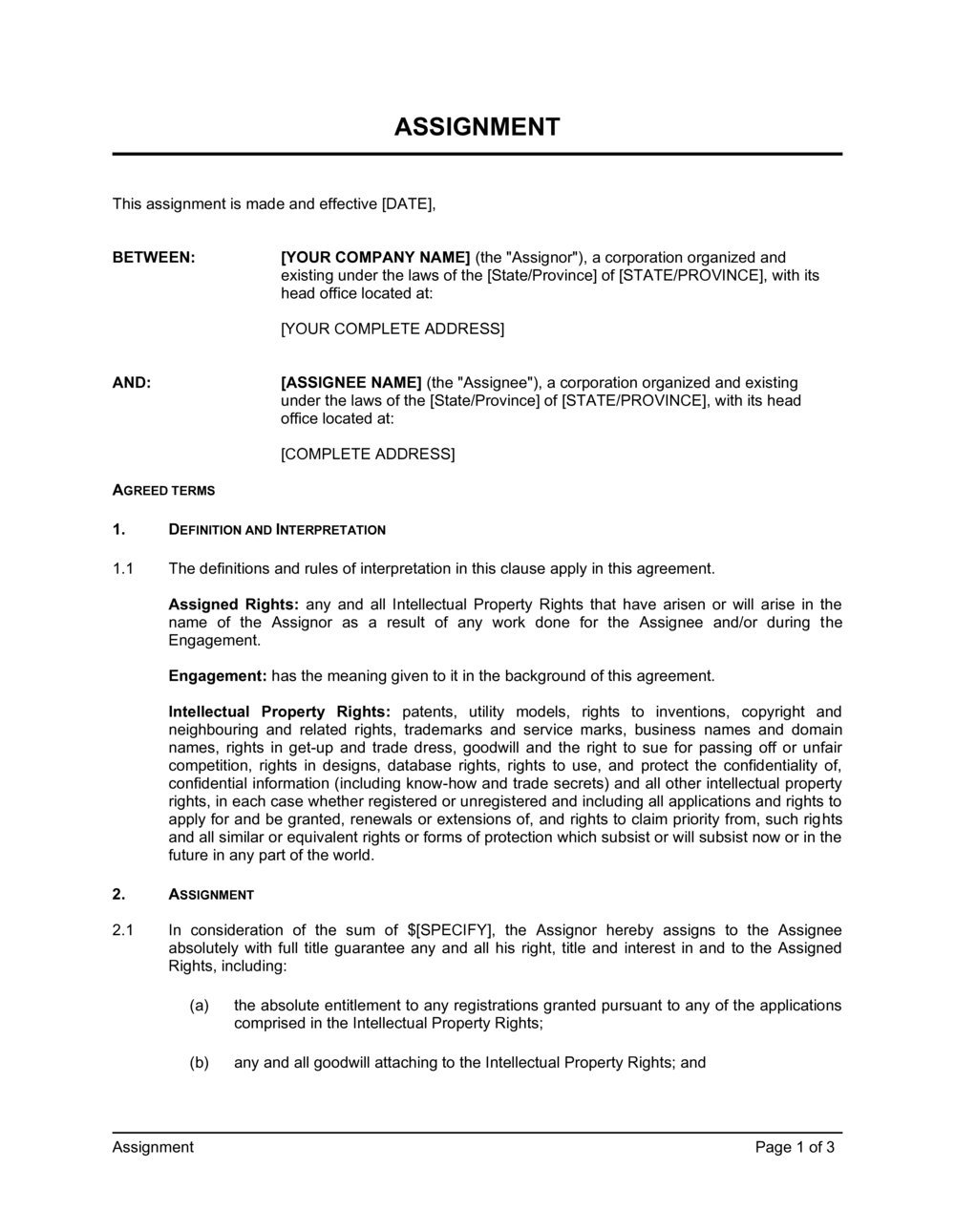
Assignment Agreement Template

Free Word download β€’ Edit online β€’ Save & share with Drive β€’ Export to PDF

3 pagesβ€’25–30 min to fillβ€’Difficulty: Complexβ€’Signature requiredβ€’Legal review recommended
Learn more ↓
FreeAssignment Agreement Template

At a glance

What it is
An Assignment Agreement is a legally binding contract that transfers a party's rights, benefits, and β€” where included β€” obligations under an existing contract or asset to a third party. This free Word download gives you a structured, attorney-reviewed starting point you can edit online and export as PDF to execute the transfer of contracts, intellectual property, leases, or other business assets.
When you need it
Use it when a business is sold or restructured and existing contracts must transfer to a new owner, when a contractor assigns deliverables or IP to a client, when a lender transfers a loan, or when a tenant assigns a lease to a new occupant. Any time rights under an agreement change hands, this document creates the enforceable paper trail.
What's inside
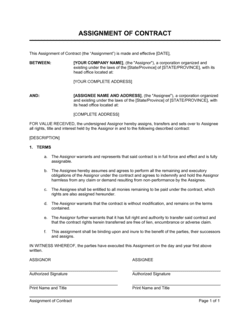
Identification of assignor, assignee, and obligor; a description of the assigned rights and the underlying agreement; consent and notice provisions; representations and warranties; assumption of obligations; indemnification; governing law; and signature blocks for all required parties.

What is an Assignment Agreement?

An Assignment Agreement is a legally binding contract that transfers one party's rights β€” and, where explicitly agreed, performance obligations β€” under an existing agreement or asset to a new party called the assignee. The party making the transfer is the assignor; the original counterparty who continues to be owed performance is the obligor. Unlike a novation, a standard assignment does not automatically release the assignor from liability β€” the obligor may still hold the original party accountable if the assignee fails to perform. Assignment agreements are used to transfer contract rights in business sales, assign intellectual property from creators to companies, hand over commercial leases, and move loan receivables between financial institutions.

Why You Need This Document

Transferring rights informally β€” by email, oral agreement, or a brief addendum β€” leaves every party exposed. Without a properly executed assignment agreement, the assignee has no documented title to the rights it believes it purchased, the obligor may refuse to recognize the transfer, and the assignor cannot prove it was released from post-transfer obligations. In IP-intensive businesses, an undocumented or unrecorded assignment can surface as a fatal defect during investor due diligence: if a founder's code was never formally assigned to the company entity, the company may not legally own its own product. In commercial real estate, proceeding without a written lease assignment and landlord consent can trigger immediate default and lease termination. A complete, signed assignment agreement β€” filed with the relevant registry where required β€” creates the paper trail that protects all three parties, establishes a clear effective date for liability allocation, and survives the scrutiny of future buyers, lenders, and courts.

Which variant fits your situation?

If your situation is…Use this template
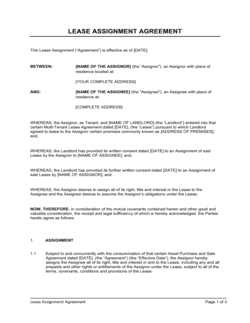
Assigning a commercial lease from an outgoing to an incoming tenantLease Assignment Agreement
Transferring intellectual property rights from creator to a companyIP Assignment Agreement
Assigning a sales or service contract to a successor businessContract Assignment Agreement
Transferring a promissory note or loan to a third-party buyerAssignment of Promissory Note
Delegating performance obligations while retaining rightsDelegation Agreement
Moving all contracts, assets, and liabilities in a full business saleAsset Purchase Agreement
Assigning a real estate purchase contract before closingReal Estate Assignment Agreement

Common mistakes to avoid

❌ Assigning without checking for anti-assignment clauses

Why it matters: Most commercial contracts β€” including software licenses, service agreements, and commercial leases β€” contain anti-assignment provisions. Assigning without required consent can trigger a breach and allow the obligor to terminate the underlying contract immediately.

Fix: Read the underlying agreement in full before drafting. If consent is required, obtain it in writing and attach it to the assignment agreement as an exhibit before the effective date.

❌ Failing to specify what rights are transferred

Why it matters: Vague language like 'all rights' in a complex multi-deliverable contract creates disputes about what actually transferred and whether certain benefits β€” warranties, indemnities, IP licenses β€” were included.

Fix: List every specific right being transferred by reference to the relevant section of the underlying agreement. If anything is excluded, state it explicitly in a carve-out clause.

❌ No obligation cut-off date between assignor and assignee

Why it matters: Without a defined effective date splitting pre- and post-assignment performance duties, the assignee may be liable for the assignor's prior defaults, unpaid amounts, or warranty claims the obligor raises after the transfer.

Fix: State the exact effective date in the agreement and include explicit language confirming the assignor's liability for pre-date obligations and the assignee's liability for post-date obligations.

❌ Treating assignment as equivalent to novation

Why it matters: A standard assignment transfers rights but does not automatically release the assignor from the underlying contract. The original party may remain liable to the obligor even after the assignment, creating double exposure.

Fix: If a full release is intended, execute a novation agreement signed by all three parties β€” assignor, assignee, and obligor β€” which formally substitutes the assignee and releases the assignor from future liability.

❌ Omitting the obligor's consent signature when required

Why it matters: Recording consent in a side letter instead of the assignment agreement itself can create evidentiary gaps. If the obligor later disputes giving consent, a separate undated email is far weaker evidence than a countersigned clause in the main document.

Fix: Include a formal consent and acknowledgment block in the assignment agreement itself and have the obligor execute it as a signatory, not as a witness.

❌ Skipping recordation of IP assignments

Why it matters: An unrecorded patent or copyright assignment may be valid between the parties but ineffective against a subsequent good-faith purchaser who records first. A startup that never records its founder IP assignment can face a competing ownership claim during due diligence.

Fix: File patent assignments with the USPTO within three months of execution and copyright assignments with the US Copyright Office. For trademarks, record the assignment with the USPTO's Assignment Division.

The 10 key clauses, explained

Parties and recitals

In plain language: Identifies the assignor, assignee, and obligor by full legal name and entity type, and briefly describes the purpose and background of the assignment.

Sample language
This Assignment Agreement ('Agreement') is entered into as of [EFFECTIVE DATE] by and between [ASSIGNOR LEGAL NAME], a [STATE] [ENTITY TYPE] ('Assignor'), and [ASSIGNEE LEGAL NAME], a [STATE] [ENTITY TYPE] ('Assignee'). WHEREAS, Assignor is a party to that certain [DESCRIPTION OF UNDERLYING AGREEMENT] dated [DATE] (the 'Underlying Agreement'); and WHEREAS, Assignor desires to assign its rights thereunder to Assignee on the terms set forth herein.

Common mistake: Using trade names instead of registered legal entity names. A mismatch between the agreement and public records can void the assignment or create disputes about which entity actually holds the transferred rights.

Description of assigned rights

In plain language: Specifies precisely what is being transferred β€” all rights, a subset of rights, receivables, IP, or lease interests β€” and references the underlying agreement with full identifying details.

Sample language
Assignor hereby assigns, transfers, and conveys to Assignee all of Assignor's right, title, and interest in and to [SPECIFIC RIGHTS ASSIGNED] arising under the Underlying Agreement, including but not limited to [LIST SPECIFIC RIGHTS β€” e.g., the right to receive payment, the right to enforce warranties, the license to use the [SOFTWARE / IP / TRADEMARK]].

Common mistake: Using catch-all language like 'all rights under the contract' without specifying what those rights are. If the underlying agreement is complex, vague language produces disputes over what actually transferred.

Assumption of obligations

In plain language: States whether the assignee is also taking on performance duties from the underlying agreement β€” and to what extent β€” and whether the assignor remains secondarily liable.

Sample language
Assignee hereby accepts the foregoing assignment and assumes and agrees to perform all obligations of Assignor under the Underlying Agreement arising on or after the Effective Date, including [SPECIFIC OBLIGATIONS β€” e.g., delivery of [SERVICES / GOODS], payment of [AMOUNTS]]. Assignor shall remain liable for all obligations arising prior to the Effective Date.

Common mistake: Failing to clearly split pre-assignment and post-assignment obligations. Without an explicit cut-off date, the assignee may inherit the assignor's pre-existing breaches or unpaid amounts.

Consent to assignment and obligor notice

In plain language: Records the obligor's written consent where the underlying agreement requires it, and sets out how and when the obligor must be notified of the assignment.

Sample language
The undersigned [OBLIGOR LEGAL NAME] ('Obligor') hereby consents to the assignment set forth herein and agrees to recognize Assignee as the holder of the assigned rights under the Underlying Agreement from and after the Effective Date. Written notice of this assignment shall be delivered to Obligor at [ADDRESS / EMAIL] within [X] business days of execution.

Common mistake: Proceeding without consent when the underlying agreement requires it. An assignment made in breach of an anti-assignment clause is typically voidable by the obligor and may trigger a default under the underlying contract.

Representations and warranties of the assignor

In plain language: The assignor confirms that the underlying agreement is valid and in force, that no default exists, and that the assignor has full authority to make the assignment.

Sample language
Assignor represents and warrants to Assignee that: (a) the Underlying Agreement is in full force and effect; (b) Assignor is not in default thereunder and no event of default has occurred or is reasonably anticipated; (c) Assignor has the full right, power, and authority to execute this Agreement and to assign the rights described herein; and (d) the assigned rights are free of any lien, encumbrance, or third-party claim.

Common mistake: Omitting the warranty that the underlying agreement is in good standing. If the contract is already in default at the time of assignment, the assignee inherits a worthless or defective right without recourse.

Representations and warranties of the assignee

In plain language: The assignee confirms it has the authority to enter the agreement and the capacity to perform any assumed obligations.

Sample language
Assignee represents and warrants to Assignor that: (a) Assignee has the full right, power, and authority to execute this Agreement and to assume the obligations described herein; (b) the execution of this Agreement does not conflict with any other agreement to which Assignee is a party; and (c) Assignee has reviewed the Underlying Agreement and understands its terms.

Common mistake: Skipping assignee warranties entirely. If the assignee lacks authority or is already in conflict with the underlying agreement's terms, the entire arrangement collapses β€” assignor warranties alone do not protect both parties.

Indemnification

In plain language: Each party agrees to compensate the other for losses arising from their own pre- or post-assignment conduct β€” assignor for pre-effective-date matters, assignee for post-effective-date matters.

Sample language
Assignor shall indemnify, defend, and hold harmless Assignee from any claims, losses, or liabilities arising out of Assignor's performance or non-performance under the Underlying Agreement prior to the Effective Date. Assignee shall indemnify, defend, and hold harmless Assignor from any claims, losses, or liabilities arising out of Assignee's performance or non-performance on or after the Effective Date.

Common mistake: One-sided indemnification that only protects the assignee. If the assignor retains any residual liability to the obligor, the assignor needs equal protection against the assignee's post-assignment defaults.

Consideration

In plain language: States what the assignee is paying β€” or otherwise giving β€” in exchange for the transfer of rights, making the agreement binding as a contract.

Sample language
In consideration of the assignment set forth herein, Assignee shall pay Assignor the sum of $[AMOUNT] on or before [DATE] / [as part of the broader consideration set out in the [ASSET PURCHASE AGREEMENT / OTHER AGREEMENT] dated [DATE]], the receipt and sufficiency of which is hereby acknowledged.

Common mistake: Omitting consideration entirely or stating 'for good and valuable consideration' without any specifics. Some jurisdictions require identifiable consideration to enforce a contract; a gratuitous assignment may be treated as a gift with different legal consequences.

Governing law and dispute resolution

In plain language: Specifies which jurisdiction's law governs the agreement and how disputes between the assignor and assignee are resolved.

Sample language
This Agreement shall be governed by and construed in accordance with the laws of the State of [STATE], without regard to its conflict-of-law provisions. Any dispute arising under this Agreement shall be resolved by [binding arbitration administered by [AAA / JAMS] in [CITY] / litigation in the state or federal courts located in [COUNTY, STATE]], and the parties consent to personal jurisdiction therein.

Common mistake: Choosing a governing law that differs from the underlying agreement's governing law without addressing the conflict. Inconsistent governing law provisions between the two documents create ambiguity courts must resolve β€” often at significant cost.

Entire agreement and further assurances

In plain language: Confirms the assignment agreement is the complete record of the transfer, supersedes prior discussions, and obligates both parties to execute any additional documents needed to complete the assignment.

Sample language
This Agreement constitutes the entire agreement between the parties with respect to the subject matter hereof and supersedes all prior negotiations, representations, and understandings. Each party agrees to execute and deliver such further instruments and to take such additional actions as the other party may reasonably request to carry out the purposes of this Agreement.

Common mistake: No further-assurances clause. Without it, a party who refuses to sign follow-on transfer documents β€” patent assignments at the USPTO, lease assignment filings, or UCC amendments β€” has no contractual obligation to cooperate.

How to fill it out

  1. 1

    Identify all three parties by full legal name

    Enter the assignor's and assignee's registered legal entity names β€” not trade names or DBA names β€” and include the obligor's legal name if their consent is required or is being recorded in the agreement.

    πŸ’‘ Pull the exact entity name from your state's corporate registry. A one-word discrepancy between the agreement and public filings can complicate enforcement.

  2. 2

    Review the underlying agreement for anti-assignment clauses

    Before drafting, read the original contract in full to determine whether assignment requires the obligor's written consent, is prohibited outright, or is freely permitted. Document your finding and obtain consent in writing if required.

    πŸ’‘ Many commercial leases and SaaS agreements prohibit assignment without consent β€” proceeding without it can trigger an immediate default and termination of the underlying contract.

  3. 3

    Define the assigned rights with precision

    List specifically which rights are being transferred β€” payment rights, license rights, warranty rights, or the full bundle. Reference the underlying agreement by title, date, and parties. If only a subset of rights transfers, enumerate what is excluded.

    πŸ’‘ If the underlying agreement has a defined schedule or exhibit listing rights or deliverables, reproduce or cross-reference it in the assignment agreement to eliminate ambiguity.

  4. 4

    Decide whether obligations transfer and set the cut-off date

    Determine whether the assignee will assume performance duties under the underlying agreement. If yes, set a specific effective date to split pre- and post-assignment responsibilities. State clearly whether the assignor remains secondarily liable after the effective date.

    πŸ’‘ If you want the assignor fully released from future obligations, consider a novation agreement instead β€” a standard assignment does not automatically release the assignor.

  5. 5

    Complete the representations and warranties for both parties

    Fill in the assignor's warranties regarding the underlying agreement's standing, absence of defaults, and clear title to the assigned rights. Include the assignee's warranties confirming authority and no conflicting obligations.

    πŸ’‘ Ask the obligor to confirm in writing β€” via the consent block or a side letter β€” that no defaults exist as of the effective date. This protects the assignee against inherited problems.

  6. 6

    State the consideration clearly

    Enter the specific dollar amount, asset, or reference to a broader transaction (such as an asset purchase agreement) that constitutes the consideration for the assignment. Never leave this section blank or use vague boilerplate.

    πŸ’‘ If the assignment is part of a larger deal, cross-reference the master transaction document by name and date so the consideration is traceable to a specific obligation.

  7. 7

    Confirm governing law matches the underlying agreement

    Check the governing law clause in the underlying agreement and, unless there is a specific reason to differ, use the same jurisdiction in the assignment agreement. Note any state-specific requirements for recording or filing the assignment.

    πŸ’‘ IP assignments β€” especially patents and copyrights β€” may need to be recorded with the USPTO or Copyright Office to be effective against third parties, regardless of what the private agreement says.

  8. 8

    Execute and deliver notice to the obligor

    Obtain wet or electronic signatures from all required parties before the effective date. Deliver written notice of the assignment to the obligor as required by the underlying agreement or within the timeframe stated in the assignment agreement.

    πŸ’‘ Send the obligor notice via a method that creates a delivery record β€” certified mail, courier with tracking, or email with read receipt β€” so you can prove timely notification if a dispute arises.

Frequently asked questions

What is an assignment agreement?

An assignment agreement is a legally binding contract that transfers one party's rights β€” and optionally obligations β€” under an existing agreement or asset to a third party called the assignee. It identifies the assigned rights with specificity, records any required consent from the original counterparty, and sets an effective date from which the assignee steps into the assignor's position. Assignment agreements are used across business sales, IP transfers, lease handovers, and loan assignments.

What is the difference between an assignment and a novation?

An assignment transfers rights β€” and sometimes obligations β€” but typically leaves the original party (the assignor) with residual liability to the counterparty. A novation replaces the original party entirely, requiring the consent of all three parties and releasing the assignor from all future obligations. If your goal is a clean break with no ongoing liability, use a novation agreement rather than a standard assignment.

What rights can be assigned?

Most contractual rights are assignable unless the underlying agreement prohibits it or the right is personal in nature β€” such as a right tied to a specific individual's skill or identity. Commonly assigned rights include payment receivables, IP licenses, lease interests, warranty benefits, and service delivery rights. Obligations β€” performance duties β€” require the counterparty's agreement to transfer and do not pass automatically with an assignment of rights.

Does an assignment release the assignor from liability?

Generally, no. Unless the counterparty agrees to a full release (which constitutes a novation), the assignor typically remains secondarily liable to the original counterparty even after the assignment. This means that if the assignee fails to perform, the counterparty may still pursue the assignor. Assignors who want a complete release must negotiate a novation signed by all three parties.

Does an assignment agreement need to be notarized?

In most jurisdictions and for most contract types, notarization is not required for an assignment agreement to be legally binding between the parties. However, certain recorded instruments β€” real estate assignments, some patent assignments, and mortgage assignments β€” may require notarization to be filed with a government registry and effective against third parties. Confirm the requirements for your specific asset type and jurisdiction before signing.

What happens to IP assignments that are never recorded?

An unrecorded IP assignment is generally enforceable between the assignor and assignee but may be ineffective against a subsequent purchaser who acquires the same rights in good faith and records first. For patents, the USPTO treats a subsequent recorded assignment as superior if the prior assignment was not recorded within three months of execution. For startups, unrecorded founder IP assignments are a common due-diligence red flag that can delay or derail funding rounds.

Can part of a contract be assigned without assigning the whole thing?

Yes. A partial assignment transfers a defined subset of rights under a contract β€” such as the right to receive specific payments, or a license to use particular IP β€” while leaving other rights with the assignor. Partial assignments are common in receivables financing and IP licensing. The underlying agreement must permit partial assignments, and the scope of what is transferred must be defined with precision to avoid disputes over what remains with the assignor.

Is an assignment agreement the same as an asset purchase agreement?

No. An asset purchase agreement covers the entire transaction of buying a business's assets β€” equipment, inventory, goodwill, real property, and contracts β€” and includes representations, warranties, closing conditions, and purchase price mechanics. An assignment agreement is one of the closing deliverables within an asset sale, specifically documenting the transfer of individual contracts or rights. In an M&A transaction, you typically need both.

How this compares to alternatives

vs Novation Agreement

A novation replaces the original contracting party entirely, releasing the assignor from all future obligations with the counterparty's consent. A standard assignment transfers rights but leaves the assignor potentially liable. Use novation when you need a clean release; use assignment when a full three-party substitution is impractical or the counterparty will not agree to release the original party.

vs Asset Purchase Agreement

An asset purchase agreement governs the entire sale of a business's assets β€” price, closing conditions, representations, and warranties across all assets. An assignment agreement is a single-purpose document transferring one or more specific contracts or rights, often used as a closing deliverable within a broader asset sale. Both documents are typically needed in an M&A transaction.

vs Subcontract Agreement

A subcontract agreement lets a contractor hire a third party to perform part of its obligations while retaining its own contractual relationship with the client. An assignment transfers the contractor's position β€” rights and duties β€” to the third party directly. Subcontracting does not change who the client's contractual counterparty is; assignment does.

vs License Agreement

A license grants a third party permission to use rights β€” IP, software, or trademarks β€” while the licensor retains ownership. An assignment permanently transfers ownership of those rights to the assignee. If you want to retain ownership and merely share use, use a license. If you want to exit ownership entirely, use an assignment.

Industry-specific considerations

Technology / SaaS

IP and software license assignments are critical when assigning founder-created code to a company entity before a funding round, or when SaaS contracts transfer in an acquisition β€” each requiring individual obligor consent under standard anti-assignment provisions.

Real estate

Commercial lease assignments occur whenever a tenant sells its business or exits a location, requiring landlord consent and a formal assignment and assumption recorded with the lease; real estate purchase contracts are also assigned by wholesalers before closing.

Financial services

Loan assignments and promissory note transfers require precise identification of the assigned debt instrument, compliance with UCC Article 9 filing requirements, and β€” for mortgage assignments β€” recordation in the county land records.

Professional services

Agency and consulting firms assign client service agreements when merging with or being acquired by a larger firm, requiring individual client consent and careful delineation of which pre-assignment deliverable obligations remain with the original firm.

Jurisdictional notes

United States

Under the UCC, most rights to payment are freely assignable regardless of anti-assignment clauses in the underlying contract. Patent assignments must be recorded with the USPTO within three months to be effective against subsequent purchasers. Several states β€” including California and New York β€” impose specific requirements on wage and IP assignments. Anti-assignment clauses in government contracts are governed by the Anti-Assignment Acts (41 U.S.C. Β§ 6305), which restrict federal contract transfers without agency approval.

Canada

Assignment law in Canada is governed provincially. Ontario's Conveyancing and Law of Property Act and similar statutes in other provinces permit assignment of most contractual rights but require written notice to the obligor to make the assignment effective against them. Quebec's Civil Code distinguishes between assignment of rights (transport de crΓ©ances) and substitution β€” a closer analog to novation β€” and applies distinct rules to each. Commercial lease assignments in most provinces require landlord consent and are often subject to the Landlord and Tenant Act or commercial tenancy legislation.

United Kingdom

Under English law, the benefit of a contract is generally assignable without consent unless the underlying agreement restricts it; the burden β€” performance obligations β€” cannot be assigned without novation or the counterparty's agreement. Legal assignments under s.136 of the Law of Property Act 1925 must be in writing and notice must be given to the obligor in writing to be effective at law. Equitable assignments are valid without notice but give the assignee fewer procedural rights. IP assignments involving registered rights must be recorded with the Intellectual Property Office to bind third parties.

European Union

Assignment rules vary significantly across EU member states. France distinguishes between cession de contrat (transfer of the entire contractual position, requiring counterparty consent under Article 1216 of the Civil Code) and cession de crΓ©ance (assignment of receivables, effective without consent but requiring notification). Germany permits assignment of most contractual claims under Β§398 BGB but restricts assignment where the underlying obligation is inherently personal. GDPR considerations arise when the assigned contract involves processing personal data β€” the assignee must ensure its own data processing agreements comply before assuming the role of data controller or processor.

Template vs lawyer β€” what fits your deal?

PathBest forCostTime
Use the templateStandard contract assignments between consenting parties where the underlying agreement is straightforward and the value at stake is under $50,000Free30–60 minutes
Template + legal reviewIP assignments in a funding context, commercial lease assignments, or any assignment where the underlying contract has complex anti-assignment or consent provisions$300–$8002–5 business days
Custom draftedM&A bulk contract assignments, regulated asset transfers (mortgages, financial instruments), or multi-jurisdiction assignments where local law requirements vary$1,500–$5,000+1–3 weeks

Glossary

Assignor
The party who currently holds rights under an existing contract or asset and is transferring those rights to another party.
Assignee
The party receiving the transferred rights, benefits, and β€” if specified β€” obligations from the assignor.
Obligor
The original counterparty to the underlying contract who owes performance to whoever holds the rights β€” also called the debtor or non-assigning party.
Underlying Agreement
The original contract whose rights or obligations are being transferred through the assignment agreement.
Anti-Assignment Clause
A provision in the underlying agreement that prohibits or restricts one party from assigning its rights without the other party's written consent.
Assumption of Obligations
A clause in the assignment agreement by which the assignee agrees to take on performance duties from the underlying contract, not just the rights.
Novation
A three-party agreement that replaces the original party entirely, releasing the assignor from all future obligations β€” distinct from a standard assignment, where the assignor may retain liability.
Consent to Assignment
Written approval from the obligor or counterparty allowing the assignment to proceed, required when the underlying agreement contains an anti-assignment clause.
Consideration
Something of value exchanged between the assignor and assignee to make the assignment agreement legally binding β€” can be money, a prior debt, or mutual promises.
Representations and Warranties
Statements of fact made by each party at the time of signing, on which the other party relies β€” for example, the assignor warranting that the underlying contract is in good standing.
Indemnification
A contractual obligation by one party to compensate the other for losses, claims, or liabilities arising from a specific event β€” such as the assignor's pre-assignment breaches.
Effective Date
The specific calendar date on which the assignment takes legal effect and the assignee steps into the assignor's position under the underlying agreement.

Part of your Business Operating System

This document is one of 3,000+ business & legal templates included in Business in a Box.

  • Fill-in-the-blanks β€” ready in minutes
  • 100% customizable Word document
  • Compatible with all office suites
  • Export to PDF and share electronically

Create your document in 3 simple steps.

From template to signed document β€” all inside one Business Operating System.
1
Download or open template

Access over 3,000+ business and legal templates for any business task, project or initiative.

2
Edit and fill in the blanks with AI

Customize your ready-made business document template and save it in the cloud.

3
Save, Share, Send, Sign

Share your files and folders with your team. Create a space of seamless collaboration.

Save time, save money, and create top-quality documents.

β˜…β˜…β˜…β˜…β˜…

"Fantastic value! I'm not sure how I'd do without it. It's worth its weight in gold and paid back for itself many times."

Managing Director Β· Mall Farm
Robert Whalley
Managing Director, Mall Farm Proprietary Limited
β˜…β˜…β˜…β˜…β˜…

"I have been using Business in a Box for years. It has been the most useful source of templates I have encountered. I recommend it to anyone."

Business Owner Β· 4+ years
Dr Michael John Freestone
Business Owner
β˜…β˜…β˜…β˜…β˜…

"It has been a life saver so many times I have lost count. Business in a Box has saved me so much time and as you know, time is money."

Owner Β· Upstate Web
David G. Moore Jr.
Owner, Upstate Web

Run your business with a system β€” not scattered tools

Stop downloading documents. Start operating with clarity. Business in a Box gives you the Business Operating System used by over 250,000 companies worldwide to structure, run, and grow their business.

Free Forever PlanΒ Β·Β No credit card required