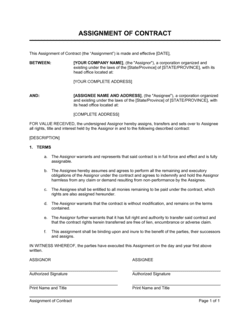
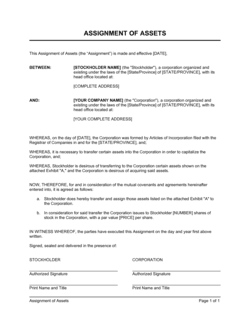
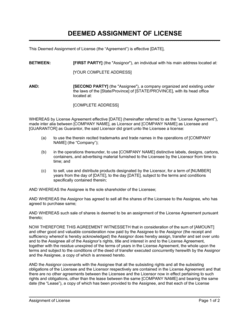
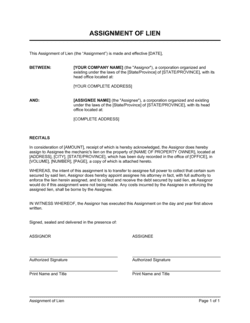
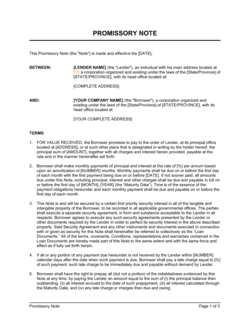
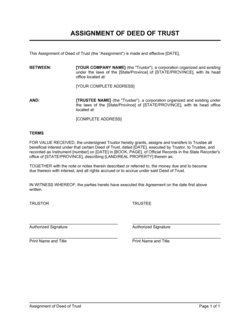
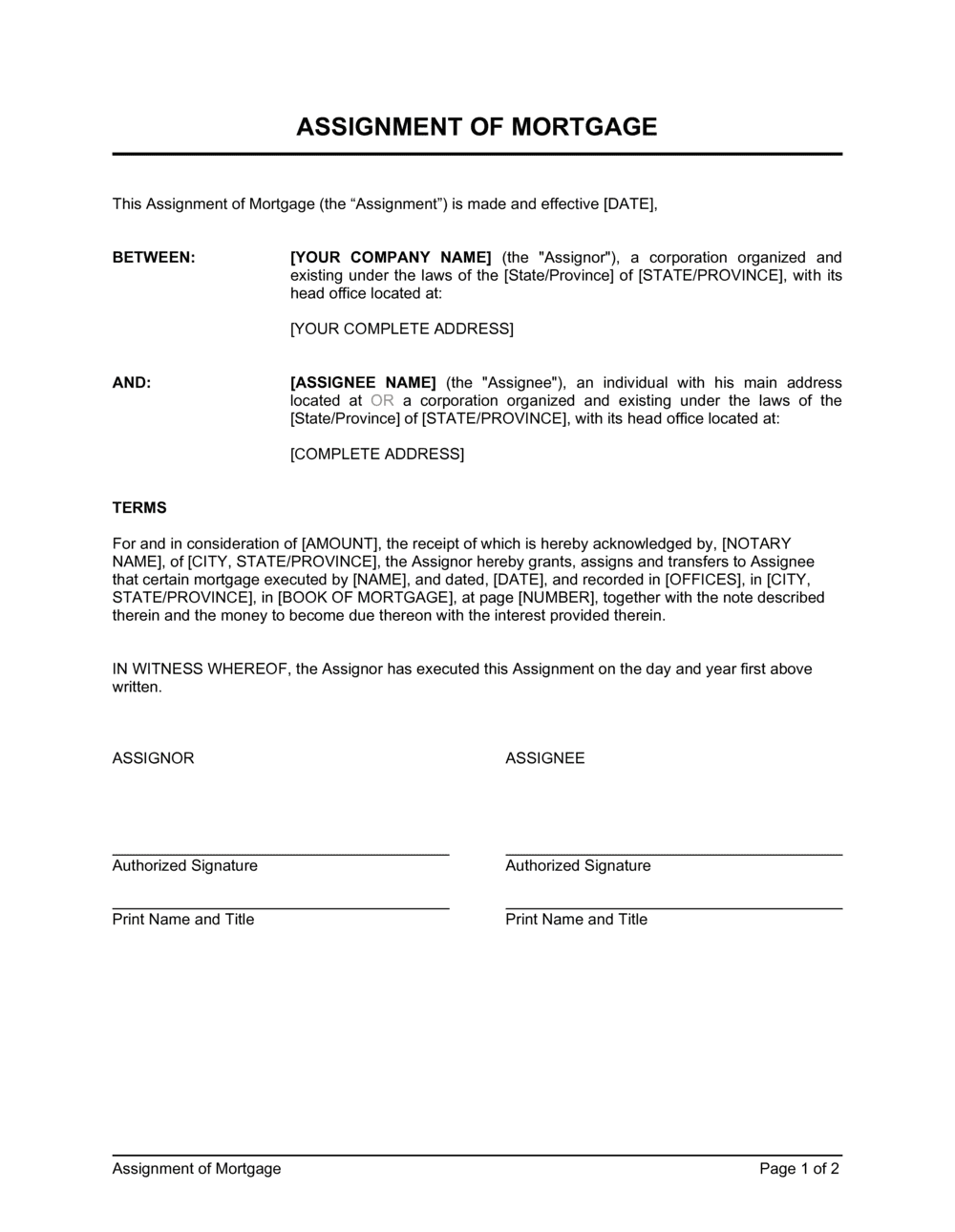
Assignment of Mortgage Template

Free Word download • Edit online • Save & share with Drive • Export to PDF

2 pages20–30 min to fillDifficulty: StandardSignature requiredLegal review recommended
Learn more ↓
FreeAssignment of Mortgage Template

At a glance

What it is
An Assignment of Mortgage is a legally binding instrument through which an original mortgage lender (the assignor) transfers all rights, title, and interest in a mortgage loan to a new party (the assignee). This free Word download provides a professionally structured template you can edit online and export as PDF — covering all essential clauses required for valid execution and recording at the relevant land registry or county recorder's office.
When you need it
Use it when a lender sells a mortgage loan to another financial institution, when a mortgage is bundled into a secondary-market transaction, or when private lenders transfer loan servicing rights as part of a portfolio sale or estate settlement.
What's inside
Identification of the assignor, assignee, and the underlying mortgage; a legal description of the encumbered property; the consideration paid for the assignment; representations and warranties from the assignor; borrower notification requirements; and governing law and recording instructions.

What is an Assignment of Mortgage?

An Assignment of Mortgage is a legally binding instrument by which a mortgage lender — the assignor — formally transfers all of its rights, title, and interest in an existing mortgage loan to a new party — the assignee. The underlying loan terms remain unchanged: the borrower continues to owe the same amount at the same interest rate on the same repayment schedule. What changes is who is legally entitled to receive those payments and who holds the security interest in the property. Assignments are a routine feature of secondary mortgage markets, enabling banks and private lenders to sell loan portfolios, free up capital, and transfer servicing obligations while keeping the original borrower's contract intact. To be effective against third parties, the assignment must be executed with proper notarization and recorded in the public land records of the jurisdiction where the property is located.

Why You Need This Document

Operating without a recorded assignment of mortgage exposes the assignee to serious and often irreversible legal risk. An unrecorded transfer gives the assignee no priority against subsequent lien creditors or good-faith purchasers who record first — under race-notice statutes in most US states, the assignee can lose the entire security interest despite having paid for it. Beyond recording, a missing or defective assignment document has derailed foreclosure actions in multiple jurisdictions where courts found that the foreclosing party could not prove a clean chain of title from the original mortgagee. For the assignor, failing to execute a proper assignment leaves contingent liability attached to a loan that was economically sold. This template provides the complete clause structure — parties, property description, consideration, representations, borrower notification, and governing law — needed to execute a valid, recordable transfer that protects both parties and preserves an unbroken chain of title.

Which variant fits your situation?

If your situation is…Use this template
Transferring a residential mortgage between institutional lendersAssignment Of Mortgage (Residential)
Assigning a commercial mortgage note to an investment fundCommercial Mortgage Assignment
Transferring mortgage servicing rights without full loan saleMortgage Servicing Transfer Agreement
Releasing the mortgage after full repayment by the borrowerMortgage Release / Satisfaction of Mortgage
Assigning a deed of trust instead of a traditional mortgageAssignment of Deed of Trust
Notifying the borrower of the new lender following assignmentNotice of Assignment of Mortgage
Transferring all rights under a promissory note alongside the mortgageAllonge to Promissory Note

Common mistakes to avoid

❌ Failing to record the assignment

Why it matters: An unrecorded assignment gives the assignee only equitable title. Under race-notice recording statutes in most US states, a subsequent bona fide purchaser or lien creditor who records first takes priority — the assignee can lose their entire security interest.

Fix: Record the executed assignment at the county recorder's office within five business days of execution. Keep a conformed copy with the recorder's file stamp as proof of priority.

❌ Mismatched legal names between the assignment and the recorded mortgage

Why it matters: A discrepancy between the assignor's name on the assignment and the mortgagee's name on the original recorded instrument creates a gap in the chain of title — title companies will flag it as a defect, and future buyers or lenders may require a corrective assignment before closing.

Fix: Pull the recorded mortgage from the county recorder's index before drafting and use the mortgagee name exactly as it appears, including punctuation and entity designations (e.g., 'N.A.' vs 'NA').

❌ Assigning the mortgage without also transferring the promissory note

Why it matters: The mortgage is a security instrument; the note is the debt. Transferring one without the other can leave the assignee holding an unenforceable lien — courts in some jurisdictions have dismissed foreclosure actions where the note and mortgage were split between different parties.

Fix: Execute an allonge or separate note endorsement alongside the mortgage assignment so both instruments are transferred to the same party simultaneously.

❌ Skipping borrower notification after the assignment

Why it matters: Under RESPA in the US, failure to notify the borrower within 15 days of a servicing transfer can result in civil liability up to $2,000 per violation plus actual damages and attorney fees. Borrowers who send payments to the old servicer without notice are legally protected from late fees for 60 days.

Fix: Prepare the borrower notification letter before the assignment closes and send it on the effective date. Document the mailing with certified mail or a delivery confirmation service.

❌ Using a street address instead of a full legal property description

Why it matters: Street addresses are not legally sufficient identifiers for recorded instruments. A recorder's office may accept the filing but the assignment will be legally deficient, and a title examiner will flag it as a cloud on title.

Fix: Copy the legal description verbatim from the original mortgage or the current title commitment. If the description spans multiple lines or pages, attach it as an exhibit and reference it in the body of the assignment.

❌ Backdating or forward-dating the effective date significantly

Why it matters: An effective date that materially predates the execution date raises fraudulent transfer concerns in any bankruptcy proceeding involving the assignor, and a date far in the future leaves an unrecorded gap during which competing claims can arise.

Fix: Use the actual execution date as the effective date, or clearly state a near-future closing date that corresponds to the actual funds transfer and document delivery.

The 10 key clauses, explained

Parties and Recitals

In plain language: Identifies the assignor and assignee by full legal name and address, and provides background context — the original loan date, borrower name, and recorded mortgage reference number.

Sample language
FOR VALUE RECEIVED, [ASSIGNOR FULL LEGAL NAME], a [ENTITY TYPE] organized under the laws of [STATE/COUNTRY] ('Assignor'), hereby assigns, transfers, and conveys to [ASSIGNEE FULL LEGAL NAME], a [ENTITY TYPE] ('Assignee'), all of Assignor's right, title, and interest in and to that certain Mortgage dated [DATE], executed by [BORROWER NAME] in favor of Assignor, recorded in [COUNTY/LAND REGISTRY] as Document No. [DOCUMENT NUMBER].

Common mistake: Using a trade name or DBA instead of the full registered legal entity name. If the assignor name does not match the recorded mortgagee exactly, the county recorder may reject the filing and the chain of title will show a gap.

Description of the Mortgage and Underlying Note

In plain language: References the original mortgage instrument and the promissory note it secures — including recording details, original loan amount, and loan number — so there is no ambiguity about which obligation is being transferred.

Sample language
The Mortgage secures that certain Promissory Note dated [DATE] in the original principal amount of $[LOAN AMOUNT], Loan No. [LOAN NUMBER], and all renewals, extensions, modifications, and substitutions thereof.

Common mistake: Failing to reference the promissory note alongside the mortgage. In most jurisdictions the note and mortgage are separate instruments — assigning the mortgage without an allonge or separate note endorsement can leave the assignee unable to enforce payment.

Legal Description of the Property

In plain language: Sets out the full legal description of the property that serves as collateral — not just the street address, but the formal metes-and-bounds, lot-and-block, or parcel identification number as recorded in the land records.

Sample language
The property encumbered by the Mortgage is located at [STREET ADDRESS], [CITY], [STATE] [ZIP], and more particularly described as: [FULL LEGAL DESCRIPTION AS RECORDED IN BOOK/PAGE OR DOCUMENT NO. IN THE OFFICE OF THE [COUNTY] RECORDER].

Common mistake: Using the street address alone without including the full recorded legal description. A street address is not a legally sufficient property identifier for recording purposes and will cause the assignment to be rejected or the lien to be unenforceable against subsequent purchasers.

Consideration

In plain language: States the value exchanged for the assignment — either the actual purchase price or the standard nominal consideration formula used when the parties prefer to keep the price private.

Sample language
In consideration of the sum of [TEN DOLLARS ($10.00) AND OTHER GOOD AND VALUABLE CONSIDERATION / $[PURCHASE PRICE]], the receipt and sufficiency of which are hereby acknowledged, Assignor hereby assigns and transfers the Mortgage to Assignee.

Common mistake: Omitting consideration entirely. Courts in several jurisdictions have treated assignments without stated consideration as gratuitous transfers, creating enforceability questions — particularly in bankruptcy proceedings involving the assignor.

Representations and Warranties of the Assignor

In plain language: The assignor's contractual promises that the mortgage is valid, the debt is outstanding in the stated amount, no prior undisclosed assignments have been made, and the assignor has authority to transfer.

Sample language
Assignor represents and warrants that: (a) Assignor is the lawful holder of the Mortgage; (b) the Mortgage has not been previously assigned, pledged, or encumbered; (c) as of the date hereof, the unpaid principal balance of the Note is $[BALANCE]; and (d) Assignor has full authority to execute and deliver this Assignment.

Common mistake: Accepting a quitclaim-style assignment with no representations. An assignment that conveys only 'whatever interest the assignor may have' gives the assignee no recourse if the mortgage was previously assigned to a third party or is subject to an undisclosed defect.

Borrower Notification Obligation

In plain language: Records the parties' agreement on when and how the borrower (mortgagor) will be notified of the assignment — typically within a defined number of days after execution — and who bears responsibility for sending the notice.

Sample language
Assignee shall provide written notice of this Assignment to Borrower within [15] days of the date hereof, in accordance with applicable law, including the Real Estate Settlement Procedures Act (RESPA), 12 U.S.C. § 2605, where applicable.

Common mistake: Ignoring statutory notification requirements. In the US, RESPA requires the transferee servicer to notify the borrower within 15 days of the transfer. Failure to comply carries civil liability and can expose the assignee to regulatory penalties.

Transfer of Servicing Rights

In plain language: Specifies whether mortgage servicing rights — collecting payments, managing escrow, handling defaults — transfer to the assignee or remain with the assignor or a designated servicer.

Sample language
Servicing of the Mortgage [SHALL / SHALL NOT] transfer to Assignee as of the Effective Date. [If retained: Assignor shall continue to service the Mortgage pursuant to a separate Servicing Agreement dated [DATE].] All payments due after the Effective Date shall be directed to [ASSIGNEE / DESIGNATED SERVICER] at [ADDRESS / PAYMENT PORTAL].

Common mistake: Leaving servicing responsibilities ambiguous. If neither party knows who is responsible for collecting payments and managing escrow after the transfer, the borrower may pay the wrong party — creating credit disputes, escrow shortfalls, and potential foreclosure complications.

Effective Date and Conditions Precedent

In plain language: States when the assignment becomes operative and any conditions that must be satisfied before the transfer is effective — such as receipt of purchase funds, delivery of original loan files, or regulatory approval.

Sample language
This Assignment shall be effective as of [DATE] ('Effective Date'), provided that Assignee has delivered the Purchase Price to Assignor in immediately available funds, and Assignor has delivered the original Note, Mortgage, and all related loan documents to Assignee, on or before the Effective Date.

Common mistake: Dating the assignment document weeks or months after it is executed. A backdated or forward-dated effective date that differs significantly from the recording date can trigger title insurance objections and raise fraudulent transfer questions in bankruptcy proceedings.

Governing Law and Recording Instructions

In plain language: Designates which jurisdiction's law governs the assignment and confirms that the assignee is responsible for recording the document in the county or land registry where the property is located.

Sample language
This Assignment shall be governed by the laws of the State of [STATE], without regard to its conflict-of-laws provisions. Assignee shall promptly record this Assignment in the Office of the [COUNTY] Recorder of [COUNTY], [STATE], and shall bear all recording fees and transfer taxes, if any.

Common mistake: Failing to record the assignment promptly after execution. An unrecorded assignment gives the assignee only equitable — not legal — title, meaning a subsequent good-faith purchaser or bankruptcy trustee may take priority over the assignee under the race-notice recording rules in most US states.

Successor and Assigns; Entire Agreement

In plain language: Confirms the assignment binds both parties' successors and assigns, and that the written document constitutes the full agreement, superseding any prior oral or written understandings about the transfer.

Sample language
This Assignment shall be binding upon and inure to the benefit of the parties and their respective heirs, successors, and permitted assigns. This Assignment constitutes the entire agreement between the parties with respect to the assignment of the Mortgage and supersedes all prior negotiations, representations, and understandings.

Common mistake: Omitting the entire-agreement clause when a loan purchase and sale agreement exists separately. Without it, terms in the purchase agreement — such as seller representations or repurchase obligations — may be argued to survive and override the assignment's limited warranties.

How to fill it out

  1. 1

    Identify and verify the parties' legal names

    Enter the assignor's and assignee's full registered legal names — not trade names or DBAs — exactly as they appear on their corporate registration documents. For individuals, use the name on government-issued ID.

    💡 Cross-reference the assignor's name against the recorded mortgage instrument at the county recorder's office before drafting — any mismatch will cause rejection at recording.

  2. 2

    Pull the original mortgage recording details

    Locate the county recorder's document number, book and page reference, and recording date for the original mortgage. Enter these exactly as they appear in the public record.

    💡 Most US county recorders provide free online access to recorded instrument indexes — search by grantor name and recording date to retrieve the exact reference numbers.

  3. 3

    Insert the full legal description of the property

    Copy the legal description verbatim from the original mortgage instrument or from the current title search. Do not abbreviate or paraphrase — even minor discrepancies can invalidate the recording.

    💡 If the property has been subdivided or re-platted since the original mortgage was recorded, obtain an updated legal description from a licensed title company or surveyor before completing this section.

  4. 4

    State the consideration

    Enter either the actual purchase price or the nominal consideration amount ('ten dollars and other good and valuable consideration') in both numeral and written form. Confirm with the assignee whether the actual price should appear in the publicly recorded document.

    💡 If the parties want to keep the purchase price confidential, use the nominal consideration formula — most US jurisdictions accept this for recording purposes, though transfer tax calculations may still require disclosure separately.

  5. 5

    Complete the representations and warranties block

    Fill in the outstanding principal balance as of the assignment date, confirm no prior undisclosed assignments, and have the assignor verify their authority to transfer — particularly for corporate assignors requiring board authorization.

    💡 Request a payoff or loan status statement from the current servicer dated within 30 days of the assignment to confirm the outstanding balance figure used in this clause.

  6. 6

    Address servicing rights explicitly

    Mark whether servicing transfers with the mortgage or stays with the assignor. If servicing transfers, provide the assignee's payment address and escrow contact. If retained by a third servicer, attach the servicing agreement by reference.

    💡 Draft a borrower notification letter simultaneously so it is ready to send within the statutory window (15 days under RESPA for US transactions) on the effective date.

  7. 7

    Execute with proper formalities

    Both parties must sign in the presence of a notary public. Most US states and all Canadian provinces require notarization for recording. Some states also require one or two witnesses in addition to notarization.

    💡 Check the recording requirements for the specific county where the property is located before execution — some counties require a prepared-by line, a return-to address, and a specific margin size on the first page.

  8. 8

    Record the assignment promptly

    Submit the fully executed, notarized original to the county recorder or land registry office with the applicable recording fee. Obtain a conformed copy with the recorder's stamp for both parties' files.

    💡 File for recording within five business days of execution. Delays expose the assignee to the risk of a competing lien, a bankruptcy filing by the assignor, or a sale of the property that could extinguish an unrecorded interest.

Frequently asked questions

What is an assignment of mortgage?

An assignment of mortgage is a legal document that transfers a lender's rights, title, and interest in a mortgage loan — including the right to collect payments and enforce the security interest — to a new party called the assignee. The borrower's obligation to repay the loan does not change; only the identity of the party entitled to receive payment and enforce the lien changes. Assignments occur routinely in secondary mortgage markets, portfolio sales, and estate transfers.

Does an assignment of mortgage need to be recorded?

Yes, in virtually all US states and most common-law jurisdictions, recording is required to protect the assignee's priority against subsequent purchasers and lien creditors. An unrecorded assignment gives the assignee only equitable title — under race-notice statutes, a later party who records first can take priority. Recording fees typically range from $20 to $150 depending on the county.

Does an assignment of mortgage affect the borrower?

The assignment transfers who receives payments and holds the lien but does not change the borrower's loan terms — interest rate, payment amount, maturity date, and escrow obligations remain the same. The borrower must be notified of the transfer and provided with the new servicer's payment address. Under RESPA in the US, the borrower has a 60-day grace period after the transfer during which they cannot be penalized for sending payments to the prior servicer.

What is the difference between an assignment of mortgage and a mortgage release?

An assignment of mortgage transfers the lender's interest to a new party while the debt remains outstanding. A mortgage release (also called a satisfaction of mortgage or discharge of mortgage) extinguishes the lien entirely because the borrower has repaid the loan in full. An assignment keeps the security interest alive under new ownership; a release terminates it. Both must be recorded to update the public title record.

What is the difference between assigning a mortgage and a deed of trust?

A mortgage is a two-party instrument (borrower and lender), while a deed of trust involves three parties (borrower, trustee, and beneficiary lender). An assignment of mortgage transfers the mortgagee's interest; an assignment of deed of trust transfers the beneficiary's interest. The mechanics and recording requirements are similar, but the foreclosure process differs significantly between the two — deeds of trust typically allow non-judicial foreclosure, while mortgages often require judicial proceedings.

Does the promissory note need to be assigned along with the mortgage?

Yes. The mortgage is a security instrument that is only enforceable by the party holding the underlying promissory note. Transferring the mortgage without also endorsing or assigning the note can create a 'split-the-note' problem where no single party holds both instruments — a defect that courts in some US states have used to dismiss foreclosure actions. Always execute an allonge or note endorsement simultaneously with the mortgage assignment.

Do I need a lawyer to complete an assignment of mortgage?

For straightforward residential assignments between institutional parties familiar with the process, a high-quality template is a practical starting point. However, legal review is strongly recommended when the transaction involves a large commercial mortgage, a portfolio of loans, cross-border elements, a borrower in default, or any bankruptcy exposure on the assignor's side. Recording requirements also vary by county and state, and errors can create title defects that are expensive to correct after the fact.

What happens if an assignment of mortgage is never recorded?

An unrecorded assignment is valid between the assignor and assignee but provides no constructive notice to third parties. Under race-notice recording statutes (the majority rule in the US), a subsequent buyer or lender who records a competing interest without actual knowledge of the prior unrecorded assignment will take priority. In a bankruptcy of the assignor, a trustee in bankruptcy may also avoid an unrecorded transfer as a preferential or fraudulent transfer.

How this compares to alternatives

vs Mortgage Release / Satisfaction of Mortgage

A mortgage release terminates the lien entirely because the borrower has repaid the debt in full. An assignment of mortgage keeps the lien alive but transfers it to a new holder. Use a release when the loan is paid off; use an assignment when the loan is sold or transferred while the debt remains outstanding.

vs Deed of Trust Assignment

An assignment of deed of trust transfers the beneficiary's interest in a three-party trust deed instrument, which is used in approximately 30 US states instead of a traditional two-party mortgage. The economic purpose is identical, but the foreclosure mechanics differ — deeds of trust typically allow faster non-judicial foreclosure. The correct instrument depends entirely on the state where the property is located.

vs Loan Purchase and Sale Agreement

A loan purchase and sale agreement is the underlying commercial contract that governs the economics, representations, and conditions of the mortgage sale — price, due diligence, repurchase obligations. The assignment of mortgage is the recorded transfer instrument that actually moves the lien in the public record. Both documents are typically executed together; the purchase agreement governs disputes between the parties, while the assignment creates the public chain of title.

vs Allonge to Promissory Note

An allonge endorses and transfers the promissory note — the debt instrument — to the assignee. An assignment of mortgage transfers the security instrument. Because the note and mortgage are legally distinct, both must be transferred simultaneously for the assignee to hold a complete, enforceable interest. The two documents are complements, not alternatives.

Industry-specific considerations

Banking and Mortgage Lending

High-volume portfolio sales to government-sponsored enterprises (Fannie Mae, Freddie Mac) require MERS-compliant assignment language and batch recording procedures.

Real Estate Investment

Individual mortgage note buyers require full chain-of-title verification and concurrent allonge execution to confirm both instruments transfer to the same investment entity.

Private Equity and Debt Funds

Bulk acquisitions of non-performing loan portfolios require representations on default status, outstanding balances, and prior modification history for each assigned mortgage.

Estate and Trust Administration

Transfers of mortgage interests from a deceased lender's estate require probate court authorization or trustee certification before the assignment can be validly executed and recorded.

Jurisdictional notes

United States

Recording requirements, fees, and formalities vary by state and county — some states require two witnesses in addition to notarization. Under RESPA, the assignee servicer must notify the borrower within 15 days of a servicing transfer. California, Texas, and approximately 30 other states primarily use deeds of trust rather than mortgages; confirm which instrument governs before selecting this template. MERS assignments follow a separate standardized process for loans registered in the MERS system.

Canada

Mortgage assignments are governed by provincial law and must be registered in the provincial land title or land registry office — not a county recorder. Ontario and British Columbia use a Land Title Act registration system; Quebec uses the Civil Code and the Register of Personal and Movable Real Rights. In Quebec, all legal documents including mortgage assignments must be available in French for provincially regulated lenders. Federal mortgage lenders (chartered banks) must also comply with the Interest Act and the Bank Act.

United Kingdom

Mortgages in England and Wales are registered at HM Land Registry; assignments must be registered via a Form DS3 (partial discharge) or AP1 application depending on the transaction structure. Legal assignments of a mortgage require written notice to the borrower under the Law of Property Act 1925, s.136. Scotland operates under a separate land law system using the Land Register of Scotland, and the terminology differs — 'standard security' is used in place of mortgage. Northern Ireland uses the Land Registry of Northern Ireland.

European Union

Mortgage assignment rules vary significantly by member state — there is no single EU-wide instrument. France requires notarial form and registration with the Service de Publicité Foncière. Germany requires a notarized Grundschuldabtretung registered in the Grundbuch (land register). The EU Mortgage Credit Directive (2014/17/EU) imposes consumer notification obligations on lenders transferring residential mortgage contracts. GDPR requires that any transfer of loan data to a new holder be disclosed to the borrower as a change in data controller, typically addressed in the notification letter.

Template vs lawyer — what fits your deal?

PathBest forCostTime
Use the templatePrivate lenders and real estate investors transferring a single residential mortgage between familiar parties in a straightforward transactionFree30–60 minutes to complete; 1–5 business days to record
Template + legal reviewInstitutional lenders, transactions with a borrower in default, or assignments involving a commercial property or multiple loans$300–$800 for a real estate attorney review2–5 business days
Custom draftedPortfolio mortgage sales, cross-border transactions, securitization-related assignments, or any assignment with bankruptcy or fraud exposure$1,500–$5,000+ depending on complexity and loan count1–3 weeks

Glossary

Assignor
The original mortgage holder who transfers their rights and interest in the mortgage to another party.
Assignee
The party receiving the mortgage rights, title, and interest through the assignment.
Mortgagor
The borrower who originally granted the mortgage lien against their property as security for the loan.
Mortgagee
The lender who holds the mortgage lien — the party whose interest is being transferred in an assignment.
Consideration
The payment or value exchanged for the assignment of the mortgage, which must be stated to make the transfer legally valid in most jurisdictions.
Legal Description
The formal identification of a property using metes-and-bounds, lot-and-block, or government survey notation as recorded in public land records.
Chain of Title
The sequential record of all ownership and encumbrance transfers for a property — an unbroken chain is required for a clear and marketable title.
Recording
The act of filing an executed assignment with the county recorder, land registry, or equivalent public office to provide constructive notice of the transfer.
Notarization
Authentication of signatures on a legal instrument by a licensed notary public, required for recording in most US states and many international jurisdictions.
MERS (Mortgage Electronic Registration System)
A private US registry that tracks mortgage ownership and servicing rights electronically, often named as the nominee mortgagee to simplify assignment recording.
Allonge
A separate document attached to a promissory note that endorses or transfers the note — typically executed alongside an assignment of mortgage to transfer both instruments.
Lien Position
The priority ranking of a mortgage or other encumbrance against a property — a first-lien mortgage has priority over second-lien or junior liens in the event of foreclosure.

Part of your Business Operating System

This document is one of 3,000+ business & legal templates included in Business in a Box.

  • Fill-in-the-blanks — ready in minutes
  • 100% customizable Word document
  • Compatible with all office suites
  • Export to PDF and share electronically

Create your document in 3 simple steps.

From template to signed document — all inside one Business Operating System.
1
Download or open template

Access over 3,000+ business and legal templates for any business task, project or initiative.

2
Edit and fill in the blanks with AI

Customize your ready-made business document template and save it in the cloud.

3
Save, Share, Send, Sign

Share your files and folders with your team. Create a space of seamless collaboration.

Save time, save money, and create top-quality documents.

★★★★★

"Fantastic value! I'm not sure how I'd do without it. It's worth its weight in gold and paid back for itself many times."

Managing Director · Mall Farm
Robert Whalley
Managing Director, Mall Farm Proprietary Limited
★★★★★

"I have been using Business in a Box for years. It has been the most useful source of templates I have encountered. I recommend it to anyone."

Business Owner · 4+ years
Dr Michael John Freestone
Business Owner
★★★★★

"It has been a life saver so many times I have lost count. Business in a Box has saved me so much time and as you know, time is money."

Owner · Upstate Web
David G. Moore Jr.
Owner, Upstate Web

Run your business with a system — not scattered tools

Stop downloading documents. Start operating with clarity. Business in a Box gives you the Business Operating System used by over 250,000 companies worldwide to structure, run, and grow their business.

Start free · No credit card required