- Emergency Response Policy
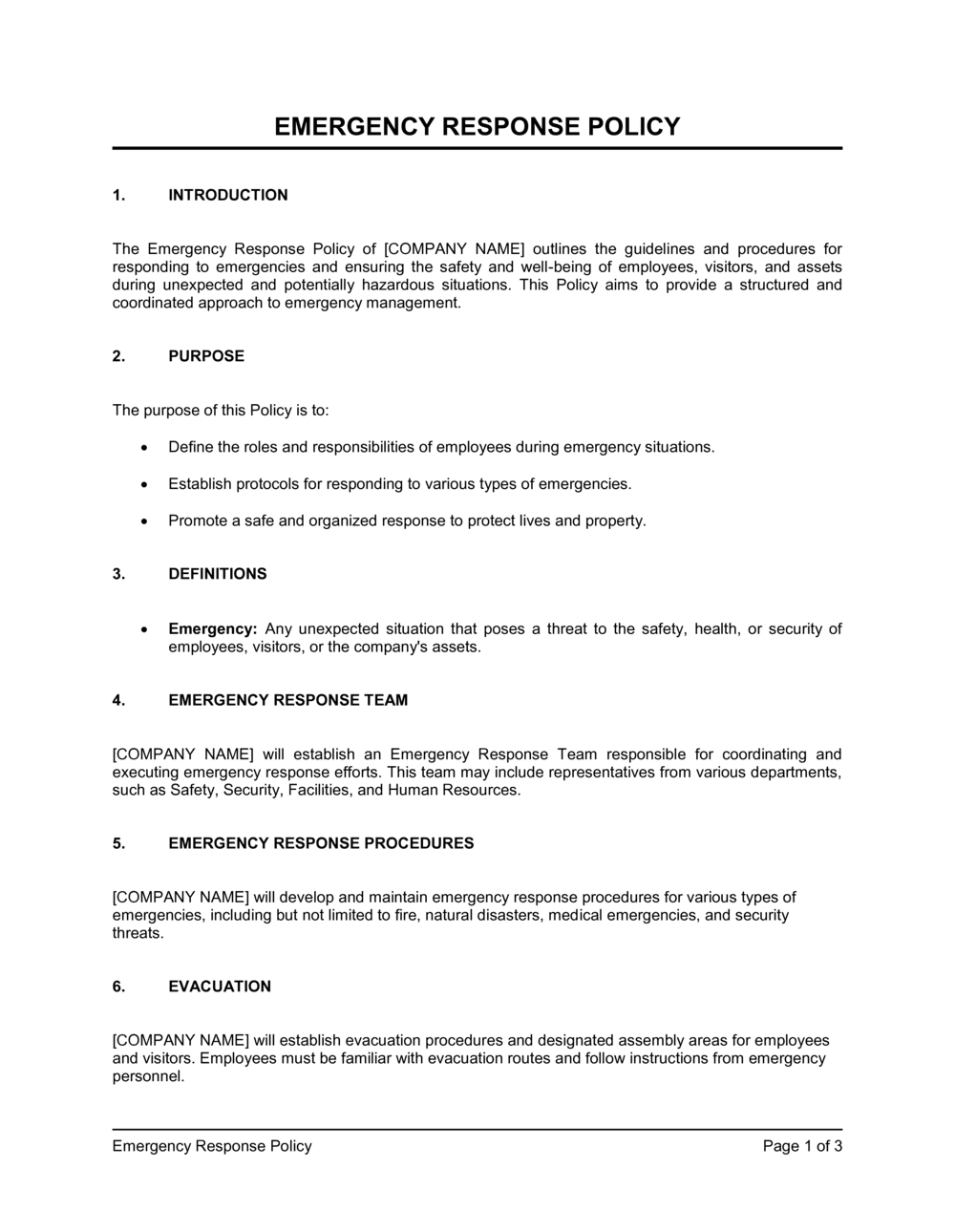
- A formal document that defines the procedures, roles, and resources a business uses to respond to and recover from workplace emergencies.
- Emergency Warden
- A designated employee responsible for guiding staff through evacuation or shelter-in-place procedures and accounting for all personnel at an assembly point.
- Assembly Point
- A pre-designated outdoor or remote location where all employees gather after evacuating a building so wardens can confirm everyone is accounted for.
- Shelter-in-Place
- A protective action requiring employees to remain inside the building in a designated interior room, used during external threats such as severe weather or hazardous material releases.
- Incident Commander
- The individual — typically the senior on-site manager or safety officer — who holds overall decision-making authority during an active emergency.
- OSHA
- The US Occupational Safety and Health Administration, the federal agency that sets and enforces workplace safety standards, including emergency action plan requirements under 29 CFR 1910.38.
- Emergency Action Plan (EAP)
- The OSHA-defined minimum written document describing evacuation procedures, emergency contacts, and employee roles — a subset of what a full emergency response policy covers.
- Hazard Assessment
- A systematic review of a workplace to identify potential emergency scenarios — fire, flood, chemical spill, medical incident — and rate their likelihood and severity.
- Chain of Command
- The ordered list of individuals who assume decision-making authority if the primary Incident Commander is unavailable during an emergency.
- After-Action Review
- A structured debrief conducted within 48–72 hours of an emergency to document what happened, what worked, what failed, and what changes are needed to the policy.
- Mutual Aid Agreement
- A pre-established arrangement with neighboring businesses, government agencies, or industry peers to share resources — personnel, equipment, space — during a large-scale emergency.