Health and Safety Policy Template

Free Word download β€’ Edit online β€’ Save & share with Drive β€’ Export to PDF

2 pagesβ€’20–30 min to fillβ€’Difficulty: Standard
Learn more ↓
FreeHealth and Safety Policy Template

At a glance

What it is
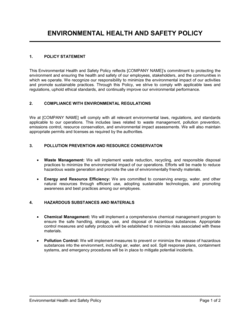
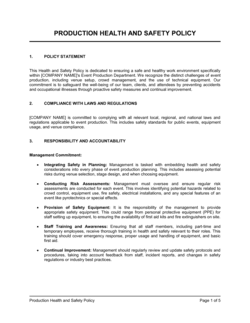
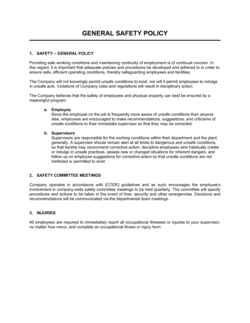
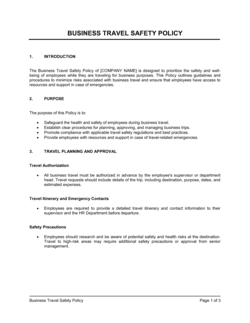
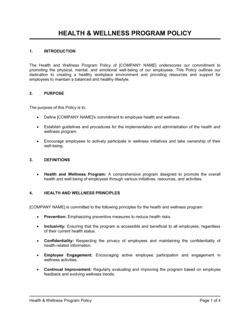
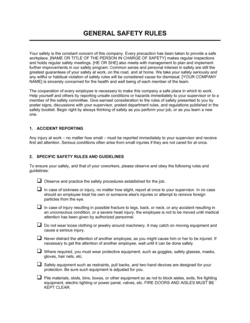
A Health and Safety Policy is a formal written document stating an organization's commitment to protecting employees, contractors, and visitors from workplace hazards. This free Word download covers responsibilities, hazard identification, PPE requirements, training obligations, incident reporting procedures, and compliance with OSHA and equivalent regulations β€” ready to edit online and export as PDF.
When you need it
Use it when onboarding your first employees, preparing for a regulatory inspection, or formalizing safety practices that have been managed informally. In most jurisdictions, a written policy is legally required once you reach 5 or more employees.
What's inside
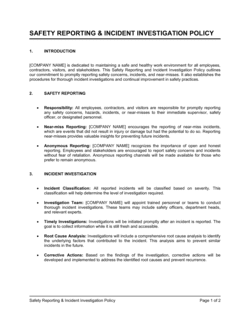
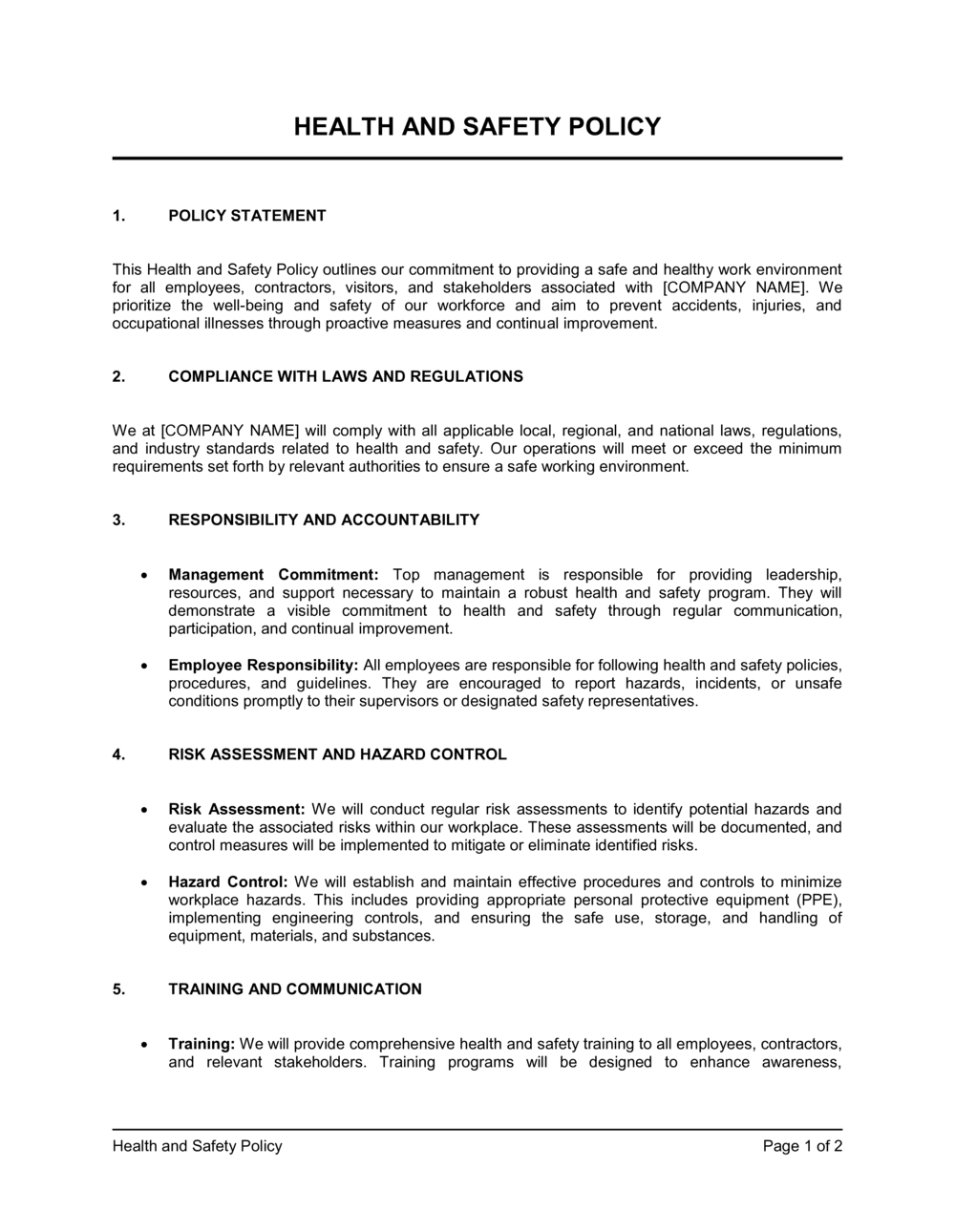
Policy statement and employer commitment, defined roles and responsibilities, hazard identification and risk assessment procedures, PPE requirements, safety training schedule, incident and near-miss reporting process, emergency response procedures, and a review and revision schedule.

What is a Health and Safety Policy?

A Health and Safety Policy is a formal written document in which an organization commits to protecting employees, contractors, and visitors from workplace hazards. It establishes who is responsible for safety at every level of the organization, how hazards are identified and controlled, what training is required, and how incidents and near misses are reported and investigated. Unlike an informal set of safety rules, a written policy creates a documented compliance baseline that regulators, insurers, and courts can measure the organization against β€” and in most jurisdictions, it is a statutory requirement for any employer above a defined size threshold.

Why You Need This Document

Operating without a written health and safety policy exposes your business on three simultaneous fronts. Regulators β€” OSHA in the US, the HSE in the UK, and equivalent bodies in Canada and Australia β€” can issue citations, financial penalties, and Improvement Notices to any employer who cannot produce a written policy during an inspection. Insurers use the absence of a documented safety program as grounds to reduce or deny liability claims. And in a personal injury lawsuit, the first thing plaintiff's counsel requests is evidence that you identified the hazard, assigned someone to control it, and trained your employees β€” all of which a properly completed policy documents. This template gives you a compliant, audit-ready starting point in hours rather than days, structured around the sections regulators actually check.

Which variant fits your situation?

If your situation is…Use this template
General office or service-based businessHealth and Safety Policy
Construction, trades, or high-hazard industrial siteConstruction Safety Plan
Documenting how to respond to a specific type of emergencyEmergency Response Plan
Identifying and rating individual workplace hazardsRisk Assessment Template
Recording and tracking workplace injuries and illnessesIncident Report Form
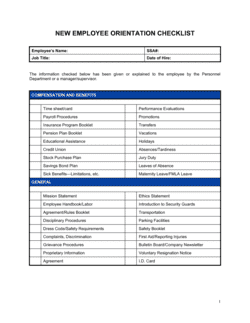
Communicating safety rules to new employees on day oneEmployee Onboarding Checklist
Documenting COVID-19 or infectious disease controlsWorkplace Health and Safety Procedure

Common mistakes to avoid

❌ No named safety officer or responsibility owner

Why it matters: When a regulator investigates an incident, the first question is who was responsible for safety oversight. A policy that assigns duties to a 'department' rather than a named role produces no one accountable.

Fix: Name a specific individual as Safety Officer and list their direct responsibilities. Update the name whenever the role changes hands β€” do not wait for the annual review.

❌ Using generic PPE language not tied to specific tasks

Why it matters: A clause like 'employees should wear appropriate PPE' is unenforceable and will not satisfy an OSHA inspector or defend an employer in a personal injury claim.

Fix: Map every PPE requirement to the task and location where it applies, with the applicable standard (e.g., ANSI Z87.1 for eye protection) and the consequence for non-compliance.

❌ Skipping the risk assessment update after an incident

Why it matters: Regulators treat a post-incident failure to reassess as evidence of systemic non-compliance β€” it converts a single incident into a pattern and elevates any financial penalty.

Fix: Add a mandatory trigger to your incident reporting process: every OSHA-recordable incident requires a risk assessment review within 5 working days of the investigation closing.

❌ Distributing the policy without collecting acknowledgments

Why it matters: In an injury claim or regulatory inspection, an employer who cannot prove employees received and read the policy cannot rely on it as a defense.

Fix: Require a dated signature from every employee confirming they have received, read, and understood the policy. Store acknowledgments in each employee's personnel file.

❌ Setting a review clause with no fixed date or named owner

Why it matters: An undated review clause reliably produces a policy that is not updated for years. Outdated policies that reference superseded regulations are worse than no policy in some enforcement contexts.

Fix: Enter a specific calendar date β€” 'this policy will be reviewed by [NAME] by [DATE]' β€” and assign it as a recurring calendar task on the day of signing.

❌ Limiting scope to direct employees and ignoring contractors

Why it matters: OSHA's multi-employer citation policy holds host employers responsible for contractor safety on their premises. A scope that excludes contractors leaves a significant compliance and liability gap.

Fix: Extend the policy scope explicitly to all contractors and temporary workers, and require them to sign a contractor safety acknowledgment before commencing work on site.

The 10 key sections, explained

Policy statement and employer commitment

Scope and applicability

Roles and responsibilities

Hazard identification and risk assessment

Hazard control measures

PPE requirements

Safety training and induction

Incident and near-miss reporting

Emergency response procedures

Policy review and revision schedule

How to fill it out

  1. 1

    Complete the employer details and policy statement

    Enter the company's legal name, primary site address, and the name and title of the executive signing the policy. Date the document and add a wet or electronic signature line.

    πŸ’‘ The signing executive should be the highest available authority β€” CEO or Managing Director β€” not an HR coordinator. Regulator-facing documents carry more weight with C-suite signatures.

  2. 2

    Define the scope and list all covered locations

    Specify every physical location and type of work covered. If contractors regularly work on your premises, name them explicitly or use a class description like 'all contractors engaged by [COMPANY NAME].'

    πŸ’‘ If your policy will be shared with clients or main contractors for pre-qualification, confirm their scope requirements before finalizing β€” some require specific contractor management language.

  3. 3

    Assign named owners to every responsibility

    Replace every '[TITLE]' placeholder with a real name or a named role that is always filled. For each responsibility, note the frequency β€” 'monthly site inspections' not 'regular inspections.'

    πŸ’‘ Create a one-page RACI chart as an appendix. It makes accountability visible to both regulators and employees and is easy to update when roles change.

  4. 4

    Complete the hazard identification section for your specific operations

    Walk each work area and list the top hazards relevant to your industry β€” slips and trips for offices, manual handling for warehouses, chemical exposure for labs. Link each hazard to its control measure.

    πŸ’‘ Use the Business in a Box Risk Assessment Form as Appendix A to capture hazard ratings before populating this section β€” the assessment outputs feed directly into section 4 and 5.

  5. 5

    Specify PPE requirements by task and area

    For each mandatory PPE item, name the task or location where it applies, the minimum standard (e.g., EN 166 for eye protection), and the inspection and replacement schedule.

    πŸ’‘ Photograph your work areas and annotate required PPE at entry points β€” a visual reference dramatically improves day-to-day compliance compared to text alone.

  6. 6

    Set the training schedule and acknowledgment process

    List every mandatory training module, its frequency, and who delivers it. Add a sign-off sheet as an appendix for employees to confirm they have received and understood each module.

    πŸ’‘ Store signed training acknowledgments in each employee's HR file β€” OSHA and equivalent regulators can request these going back 3–5 years.

  7. 7

    Populate emergency contacts and evacuation details

    Enter current first-aider names, first-aid kit locations, assembly points, and emergency services numbers. Verify every entry against your current site layout before publishing.

    πŸ’‘ Post a laminated one-page emergency summary in every work area β€” this section of the policy is the source document for those summaries.

  8. 8

    Set the review date and communicate the policy

    Enter a specific review date no more than 12 months from the signing date. Distribute the policy to all staff, collect signed acknowledgments, and post a copy in a visible location.

    πŸ’‘ Schedule the review date in your calendar the day you sign the policy β€” policies that miss their review date are the first thing noted in a regulatory inspection.

Frequently asked questions

What is a health and safety policy?

A health and safety policy is a formal written document in which an organization states its commitment to protecting employees, contractors, and visitors from workplace hazards. It defines who is responsible for safety, how hazards are identified and controlled, what training is required, and how incidents are reported. In most jurisdictions, a written policy is a legal requirement once an employer reaches a defined size threshold β€” typically 5 employees in the UK and 10 or more employees for certain OSHA standards in the US.

Is a health and safety policy legally required?

In most jurisdictions, yes β€” once an employer reaches a defined size threshold. In the UK, the Health and Safety at Work Act 1974 requires a written policy for employers with 5 or more employees. In the US, OSHA's General Duty Clause requires all employers to provide a safe workplace, and several OSHA standards mandate written safety programs for specific hazards regardless of company size. In Canada and Australia, equivalent provincial and state legislation impose similar obligations. Consider consulting a safety professional to confirm the specific requirements in your jurisdiction.

What should a health and safety policy include?

A complete policy includes a signed employer commitment statement, defined scope, named roles and responsibilities, hazard identification and risk assessment procedures, a hierarchy-of-controls framework, PPE requirements by task, mandatory training schedule, incident and near-miss reporting procedures, emergency response steps, and a dated review schedule. Missing any of these creates gaps that regulators and insurers identify immediately during an audit.

How often should a health and safety policy be reviewed?

At minimum, annually. An immediate review is also required after any OSHA-recordable or equivalent serious incident, a significant near miss, the introduction of new equipment or substances, changes to relevant regulations, or a material change to operations or headcount. A policy reviewed on a fixed annual schedule with a named owner is far more likely to stay current than one reviewed 'as needed.'

Who is responsible for health and safety in the workplace?

The employer bears primary legal responsibility, but the obligation cascades through the organization. Senior leadership sets the commitment; managers and supervisors enforce day-to-day compliance; a designated safety officer manages inspections, training, and records; and all employees are responsible for following procedures and reporting hazards. A policy that assigns safety responsibility only to a single department is incomplete and will not withstand regulatory scrutiny.

What is the difference between a health and safety policy and a risk assessment?

A health and safety policy states the organization's commitment, structure, and procedures at a high level β€” it is the governing document. A risk assessment is a task- or site-specific analysis identifying particular hazards, rating their likelihood and severity, and documenting chosen control measures. Risk assessments are typically referenced in the policy as required outputs and stored as appendices or supporting documents.

Does a health and safety policy need to be signed?

While a physical signature is not always a statutory requirement, a named, dated senior-management signature is considered best practice and is expected by regulators, auditors, and insurers. It demonstrates active employer commitment rather than a policy produced to tick a box. Unsigned policies regularly draw adverse comment in OSHA inspections and HSE audits.

Can I use a template for my health and safety policy?

Yes β€” a structured template covers the required sections and ensures you do not miss legally mandated elements. The key is populating it with your specific hazards, named responsible individuals, and site-specific procedures rather than leaving placeholder language in place. A template with generic content offers less regulatory protection than a fully customized document.

What happens if a business does not have a health and safety policy?

In the US, OSHA can issue citations and financial penalties under the General Duty Clause. In the UK, the HSE can issue Improvement Notices, Prohibition Notices, and prosecute under the Health and Safety at Work Act. Beyond regulatory penalties, the absence of a written policy significantly weakens an employer's position in any personal injury claim, because it signals the employer did not take reasonable steps to identify and control workplace risks.

How this compares to alternatives

vs Emergency Response Plan

An emergency response plan is a detailed, step-by-step operational document for specific crisis scenarios β€” fire, chemical spill, medical emergency, or natural disaster. A health and safety policy references emergency procedures at a high level and provides the governance framework. Both documents are needed; the policy is the umbrella, and the emergency plan is the actionable drill guide.

vs Incident Report Form

An incident report form captures the facts of a specific event β€” date, location, individuals involved, injuries, and immediate actions taken. A health and safety policy establishes the requirement to complete incident reports and defines the reporting timeline and escalation path. The form is the record; the policy is the system that produces it.

vs Employee Handbook

An employee handbook covers the full range of workplace policies β€” conduct, leave, benefits, and general expectations. A health and safety policy is a standalone regulatory document with specific legal standing that should be signed separately. Embedding it inside a handbook without a standalone acknowledgment can weaken its enforceability in a regulatory context.

vs Risk Assessment Template

A risk assessment template documents the specific hazards, likelihood ratings, and control measures for a defined task or work area. A health and safety policy mandates that risk assessments be conducted and establishes who owns them and how often they are reviewed. Risk assessments are the evidence; the policy is the requirement.

Industry-specific considerations

Construction and trades

Fall protection, scaffolding inspection, confined space entry, and tool-specific PPE requirements are mandated by OSHA 1926 and require documented site-specific procedures beyond a generic policy.

Manufacturing

Machine guarding, lockout/tagout procedures, chemical handling under OSHA's Hazard Communication Standard, and noise exposure monitoring require dedicated policy sections and supporting SOPs.

Healthcare

Bloodborne pathogen exposure control, sharps handling, patient-handling ergonomics, and infection control protocols are regulated separately and must be cross-referenced in the main policy.

Professional services and offices

DSE (display screen equipment) assessments, ergonomic workstation standards, lone-worker procedures, and fire evacuation planning are the primary focus for white-collar environments.

Template vs pro β€” what fits your needs?

PathBest forCostTime
Use the templateSmall and medium businesses in low-to-medium hazard environments such as offices, retail, and professional servicesFree2–4 hours to complete and distribute
Template + professional reviewBusinesses in higher-hazard industries, those preparing for a regulatory inspection, or companies with contractors on site$300–$800 for a safety consultant review1–3 days
Custom draftedHigh-hazard industries such as construction, manufacturing, or healthcare where OSHA or equivalent standards mandate multiple written programs$1,500–$5,000+ for a full safety management system2–6 weeks

Glossary

OSHA
The Occupational Safety and Health Administration β€” the US federal agency that sets and enforces workplace safety standards and requires written safety programs for most employers.
Hazard Identification
The systematic process of recognizing conditions or activities in the workplace that could cause injury, illness, or property damage.
Risk Assessment
An evaluation of the likelihood and severity of harm from an identified hazard, used to prioritize control measures.
PPE (Personal Protective Equipment)
Equipment worn by workers to minimize exposure to hazards β€” including hard hats, safety glasses, gloves, high-visibility vests, and respirators.
Hierarchy of Controls
A five-level framework for managing hazards in order of effectiveness: elimination, substitution, engineering controls, administrative controls, and PPE.
Near Miss
An unplanned event that did not result in injury or damage but had the potential to do so β€” required to be reported and investigated under most safety management systems.
RIDDOR
Reporting of Injuries, Diseases and Dangerous Occurrences Regulations β€” the UK equivalent of OSHA's recordkeeping requirement for workplace incidents.
Safety Officer
The designated individual responsible for day-to-day safety compliance, hazard inspections, training coordination, and incident investigation.
Toolbox Talk
A short, informal safety briefing β€” typically 10–15 minutes β€” conducted at the start of a shift or workday to review a specific hazard or procedure.
MSDS / SDS
Material Safety Data Sheet / Safety Data Sheet β€” a standardized document describing the properties, hazards, and safe handling requirements of a chemical substance.

Part of your Business Operating System

This document is one of 3,000+ business & legal templates included in Business in a Box.

  • Fill-in-the-blanks β€” ready in minutes
  • 100% customizable Word document
  • Compatible with all office suites
  • Export to PDF and share electronically

Create your document in 3 simple steps.

From template to signed document β€” all inside one Business Operating System.
1
Download or open template

Access over 3,000+ business and legal templates for any business task, project or initiative.

2
Edit and fill in the blanks with AI

Customize your ready-made business document template and save it in the cloud.

3
Save, Share, Send, Sign

Share your files and folders with your team. Create a space of seamless collaboration.

Save time, save money, and create top-quality documents.

β˜…β˜…β˜…β˜…β˜…

"Fantastic value! I'm not sure how I'd do without it. It's worth its weight in gold and paid back for itself many times."

Managing Director Β· Mall Farm
Robert Whalley
Managing Director, Mall Farm Proprietary Limited
β˜…β˜…β˜…β˜…β˜…

"I have been using Business in a Box for years. It has been the most useful source of templates I have encountered. I recommend it to anyone."

Business Owner Β· 4+ years
Dr Michael John Freestone
Business Owner
β˜…β˜…β˜…β˜…β˜…

"It has been a life saver so many times I have lost count. Business in a Box has saved me so much time and as you know, time is money."

Owner Β· Upstate Web
David G. Moore Jr.
Owner, Upstate Web

Run your business with a system β€” not scattered tools

Stop downloading documents. Start operating with clarity. Business in a Box gives you the Business Operating System used by over 250,000 companies worldwide to structure, run, and grow their business.

Free Forever PlanΒ Β·Β No credit card required