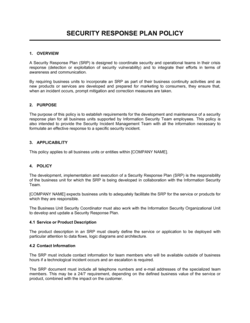
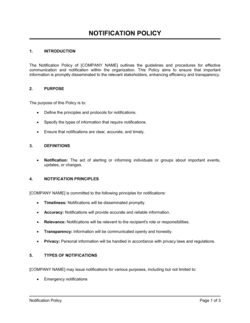
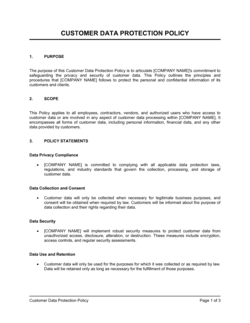
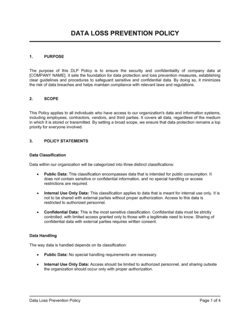
Data Breach Response and Notification Policy Template

Free Word download β€’ Edit online β€’ Save & share with Drive β€’ Export to PDF

3 pagesβ€’20–25 min to fillβ€’Difficulty: Standard
Learn more ↓
FreeData Breach Response and Notification Policy Template

At a glance

What it is
A Data Breach Response and Notification Policy is an operational document that defines how your organization detects, contains, assesses, and reports a data security incident β€” from the moment a breach is suspected through post-incident review. This free Word download gives you a structured, editable framework you can customize to your organization's size, systems, and regulatory obligations, then export as PDF for staff distribution or regulator submission.
When you need it
Use it before any security incident occurs β€” as a preventive operational control β€” so that when a breach happens, every team member knows exactly what to do, in what order, and within what timeframe. Organizations subject to GDPR, HIPAA, CCPA, or state breach notification laws need a documented policy to demonstrate compliance readiness.
What's inside
Policy scope and definitions, breach classification criteria, roles and responsibilities, detection and reporting procedures, containment and eradication steps, legal notification requirements and timelines, internal and external communication protocols, and post-incident review procedures.

What is a Data Breach Response and Notification Policy?

A Data Breach Response and Notification Policy is an operational document that defines the step-by-step procedures an organization follows when personal or confidential data is accessed, disclosed, or destroyed without authorization. It covers the full incident lifecycle β€” from the moment a breach is detected through containment, legal notification, individual communication, and post-incident review β€” assigning specific duties to named roles and setting enforceable timelines at each stage. Unlike a general information security policy, which governs preventive controls, this document is the emergency playbook that activates the moment those controls fail.

Why You Need This Document

Without a documented breach response policy, organizations consistently miss legally mandated notification deadlines β€” GDPR's 72-hour regulator notification window and HIPAA's 60-day individual notification requirement leave no room for improvisation. The regulatory consequences of a missed deadline are material: GDPR fines reach €10 million or 2% of global annual turnover for notification failures alone, independent of any fine for the underlying breach. Beyond regulators, cyber insurers are increasingly requiring a documented, tested policy as a condition of coverage β€” and claims submitted without one face heightened scrutiny. A well-constructed policy also limits reputational damage by ensuring that customer notifications are accurate, actionable, and sent through a coordinated process rather than a panicked improvisation. This template gives your team a structured, customizable starting point that covers every phase of response, so the first data breach your organization faces is not also the first time anyone has thought through what to do.

Which variant fits your situation?

If your situation is…Use this template
Healthcare organization handling protected health informationHIPAA Breach Notification Policy
SaaS company serving EU customers under GDPRGDPR Data Breach Notification Procedure
General cyber incident response covering all IT security eventsIncident Response Plan
Board or executive-level communication after a confirmed breachData Breach Notification Letter
Customer-facing disclosure of a breach affecting personal dataCustomer Data Breach Notification Letter
Internal policy governing employee handling of personal dataData Protection Policy
Ongoing risk assessment and security controls documentationInformation Security Policy

Common mistakes to avoid

❌ Using a single notification timeline for all jurisdictions

Why it matters: GDPR requires 72-hour regulator notification; HIPAA allows 60 days for individual notices; US state laws range from 30 to 90 days. A one-size timeline guarantees a missed deadline somewhere.

Fix: Build a jurisdiction table in the policy listing each applicable law, the notification recipient, and the exact deadline. Update it whenever you expand into a new market.

❌ Failing to document no-notification decisions

Why it matters: When a regulator investigates and you cannot produce a written risk assessment explaining why you chose not to notify, the absence of documentation is treated as evidence of non-compliance.

Fix: Require the IRT to complete a written breach assessment form for every confirmed incident, regardless of notification outcome, and retain it for a minimum of three years.

❌ Assigning roles to departments instead of named individuals

Why it matters: During an active incident, 'IT will contain' and 'Legal will advise' produce 30-minute delays while people figure out who specifically is responsible. This directly extends the breach window and the notification timeline.

Fix: Name a primary and a backup contact for every IRT role, including personal contact details stored in a separately secured appendix that remains accessible when primary systems are compromised.

❌ Never testing the policy with a simulated incident

Why it matters: Untested policies routinely fail in real incidents β€” notification drafts are missing, escalation contacts are outdated, and teams discover mid-breach that the policy's 4-hour containment window is technically impossible.

Fix: Run a tabletop exercise at least once per year using a scenario that reflects your actual threat environment β€” ransomware, accidental cloud misconfiguration, or third-party processor breach.

❌ Writing individual notification letters that omit actionable guidance

Why it matters: A notice that says only 'your data may have been exposed' without specifying what data, what risks it creates, and what steps to take generates regulatory complaints and class-action exposure.

Fix: Pre-draft notification templates that include: the specific data categories affected, the likely harm, concrete protective steps (e.g., 'place a fraud alert with the three credit bureaus'), and a dedicated response contact.

❌ Treating the policy as a one-time document and never updating it

Why it matters: A policy written before a major cloud migration, new SaaS onboarding, or regulatory change is a liability rather than a protection β€” it describes a response process that no longer matches your actual environment.

Fix: Schedule an annual policy review and trigger an immediate out-of-cycle review after any significant system change, third-party breach notification, or update to applicable data protection law.

The 9 key sections, explained

Policy scope and objectives

Definitions and breach classification

Roles and responsibilities

Detection and initial reporting

Containment and eradication

Breach assessment and notification decision

Regulatory and legal notification

Individual notification and communication

Post-incident review and lessons learned

How to fill it out

  1. 1

    Customize the scope and definitions for your organization

    Replace all placeholders in the scope section with your organization's actual systems, data categories, and third-party relationships. Add any industry-specific data types β€” PHI for healthcare, cardholder data for payments.

    πŸ’‘ List the specific cloud services, SaaS platforms, and third-party processors in the scope section β€” named systems are audited; generic references are not.

  2. 2

    Define your breach severity tiers

    Establish at least three severity levels (e.g., Low, High, Critical) with clear criteria β€” number of records affected, type of data, whether encryption was in place. Each tier should trigger a defined escalation timeline.

    πŸ’‘ Tie each severity level to a specific notification timeline and an IRT escalation contact so the classification automatically drives the response.

  3. 3

    Assign named individuals to each IRT role

    Replace generic role descriptions with specific job titles and the names of primary and backup contacts for each function β€” IT security, legal, communications, and executive sponsor.

    πŸ’‘ Include personal mobile numbers for the IT security lead and DPO in a separately stored appendix β€” public directories go unanswered at midnight.

  4. 4

    Map your regulatory notification obligations

    Identify every jurisdiction in which you hold personal data and document the applicable notification timelines, required content, and the specific regulator to be notified. Add these as a jurisdiction table in the notification section.

    πŸ’‘ If you serve EU residents, GDPR's 72-hour clock runs from when you become 'aware' of a breach β€” meaning your detection-to-assessment process must complete in under 48 hours to leave time for the notification itself.

  5. 5

    Define your notification templates and communication channels

    Draft skeleton notification letters for regulators and individuals in the communication section. Specify which channels you will use β€” email, postal, press release, or website notice β€” and under what circumstances each applies.

    πŸ’‘ Pre-draft the regulator notification form before an incident happens. Under GDPR, the ICO and most EU DPAs publish online forms β€” download them now and populate the non-incident-specific fields in advance.

  6. 6

    Set up your incident log and documentation process

    Specify where breach records will be maintained, who owns them, and the minimum fields to be captured β€” incident date, discovery date, data types, number of individuals, containment actions, and notification dates.

    πŸ’‘ GDPR Article 33(5) requires you to document all breaches regardless of whether notification was required. A single shared log satisfies this obligation and also supports cyber insurance claims.

  7. 7

    Schedule a tabletop exercise before finalizing the policy

    Before distributing the policy, run a 90-minute tabletop exercise using a realistic breach scenario to test whether your timelines, escalation paths, and notification drafts actually work under pressure.

    πŸ’‘ The most common tabletop finding is that the IRT lead has no decision-making authority without approval from a senior executive who is unreachable. Fix the authority matrix before the exercise ends.

  8. 8

    Establish a policy review cadence

    Add a review schedule to the policy header β€” annually at minimum, and immediately following any breach or significant change to systems, regulations, or third-party relationships.

    πŸ’‘ Tie the review date to your cyber insurance renewal cycle β€” insurers increasingly require documented evidence of an up-to-date breach response policy at renewal.

Frequently asked questions

What is a data breach response and notification policy?

A data breach response and notification policy is an operational document that defines how an organization detects, contains, assesses, and reports a security incident involving personal or confidential data. It assigns roles, sets internal escalation timelines, maps regulatory notification obligations, and establishes post-incident review procedures. Having the policy in place before an incident occurs is what allows an organization to meet 72-hour and 60-day notification deadlines under GDPR and HIPAA respectively.

Is a data breach response policy legally required?

GDPR Article 33 requires documented breach notification procedures for any organization processing EU residents' personal data. HIPAA requires covered entities and business associates to maintain written breach notification policies. Most US state data breach laws do not mandate a written policy but do impose notification obligations that are practically impossible to meet without one. Cyber insurers increasingly require a documented policy as a condition of coverage.

What is the difference between a data breach response policy and an incident response plan?

An incident response plan covers all IT security events β€” network intrusions, DDoS attacks, system outages β€” regardless of whether personal data is involved. A data breach response and notification policy is specifically focused on incidents involving personal or confidential data, and it adds the legal notification obligations, communication protocols, and individual rights considerations that pure IT incidents do not trigger. Many organizations maintain both documents, with the breach policy referencing the broader incident response plan for technical containment steps.

How quickly do we need to notify regulators after a data breach?

Under GDPR, the supervisory authority must be notified within 72 hours of becoming aware of a qualifying breach. HIPAA requires notification to HHS and affected individuals within 60 days of discovering a breach; breaches affecting more than 500 individuals in a state also require immediate media notification. US state laws vary from 30 to 90 days. The notification clock typically starts at discovery, not confirmation β€” so a slow internal investigation does not extend your deadline.

What information must a breach notification include?

GDPR requires: nature of the breach, categories and approximate number of individuals affected, categories and approximate number of records affected, likely consequences, and measures taken or proposed to address the breach. HIPAA requires similar content plus a description of the types of unsecured PHI involved. Individual notifications must also include what steps affected persons should take to protect themselves and a dedicated contact for inquiries.

Does a data breach policy need to cover third-party processors?

Yes. Under GDPR, data processors must notify the controller of a breach without undue delay β€” and the controller's 72-hour notification clock runs regardless of when the processor tells you. Your policy should include vendor notification requirements, contract clauses mandating processor breach reporting within 24–48 hours, and a process for assessing processor-side incidents as your own. Many organizations discover during a breach that their processor contracts contained no notification obligation at all.

How often should a data breach response policy be reviewed?

At a minimum, review the policy annually. Trigger an immediate out-of-cycle review after any confirmed breach, significant system change (cloud migration, new SaaS platform), material change to your third-party processor relationships, or update to applicable data protection legislation. Policies more than 18 months old without a review on record are frequently cited as a compliance gap during audits.

What is a tabletop exercise and why does it matter for breach response?

A tabletop exercise is a structured simulation where the IRT walks through a realistic breach scenario β€” for example, a ransomware attack that encrypts a server holding customer records β€” to test whether the policy's timelines, escalation paths, and notification drafts work in practice. Tabletop exercises consistently reveal gaps that reading the policy never does: missing decision-making authority, outdated contacts, notification templates that haven't been drafted, and containment steps that require tools the team doesn't have access to. Running one annually is the single most effective way to keep a breach policy functional.

Can a small business use this template without a dedicated IT security team?

Yes. The policy is designed to be scaled to the organization's size and resources. For small businesses without an in-house IT security team, the IRT lead role is typically filled by the owner or operations manager, with a managed security service provider (MSSP) or IT consultant named as the technical response contact. The key is to have named contacts, documented procedures, and at least one pre-drafted notification template before an incident occurs β€” not to have an enterprise-scale security team.

How this compares to alternatives

vs Incident Response Plan

An incident response plan addresses all IT security events β€” network intrusions, outages, DDoS β€” regardless of whether personal data is involved. A data breach response policy specifically governs incidents involving personal or confidential data and adds regulatory notification timelines, individual communication requirements, and legal documentation obligations. Most organizations need both documents, with the breach policy referencing the broader incident response plan for technical containment procedures.

vs Information Security Policy

An information security policy establishes preventive controls β€” access management, encryption standards, acceptable use β€” to reduce the likelihood of a breach. A data breach response policy is the reactive counterpart, defining what happens after a breach occurs despite those controls. The security policy reduces breach probability; the breach response policy limits the damage when prevention fails.

vs Data Protection Policy

A data protection policy defines how personal data is collected, stored, processed, and deleted in the course of normal operations β€” covering lawful basis, retention periods, and individual rights. A data breach response policy is narrowly focused on the emergency procedures triggered when those normal-operations protections fail. Both documents are required for GDPR compliance, and they cross-reference each other.

vs Business Continuity Plan

A business continuity plan covers how the organization maintains or restores operations after any disruptive event β€” natural disaster, power failure, or cyberattack. A data breach response policy is specifically focused on the legal and communicative obligations that arise when personal data is compromised, which a generic BCP does not address. A serious ransomware event typically triggers both documents simultaneously.

Industry-specific considerations

Healthcare

HIPAA Breach Notification Rule requires covered entities to notify HHS, affected individuals, and in large breaches, prominent media outlets within 60 days of discovery β€” making a documented, tested policy a regulatory prerequisite.

Financial Services

PCI DSS, GLBA, and state financial regulators impose strict breach notification and forensic documentation requirements, with regulatory fines and card-brand penalties that can exceed the direct costs of the breach itself.

SaaS / Technology

Enterprise customers require a documented breach response policy as a baseline vendor security control, and SaaS companies processing EU user data face GDPR's 72-hour regulator notification window.

Retail / E-commerce

Cardholder data breaches trigger simultaneous PCI DSS forensic investigation requirements and multi-state notification obligations, with customer trust and brand reputation at acute risk from public disclosure.

Education

FERPA governs student record breaches at US institutions, while EU universities face GDPR obligations; both frameworks require documented procedures for notifying students, parents, and in some cases, accreditation bodies.

Professional Services

Law firms, accounting practices, and consultancies hold highly sensitive client data subject to professional privilege and confidentiality obligations, making breach response procedures critical to both regulatory compliance and professional liability management.

Template vs pro β€” what fits your needs?

PathBest forCostTime
Use the templateSmall to mid-size businesses establishing a first breach response policy for compliance or cyber insurance purposesFree3–6 hours to customize and review
Template + professional reviewOrganizations subject to GDPR, HIPAA, or PCI DSS that need a compliance-ready policy reviewed against their specific regulatory profile$500–$2,000 for a privacy attorney or compliance consultant review1–2 weeks
Custom draftedEnterprise organizations with multi-jurisdiction data obligations, complex processor networks, or a recent breach that exposed policy gaps$3,000–$10,000+ for a full privacy counsel engagement3–6 weeks

Glossary

Data Breach
An incident in which personal or confidential data is accessed, disclosed, altered, or destroyed without authorization.
Personal Data
Any information that can directly or indirectly identify a living individual β€” including names, email addresses, IP addresses, and health records.
Notification Window
The legally mandated time period within which affected individuals and regulators must be informed of a confirmed breach β€” 72 hours under GDPR, up to 60 days under HIPAA.
Containment
Immediate actions taken to stop an ongoing breach or prevent its spread β€” such as isolating affected systems, revoking credentials, or blocking network traffic.
Eradication
Removing the root cause of a breach from the environment β€” deleting malware, closing exploited vulnerabilities, or purging unauthorized access.
Incident Response Team (IRT)
A cross-functional group β€” typically including IT, legal, HR, and communications β€” responsible for coordinating the organization's response to a confirmed breach.
Data Controller
Under GDPR and similar frameworks, the organization that determines the purposes and means of processing personal data β€” and bears primary breach notification responsibility.
Data Processor
A third party that processes personal data on behalf of a controller β€” contractually required to notify the controller of any breach without undue delay.
Risk Assessment
An evaluation of the likelihood and severity of harm to affected individuals resulting from a breach, used to determine whether notification is legally required.
Forensic Investigation
A technical examination of affected systems to determine the scope, origin, timeline, and method of a breach β€” typically conducted before or alongside notification.
Supervisory Authority
The regulatory body empowered to receive breach notifications and enforce data protection law in a given jurisdiction β€” such as the ICO in the UK or the DPA in EU member states.

Part of your Business Operating System

This document is one of 3,000+ business & legal templates included in Business in a Box.

  • Fill-in-the-blanks β€” ready in minutes
  • 100% customizable Word document
  • Compatible with all office suites
  • Export to PDF and share electronically

Create your document in 3 simple steps.

From template to signed document β€” all inside one Business Operating System.
1
Download or open template

Access over 3,000+ business and legal templates for any business task, project or initiative.

2
Edit and fill in the blanks with AI

Customize your ready-made business document template and save it in the cloud.

3
Save, Share, Send, Sign

Share your files and folders with your team. Create a space of seamless collaboration.

Save time, save money, and create top-quality documents.

β˜…β˜…β˜…β˜…β˜…

"Fantastic value! I'm not sure how I'd do without it. It's worth its weight in gold and paid back for itself many times."

Managing Director Β· Mall Farm
Robert Whalley
Managing Director, Mall Farm Proprietary Limited
β˜…β˜…β˜…β˜…β˜…

"I have been using Business in a Box for years. It has been the most useful source of templates I have encountered. I recommend it to anyone."

Business Owner Β· 4+ years
Dr Michael John Freestone
Business Owner
β˜…β˜…β˜…β˜…β˜…

"It has been a life saver so many times I have lost count. Business in a Box has saved me so much time and as you know, time is money."

Owner Β· Upstate Web
David G. Moore Jr.
Owner, Upstate Web

Run your business with a system β€” not scattered tools

Stop downloading documents. Start operating with clarity. Business in a Box gives you the Business Operating System used by over 250,000 companies worldwide to structure, run, and grow their business.

Free Forever PlanΒ Β·Β No credit card required