Emergency Response Plan Template

Free Word download β€’ Edit online β€’ Save & share with Drive β€’ Export to PDF

20 pagesβ€’30–45 min to fillβ€’Difficulty: Complex
Learn more ↓
FreeEmergency Response Plan Template

At a glance

What it is
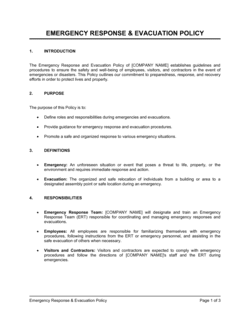
An Emergency Response Plan is a structured operational document that defines how a business detects, responds to, and recovers from emergencies β€” fires, natural disasters, security incidents, hazardous material releases, or critical system failures. This free Word download gives you a ready-to-edit framework covering roles, procedures, communication protocols, and recovery steps that you can customize to your site and export as PDF for staff distribution.
When you need it
Use it when opening a new facility, completing a regulatory compliance review, onboarding new staff, or updating procedures after an incident or near-miss. Many insurers and government regulators require a written emergency response plan before a business can operate.
What's inside
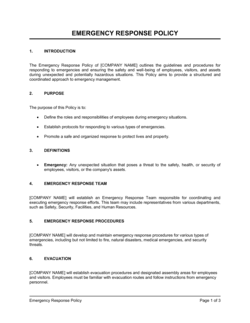
Purpose and scope, emergency contact directory, incident classification matrix, evacuation and shelter-in-place procedures, roles and responsibilities for the emergency response team, communication protocols, containment and first-response actions, business continuity and recovery steps, training schedule, and a plan review and revision log.

What is an Emergency Response Plan?

An Emergency Response Plan is a structured operational document that defines exactly how a business prepares for, responds to, and recovers from emergencies β€” fires, natural disasters, power failures, medical crises, chemical spills, or active security threats. It assigns specific response roles to named individuals, maps evacuation routes and assembly points, classifies incidents by severity, and sets communication protocols for notifying staff, external agencies, and insurers. Rather than leaving response actions to improvisation at the worst possible moment, a written plan converts institutional preparedness into step-by-step procedures any employee can follow.

Why You Need This Document

Without a written emergency response plan, response time slows β€” people wait for instructions that no one is authorized to give β€” and preventable injuries and property damage result from that delay. OSHA's Emergency Action Plan standard (29 CFR 1910.38) requires most US employers with more than 10 employees to maintain a written plan, and local fire codes, state regulations, and many commercial property insurers impose additional requirements. Beyond compliance, the operational stakes are direct: a facility that cannot demonstrate a credible, tested plan is more likely to face regulatory fines after an audit, pay higher insurance premiums, and sustain longer operational downtime following an incident. This template gives you a site-ready starting point β€” complete with classification criteria, role assignments, evacuation procedures, and a drill schedule β€” that you can customize to your facility in hours rather than weeks.

Which variant fits your situation?

If your situation is…Use this template
Multi-location business needing a single enterprise-wide frameworkBusiness Continuity Plan
IT or data infrastructure outage requiring a technology-focused planDisaster Recovery Plan
Office or building with a specific fire evacuation requirementFire Evacuation Plan
Public-facing event with crowd-safety and medical response needsEvent Emergency Plan
Healthcare or laboratory setting with biohazard or chemical exposure riskHazardous Materials Response Plan
School or childcare facility with lockdown and reunification protocolsSchool Emergency Response Plan
Supply chain or vendor disruption threatening ongoing operationsCrisis Management Plan

Common mistakes to avoid

❌ Assigning roles by department title instead of individual name

Why it matters: When a department is reorganized or the titleholder is away, the role is effectively vacant during the incident β€” response coordination breaks down immediately.

Fix: List first and last names plus direct mobile numbers for every emergency role, and update the directory within 5 business days of any personnel change.

❌ Single evacuation route per floor

Why it matters: A blocked or smoke-filled primary exit leaves occupants without a pre-approved path, increasing injury risk and making headcounts impossible at the assembly point.

Fix: Map at least two evacuation routes per zone and post laminated route cards at every exit door, not just the main stairwell entrance.

❌ No post-incident review trigger in the plan

Why it matters: Lessons from real incidents β€” near-misses included β€” are lost if the plan is only reviewed on a fixed annual schedule, compounding the same procedural failures.

Fix: Add a standing requirement: any Level 2 or Level 3 incident triggers a mandatory after-action review and plan update within 30 days of the event.

❌ Vague recovery criteria with no named authority to declare all-clear

Why it matters: Without a defined decision-maker and observable conditions for re-entry, either staff re-enter too early (safety risk) or operations stall because no one feels authorized to resume (financial cost).

Fix: State the exact conditions β€” written external clearance, IC sign-off, utility restoration β€” and the named role authorized to declare operations resumed.

The 10 key sections, explained

Purpose, scope, and objectives

Emergency contact directory

Hazard and risk identification

Roles and responsibilities

Incident classification and activation criteria

Evacuation and shelter-in-place procedures

Communication protocols

Containment and first-response actions

Recovery and return-to-operations

Training, drills, and plan review schedule

How to fill it out

  1. 1

    Identify your facility's specific hazards

    Walk the site and list every credible emergency scenario β€” fire, severe weather, power outage, medical crisis, chemical exposure, security threat. Score each by probability and potential impact to produce a prioritized hazard list.

    πŸ’‘ Check your insurance carrier's loss history for your building class and ZIP code β€” it surfaces risks that site walkthroughs routinely miss.

  2. 2

    Assign emergency roles to named individuals

    Designate an Incident Commander, at least one backup IC, Floor Wardens for each occupied floor or zone, a First Aid Officer, and a Communications Lead. Record the role and the person's direct mobile number.

    πŸ’‘ Assign backup designees for every role β€” not just the IC. Floor Wardens are the most frequently absent role during real incidents because their primary duties take them off-site.

  3. 3

    Map evacuation routes and assembly points

    Draw or obtain a floor plan for each level, mark all fire exits and stairwells, and designate at least two assembly points at a safe distance from the building. Label zones A, B, and C so wardens can manage headcounts separately.

    πŸ’‘ Post laminated route maps at every exit door β€” not just in the break room. OSHA requires them to be visible from any normal work position.

  4. 4

    Write the incident classification criteria

    Define Level 1, 2, and 3 incidents using specific, observable triggers β€” not subjective language. For each level, state exactly which response actions are activated and who is notified.

    πŸ’‘ Test your classifications by describing three past incidents at your facility and checking that each would have triggered the correct level β€” adjust where they don't.

  5. 5

    Build the emergency contact directory

    Compile internal responders and external agencies β€” fire department, police non-emergency, gas utility, hazmat, poison control, your insurer β€” with 24-hour numbers. Include a note on each contact's role in the response.

    πŸ’‘ Verify every external phone number by calling it before finalizing the plan. Published numbers for utilities and agencies change more often than most people expect.

  6. 6

    Draft procedure-specific response checklists

    For each top-priority hazard, write a numbered checklist of immediate actions any employee can follow without specialist knowledge. Keep each step to a single, observable action.

    πŸ’‘ Have a new employee read each checklist aloud and attempt to follow it β€” if they hesitate or ask for clarification, the language needs simplifying.

  7. 7

    Define recovery criteria and business continuity linkage

    State the observable conditions that authorize re-entry (written all-clear from fire marshal or IC), list the critical functions to restore first, and reference your Business Continuity Plan for extended outages.

    πŸ’‘ Sequence recovery by function priority: life safety systems, then payroll, then customer-facing operations β€” not by which manager asks loudest.

  8. 8

    Schedule drills and set a review owner

    Enter drill dates on the company calendar for the full year, assign a named owner for the annual plan review, and add a 30-day post-incident review trigger to the plan header.

    πŸ’‘ Announce drill dates to managers but not staff β€” an announced drill at shift change tests the plan under the most controlled conditions possible while still surfacing procedural gaps.

Frequently asked questions

What is an emergency response plan?

An emergency response plan is a written document that defines how a business detects, responds to, and recovers from emergencies β€” fires, natural disasters, security incidents, hazardous material releases, or critical infrastructure failures. It assigns roles, maps evacuation routes, establishes communication protocols, and sets recovery criteria so every employee knows exactly what to do without waiting for instructions.

Is an emergency response plan required by law?

In the United States, OSHA's Emergency Action Plan standard (29 CFR 1910.38) requires most employers with more than 10 employees to maintain a written emergency action plan. Local fire codes, state regulations, and industry-specific rules (healthcare, construction, hazardous materials) impose additional requirements. Many commercial property insurers also require a written plan as a condition of coverage. Check applicable federal, state, and local requirements for your industry and facility type.

What is the difference between an emergency response plan and a business continuity plan?

An emergency response plan covers the immediate response phase β€” protecting life, containing the incident, evacuating the building, and handing off to external agencies. A business continuity plan covers what comes after β€” how the organization restores critical functions, serves customers, and resumes normal operations over days or weeks. Both documents are needed; the emergency response plan should explicitly reference the business continuity plan at the recovery stage.

How often should an emergency response plan be updated?

At minimum, review and re-approve the plan annually, and update it within 30 days of any significant incident, near-miss, or organizational change β€” new facility, new hazards, personnel changes in key roles, or a failed drill. Outdated contact directories and obsolete evacuation routes are the two most common gaps found during regulatory audits.

Who should be involved in writing an emergency response plan?

The facilities manager or safety officer typically leads the effort, but the plan requires input from HR (personnel rosters), IT (system recovery), department heads (critical function priorities), and representatives from each floor or shift who will serve as Floor Wardens. External input from your local fire department β€” many offer free site walk-throughs β€” significantly improves the quality of evacuation procedures and hazard identification.

What drills are required to support an emergency response plan?

OSHA and most local fire codes require at least one fire evacuation drill per year for many occupancy types; schools and healthcare facilities face more frequent requirements. Best practice is quarterly unannounced fire drills, an annual full-scale tabletop exercise for the Emergency Response Team, and a shelter-in-place drill at least once per year. Document every drill and include the after-action findings in the plan's revision log.

Can a small business use a template, or does the plan need to be custom-drafted?

Most small businesses β€” under 100 employees, single location, standard occupancy β€” can produce a compliant, effective plan by adapting a quality template with site-specific details: accurate floor plans, named role holders, facility-specific hazards, and correct external contact numbers. Businesses with hazardous materials, multi-site operations, or complex regulatory requirements benefit from engaging a safety consultant to review the completed template before it is finalized.

What is a tabletop exercise, and why does it matter?

A tabletop exercise is a facilitated discussion-based drill where the Emergency Response Team walks through a simulated incident scenario β€” step by step, in a conference room β€” to test their knowledge of the plan without physically evacuating. It surfaces gaps in role clarity, communication failures, and decision-making bottlenecks in about 90 minutes, at zero disruption to operations. Most organizations that conduct tabletops discover at least one material gap in their written plan.

What should be posted in the workplace to support the emergency response plan?

At minimum: laminated evacuation route maps at every exit, the emergency contact directory in a visible location near each main phone or workstation, and AED and first-aid kit locations marked on posted floor plans. Many facilities also post the incident classification summary and the assembly point diagram at building entrances. These physical postings must be updated whenever the plan changes β€” outdated posted materials are a common audit finding.

How this compares to alternatives

vs Business Continuity Plan

An emergency response plan governs the immediate incident phase β€” life safety, evacuation, containment, and handoff to external agencies. A business continuity plan governs the recovery phase β€” restoring critical functions and resuming operations over days or weeks after the incident is contained. The two documents are complementary and should cross-reference each other, but they address different time horizons and audiences.

vs Crisis Management Plan

A crisis management plan focuses on organizational decision-making, stakeholder communication, and reputational response during high-visibility events β€” product recalls, data breaches, executive misconduct. An emergency response plan focuses on physical site safety and operational containment. A major incident often requires activating both simultaneously.

vs Disaster Recovery Plan

A disaster recovery plan is specifically concerned with restoring IT systems, data, and technology infrastructure after a disruption. An emergency response plan addresses the full spectrum of physical and operational emergencies at a facility level, of which an IT outage is only one scenario. Organizations with significant IT dependencies need both.

vs Health and Safety Policy

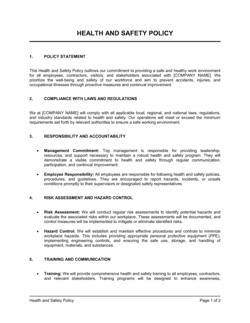
A health and safety policy states the organization's principles, responsibilities, and commitments to workplace safety β€” it is a governance document. An emergency response plan is an operational procedure document that defines exactly what to do when something goes wrong. The policy establishes the obligation; the emergency response plan fulfills it.

Industry-specific considerations

Manufacturing and warehousing

Chemical storage, heavy machinery hazards, and shift-change coordination require hazmat response checklists and zone-based muster lists tied to production areas.

Healthcare and life sciences

Patient evacuation protocols, infection-control containment procedures, and Joint Commission or CMS compliance requirements add layers beyond standard occupancy plans.

Construction

Active jobsite permits in most jurisdictions require a site-specific emergency response plan covering fall rescue, trenching collapse, and equipment accident procedures.

Retail and hospitality

High customer volume, variable staffing, and public-facing locations require clear procedures for active threat scenarios, medical emergencies, and crowd-management during evacuation.

Education and childcare

Lockdown, reunification, and parent notification protocols are legally mandated in most states and require more frequent drills and documented staff training than standard commercial occupancies.

Professional services and office

Lower physical hazard profiles mean fire, medical emergency, and severe weather are the primary scenarios, but multi-tenant buildings require coordination with property management on shared evacuation procedures.

Template vs pro β€” what fits your needs?

PathBest forCostTime
Use the templateSmall to mid-size businesses with a single location, standard occupancy, and no hazardous materialsFree4–8 hours to complete and customize
Template + professional reviewMulti-floor offices, light manufacturing, or any facility subject to OSHA, fire code, or insurer audit requirements$300–$1,500 for a safety consultant review1–2 weeks
Custom draftedHazardous materials facilities, healthcare, construction sites, multi-location enterprises, or regulated industries with mandatory third-party approval$2,000–$10,000+ depending on facility complexity4–10 weeks

Glossary

Incident Commander
The designated person who takes operational control during an emergency, coordinates response activities, and serves as the primary decision-maker until normal operations resume.
Evacuation Assembly Point
A pre-identified outdoor location where staff gather after evacuating a building so a headcount can be taken and accounted for.
Shelter-in-Place
A procedure directing occupants to remain inside the building and seal off ventilation during an external chemical, biological, or hazardous air-quality event.
Incident Classification
A tiered severity rating β€” typically Level 1 (minor), Level 2 (moderate), Level 3 (major) β€” that determines which response procedures and escalation paths are activated.
Emergency Response Team (ERT)
A trained group of designated employees responsible for executing specific response tasks β€” first aid, floor warden duties, communication, or equipment shutdown β€” during an incident.
After-Action Report
A structured debrief document completed after a real incident or drill that records what happened, what worked, what failed, and what changes the plan requires.
Business Continuity
The capability of an organization to maintain or quickly resume essential functions after a disruptive event β€” addressed in the recovery phase of an emergency response plan.
Muster List
A roster of all personnel assigned to a specific zone or building, used during evacuation to verify that everyone has exited safely.
Chain of Command
The ordered hierarchy of authority and delegation within the emergency response structure, defining who acts when the primary Incident Commander is unavailable.
Hazard Vulnerability Assessment (HVA)
A risk-scoring exercise that identifies the emergencies most likely to affect a specific facility and ranks them by probability and potential impact.

Part of your Business Operating System

This document is one of 3,000+ business & legal templates included in Business in a Box.

  • Fill-in-the-blanks β€” ready in minutes
  • 100% customizable Word document
  • Compatible with all office suites
  • Export to PDF and share electronically

Create your document in 3 simple steps.

From template to signed document β€” all inside one Business Operating System.
1
Download or open template

Access over 3,000+ business and legal templates for any business task, project or initiative.

2
Edit and fill in the blanks with AI

Customize your ready-made business document template and save it in the cloud.

3
Save, Share, Send, Sign

Share your files and folders with your team. Create a space of seamless collaboration.

Save time, save money, and create top-quality documents.

β˜…β˜…β˜…β˜…β˜…

"Fantastic value! I'm not sure how I'd do without it. It's worth its weight in gold and paid back for itself many times."

Managing Director Β· Mall Farm
Robert Whalley
Managing Director, Mall Farm Proprietary Limited
β˜…β˜…β˜…β˜…β˜…

"I have been using Business in a Box for years. It has been the most useful source of templates I have encountered. I recommend it to anyone."

Business Owner Β· 4+ years
Dr Michael John Freestone
Business Owner
β˜…β˜…β˜…β˜…β˜…

"It has been a life saver so many times I have lost count. Business in a Box has saved me so much time and as you know, time is money."

Owner Β· Upstate Web
David G. Moore Jr.
Owner, Upstate Web

Run your business with a system β€” not scattered tools

Stop downloading documents. Start operating with clarity. Business in a Box gives you the Business Operating System used by over 250,000 companies worldwide to structure, run, and grow their business.

Start freeΒ Β·Β No credit card required