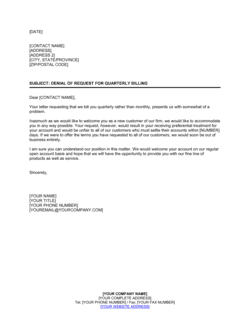
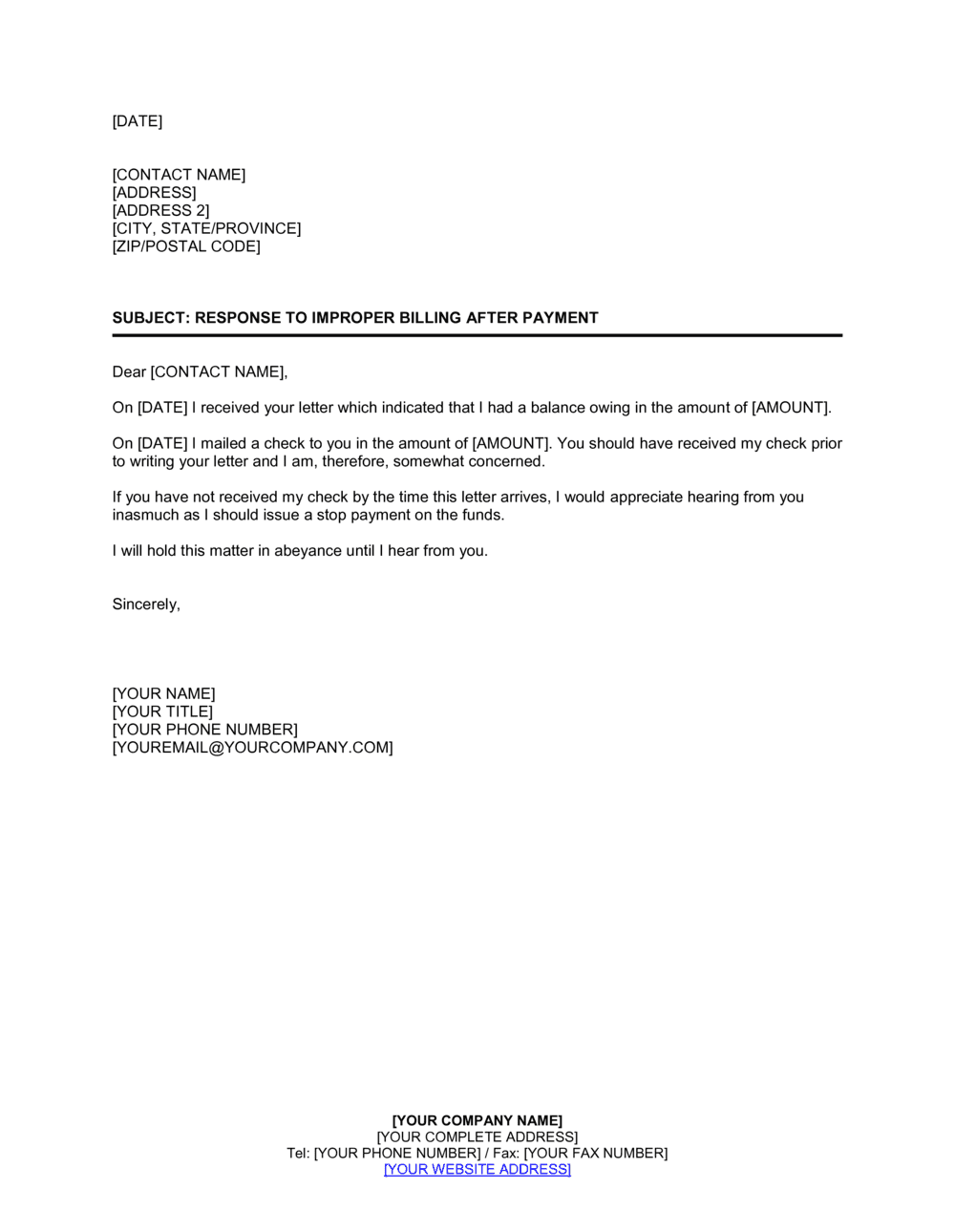
Response to Improper Billing after Payment Template

Free Word download • Edit online • Save & share with Drive • Export to PDF

1 page20–30 min to fillDifficulty: StandardSignature requiredLegal review recommended
Learn more ↓
FreeResponse to Improper Billing after Payment Template

At a glance

What it is
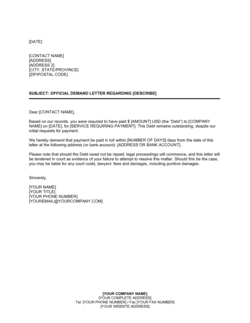
A Response To Improper Billing After Payment is a formal written letter a business or individual sends to a vendor, supplier, or service provider to dispute erroneous charges that appeared on an invoice after payment has already been made. This free Word download gives you a structured, professionally formatted document you can edit online and send as a PDF or hard copy to initiate a refund, credit, or correction.
When you need it
Use it when you discover a duplicate charge, an amount billed beyond the agreed contract price, a charge for goods or services not received, or any unauthorized line item after you have already remitted payment. It is also appropriate when a vendor continues to send follow-up invoices for an amount that has already been settled.
What's inside
Identification of the parties and original invoice references, a clear statement of the billing error and the amount in dispute, the legal and contractual basis for the objection, a demand for correction or refund, supporting documentation references, and a deadline for response — all in a format designed to serve as a formal record if escalation becomes necessary.

What is a Response To Improper Billing After Payment?

A Response To Improper Billing After Payment is a formal written letter a business or individual sends to a vendor, supplier, or service provider to dispute erroneous charges that arose after the original invoice has already been paid in full. It may address a duplicate invoice for the same period, a charge that exceeds the contracted rate, an unauthorized fee added after settlement, or continued billing demands for an account that has already been settled. The letter establishes a documented legal record of the dispute, cites the contractual or legal basis for the objection, and demands a specific remedy — refund, credit note, or written cancellation — within a defined timeframe. Unlike an informal email, a properly executed dispute letter starts the clock on the vendor's response obligation and preserves all of the sender's rights if the matter escalates to arbitration or litigation.

Why You Need This Document

Without a formal written dispute letter, an improper post-payment charge can quietly become an accepted liability — vendors treat silence as acquiescence, and courts treat it as conduct consistent with owing the money. An undocumented dispute also leaves you without evidence when the vendor's accounts receivable department refers the amount to a collection agency or reports a delinquency. A well-drafted response to improper billing does four things simultaneously: it puts the vendor on formal notice with a paper trail, it cites the specific legal and contractual basis so the vendor cannot claim the dispute is unclear, it sets a deadline with stated consequences that accounts receivable departments take seriously, and it reserves all further legal rights including interest recovery and cost claims. This template gives you a professionally structured, legally sound starting point in under an hour — at a fraction of the cost of having a lawyer draft the same letter from scratch.

Which variant fits your situation?

If your situation is…Use this template
Disputing a duplicate charge for the same invoice or service periodResponse To Improper Billing After Payment (Duplicate Charge)
Challenging a charge that exceeds the agreed contract priceResponse To Improper Billing After Payment (Contract Overcharge)
Objecting to charges for goods or services never receivedResponse To Improper Billing After Payment (Undelivered Services)
Requesting a formal credit note to offset a future invoiceCredit Note Request Letter
Sending a first formal demand before filing a chargebackDemand For Refund Letter
Vendor refuses to acknowledge the dispute and collections contact beginsResponse To Collection Agency
Escalating an unresolved billing dispute to a formal legal demandDemand Letter

Common mistakes to avoid

❌ Sending the dispute without proof of original payment

Why it matters: A vendor can deny receipt of the original payment or claim the funds were applied to a different invoice, forcing you to locate evidence under time pressure while the dispute stalls.

Fix: Attach remittance advice, a bank wire confirmation, or a cleared check image to the very first letter. Proof of payment is non-negotiable in any billing dispute.

❌ Using vague language to describe the billing error

Why it matters: Descriptions like 'the invoice is incorrect' give the vendor's accounting team no actionable information, allowing them to respond with a generic 'we are looking into it' and delay indefinitely.

Fix: Name the specific line item, the dollar amount in dispute, the invoice number of the erroneous billing, and the precise reason it is improper — duplicate, overcharge, or unauthorized charge.

❌ Setting a response deadline with no stated consequence

Why it matters: Accounts receivable departments routinely deprioritize dispute letters that carry no consequence for inaction — the deadline becomes meaningless and the dispute drags on for months.

Fix: State explicitly what will happen if the deadline is missed: chargeback filing, payment withholding, referral to legal counsel, or a regulatory complaint. Choose consequences you are actually prepared to follow through on.

❌ Omitting the reservation of rights clause

Why it matters: Without it, a vendor may characterize your letter as a full and final resolution of the dispute, limiting your ability to claim interest on the overpayment, recover legal costs, or pursue further remedies if they only partially correct the error.

Fix: Include a standard reservation of rights paragraph in every dispute letter, regardless of how amicable the vendor relationship is.

❌ Sending the letter to a general inbox rather than the correct contact

Why it matters: Billing disputes sent to a generic 'info@' or 'accounts@' address are frequently lost, ignored, or routed to a customer service representative with no authority to issue refunds or credit notes.

Fix: Address the letter to the vendor's accounts receivable manager or controller by name, copy their legal department, and use a delivery method — certified mail or courier — that generates a signed acknowledgment of receipt.

❌ Waiting too long to send the dispute letter

Why it matters: Many contracts include a billing dispute window — typically 30 to 90 days from the invoice date — after which disputes are deemed waived. Statutory limitations periods for overpayment recovery also begin running from the payment date in most jurisdictions.

Fix: Issue the dispute letter as soon as the erroneous billing is discovered. If you are approaching a contract dispute deadline, note that deadline explicitly in the letter and send it before it expires.

The 9 key clauses, explained

Identification of Parties and Reference Documents

In plain language: Identifies both the sender and the billing party by legal name and contact information, and cites the specific invoice number, date, purchase order, and contract reference being disputed.

Sample language
This letter is submitted by [COMPANY NAME], [ADDRESS] ('Payor'), to [VENDOR LEGAL NAME], [ADDRESS] ('Vendor'), regarding Invoice No. [INVOICE NUMBER] dated [INVOICE DATE], issued under Contract No. [CONTRACT NUMBER] / Purchase Order No. [PO NUMBER].

Common mistake: Referencing only the invoice number without citing the underlying contract or PO. Without the contract reference, the vendor can dispute what pricing terms were actually agreed upon.

Statement of Payment Already Made

In plain language: Confirms that the original invoice was paid in full, states the payment amount, method, and date, and attaches or references proof of payment such as a bank confirmation or remittance advice.

Sample language
Payor remitted full payment of $[AMOUNT] on [DATE] via [PAYMENT METHOD — wire transfer / ACH / check no. [NUMBER]]. A copy of the remittance advice and bank confirmation is attached hereto as Exhibit A.

Common mistake: Stating payment was made without attaching evidence. A bare assertion invites the vendor to deny receipt, which stalls the dispute and shifts the burden of proof.

Description of the Billing Error

In plain language: Describes specifically what is wrong with the post-payment billing — the nature of the error (duplicate charge, overcharge, unauthorized fee, or charge for undelivered services), the amount in dispute, and how the error was identified.

Sample language
Subsequent to the above payment, Vendor issued [Invoice No. / a statement dated [DATE]] in the amount of $[AMOUNT], which [duplicates the charge already paid / exceeds the contracted rate of $[RATE] by $[EXCESS AMOUNT] / includes a charge of $[AMOUNT] for [DESCRIPTION OF UNAUTHORIZED LINE ITEM]].

Common mistake: Writing a vague description like 'the amount is incorrect' without specifying the exact line item, dollar amount in dispute, and the reason it is improper. Vagueness allows the vendor to claim the dispute is unclear and delay action.

Contractual and Legal Basis for Objection

In plain language: Cites the specific contract clause, rate schedule, or statutory provision that establishes the vendor had no right to issue the additional charge.

Sample language
Pursuant to Section [X] of the Agreement dated [DATE], the total fees for [SERVICE / GOODS] are fixed at $[AMOUNT] per [PERIOD / UNIT]. No additional charges may be assessed without prior written authorization from Payor. The amount now claimed by Vendor has no contractual basis.

Common mistake: Omitting any legal or contractual foundation and relying solely on a factual description of the error. Without citing the governing agreement, the letter reads as a complaint rather than a formal legal objection.

Demand for Correction, Refund, or Credit

In plain language: States precisely what the sender requires — a written confirmation that the erroneous invoice is cancelled, a refund of the overpaid amount, or the issuance of a credit note — and the form in which it should be delivered.

Sample language
Payor demands that Vendor: (a) issue a written confirmation cancelling Invoice No. [NUMBER] in its entirety within [X] business days; and/or (b) remit a refund of $[AMOUNT] to [BANK / ADDRESS] by [DATE]; and/or (c) issue a Credit Note in the amount of $[AMOUNT] to be applied against [NEXT INVOICE / FUTURE ACCOUNT].

Common mistake: Requesting a correction without specifying the form, amount, or delivery method. An open-ended demand gives the vendor discretion to respond with a partial credit or a token acknowledgment that does not resolve the dispute.

Response Deadline and Consequences of Non-Response

In plain language: Sets a specific deadline — typically 10 to 30 business days — for the vendor to respond or act, and states clearly what escalation steps will follow if the deadline is missed.

Sample language
Vendor is required to respond in writing and take corrective action no later than [DATE], being [X] business days from the date of this letter. Failure to do so will leave Payor with no alternative but to [withhold future payments / initiate a chargeback / refer the matter to legal counsel / file a complaint with [REGULATORY BODY]].

Common mistake: Setting a deadline without stating the consequence of missing it. A deadline with no stated consequence is routinely ignored by vendor accounts-receivable departments.

Reservation of Rights

In plain language: Preserves the sender's right to pursue all available legal and equitable remedies — including recovery of legal costs, interest on overpayments, and damages — without the letter being construed as a waiver.

Sample language
Nothing in this letter shall be construed as a waiver of any rights or remedies available to Payor under the Agreement, at law, or in equity, all of which are expressly reserved. Payor reserves the right to seek recovery of any costs, interest, or damages incurred as a result of Vendor's improper billing.

Common mistake: Omitting a reservation of rights entirely. Without it, a vendor may argue that the letter represents a final settlement of the issue, limiting the sender's ability to claim interest or costs later.

Without Prejudice Designation (Optional)

In plain language: Labels the letter 'without prejudice' to prevent its contents from being used as an admission in subsequent litigation, while still putting the vendor on formal written notice.

Sample language
This letter is sent on a without prejudice basis and without any admission of liability. It is intended solely to facilitate resolution of the billing dispute described herein and shall not be construed as a waiver of any rights or claims.

Common mistake: Using 'without prejudice' as a blanket disclaimer on all dispute correspondence regardless of context. In some jurisdictions — notably the UK and Canada — the designation has specific procedural effects and should only be used when the letter contains settlement proposals or admissions.

Signature and Authorization Block

In plain language: Identifies the authorized signatory — name, title, and company — and confirms that the person sending the letter has authority to bind the company to the dispute.

Sample language
Sincerely, [SIGNATORY FULL NAME] | [TITLE] | [COMPANY LEGAL NAME] | [DATE] | cc: [LEGAL COUNSEL / ACCOUNTS PAYABLE FILE]

Common mistake: Having a junior accounts payable clerk sign a formal legal dispute letter without confirming they have signatory authority. Vendors and their legal counsel will challenge whether the letter was authorized, potentially invalidating it as formal notice.

How to fill it out

  1. 1

    Gather all supporting documents before drafting

    Collect the original contract or purchase order, the paid invoice, your remittance advice or bank confirmation, and the erroneous subsequent billing. You need specific dollar amounts, dates, and document numbers before writing a single sentence.

    💡 A billing dispute that arrives with exhibits attached is resolved in days; one without evidence is debated for weeks. Attach everything in the first letter.

  2. 2

    Identify the exact nature and amount of the billing error

    Determine whether the error is a duplicate charge, an overcharge above the contracted rate, an unauthorized fee, or a charge for services not rendered. Calculate the specific dollar amount in dispute and confirm it against your records.

    💡 If multiple errors appear on the same invoice, list each one separately with its own amount — a combined 'the total is wrong' description makes the vendor's accounting team's job harder and slows resolution.

  3. 3

    Enter the parties, invoice references, and contract details

    Complete the identification clause with both parties' full legal names, addresses, the invoice number, the invoice date, and the contract or PO number that governs the relationship. Include your internal reference number if your AP system uses one.

    💡 Match the vendor's legal name exactly as it appears on their invoice — using a trade name instead of the registered entity can create ambiguity about who the letter is addressed to.

  4. 4

    Document the original payment with proof

    State the exact amount paid, the payment date, and the method. Reference the remittance advice and attach a copy of your bank confirmation or cleared check image as Exhibit A.

    💡 A wire transfer reference number or ACH trace ID is the strongest payment proof — it creates a unique transaction identifier that cannot be disputed.

  5. 5

    Draft the description of the billing error with specifics

    Describe the error in plain terms: what was billed, what had already been paid, the exact line item or amount in dispute, and when you discovered the discrepancy. Cite the specific invoice number of the erroneous billing.

    💡 Write as if the reader is an accounts payable supervisor who was not involved in the original transaction — do not assume they know the history.

  6. 6

    Cite the governing contract clause or legal principle

    Reference the specific section of your agreement that limits fees to the contracted amount, or cite the legal principle — such as unjust enrichment — that applies if no contract clause directly addresses the error.

    💡 If your contract has a billing dispute or audit clause, cite it by section number — it typically grants you an explicit right to dispute and sets the vendor's response obligation.

  7. 7

    State your demand precisely and set a deadline

    Specify whether you want a refund, a credit note, a cancellation confirmation, or all three. Set a deadline of 10 to 30 business days from the letter date and state what action you will take if the deadline is not met.

    💡 A 15-business-day deadline is specific enough to create urgency without being unreasonable — it gives the vendor's accounting team time to act while maintaining pressure.

  8. 8

    Have an authorized officer sign and retain a dated copy

    Confirm the signatory has authority to bind the company, sign and date the letter, and send it by a method that creates a delivery record — certified mail, courier, or email with read receipt. File the original with your accounts payable records.

    💡 Send the letter to both the vendor's accounts receivable contact and their general counsel or legal department simultaneously — it signals you are prepared to escalate and often accelerates resolution.

Frequently asked questions

What is a response to improper billing after payment?

A response to improper billing after payment is a formal written letter sent to a vendor or service provider to dispute charges that are incorrect, duplicated, or unauthorized — after you have already paid the original invoice. It creates a documented record of the dispute, states the legal and contractual basis for the objection, and demands a specific remedy such as a refund or credit note within a defined timeframe.

When should I send a billing dispute letter after payment?

Send it as soon as you identify the error — typically within 30 days of receiving the erroneous billing or discovering the discrepancy in your accounts. Many commercial contracts include a dispute window of 30 to 90 days from invoice date, after which claims may be waived. Waiting also allows interest to accrue on an overpayment you are entitled to recover, and gives the vendor grounds to argue the charge was accepted by conduct.

Does a billing dispute letter need to be signed?

Yes. A billing dispute letter should be signed by an authorized officer or signatory of the disputing company — someone with authority to bind the business to the legal position set out in the letter. An unsigned letter or one signed by an unauthorized employee can be challenged by the vendor as informal correspondence rather than formal legal notice, weakening its effect as a record if the matter escalates.

What should I attach to a billing dispute letter?

At minimum: a copy of the erroneous invoice being disputed, a copy of the original paid invoice, proof of the original payment (bank wire confirmation, ACH trace, cleared check, or remittance advice), and the relevant section of the governing contract or purchase order. The more documentation you attach in the first letter, the fewer rounds of back-and-forth are needed before the vendor acts.

Can I withhold future payments while a billing dispute is pending?

This depends on the terms of your contract and the jurisdiction. Many commercial agreements include a set-off right allowing you to withhold the disputed amount from future invoices pending resolution. In the absence of a contractual set-off clause, withholding payment on an unrelated invoice carries risk of a breach of contract claim. Consider consulting a lawyer before withholding payment, particularly for large or ongoing vendor relationships.

What happens if the vendor ignores my billing dispute letter?

If the vendor does not respond by your stated deadline, your next steps typically include filing a chargeback with your bank or credit card issuer (if the payment was made by card and within the chargeback window), withholding the disputed amount from future payments under a contractual set-off right, referring the matter to a collections or dispute resolution service, or instructing legal counsel to send a formal demand letter. The dispute letter itself becomes critical evidence in any subsequent proceeding.

Is a billing dispute letter legally binding?

The letter itself is not a binding contract, but it creates a formal legal record that the dispute was raised, the amount was identified, and a deadline was given. This record is material in any subsequent legal proceedings, arbitration, or regulatory complaint. A well-drafted letter also starts the clock on any response obligations the vendor has under your contract or applicable consumer or commercial law.

Can I use this letter for medical billing disputes?

Yes, with adaptation. Medical billing disputes follow the same core structure — identify the error, reference the explanation of benefits or insurance adjudication, state what was already paid, and demand correction. However, medical billing disputes in the US are also governed by specific regulations including the No Surprises Act and state balance-billing laws, so consulting a healthcare billing advocate or attorney is advisable for disputes above a material threshold.

How this compares to alternatives

vs Demand For Refund Letter

A demand for refund letter is used when a buyer seeks return of payment for a product or service that was defective, not delivered, or cancelled. A response to improper billing after payment is narrower — it specifically challenges the billing itself as erroneous or unauthorized, rather than the underlying transaction. Use the billing dispute letter when payment was correct at the time but a subsequent invoice is wrong; use the demand for refund when the original transaction itself entitles you to your money back.

vs Response To A Collection Agency

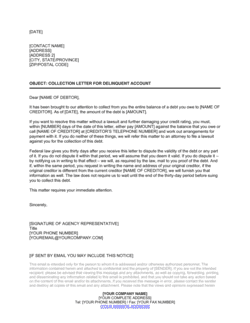
A response to a collection agency is sent after a debt has been passed to a third-party collector and disputes the validity or amount of the debt in that context. A response to improper billing after payment is sent directly to the original vendor before any collections involvement, disputing the billing at its source. If a vendor has already referred the disputed amount to a collector, a response to collection agency letter is the more appropriate next step.

vs Invoice Dispute Letter

A general invoice dispute letter is used to challenge an invoice before payment is made — disputing the amount, the work performed, or the terms before funds leave your account. A response to improper billing after payment is the post-payment counterpart: it establishes that you have already paid, making the subsequent billing a double-charge or unauthorized claim rather than a pre-payment disagreement. The legal framing and remedy demanded differ significantly between the two scenarios.

vs Credit Note

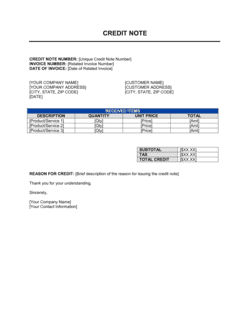
A credit note is the document a vendor issues to acknowledge and correct an overbilling — it is the resolution, not the initiating action. A response to improper billing after payment is the letter you send to the vendor to demand that they issue a credit note or refund. One drives the process; the other is the outcome. Both documents should be retained together in your accounts payable file to close the dispute cleanly.

Industry-specific considerations

Professional Services

Law firms, accounting practices, and consultants frequently encounter post-engagement billing adjustments; a formal dispute letter preserves the client's right to challenge time entries or disbursement charges added after the final invoice was paid.

Healthcare

Hospitals and clinics are subject to balance-billing regulations and insurance adjudication rules; a written dispute letter is the required first step before escalating to a state insurance commissioner or using the No Surprises Act process.

Construction and Trades

Subcontractor overbilling for materials, change orders billed after final payment, or disputed retention releases make written dispute letters an essential part of project close-out documentation.

Retail and E-commerce

Supplier chargebacks, freight cost disputes, and vendor compliance fees billed after confirmed delivery require documented disputes to protect margins and maintain clean accounts payable records.

Jurisdictional notes

United States

Commercial billing disputes are primarily governed by the UCC Article 2 (for goods) and state common law (for services). The statute of limitations for an action to recover an overpayment typically runs 3–6 years depending on the state, starting from the date of payment. Healthcare billing disputes are additionally governed by the No Surprises Act and state balance-billing laws. Some states require a specific written demand before a civil suit can proceed.

Canada

Limitation periods for recovering overpayments are generally 2 years from discovery of the error in most provinces under basic limitation acts. Quebec's Civil Code provides a 3-year limitation period. Commercial contracts governed by provincial sale of goods legislation may impose additional dispute procedures. Quebec requires dispute correspondence affecting Quebec-based parties to be in French unless both parties agree otherwise.

United Kingdom

The Limitation Act 1980 provides a 6-year limitation period for contract claims in England and Wales, including claims for overpayment recovery. The Late Payment of Commercial Debts (Interest) Act 1998 allows businesses to claim statutory interest on undisputed debts, and the same principle supports interest claims on amounts wrongly extracted. Pre-action protocols under the Civil Procedure Rules require a formal letter of claim before issuing proceedings, making a well-drafted dispute letter an essential procedural step.

European Union

Limitation periods vary significantly across EU member states — from 2 years in Germany to 5 years in France and Spain under general civil law. The EU Late Payment Directive (2011/7/EU) establishes that invoices not corresponding to agreed terms are not due, supporting the position that post-payment overbilling creates an immediate right of recovery. GDPR considerations apply when the dispute correspondence contains personal data of employees or contacts.

Template vs lawyer — what fits your deal?

PathBest forCostTime
Use the templateStandard overbilling or duplicate-charge disputes with a known vendor on a clear contractFree30–60 minutes
Template + legal reviewDisputes involving amounts above $5,000, ongoing vendor relationships, or contracts with complex set-off or dispute resolution clauses$150–$400 for a lawyer review1–2 business days
Custom draftedHigh-value disputes, healthcare billing regulatory matters, or situations where litigation or arbitration is likely$500–$2,000+3–7 business days

Glossary

Improper Billing
Any invoice or charge that does not accurately reflect the goods delivered, services rendered, or price agreed upon in the underlying contract or purchase order.
Duplicate Invoice
An invoice issued for the same transaction, period, or service that has already been billed and paid, resulting in the payer being charged twice.
Overcharge
A billed amount that exceeds the agreed contract price, rate schedule, or quoted figure — whether due to error, unauthorized fee addition, or rate discrepancy.
Credit Note
A document issued by the vendor that reduces or cancels a previously sent invoice, used to formally acknowledge an overbilling and offset the amount against future invoices or trigger a refund.
Purchase Order (PO)
A buyer-issued document authorizing a specific purchase at a defined price; invoices that exceed the PO amount are improper and form the basis for a billing dispute.
Accounts Payable
The internal function responsible for processing, approving, and paying vendor invoices; the typical origin of billing dispute correspondence in larger organizations.
Statute of Limitations
The legally defined window within which a party must file a claim or formal dispute; for billing disputes this varies by jurisdiction and contract terms.
Without Prejudice
A designation on a letter indicating that its contents cannot be used as an admission of liability in subsequent legal proceedings — useful when the full dispute is not yet resolved.
Unjust Enrichment
A legal principle holding that a party who receives a benefit — such as a double payment — to which they are not entitled must return it.
Estoppel
A legal doctrine that can prevent a creditor from pursuing additional payment if their prior conduct, such as issuing a receipt or confirming settlement, indicated the debt was satisfied.
Remittance Advice
A document sent with a payment that identifies which invoices are being paid, the amounts applied, and any deductions — used as proof of payment in billing disputes.
Cure Period
A defined number of days given to the billing party to correct an error or issue a refund before the disputing party escalates to legal remedies.

Part of your Business Operating System

This document is one of 3,000+ business & legal templates included in Business in a Box.

  • Fill-in-the-blanks — ready in minutes
  • 100% customizable Word document
  • Compatible with all office suites
  • Export to PDF and share electronically

Create your document in 3 simple steps.

From template to signed document — all inside one Business Operating System.
1
Download or open template

Access over 3,000+ business and legal templates for any business task, project or initiative.

2
Edit and fill in the blanks with AI

Customize your ready-made business document template and save it in the cloud.

3
Save, Share, Send, Sign

Share your files and folders with your team. Create a space of seamless collaboration.

Save time, save money, and create top-quality documents.

★★★★★

"Fantastic value! I'm not sure how I'd do without it. It's worth its weight in gold and paid back for itself many times."

Managing Director · Mall Farm
Robert Whalley
Managing Director, Mall Farm Proprietary Limited
★★★★★

"I have been using Business in a Box for years. It has been the most useful source of templates I have encountered. I recommend it to anyone."

Business Owner · 4+ years
Dr Michael John Freestone
Business Owner
★★★★★

"It has been a life saver so many times I have lost count. Business in a Box has saved me so much time and as you know, time is money."

Owner · Upstate Web
David G. Moore Jr.
Owner, Upstate Web

Run your business with a system — not scattered tools

Stop downloading documents. Start operating with clarity. Business in a Box gives you the Business Operating System used by over 250,000 companies worldwide to structure, run, and grow their business.

Start free · No credit card required