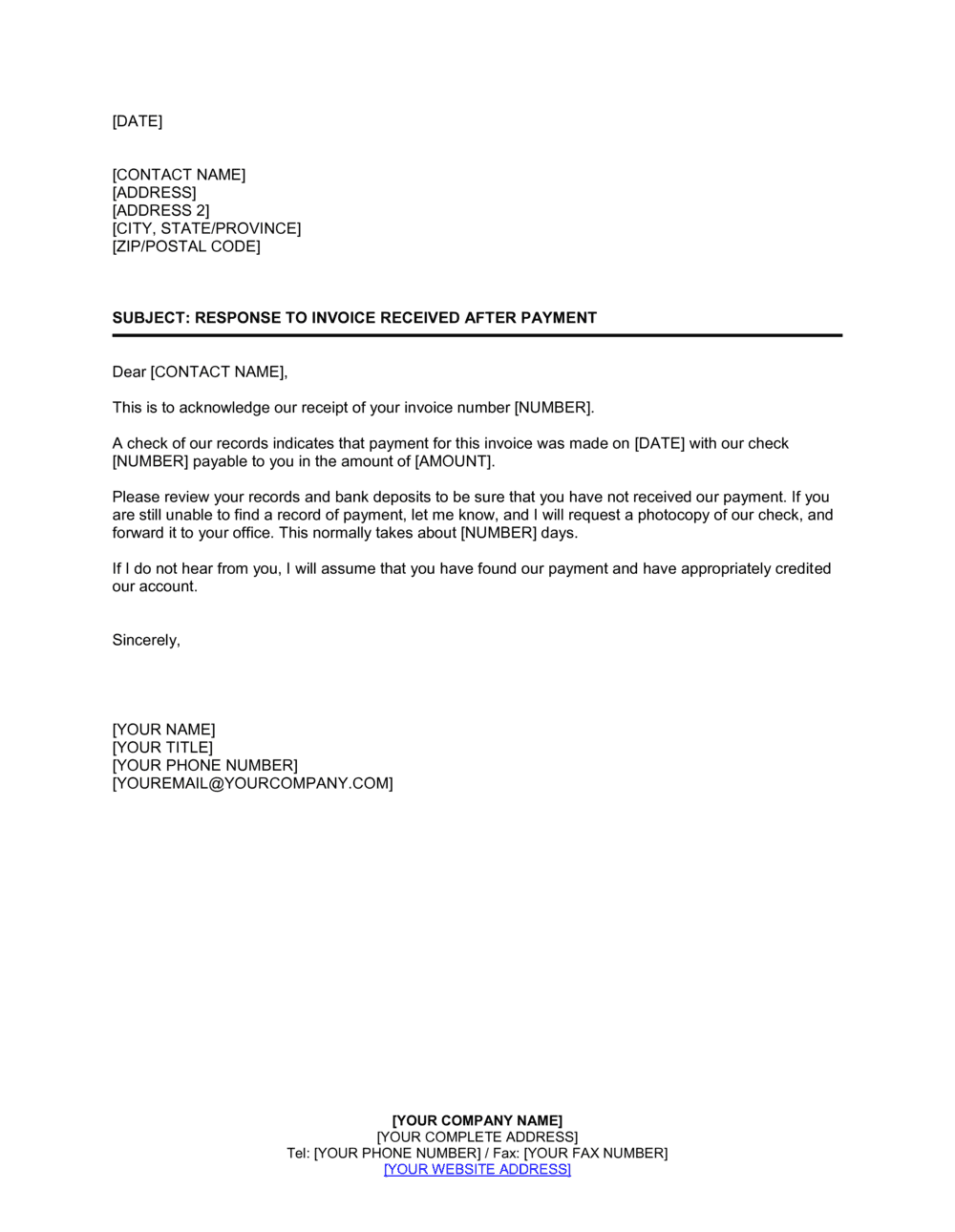
Response to Invoice Received after Payment Template

Free Word download β€’ Edit online β€’ Save & share with Drive β€’ Export to PDF

1 pageβ€’20–30 min to fillβ€’Difficulty: Standardβ€’Signature requiredβ€’Legal review recommended
Learn more ↓
FreeResponse to Invoice Received after Payment Template

At a glance

What it is
A Response To Invoice Received After Payment is a formal written notice an accounts payable department or business owner sends to a vendor or supplier when an invoice arrives after payment for the underlying goods or services has already been remitted. This free Word download lets you document the prior payment, reference the original transaction details, and formally close the matter β€” all in a single letter you can edit online and export as PDF.
When you need it
Use it any time a supplier sends an invoice for work or goods you have already paid for β€” whether the payment preceded the invoice due to a billing delay, a miscommunication, or a duplicate billing cycle. It is also appropriate when a vendor re-issues a previously settled invoice under a new number.
What's inside
Sender and recipient identification, reference to the original purchase order or agreement, proof-of-payment details including date and method, a clear statement that no further payment is owed, a request for written confirmation of closure, and a record-retention notice β€” all formatted as a signed formal business letter.

What is a Response To Invoice Received After Payment?

A Response To Invoice Received After Payment is a formal written notice a buyer or accounts payable department sends to a vendor when a billing document arrives after the underlying obligation has already been fully settled. It functions simultaneously as a notification letter, a documented proof-of-payment record, and a formal request to close the vendor's accounts receivable entry β€” all in a single signed correspondence. The letter cites the original purchase order or agreement, identifies the late invoice by number and amount, states the prior payment date and bank-level reference, and formally declares that no further remittance will be made. Because it creates a timestamped paper trail referencing specific transaction identifiers, it is the document that transforms a verbal "we already paid you" into a legally defensible written record.

Why You Need This Document

Ignoring a late vendor invoice β€” even one you know was already paid β€” is one of the more expensive administrative habits a business can develop. Without a formal written response, the invoice remains open in the vendor's accounts receivable system, triggering automated payment reminders, late-fee notices, and, in time, potential referral to a collection agency. A collection referral for a legitimately paid obligation can affect your business credit profile and takes weeks to reverse even after the error is acknowledged. AP teams that respond informally by phone create no record; a call that the vendor's representative doesn't document might as well not have happened. This template closes the matter in writing, in a format that vendor AR departments, collections agencies, and courts can act on immediately β€” protecting your cash flow records, your vendor relationship, and your credit standing with a single 15-minute document.

Which variant fits your situation?

If your situation is…Use this template
Invoice received is identical to one already paid β€” exact duplicateResponse To Invoice Received After Payment
Invoice amount differs from what was paid β€” partial disputeInvoice Dispute Letter
Vendor is claiming non-payment despite remittance confirmationProof of Payment Letter
Multiple invoices received for a single completed projectDuplicate Invoice Rejection Letter
Overpayment made and a refund is requiredRequest for Refund Letter
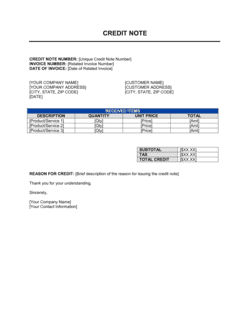
Ongoing supplier relationship requiring a formal credit memoCredit Note
Late invoice causes a tax-year accounting discrepancyAccounting Adjustment Letter

Common mistakes to avoid

❌ Using vague or hedging payment language

Why it matters: Phrases like 'we believe payment was sent' or 'it is our understanding that this was paid' imply uncertainty. Vendors and collection agencies treat ambiguous language as an opening to continue pursuing payment.

Fix: State the payment date, method, and reference number categorically and in the same sentence. 'Full payment of $[X] was remitted on [DATE] via ACH, Reference No. [X]' is unambiguous and harder to challenge.

❌ Omitting the bank-level transaction reference

Why it matters: Your internal accounting system's payment ID means nothing to the vendor's bank. Without a bank reference number, ACH trace, or wire confirmation, the vendor cannot independently verify receipt β€” and will continue following up.

Fix: Log into your bank portal or contact your bank to obtain the ACH trace number or wire confirmation number and include it in the letter alongside Exhibit A.

❌ Not requesting a credit memo

Why it matters: Even after receiving your letter, the invoice remains open in the vendor's AR system until a credit memo is posted. Automated reminders and potential collections referrals continue until the AR record is formally closed.

Fix: Explicitly request a credit memo for the full invoiced amount within a specified number of business days, and follow up if it is not received by the deadline.

❌ Sending the letter to the wrong contact

Why it matters: A project manager, sales rep, or account manager typically has no authority to close an AR record. The letter sits with them while the AR team continues issuing demands.

Fix: Address and copy the letter directly to the vendor's accounts receivable department. Call the vendor's main line to confirm the correct AR email address before sending.

❌ Skipping the escalation and legal rights clause

Why it matters: Without a documented warning that further collection activity will expose the vendor to legal liability, there is no formal notice on file if the matter escalates to a collection agency, credit bureau report, or lawsuit.

Fix: Include the escalation clause in every response letter, even if you expect the vendor to cooperate. It costs nothing to include and substantially strengthens your position if cooperation does not follow.

❌ Failing to retain a signed copy and proof of delivery

Why it matters: If the vendor later disputes receiving the letter, an unsigned or unsent draft is worthless. Without delivery proof, you cannot establish that the vendor had notice β€” which is the foundation of any legal defense.

Fix: Send via email with read receipt and retain the sent email with timestamp. For higher-value disputes, follow up with a certified mail copy and retain the delivery confirmation.

The 10 key clauses, explained

Parties and Date

In plain language: Identifies the sender (paying party) and recipient (vendor or supplier) by full legal name and contact details, and records the date the letter is issued.

Sample language
[SENDER COMPANY NAME] | [ADDRESS] | [CITY, STATE, ZIP] | [DATE] | To: [VENDOR LEGAL NAME] | Attn: [CONTACT NAME / ACCOUNTS RECEIVABLE DEPARTMENT]

Common mistake: Addressing the letter to a project contact rather than the vendor's accounts receivable department β€” the letter then sits unprocessed while the AR team continues to follow up for payment.

Reference to Original Agreement or Purchase Order

In plain language: Cites the specific contract, purchase order, or work order that governs the transaction, giving both parties a shared reference point.

Sample language
This letter relates to Purchase Order No. [PO NUMBER] dated [DATE], entered into between [SENDER] and [VENDOR] for [BRIEF DESCRIPTION OF GOODS/SERVICES].

Common mistake: Omitting the PO or contract reference number and relying only on a verbal description of the work β€” making it impossible for the vendor's AR system to match the letter to the correct account.

Identification of the Late Invoice

In plain language: States the invoice number, invoice date, and amount that the vendor sent after payment had already been made.

Sample language
We have received your Invoice No. [INVOICE NUMBER], dated [INVOICE DATE], in the amount of [CURRENCY AND AMOUNT], which we understand relates to the above-referenced purchase order.

Common mistake: Not quoting the invoice number in full β€” vendors with high transaction volumes cannot locate the specific document, and the letter triggers a second follow-up rather than resolving the matter.

Statement of Prior Payment

In plain language: The core clause: a clear, direct statement that full payment was already remitted before the invoice was received, with the payment date and method stated explicitly.

Sample language
Please be advised that full payment in the amount of [CURRENCY AND AMOUNT] was remitted to [VENDOR NAME] on [PAYMENT DATE] via [PAYMENT METHOD β€” e.g., ACH transfer / wire / check No. XXXXX], prior to our receipt of the above invoice.

Common mistake: Using vague language such as 'we believe payment was made' instead of stating the date and method categorically β€” hedging language implies uncertainty and invites the vendor to press for payment.

Proof of Payment Details

In plain language: Provides the specific transaction identifiers β€” bank reference number, ACH trace, wire confirmation, or check number β€” that allow the vendor to verify receipt in their own banking records.

Sample language
For your reference, payment was processed under Bank Reference / Transaction ID No. [REFERENCE NUMBER]. A copy of our [bank statement / wire confirmation / remittance advice] evidencing this payment is enclosed as Exhibit A.

Common mistake: Stating only the internal payment reference from the sender's accounting system without providing a bank-level identifier β€” internal IDs are meaningless to the vendor's bank and cannot be used to trace the transaction.

Declaration That No Further Payment Is Owed

In plain language: Formally states that the obligation underlying the invoice has been satisfied in full and that no additional payment will be made in response to the late invoice.

Sample language
Accordingly, the obligation referenced in Invoice No. [INVOICE NUMBER] has been satisfied in full. [SENDER COMPANY NAME] will not remit any further payment in response to this invoice.

Common mistake: Phrasing this as a request or a suggestion rather than a declarative statement β€” 'we trust this will close the matter' is not equivalent to 'no further payment will be made' and does not create a clear record.

Request for Written Confirmation and Credit Memo

In plain language: Asks the vendor to formally acknowledge the closed status of the account and, where applicable, to issue a credit memo zeroing out the late invoice in their AR records.

Sample language
We respectfully request written confirmation that Invoice No. [INVOICE NUMBER] has been marked as satisfied in your accounts receivable records, and that a credit memo for [AMOUNT] be issued within [14] business days of this letter.

Common mistake: Not requesting a credit memo β€” without one, the invoice remains open in the vendor's AR system, triggering automated payment reminders and potential collections action weeks later.

Record Retention Notice

In plain language: Notifies the recipient that all documentation related to this transaction β€” including the original agreement, payment records, and this letter β€” is being retained in the sender's files.

Sample language
[SENDER COMPANY NAME] is retaining all documentation related to this transaction, including the original purchase order, proof of payment, and this correspondence, in accordance with our standard record-retention policy for a period of [X] years.

Common mistake: Skipping this clause β€” without it, there is no documented notice that the sender has evidence on file, which weakens the sender's position if the vendor later escalates to a collection agency or legal action.

Escalation and Legal Rights Notice

In plain language: Reserves the sender's right to seek legal remedies β€” including damages and attorney fees β€” if the vendor continues to pursue payment or reports the obligation as unpaid to a credit bureau or collection agency.

Sample language
Should [VENDOR NAME] continue to pursue payment of Invoice No. [INVOICE NUMBER] after receipt of this letter, or report this obligation as outstanding to any credit bureau or collection agency, [SENDER] reserves all legal rights and remedies, including claims for damages, costs, and reasonable attorney fees.

Common mistake: Omitting this clause on the assumption that the vendor will cooperate β€” without it, the sender has no documented warning on file if the matter escalates to a demand letter or small claims action.

Signature and Authorization

In plain language: The letter is signed by an authorized representative of the sending company β€” typically an AP manager, CFO, or owner β€” with printed name, title, and contact information.

Sample language
Sincerely, [SIGNATURE] | [PRINTED NAME] | [TITLE] | [COMPANY NAME] | [PHONE] | [EMAIL] | Enclosure: Exhibit A β€” Proof of Payment

Common mistake: Sending the letter unsigned or signed by an employee who lacks authority to bind the company β€” unsigned correspondence is routinely disregarded by vendor AR and legal teams.

How to fill it out

  1. 1

    Gather your payment documentation before drafting

    Retrieve the original purchase order or contract, the payment confirmation from your bank or accounting system, and the vendor's late invoice. You need all three reference numbers before you begin.

    πŸ’‘ If the payment was made by ACH, log into your bank portal and download the ACH trace confirmation β€” this is the single most useful piece of evidence and takes two minutes to obtain.

  2. 2

    Enter the parties, date, and addresses

    Fill in your company's full legal name and address as the sender, and the vendor's legal name addressed to their accounts receivable department specifically. Date the letter on the day you send it.

    πŸ’‘ Send a copy to both the vendor's AR contact and your assigned account manager β€” AR processes the record, but the account manager can expedite a credit memo.

  3. 3

    Reference the purchase order and original agreement

    Enter the PO number, PO date, and a one-line description of the goods or services covered. If no PO exists, reference the contract or statement of work by name and date.

    πŸ’‘ If your company uses a three-way match process, attach the goods receipt confirmation alongside the PO reference β€” it eliminates any dispute about whether delivery occurred.

  4. 4

    Identify the late invoice precisely

    Enter the vendor's invoice number, invoice date, and invoiced amount exactly as printed on the document you received. Do not paraphrase or round the amount.

    πŸ’‘ Copy the invoice number character-for-character β€” vendors sometimes use alphanumeric codes that look similar but differ by one character, and an incorrect reference number derails the resolution process.

  5. 5

    State the payment date, method, and bank reference

    Enter the exact date payment was remitted, the payment method (ACH, wire, check number, or credit card last four digits), and the bank-level transaction or reference ID. Attach the proof-of-payment document as Exhibit A.

    πŸ’‘ For wire transfers, include both your outgoing wire reference and, if available, the vendor's bank's incoming confirmation number β€” two-sided confirmation leaves no room for dispute.

  6. 6

    Insert the credit memo and confirmation request

    Specify a reasonable deadline for the vendor to issue a credit memo and provide written confirmation β€” 14 business days is standard. Add the vendor's AR email address so there is no ambiguity about where to send the response.

    πŸ’‘ Follow up by phone on day 10 if you have not received a response β€” a brief call after a written notice almost always resolves the matter without further escalation.

  7. 7

    Sign, send, and file

    Have an authorized signatory β€” AP manager, CFO, or business owner β€” sign the letter. Send it via email with read receipt and retain a timestamped copy in your records alongside the proof of payment.

    πŸ’‘ Sending by email and certified mail simultaneously creates both an electronic and physical paper trail β€” useful if the matter later reaches a collection agency or legal dispute.

Frequently asked questions

What is a response to invoice received after payment?

A response to invoice received after payment is a formal written letter a buyer or accounts payable department sends to a vendor whose invoice arrived after full payment for the underlying goods or services had already been remitted. The letter documents the prior payment with specific transaction details, formally states that no further payment is owed, and requests written confirmation and a credit memo to close the vendor's accounts receivable record.

Is it legally necessary to send a written response to a late invoice?

There is generally no legal obligation to respond to a late invoice in writing, but doing so is strongly advisable. A written response creates a timestamped record of your notice to the vendor, establishes that the obligation was satisfied before the invoice arrived, and provides documentation if the matter escalates to collections or litigation. Without a written response, vendors may continue pursuing payment in good faith, believing their AR records to be correct.

What proof of payment should I include with the letter?

Include the most bank-level documentation available: an ACH trace confirmation, wire transfer confirmation, cleared check image, or bank statement showing the debit. Your internal accounting system's payment record alone is insufficient β€” it cannot be independently verified by the vendor's bank. Attach the bank-level confirmation as Exhibit A and reference it in the body of the letter.

What happens if the vendor continues to pursue payment after receiving the letter?

If a vendor continues to demand payment or refers the obligation to a collection agency after receiving a documented response with proof of payment, they may be liable for harassment, wrongful collection practices, or defamation of credit depending on the jurisdiction. In the US, referral of a disputed and paid obligation to a collection agency may trigger Fair Debt Collection Practices Act exposure for the agency involved. Retain all correspondence and consult a lawyer if collection activity continues.

Can this letter be used to dispute a partial underpayment?

This template is designed for situations where full payment preceded the invoice. If there is a discrepancy between what was paid and what the invoice claims β€” either because the invoice amount is higher than agreed or because only a partial payment was made β€” use an Invoice Dispute Letter instead, which is structured to address the specific amount in contention rather than confirming full satisfaction.

How long should I retain this letter and the proof of payment?

In most jurisdictions, business records related to payments and vendor obligations should be retained for the length of the applicable statute of limitations for contract disputes, which typically runs 3–6 years in most US states, 2–6 years across Canadian provinces, and 6 years in the UK under the Limitation Act 1980. Regulated industries (financial services, healthcare, government contractors) may have longer mandatory retention periods. When in doubt, retain for 7 years to align with common tax audit windows.

Does this letter need to be notarized or witnessed?

Notarization is not required for a vendor response letter in any major jurisdiction. A signature from an authorized company representative β€” AP manager, CFO, or business owner β€” is sufficient. The letter's legal weight comes from its contents, the specificity of the payment details, and the attached proof of payment β€” not from notarization.

What is the difference between this letter and an invoice dispute letter?

A response to invoice received after payment acknowledges the invoice but confirms the underlying obligation was already satisfied β€” no payment was omitted. An invoice dispute letter challenges the accuracy or validity of an invoice that has not yet been paid, typically because the amount, goods, or terms are incorrect. The two letters serve opposite factual scenarios and should not be used interchangeably.

Should I send this letter by email or certified mail?

Send by email first with a read receipt to create an immediate timestamp and give the vendor's AR team an electronic copy they can forward internally. For disputes involving amounts above roughly $500, follow up with a certified mail copy to create a physical delivery record. The combination of both gives you the strongest evidentiary position if the vendor later claims non-receipt.

How this compares to alternatives

vs Invoice Dispute Letter

An invoice dispute letter challenges the accuracy or validity of an invoice that has not yet been paid β€” the buyer is contesting the amount, deliverables, or terms. A response to invoice received after payment is used when the invoice is accurate but the obligation was already satisfied before the invoice arrived. Use the dispute letter when the amount is wrong; use this template when the payment was already made.

vs Credit Note

A credit note is issued by the seller to reduce or eliminate an outstanding invoice on their side of the ledger. This response letter is sent by the buyer to notify the seller that payment has already been made and to request that a credit note be issued. The two documents work in tandem β€” this letter triggers the request; the credit note closes the AR record.

vs Proof of Payment Letter

A proof of payment letter is a standalone document β€” often issued by a bank or accountant β€” confirming that a specific transaction occurred. This response template incorporates proof-of-payment details but goes further by formally notifying the vendor, asserting that no further payment is owed, and requesting account closure. For vendor disputes, this template is more appropriate than a bare proof-of-payment letter.

vs Demand Letter for Refund

A demand letter for refund is used when an overpayment has been made and the sender is seeking money back. This template is used when the correct amount was paid on time but the invoice arrived late β€” no refund is sought, and no additional payment is owed. If the invoiced amount exceeds what was originally agreed and an overpayment resulted, a demand letter for refund is the appropriate document.

Industry-specific considerations

Professional Services

Law firms, accounting practices, and consultancies often receive retainer invoices after monthly payments have cleared, requiring a documented response to keep AR records clean across both firms.

Construction and Trades

Progress billing on long-duration projects frequently results in invoices arriving after milestone payments have been wired, making a formal written response essential for lien-waiver and project closeout records.

Retail and E-commerce

High-volume supplier relationships generate frequent billing discrepancies; a standardized response letter keeps accounts payable cycles on track and prevents overpayment to suppliers with slow invoicing processes.

Technology / SaaS

Annual or multi-year software subscription payments made upfront are routinely followed by automated monthly invoices, requiring a formal response to prevent duplicate payment processing by AP teams.

Jurisdictional notes

United States

In the US, there is no federal statute governing response letters for late invoices, but state contract and commercial law determines whether a paid obligation can be re-litigated. The Uniform Commercial Code (UCC) governs goods transactions in all states; service contracts follow common law. If a vendor reports a paid obligation to a collection agency, the Fair Debt Collection Practices Act (FDCPA) may provide remedies. Statutes of limitations for written contract claims range from 3 years (California) to 6 years (New York) depending on state.

Canada

Canadian provinces govern contract disputes under provincial legislation; limitation periods for written contracts are typically 2 years from discovery under most provincial Limitations Acts. Quebec's Civil Code applies a 3-year general prescription period. A written response letter with proof of payment is particularly important in Canada because small claims courts in most provinces accept documentary evidence without oral testimony up to limits ranging from $20,000 (Ontario) to $50,000 (British Columbia).

United Kingdom

Under the Limitation Act 1980, the standard limitation period for contract claims in England and Wales is 6 years from the date the cause of action accrued. Scotland follows a 5-year prescriptive period under the Prescription and Limitation (Scotland) Act 1973. A response letter with attached bank confirmation satisfies the written-notice requirements that English courts look for when assessing whether the debtor took reasonable steps to notify the creditor. Late Payment of Commercial Debts legislation does not apply once payment has been made.

European Union

The EU Late Payment Directive (2011/7/EU) governs B2B payment timelines but does not directly address the scenario where payment precedes the invoice. Member state limitation periods vary: Germany applies a standard 3-year period under the BGB; France applies a 5-year general commercial limitation. Where invoices are issued across borders, GDPR considerations apply to any personal data included in payment documentation attached to the letter β€” limit attachments to transaction identifiers and amounts rather than personal account details.

Template vs lawyer β€” what fits your deal?

PathBest forCostTime
Use the templateStandard late-invoice situations where full payment is documented and the amount is under $10,000Free15–30 minutes
Template + legal reviewDisputes involving amounts above $10,000, vendors with a history of escalating to collections, or regulated industries$150–$400 for a one-hour lawyer review1–2 business days
Custom draftedHigh-value disputes, situations where the vendor has already referred the matter to a collection agency, or cross-border payment disputes with jurisdictional complexity$500–$2,000+3–7 business days

Glossary

Invoice Received After Payment
A situation in which a supplier sends a billing document for goods or services after the buyer has already remitted full payment.
Remittance Advice
A document sent by a payer alongside or following a payment that details which invoices or obligations the payment covers.
Purchase Order (PO)
A buyer-issued document authorizing a specific purchase from a supplier, used as the reference anchor when matching payments to invoices.
Payment Reference Number
A unique identifier assigned to a specific transaction by a bank, payment platform, or accounting system β€” used to prove a payment was made.
Accounts Payable
The accounting function responsible for recording and paying a company's outstanding obligations to vendors and suppliers.
Duplicate Invoice
An invoice issued by a vendor for an obligation that has already been billed and paid, whether under the same or a different invoice number.
Statute of Limitations (Debt)
The legally prescribed time limit within which a creditor must initiate legal action to collect an unpaid debt β€” after which the claim is generally unenforceable.
Three-Way Match
An accounts-payable control that verifies a supplier invoice against the original purchase order and the goods-receipt record before authorizing payment.
Credit Memo
A document issued by a seller to reduce or eliminate a previously invoiced amount β€” used to formally zero out an invoice that has already been paid.
Proof of Payment
Documentation β€” such as a bank statement, wire confirmation, cleared check image, or ACH trace β€” that demonstrates a specific payment was successfully transmitted and received.
Accounts Receivable
The supplier-side function that tracks money owed by customers; a late invoice situation may arise when AR records are not reconciled against incoming payments promptly.

Part of your Business Operating System

This document is one of 3,000+ business & legal templates included in Business in a Box.

  • Fill-in-the-blanks β€” ready in minutes
  • 100% customizable Word document
  • Compatible with all office suites
  • Export to PDF and share electronically

Create your document in 3 simple steps.

From template to signed document β€” all inside one Business Operating System.
1
Download or open template

Access over 3,000+ business and legal templates for any business task, project or initiative.

2
Edit and fill in the blanks with AI

Customize your ready-made business document template and save it in the cloud.

3
Save, Share, Send, Sign

Share your files and folders with your team. Create a space of seamless collaboration.

Save time, save money, and create top-quality documents.

β˜…β˜…β˜…β˜…β˜…

"Fantastic value! I'm not sure how I'd do without it. It's worth its weight in gold and paid back for itself many times."

Managing Director Β· Mall Farm
Robert Whalley
Managing Director, Mall Farm Proprietary Limited
β˜…β˜…β˜…β˜…β˜…

"I have been using Business in a Box for years. It has been the most useful source of templates I have encountered. I recommend it to anyone."

Business Owner Β· 4+ years
Dr Michael John Freestone
Business Owner
β˜…β˜…β˜…β˜…β˜…

"It has been a life saver so many times I have lost count. Business in a Box has saved me so much time and as you know, time is money."

Owner Β· Upstate Web
David G. Moore Jr.
Owner, Upstate Web

Run your business with a system β€” not scattered tools

Stop downloading documents. Start operating with clarity. Business in a Box gives you the Business Operating System used by over 250,000 companies worldwide to structure, run, and grow their business.

Start freeΒ Β·Β No credit card required