Credit Reference Response Template

Free Word download β€’ Edit online β€’ Save & share with Drive β€’ Export to PDF

1 pageβ€’20–30 min to fillβ€’Difficulty: Standardβ€’Signature requiredβ€’Legal review recommended
Learn more ↓
FreeCredit Reference Response Template

At a glance

What it is
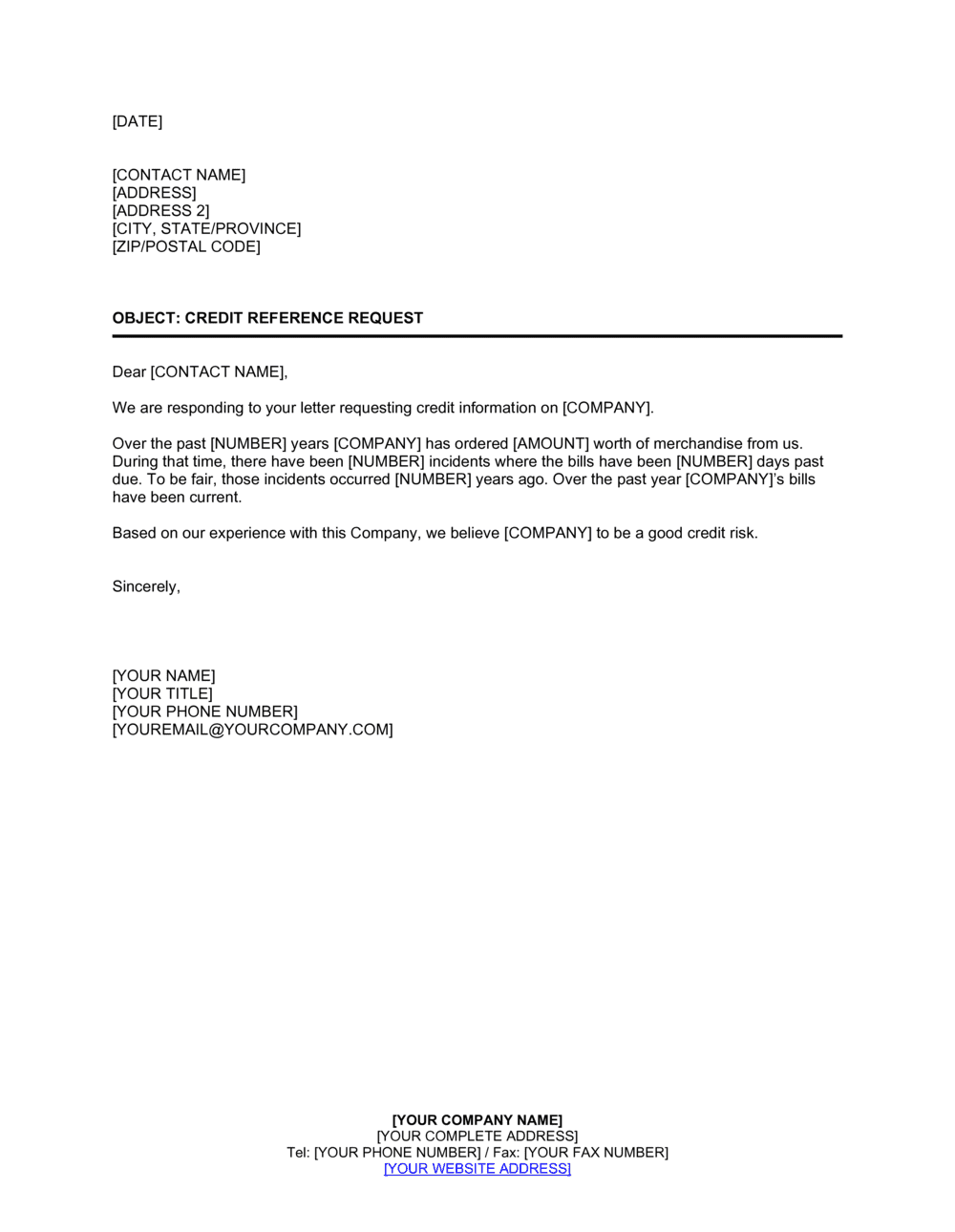
A Credit Reference Response is a formal written reply issued by a supplier, vendor, or creditor in response to a trade credit inquiry about a shared customer or business associate. This free Word download gives you a professionally structured, liability-conscious template you can edit online and export as PDF β€” covering payment history, credit limit details, account standing, and a disclaimer limiting your legal exposure.
When you need it
Use it when another business requests a credit reference for a mutual customer before extending trade credit, a line of credit, or supply terms. It is also appropriate when a financial institution, landlord, or lender asks you to verify a business relationship in writing.
What's inside
Responding party and requesting party identification, subject account details, payment history summary, credit limit and terms confirmation, account standing assessment, confidentiality notice, limitation of liability disclaimer, and authorized signatory block.

What is a Credit Reference Response?

A Credit Reference Response is a formal written statement issued by a creditor β€” typically a supplier, vendor, or financial institution β€” in reply to a third-party request for information about a shared customer's credit history and account standing. It documents the credit limit extended, the payment terms agreed, the customer's actual payment behavior over a defined period, and the current status of the account. Crucially, a properly drafted credit reference response also includes a confidentiality notice restricting the use of the information and a limitation-of-liability disclaimer protecting the responding party from legal claims arising from reliance on the reference.

Unlike a general business recommendation letter, a credit reference response is a narrowly scoped financial disclosure used by the requesting party to make a specific lending or trade credit decision. Because it influences commercial decisions with measurable financial consequences, it carries a higher standard of accuracy and greater legal scrutiny than most routine business correspondence.

Why You Need This Document

Responding to a credit inquiry without a structured, legally protective template exposes your business on multiple fronts simultaneously. A casually worded email confirming that a customer "always pays on time" β€” without a disclaimer β€” can form the basis of a negligent misstatement claim if that customer later defaults and the requesting party suffers a loss. Courts in the US, UK, and Canada have found creditors liable in exactly these circumstances when no limitation-of-liability clause was present.

Equally, sharing account data without a confidentiality notice leaves you with no contractual basis to object if the requesting party forwards your reference to the customer being evaluated β€” damaging a commercial relationship you depend on. And a response signed by someone without authority to bind the company may be legally ineffective precisely when you need it to stand up to scrutiny.

This template gives you a complete, liability-conscious framework: specific placeholders for the factual data that makes a reference useful, a confidentiality clause that restricts onward disclosure, a disclaimer that removes warranty liability, and a signature block that confirms authorized execution. What takes a legally unprotected email minutes to get wrong takes this template under thirty minutes to get right.

Which variant fits your situation?

If your situation is…Use this template
Confirming a positive payment history for a customer in good standingCredit Reference Response (Positive)
Declining to provide a reference without disclosing negative detailsCredit Reference Decline Letter
Requesting a credit reference from another supplier about a prospective customerCredit Reference Request Letter
Providing a personal credit reference for a sole trader or individualPersonal Credit Reference Letter
Confirming credit terms for a customer applying for a bank loanBank Credit Reference Letter
Documenting trade credit terms for a new customer relationshipTrade Credit Application
Summarizing a customer's full credit account history for internal reviewCustomer Credit Review Report

Common mistakes to avoid

❌ Providing a reference without customer consent

Why it matters: Sharing a customer's account data without their authorization may breach privacy legislation β€” including GDPR, PIPEDA, and US state privacy laws β€” and can damage the commercial relationship if the customer discovers it.

Fix: Require a signed consent form from the customer before responding to any external credit inquiry, and retain that consent document with your reference file.

❌ Using vague positive language with no supporting data

Why it matters: Phrases like 'always a pleasure to deal with' or 'reliable payer' without specific payment metrics are legally meaningless and can expose you to a negligent misstatement claim if the customer later defaults.

Fix: Replace subjective language with factual metrics: credit limit, payment terms, average DSO, percentage of on-time payments, and current account balance as of a specific date.

❌ Omitting the limitation of liability disclaimer

Why it matters: Courts in the US, UK, and Canada have found creditors liable for negligent misstatement in credit references when no clear disclaimer was present and the requesting party suffered a foreseeable loss in reliance on the reference.

Fix: Include a disclaimer stating that the information is provided in good faith from internal records only, without warranty, and that you accept no liability for losses arising from reliance on it.

❌ Confirming good standing when the account has unresolved issues

Why it matters: A false or misleading account-standing statement β€” even one made negligently rather than intentionally β€” is the single most common basis for legal claims against credit reference providers.

Fix: Run a fresh account report on the day you sign the reference. If there is any overdue balance or open dispute, describe it accurately rather than describing the general relationship as positive.

❌ Having an unauthorized person sign the reference

Why it matters: A signatory who lacks corporate authority to bind the company may not have the legal capacity to make the representations in the reference, undermining its enforceability and potentially exposing the individual to personal liability.

Fix: Establish a written internal policy identifying who is authorized to sign credit references β€” typically at the credit manager, finance director, or CFO level β€” and enforce it consistently.

❌ Sending the reference directly to the customer being evaluated

Why it matters: Sharing a credit reference with the subject of that reference β€” even inadvertently β€” creates relationship damage, may prompt a defamation claim if any negative information is included, and signals poor data handling to the requesting creditor.

Fix: Send the reference only to the requesting party at the verified address stated in their inquiry. Never copy the customer, and include a confidentiality clause prohibiting onward disclosure.

The 9 key clauses, explained

Responding party identification

In plain language: Identifies the business providing the reference β€” full legal name, address, contact person, and the capacity in which they know the subject.

Sample language
This credit reference is provided by [COMPANY LEGAL NAME], a [STATE/JURISDICTION] [ENTITY TYPE], located at [ADDRESS], by [AUTHORIZED CONTACT NAME], [TITLE], in our capacity as a trade creditor of [SUBJECT BUSINESS NAME].

Common mistake: Using a trade name or department name instead of the registered legal entity. If the reference is ever challenged, the signatory must match the entity on record as a creditor.

Requesting party and purpose acknowledgment

In plain language: States who requested the reference and the specific purpose for which it is being provided, limiting its use to that purpose.

Sample language
This response is provided to [REQUESTING PARTY NAME] at [ADDRESS] solely in response to their credit inquiry dated [DATE] and may not be relied upon for any other purpose.

Common mistake: Omitting the stated purpose entirely. Without a defined purpose, the recipient may use the reference in broader contexts β€” such as litigation or third-party sharing β€” increasing your liability exposure.

Subject account identification

In plain language: Identifies the customer being referenced β€” their legal name, account number, and the duration of the business relationship.

Sample language
The subject of this reference is [CUSTOMER LEGAL NAME], trading as [TRADING NAME IF DIFFERENT], account number [ACCOUNT NUMBER], with whom we have maintained a trade credit relationship since [DATE β€” MM/YYYY].

Common mistake: Referencing only a trading name when the customer operates under a different legal entity. This creates ambiguity about which entity's credit history is being described.

Credit limit and terms

In plain language: States the credit limit extended to the customer and the payment terms under which they operate.

Sample language
We have extended a credit limit of [CURRENCY][AMOUNT] to the above account on [NET 30 / NET 60 / OTHER] payment terms.

Common mistake: Stating the credit limit as a validation of the customer's creditworthiness. The limit reflects your internal risk appetite, not an objective measure of the customer's financial health β€” conflating the two overstates your endorsement.

Payment history summary

In plain language: Describes the customer's actual payment behavior β€” whether invoices were paid on time, late, or in dispute β€” over a defined lookback period.

Sample language
Over the past [X] months, [CUSTOMER NAME] has settled [X]% of invoices within agreed terms. Average days to payment: [X] days. Outstanding disputes: [NONE / DESCRIBE IF ANY].

Common mistake: Using subjective language like 'excellent payer' without backing it up with specific data. Vague positive statements do not protect you legally and provide little useful signal to the requesting party.

Current account standing

In plain language: States whether the account is current, whether there are any overdue balances, and whether the credit relationship remains active.

Sample language
As of [DATE], the account is [CURRENT AND IN GOOD STANDING / HAS AN OVERDUE BALANCE OF [CURRENCY][AMOUNT] / IS SUBJECT TO PAYMENT PLAN]. The credit facility is [ACTIVE / SUSPENDED / CLOSED].

Common mistake: Confirming an account is in good standing when there is an unresolved dispute or recent late payment. If the customer later defaults and the requesting party sues you for a negligent reference, a false 'in good standing' statement is your primary liability.

Confidentiality and permitted use

In plain language: Restricts the recipient from sharing the reference with third parties and limits its use to the specific credit decision at hand.

Sample language
The information contained in this reference is confidential and is provided solely for the purpose stated above. It may not be disclosed to, or relied upon by, any third party without the prior written consent of [COMPANY LEGAL NAME].

Common mistake: No confidentiality clause at all. Without one, the recipient is free to share your reference with the customer being evaluated β€” creating a relationship risk β€” or with other parties who could use it against you.

Limitation of liability and disclaimer

In plain language: States that the information is provided in good faith based on the respondent's own records, without warranty as to accuracy, and caps or excludes liability for losses the recipient suffers in reliance on it.

Sample language
This reference is provided in good faith based solely on our own records and experience with the above account. [COMPANY LEGAL NAME] makes no representation or warranty as to the accuracy or completeness of this information and accepts no liability for any loss or damage arising from reliance upon it.

Common mistake: Omitting the disclaimer entirely or using boilerplate that doesn't specifically exclude reliance-based liability. Courts in several jurisdictions have found liability for negligent misstatement in credit references where no clear disclaimer was present.

Authorized signature and date

In plain language: Confirms that the reference was issued by a person with authority to bind the company and records the exact date of issue.

Sample language
Signed: _________________________ | Name: [AUTHORIZED SIGNATORY NAME] | Title: [TITLE] | Date: [DATE] | On behalf of: [COMPANY LEGAL NAME]

Common mistake: Having a junior accounts-receivable clerk sign the reference without delegated authority. If the reference is challenged, a signatory who lacked authority to bind the company may render the document legally ineffective β€” or shift personal liability to the individual.

How to fill it out

  1. 1

    Verify the request is legitimate before responding

    Confirm the identity of the requesting party and that the customer named has provided written consent for the reference to be issued. Do not respond to anonymous or informal verbal requests.

    πŸ’‘ Request the customer's signed consent form before pulling any account data β€” this consent protects you legally and is required in several jurisdictions under data protection law.

  2. 2

    Identify both parties using full legal names

    Enter your company's registered legal name and address, the requesting party's full name and address, and the customer's legal trading name and account number.

    πŸ’‘ Cross-check the customer's name against your accounting system β€” customers sometimes trade under a different name than their registered entity.

  3. 3

    Pull the account data for the lookback period

    Access your accounts-receivable records and extract the credit limit, payment terms, invoice history, average DSO, and current balance for the most recent 12–24 months.

    πŸ’‘ Use a 12-month lookback as standard β€” longer periods may include outdated behavior that no longer reflects current risk, and shorter periods may be statistically weak.

  4. 4

    Describe payment history with specific data, not adjectives

    Report factual metrics: percentage of invoices paid on time, average days to payment, any late payments, and any resolved or outstanding disputes. Do not use terms like 'excellent' or 'poor' without the numbers to support them.

    πŸ’‘ If there have been late payments, describe them neutrally β€” 'three invoices were settled between 15 and 30 days after due date in Q3 2024' β€” rather than characterizing the customer's general behavior.

  5. 5

    State the current account standing accurately

    Confirm whether the account is current, overdue, or subject to a payment arrangement as of the specific date you are writing. Do not describe a forward-looking expectation.

    πŸ’‘ Date-stamp the account standing to the day you run the report β€” balances change, and a reference that becomes inaccurate within days of issue is a liability risk.

  6. 6

    Insert the confidentiality notice and liability disclaimer

    Include both the confidentiality clause limiting use to the stated purpose and the disclaimer confirming the information is provided in good faith without warranty.

    πŸ’‘ Do not soften the disclaimer by adding phrases like 'to the best of our knowledge' without also including the no-liability language β€” one without the other creates an implied warranty.

  7. 7

    Have the response signed by an authorized signatory

    Route the completed reference to a person with authority to sign on behalf of the company β€” typically a CFO, credit manager, or director. Record the title and date alongside the signature.

    πŸ’‘ Create a one-line internal approval policy confirming who is authorized to sign credit references so the same person isn't bypassed under time pressure.

  8. 8

    Retain a dated copy in your records

    File the signed reference with a copy of the original inquiry and the customer's consent form. Store the complete package for at least seven years.

    πŸ’‘ Tag the file with the requesting party's name and the date β€” if a dispute arises six months later, you need to locate the exact version you sent without searching through email threads.

Frequently asked questions

What is a credit reference response?

A credit reference response is a formal written statement issued by one business to another, confirming the credit history and account standing of a mutual customer. It is typically requested by a supplier, lender, or landlord evaluating whether to extend trade credit or financing to that customer. The response covers the credit limit, payment terms, payment behavior, and current account status, alongside a disclaimer limiting the responding party's legal liability.

Am I legally required to respond to a credit reference request?

No. In most jurisdictions, businesses are not obligated to respond to trade credit reference requests. However, refusing to respond β€” or providing a response that omits material negative information β€” can create implied representations in some cases. If you choose to respond, respond accurately and include a clear limitation-of-liability disclaimer. If you cannot provide an accurate positive reference, it is generally safer to decline in writing than to provide a misleading one.

Can I be sued for providing a credit reference?

Yes, in some circumstances. You may face liability under the tort of negligent misstatement if you provide inaccurate information and the requesting party suffers a foreseeable financial loss in reliance on it. You may also face defamation claims if the reference contains false statements of fact that damage the subject's reputation. A well-drafted limitation-of-liability clause and a confidentiality notice significantly reduce β€” but do not eliminate β€” this exposure. Consider legal review for any reference involving a customer with a complex or disputed history.

Does a credit reference response need to be signed?

Yes. A signed credit reference carries legal weight that an unsigned document does not. The signature confirms that an authorized representative of the responding business stands behind the statements made. The signatory should have delegated authority to bind the company β€” typically a finance director, credit manager, or CFO β€” and the document should record their title and the date of signing.

What information should I include β€” and exclude β€” in a credit reference?

Include: credit limit, payment terms, average days to payment, percentage of invoices paid on time, current account balance as of a specific date, and whether the account is active. Exclude: forward-looking predictions about the customer's financial health, speculation about their ability to meet future obligations, and any information obtained from sources other than your own trading records. Subjective character assessments should also be avoided unless backed by specific factual data.

What is the difference between a credit reference response and a credit report?

A credit reference response is a voluntary, one-to-one statement from a specific trading creditor describing their own experience with a customer. A credit report is compiled by a third-party credit bureau aggregating data from multiple sources β€” banks, trade creditors, public records β€” into a scored profile. Lenders typically use both: the bureau report for quantitative risk scoring and trade credit references for qualitative confirmation from known counterparties.

How long should I retain a credit reference response I have issued?

Retain the signed reference, the original inquiry, and the customer's consent form together for a minimum of seven years in most jurisdictions. This retention period aligns with standard commercial contract limitation periods in the US, Canada, and the UK. If a dispute arises from the reference, you will need to produce the exact document you issued β€” not a reconstructed version β€” to defend your position.

What should I do if asked to provide a credit reference for a customer with a poor payment history?

You have three options: respond accurately and describe the specific payment issues with supporting data and a full disclaimer; decline to respond in writing without stating reasons; or provide a neutral confirmation limited to the existence of the account and its terms without characterizing payment behavior. Providing a misleadingly positive reference for a customer you know to be a poor payer is the highest-risk choice and the one most likely to generate liability.

How this compares to alternatives

vs Credit Reference Request Letter

A credit reference request is the document a business sends to a supplier asking for information about a mutual customer. A credit reference response is the reply to that request. They are the two sides of the same transaction β€” the request initiates the inquiry; the response provides the substantive information the requester needs to make a credit decision.

vs Trade Credit Application

A trade credit application is completed by the customer seeking credit, listing their financial details, trade references, and banking information. A credit reference response is issued by one of those named references in reply to a third-party inquiry. The application creates the credit relationship; the reference response verifies the applicant's track record with existing creditors.

vs Letter of Recommendation (Business)

A general business recommendation letter endorses a company's products, services, or reputation broadly. A credit reference response is narrowly focused on payment history, credit limit, and account standing β€” it is a factual financial disclosure, not a general character endorsement. Credit reference responses carry greater legal scrutiny because they are used to make specific financial decisions.

vs Debt Collection Letter

A debt collection letter is sent directly to a delinquent customer demanding payment of an overdue balance. A credit reference response is sent to a third-party creditor providing information about a customer's account. The two documents serve opposite functions β€” one recovers money owed; the other informs a business decision about future credit extension.

Industry-specific considerations

Wholesale and distribution

High-volume trade credit relationships mean credit reference requests are frequent; standardized response templates reduce processing time and ensure consistent liability protection across hundreds of accounts.

Manufacturing

Long-term supply chain relationships often involve credit limits of six figures or more, making accurate payment history disclosure and strong disclaimer language especially important.

Professional services

Firms providing credit references for long-standing retainer clients must balance relationship preservation with accurate disclosure of any billing disputes or slow-payment history.

Financial services and lending

Banks and commercial lenders collect trade credit references as part of loan underwriting; a well-structured response accelerates the lender's diligence process and reduces follow-up requests.

Jurisdictional notes

United States

No single federal statute governs trade credit references, but the Fair Credit Reporting Act (FCRA) applies when a reference is provided to a consumer reporting agency or used for consumer credit decisions. For commercial B2B references, common-law negligent misstatement and defamation claims are the primary legal risks. Qualified privilege protections are recognized in most states for good-faith references, provided the information is accurate and the disclosure is not excessive.

Canada

PIPEDA and provincial privacy statutes (notably Quebec's Law 25) require a lawful basis for sharing customer account data with third parties β€” written consent is the most reliable basis. Common-law provinces recognize qualified privilege for credit references made in good faith. Quebec's civil law framework applies a similar good-faith standard but may impose stricter requirements on data minimization and consent documentation.

United Kingdom

The UK GDPR and Data Protection Act 2018 require that sharing a customer's payment data with a third-party creditor be justified under a lawful basis β€” legitimate interests is the most commonly relied upon basis for B2B trade references, provided a legitimate interests assessment is documented. The Defamation Act 2013 provides a qualified privilege defense for statements made on occasions of common interest, such as trade credit inquiries, provided the reference is made without malice.

European Union

GDPR Article 6 requires a lawful basis for processing personal data in credit references β€” for sole traders and partnerships, customer account data may constitute personal data requiring consent or a documented legitimate interests assessment. B2B trade credit references involving only legal entities are generally lower risk under GDPR, but member states including France and Germany apply additional national data protection rules. Cross-border references within the EU should specify which member state's law governs the document.

Template vs lawyer β€” what fits your deal?

PathBest forCostTime
Use the templateBusinesses responding to routine trade credit inquiries for customers with straightforward, positive payment historiesFree15–30 minutes per response
Template + legal reviewResponses involving customers with disputed accounts, partial payment histories, or credit limits above $100,000$150–$400 for a lawyer or credit manager review1–2 business days
Custom draftedHigh-value lending contexts, regulated industries, cross-border references subject to multiple privacy law regimes, or any situation where the customer's account history is complex or litigious$500–$2,000+3–7 business days

Glossary

Trade Credit
An arrangement where a supplier allows a business customer to receive goods or services and pay at a later agreed date, typically Net 30, Net 60, or Net 90.
Credit Limit
The maximum outstanding balance a creditor will allow a customer to carry at any one time under agreed trade terms.
Payment History
A record of how consistently and promptly a customer has paid invoices over the duration of the business relationship.
Days Sales Outstanding (DSO)
The average number of days it takes a customer to pay an invoice from the date it was issued β€” a key metric for assessing payment behavior.
Account Standing
The current status of a customer's credit account β€” typically described as current, satisfactory, irregular, or in arrears.
Limitation of Liability
A contractual clause capping the responding party's legal exposure for the accuracy or completeness of information provided in the reference.
Confidentiality Notice
A statement restricting the recipient from sharing the reference content with parties other than those directly involved in the credit decision.
Authorized Signatory
The individual with legal authority to sign documents on behalf of a company β€” binding the company to the statements made in the reference.
Net Terms
Payment terms stating the full invoice balance is due within a defined number of days from the invoice date β€” e.g., Net 30 means payment due within 30 days.
Defamation Risk
Legal exposure arising when a credit reference contains false statements of fact that damage a third party's reputation or financial standing.
Qualified Privilege
A legal doctrine protecting statements made in good faith for a legitimate purpose β€” such as a credit reference β€” from defamation claims, provided the information is accurate and not maliciously shared.

Part of your Business Operating System

This document is one of 3,000+ business & legal templates included in Business in a Box.

  • Fill-in-the-blanks β€” ready in minutes
  • 100% customizable Word document
  • Compatible with all office suites
  • Export to PDF and share electronically

Create your document in 3 simple steps.

From template to signed document β€” all inside one Business Operating System.
1
Download or open template

Access over 3,000+ business and legal templates for any business task, project or initiative.

2
Edit and fill in the blanks with AI

Customize your ready-made business document template and save it in the cloud.

3
Save, Share, Send, Sign

Share your files and folders with your team. Create a space of seamless collaboration.

Save time, save money, and create top-quality documents.

β˜…β˜…β˜…β˜…β˜…

"Fantastic value! I'm not sure how I'd do without it. It's worth its weight in gold and paid back for itself many times."

Managing Director Β· Mall Farm
Robert Whalley
Managing Director, Mall Farm Proprietary Limited
β˜…β˜…β˜…β˜…β˜…

"I have been using Business in a Box for years. It has been the most useful source of templates I have encountered. I recommend it to anyone."

Business Owner Β· 4+ years
Dr Michael John Freestone
Business Owner
β˜…β˜…β˜…β˜…β˜…

"It has been a life saver so many times I have lost count. Business in a Box has saved me so much time and as you know, time is money."

Owner Β· Upstate Web
David G. Moore Jr.
Owner, Upstate Web

Run your business with a system β€” not scattered tools

Stop downloading documents. Start operating with clarity. Business in a Box gives you the Business Operating System used by over 250,000 companies worldwide to structure, run, and grow their business.

Start freeΒ Β·Β No credit card required