1
Gather the original transaction records
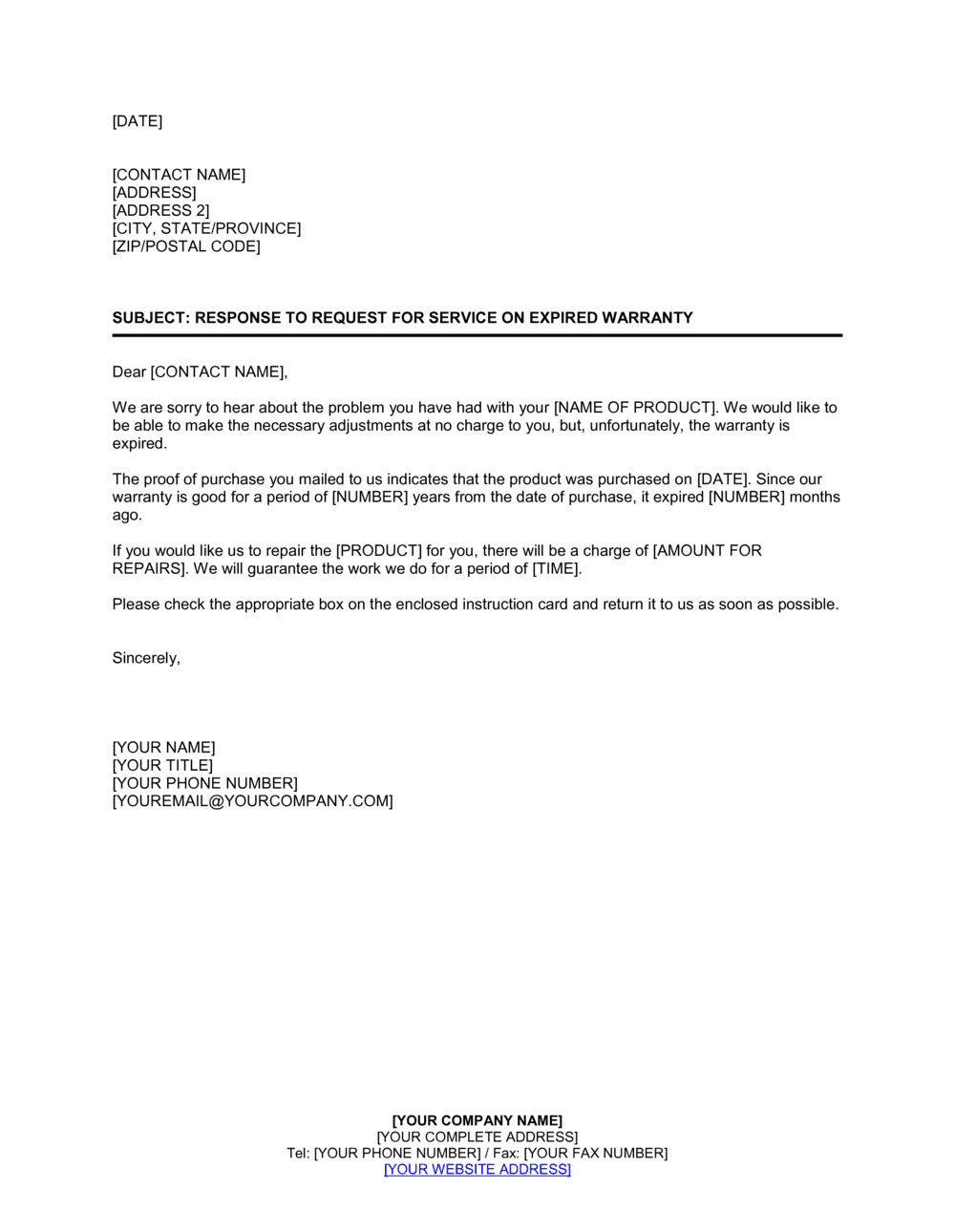
Collect the customer's original invoice or receipt, the warranty agreement issued at the time of sale, the product serial number, and the date the service request was received. You will need all four to accurately calculate and document the expiration.
💡 If your records and the customer's records show different purchase dates, request proof of purchase before sending the response — acting on disputed dates invites claims of bad faith.
2
Calculate and confirm the warranty expiration date
Using the purchase date and the warranty term stated in your warranty agreement, compute the exact expiration date. Compare it to the date you received the service request and note the gap in days or months.
💡 Express the gap as a specific number — 'received 47 days after expiration' is harder to dispute than 'after the warranty expired.'
3
Complete the parties and transaction identification clause
Fill in the company's legal name, the customer's full name and address, the product name and model, the serial number, the invoice number, and the purchase date. Every identifier should match your internal records exactly.
💡 Use the customer's name exactly as it appears on their original order to avoid any suggestion the response is addressed to a different transaction.
4
State the denial clearly and cite the warranty document
Write the denial in plain, direct language and cite the specific section of the warranty agreement that defines the coverage period. Attach or link to the warranty document.
💡 Avoid softening language like 'unfortunately we are unable' in the denial clause itself — save empathetic language for the opening paragraph and keep the operative denial unambiguous.
5
Decide whether to include a goodwill or paid-service offer
Determine whether you will offer out-of-warranty repair at a standard or discounted rate, or extend any goodwill accommodation. If you do, include explicit language stating the offer does not extend the warranty or create new obligations.
💡 A modest goodwill discount (10–15%) on out-of-warranty service resolves most disputes without legal exposure and significantly reduces negative escalation rates.
6
Insert the disclaimer in conspicuous format
Place the implied warranty disclaimer and limitation of liability in all caps or bold type, consistent with your original warranty document. Confirm the language meets the statutory requirements of the governing jurisdiction.
💡 If you ship products to multiple states or countries, ensure the disclaimer includes the phrase 'to the extent permitted by applicable law' to accommodate jurisdictions that prohibit certain exclusions.
7
Set a response deadline and add contact details
Enter a specific date by which the customer must respond — 14 to 30 days is standard — and provide a named contact with direct email and phone number.
💡 A named contact rather than a generic 'customer service' address signals good faith and reduces the chance the customer escalates to a consumer protection agency.
8
Sign, date, and send via a tracked method
Have an authorized company representative sign the letter. Send it via email with read receipt and, for high-value disputes, via certified mail to establish a delivery record.
💡 Retain a signed copy with proof of delivery in the customer's file — if the dispute proceeds to small claims or arbitration, the delivery record is critical evidence.