Production Health and Safety Policy Template

Free Word download β€’ Edit online β€’ Save & share with Drive β€’ Export to PDF

3 pagesβ€’20–30 min to fillβ€’Difficulty: Standard
Learn more ↓
FreeProduction Health and Safety Policy Template

At a glance

What it is
A Production Health and Safety Policy is a formal operational document that defines a company's commitment to protecting workers in production and manufacturing environments, sets out the rules governing safe work practices, and assigns clear responsibilities at every level of the organization. This free Word download gives you a structured, ready-to-customize policy you can edit online and export as PDF to distribute to staff, post on the shop floor, or submit to regulators and clients.
When you need it
Use it when setting up a new production facility, onboarding employees into a manufacturing or processing environment, responding to a workplace incident, or meeting the requirements of a client contract, insurance policy, or regulatory audit that requires written safety documentation.
What's inside
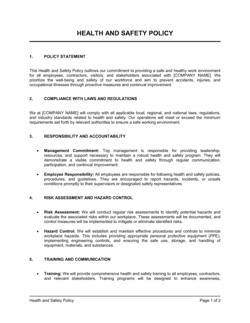
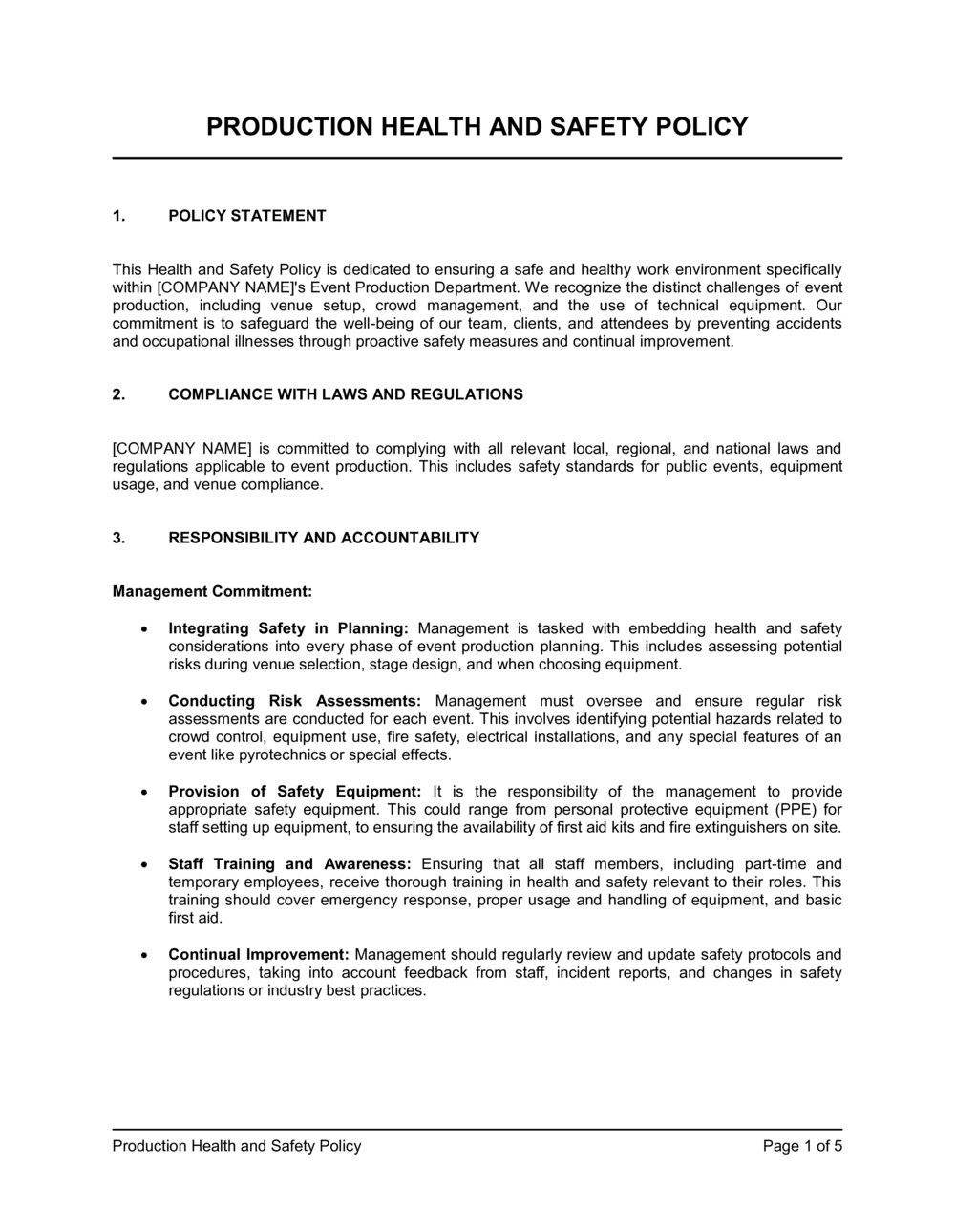
Policy statement and management commitment, roles and responsibilities, hazard identification and risk assessment procedures, personal protective equipment requirements, emergency response and incident reporting protocols, training requirements, and a compliance and review schedule.

What is a Production Health and Safety Policy?

A Production Health and Safety Policy is a formal operational document that establishes an organization's framework for managing physical safety risks in a manufacturing or production environment. It states senior management's commitment to worker protection, assigns safety responsibilities across every level of the organization, identifies the specific hazards present on the production floor, and prescribes the procedures, training, and controls that employees and contractors must follow. Unlike a generic workplace policy, it is built around the particular risks of production work β€” machinery, chemicals, noise, ergonomic strain, and emergency scenarios β€” and provides sufficient operational detail to guide supervisors and workers in real situations, not just to satisfy an audit checklist.

Why You Need This Document

Without a written production health and safety policy, you have no documented standard to train workers against, no basis for holding supervisors accountable when safety procedures are skipped, and no evidence of due diligence if a workplace injury leads to a regulatory investigation or civil claim. Regulators in the US, UK, Canada, and Australia expect employers to produce a written policy on request β€” the absence of one is itself a violation in many jurisdictions. Beyond compliance, a clearly written policy reduces incident rates by removing ambiguity: workers know exactly what PPE is required, what to do when a hazard is identified, and how to respond in an emergency. This template gives you a complete, ready-to-customize production safety policy that covers every mandatory component β€” so you can meet your legal obligations and protect your team from day one.

Which variant fits your situation?

If your situation is…Use this template
General manufacturing or assembly line environmentProduction Health and Safety Policy
Construction or civil works site safety requirementsConstruction Safety Plan
Office or commercial workplace safety obligationsWorkplace Health and Safety Policy
Chemical or hazardous materials handling environmentHazardous Materials Safety Policy
Responding to and documenting a workplace incidentIncident Report Form
Tracking and scheduling employee safety trainingEmployee Training Plan
Conducting a formal workplace risk assessmentRisk Assessment Template

Common mistakes to avoid

❌ Using a generic policy without tailoring it to the specific production environment

Why it matters: A policy that describes hazards and controls for a different type of facility gives workers inaccurate guidance and will not satisfy a regulator or auditor who inspects the actual site.

Fix: Walk the production floor before completing the template and update every hazard, PPE, and emergency procedure section to reflect what is actually present on site.

❌ Assigning all safety responsibilities to a single EHS role

Why it matters: When only one person is accountable, supervisors stop enforcing safety at the operational level β€” hazards go unreported and corrective actions stall when the EHS coordinator is unavailable.

Fix: Distribute specific, named responsibilities to every supervisory level in the Roles and Responsibilities section and reinforce accountability through monthly inspection sign-offs.

❌ Never updating the hazard register after initial setup

Why it matters: New equipment, process changes, and new chemical substances introduce hazards not covered in the original assessment β€” leaving workers unprotected and the policy non-compliant.

Fix: Trigger a hazard register review whenever production equipment changes, a new substance is introduced, or a near miss or incident occurs β€” not only on the annual review date.

❌ Omitting near-miss reporting requirements

Why it matters: Near misses are the most reliable leading indicator of future injuries. A policy that only records actual injuries misses the opportunity to eliminate hazards before someone is hurt.

Fix: Explicitly require near-miss reporting in the Incident Reporting section, set a 24-hour reporting window, and track near-miss rates as a KPI alongside lost-time injury frequency.

The 9 key sections, explained

Policy statement and management commitment

Scope and applicability

Roles and responsibilities

Hazard identification and risk assessment

Personal protective equipment (PPE) requirements

Emergency response procedures

Incident reporting and investigation

Training and competency requirements

Compliance monitoring and policy review

How to fill it out

  1. 1

    Insert your company and facility details

    Replace all [COMPANY NAME], [FACILITY NAME], and [FACILITY ADDRESS] placeholders throughout the document. Confirm you are referencing the correct legal entity name for regulatory compliance purposes.

    πŸ’‘ If your organization operates multiple production sites, create a separate version of this policy for each site rather than using a single generic document β€” site-specific hazards require site-specific controls.

  2. 2

    Define the scope and list covered roles

    In the Scope section, explicitly name all employee categories, contractor types, and activity areas the policy covers. List any roles or locations that are out of scope and explain why.

    πŸ’‘ Review your current roster of on-site contractors and confirm each is addressed β€” insurers and regulators will check this during audits.

  3. 3

    Assign roles and responsibilities by name or title

    Go through the Roles and Responsibilities section and replace generic titles with the specific job titles in your organization. Confirm each named role holder has received and acknowledged their responsibilities.

    πŸ’‘ Have each responsible manager sign or initial the responsibilities section to create a documented acknowledgment that holds up during incident investigations.

  4. 4

    Complete the hazard register for your production environment

    Walk the production floor with a supervisor and identify all hazards present β€” machinery, chemicals, ergonomics, noise, temperature, and electrical. Score each using the risk matrix and assign control measures.

    πŸ’‘ Photograph each identified hazard and attach the images to the hazard register β€” this creates a timestamped baseline that is invaluable if a dispute arises later.

  5. 5

    Specify PPE requirements by area and task

    For each production zone and task type, list the exact PPE required and the applicable performance standard. Note any exceptions and the approval process for obtaining them.

    πŸ’‘ Cross-reference your PPE list with your equipment supplier's safety data sheets β€” manufacturers specify the minimum PPE level for their machinery, and your policy must meet or exceed it.

  6. 6

    Map emergency procedures to your actual facility layout

    Update evacuation routes, muster points, and emergency contact numbers to reflect your current facility. Confirm that posted floor maps match the routes described in the policy.

    πŸ’‘ Run a timed evacuation drill within 30 days of finalizing the policy and record the result β€” this validates your procedures and creates a compliance record for insurers.

  7. 7

    Set training timelines and record-keeping locations

    Enter specific timeframes for induction, role-specific, and refresher training. Name the system or file location where training records will be stored and confirm records are retained for the required statutory period.

    πŸ’‘ If you use a learning management system, link the policy's training requirements directly to the corresponding modules so compliance tracking is automatic.

  8. 8

    Get management sign-off and distribute to all staff

    Have the plant manager or senior site leader sign the policy statement, then distribute the document to all covered employees and contractors. Collect signed acknowledgment forms confirming receipt.

    πŸ’‘ Archive signed acknowledgment forms alongside training records β€” in a regulatory inquiry, proving distribution is as important as having the policy.

Frequently asked questions

What is a production health and safety policy?

A production health and safety policy is a formal written document that defines how a manufacturing or production organization manages workplace safety. It states management's commitment to worker protection, assigns safety responsibilities to specific roles, identifies the hazards present in the production environment, and sets out the procedures workers must follow to control those hazards. It serves as both an operational guide and a compliance document for regulators, insurers, and clients.

Is a written health and safety policy legally required?

In most jurisdictions, employers above a certain size β€” typically five or more employees in the UK and similar thresholds in other countries β€” are legally required to have a written health and safety policy. In the US, OSHA does not mandate a single written policy document, but specific standards require written programs for hazards such as chemical exposure, lockout/tagout, and confined spaces. Even where not strictly mandated, a written policy is expected by insurers, clients, and courts when assessing whether an employer discharged their duty of care.

How often should a production health and safety policy be reviewed?

At minimum, review the policy annually and update it to reflect any regulatory changes, new equipment, or process modifications introduced during the year. An off-cycle review is also required after any recordable incident, near miss, or significant change to the production environment. A policy that has not been updated to reflect current conditions is generally treated as non-compliant during regulatory audits.

Who is responsible for a production health and safety policy?

Ultimate responsibility rests with senior management β€” typically the plant manager or CEO β€” who must sign the policy statement. Day-to-day implementation is typically delegated to an EHS coordinator or safety officer. Supervisors are responsible for enforcing the policy during their shifts, and all employees have a duty to follow safe work procedures and report hazards. Distributing accountability across every level is more effective than centralizing it in a single safety role.

What is the difference between a health and safety policy and a safe work method statement?

A health and safety policy is the overarching governing document that sets out an organization's safety framework, responsibilities, and general procedures. A safe work method statement (SWMS) is a task-specific document that describes how a particular high-risk activity will be performed and what controls will be applied. The policy sets the standard; the SWMS provides step-by-step instructions for a defined task. Both documents are typically required for production environments that include high-risk work activities.

Does the policy need to cover contractors and visitors?

Yes. In most jurisdictions, a host employer has a legal duty of care to contractors, subcontractors, and visitors on site β€” not just direct employees. The policy's scope section should explicitly include on-site contractors and describe the induction process they must complete before starting work. Visitors should be covered by a site entry procedure that addresses PPE, restricted areas, and emergency evacuation.

What should a production health and safety policy include for PPE?

The PPE section should identify each production area and task type, list the specific items of PPE required, reference the applicable performance standard (such as ANSI, ASTM, or EN standards), state who provides the equipment and at what cost to the worker, and describe the inspection and replacement process. Generic statements like 'appropriate PPE must be worn' are insufficient for compliance purposes and leave supervisors without clear enforcement criteria.

How do I communicate a new or updated policy to production staff?

Distribute the updated policy in writing β€” digitally and as a hard copy posted in common production areas β€” and hold a toolbox talk or shift briefing to walk through material changes. Collect signed acknowledgment forms from all covered employees and contractors and store them with training records. For significant changes to procedures or PPE requirements, pair the communication with hands-on demonstration and competency verification before the changes take effect.

Can I use this template for multiple production sites?

The template provides the framework, but each production site should have its own version tailored to site-specific hazards, emergency procedures, and facility layouts. Using a single policy for multiple sites risks including controls that are inapplicable or omitting hazards unique to a particular location. Reference a common company-level safety policy for overarching principles and create site-specific supplements for operational detail.

How this compares to alternatives

vs Workplace Health and Safety Policy

A general workplace health and safety policy covers all employees across office, administrative, and operational settings. A production health and safety policy is scoped specifically to manufacturing and production environments, with detailed sections on machinery hazards, PPE standards, lockout/tagout, and shift-based emergency procedures. Use the production-specific version when your primary hazards arise from equipment, materials, and physical production processes.

vs Incident Report Form

An incident report form is used to document a specific workplace injury, near miss, or property damage event after it occurs. A production health and safety policy is the governance document that defines how incidents should be prevented, reported, and investigated as an ongoing operational standard. The policy references the incident form as one of its tools β€” they are complementary, not interchangeable.

vs Risk Assessment Template

A risk assessment template is a standalone document used to evaluate the likelihood and severity of a specific hazard at a point in time. A production health and safety policy embeds risk assessment as a recurring procedure and provides the organizational framework within which assessments are conducted, approved, and acted upon. The policy governs the process; the risk assessment template executes one step within it.

vs Employee Handbook

An employee handbook covers the full range of employment policies β€” conduct, leave, benefits, performance, and general workplace expectations. A production health and safety policy is a dedicated operational document focused exclusively on physical safety, hazard control, and emergency procedures. The handbook may reference the safety policy but should not attempt to replace it β€” regulators and auditors expect a standalone safety document with sufficient operational detail.

Industry-specific considerations

Manufacturing

Machine guarding, lockout/tagout procedures, ergonomic risk from repetitive assembly tasks, and noise exposure monitoring are central to production safety in manufacturing environments.

Food and Beverage

Slip and fall hazards from wet floors, chemical handling for cleaning and sanitation, cold storage temperature exposure, and allergen-related contamination controls are priority areas for food production safety policies.

Construction

Working at heights, excavation and trenching, crane and rigging operations, and the coordination of multiple subcontractor activities on a shared site require detailed task-specific safety procedures beyond the standard policy framework.

Warehousing and Logistics

Forklift and pedestrian segregation, racking collapse prevention, manual handling injury reduction, and shift-based fatigue management are the primary safety focus areas in warehouse production and fulfillment environments.

Template vs pro β€” what fits your needs?

PathBest forCostTime
Use the templateSmall to mid-size production operations with straightforward hazard profiles and a single siteFree2–4 hours to customize and distribute
Template + professional reviewOperations with chemical hazards, complex machinery, or multiple contractor types on site$300–$800 for an EHS consultant review3–5 business days
Custom draftedHigh-risk industries (mining, heavy manufacturing, chemical processing) or multi-site operations with varying regulatory requirements$1,500–$5,000 for a certified safety professional engagement2–4 weeks

Glossary

Hazard Identification
The process of recognizing conditions or activities in the workplace that could cause injury, illness, or property damage.
Risk Assessment
An evaluation of the likelihood and potential severity of harm from an identified hazard, used to prioritize control measures.
PPE (Personal Protective Equipment)
Physical equipment worn by workers β€” helmets, gloves, eye protection, high-visibility vests β€” to minimize exposure to specific hazards.
Hierarchy of Controls
A ranked framework for reducing workplace hazards: elimination, substitution, engineering controls, administrative controls, and PPE β€” in that order of preference.
OSHA
The Occupational Safety and Health Administration, the US federal agency that sets and enforces workplace safety standards for most private-sector employers.
Toolbox Talk
A short, informal safety briefing held at the worksite β€” typically 5–15 minutes β€” focused on a single hazard or procedure relevant to the day's work.
Lockout/Tagout (LOTO)
A safety procedure that ensures hazardous machinery is properly shut off and cannot be restarted before maintenance or servicing work is completed.
Near Miss
An unplanned event that did not result in injury or damage but had the potential to do so β€” required to be reported under most workplace safety frameworks.
Safe Work Method Statement (SWMS)
A document that describes high-risk construction or production activities, the hazards involved, and the controls to be applied before work begins.
Competent Person
An individual with sufficient training, experience, and knowledge to identify workplace hazards and has the authority to take prompt corrective action.

Part of your Business Operating System

This document is one of 3,000+ business & legal templates included in Business in a Box.

  • Fill-in-the-blanks β€” ready in minutes
  • 100% customizable Word document
  • Compatible with all office suites
  • Export to PDF and share electronically

Create your document in 3 simple steps.

From template to signed document β€” all inside one Business Operating System.
1
Download or open template

Access over 3,000+ business and legal templates for any business task, project or initiative.

2
Edit and fill in the blanks with AI

Customize your ready-made business document template and save it in the cloud.

3
Save, Share, Send, Sign

Share your files and folders with your team. Create a space of seamless collaboration.

Save time, save money, and create top-quality documents.

β˜…β˜…β˜…β˜…β˜…

"Fantastic value! I'm not sure how I'd do without it. It's worth its weight in gold and paid back for itself many times."

Managing Director Β· Mall Farm
Robert Whalley
Managing Director, Mall Farm Proprietary Limited
β˜…β˜…β˜…β˜…β˜…

"I have been using Business in a Box for years. It has been the most useful source of templates I have encountered. I recommend it to anyone."

Business Owner Β· 4+ years
Dr Michael John Freestone
Business Owner
β˜…β˜…β˜…β˜…β˜…

"It has been a life saver so many times I have lost count. Business in a Box has saved me so much time and as you know, time is money."

Owner Β· Upstate Web
David G. Moore Jr.
Owner, Upstate Web

Run your business with a system β€” not scattered tools

Stop downloading documents. Start operating with clarity. Business in a Box gives you the Business Operating System used by over 250,000 companies worldwide to structure, run, and grow their business.

Start freeΒ Β·Β No credit card required