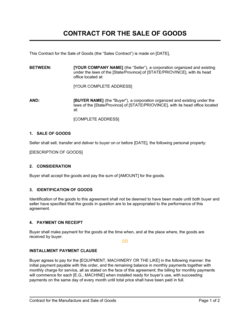
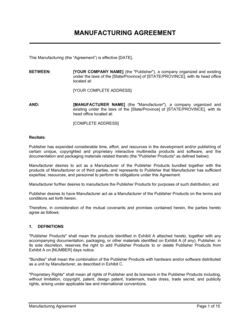
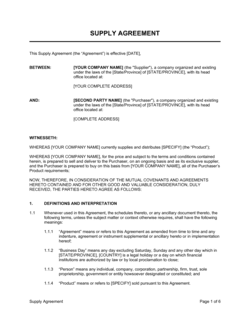
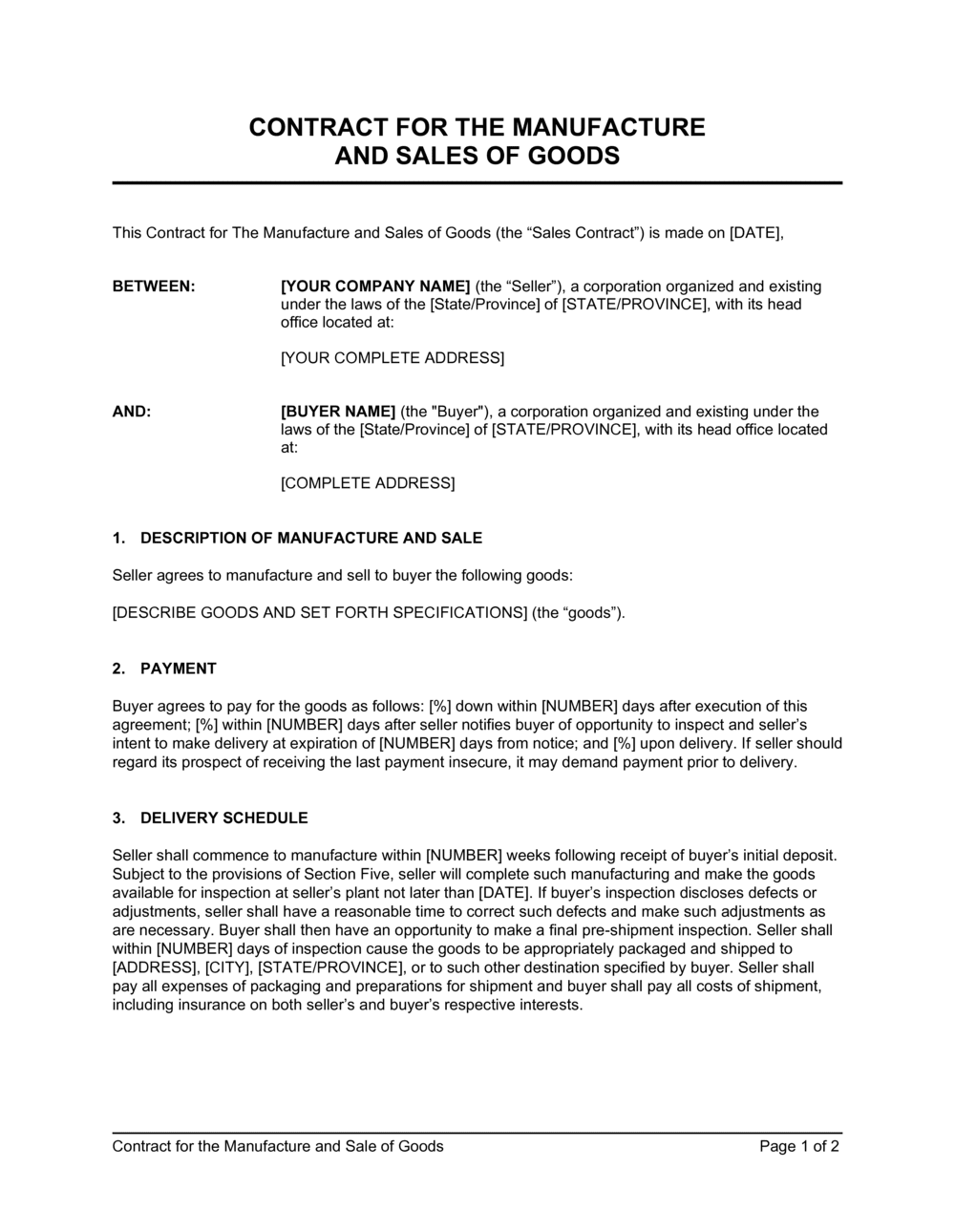
Contract for the Manufacture and Sale of Goods Template

Free Word download • Edit online • Save & share with Drive • Export to PDF

2 pages25–30 min to fillDifficulty: StandardSignature requiredLegal review recommended
Learn more ↓
FreeContract for the Manufacture and Sale of Goods Template

At a glance

What it is
A Contract for the Manufacture and Sale of Goods is a legally binding agreement between a buyer and a manufacturer that combines a production engagement with a purchase commitment in a single enforceable document. This free Word download covers product specifications, quality standards, lead times, tooling ownership, IP assignment, exclusivity, warranties, and delivery terms — ready to edit online and export as PDF.
When you need it
Use it whenever you are commissioning a manufacturer to produce custom or private-label goods to your specifications and want a binding purchase obligation alongside the production terms. It is essential before tooling, molds, or materials are ordered on your behalf.
What's inside
Product specifications and approved samples, production lead times and forecasting obligations, quality control and inspection rights, tooling and mold ownership, IP assignment and confidentiality, exclusivity terms, pricing and payment schedules, delivery and risk of loss, warranties and indemnification, and termination and remedies.

What is a Contract for the Manufacture and Sale of Goods?

A Contract for the Manufacture and Sale of Goods is a legally binding agreement between a buyer and a manufacturer that combines two distinct obligations into a single enforceable document: the manufacturer's commitment to produce custom goods to the buyer's specifications, and the buyer's commitment to purchase those goods at agreed pricing and delivery terms. Unlike a standard purchase agreement — which governs only the transfer of existing inventory — this contract governs the entire production relationship, including product specifications, approved samples, tooling and mold ownership, IP assignment, quality control and inspection rights, exclusivity, and the remedies available when goods fail to conform. It functions as the commercial constitution of the manufacturing relationship, replacing informal arrangements and verbal commitments with enforceable obligations on both sides.

Why You Need This Document

Operating without a signed manufacture and sale of goods contract exposes both parties to compounding risks from the moment tooling is ordered. Buyers who rely on emails and verbal agreements routinely discover that the manufacturer's interpretation of "conforming" differs sharply from their own — with no specification document or approved sample to arbitrate the dispute. Tooling and molds paid for by the buyer but undocumented in a contract can be held hostage by a manufacturer when the relationship breaks down, delaying supply by months while ownership is litigated. Exclusivity granted without a binding purchase commitment may be unenforceable. Without a defined inspection window and rejection procedure, a buyer who pays an invoice may inadvertently waive the right to reject defective goods delivered days earlier. This template closes each of these gaps in a single document — protecting the buyer's IP, tooling investment, and supply continuity while giving the manufacturer the volume commitment and pricing certainty needed to plan production efficiently.

Which variant fits your situation?

If your situation is…Use this template
Buying finished goods from an existing catalog without custom productionPurchase Agreement
Engaging a manufacturer for services only with no purchase commitmentManufacturing Agreement
Sourcing components or raw materials from a supplierSupply Agreement
Commissioning custom software or digital product developmentSoftware Development Agreement
Producing goods under a licensed brand or third-party IPLicense Agreement
Establishing a long-term exclusive distribution channel for manufactured goodsExclusive Distribution Agreement
Protecting product designs and trade secrets shared with a manufacturerNon-Disclosure Agreement

Common mistakes to avoid

❌ Vague or unattached product specifications

Why it matters: Without a signed-off specification document and approved sample, the manufacturer decides what 'conforming' means — leaving you with no contractual basis to reject defective goods or recover costs.

Fix: Finalize and attach a versioned Schedule A before execution, and include a clause requiring written approval of pre-production samples before any commercial production run begins.

❌ No tooling ownership clause

Why it matters: When a manufacturer holds molds or dies the buyer paid for and the relationship sours, the buyer faces months of delay and significant legal costs to recover tooling they have no documented right to.

Fix: State explicitly that all buyer-funded tooling is buyer's property, require physical marking of the tooling, and specify a return timeline upon termination.

❌ Open-ended price adjustment rights

Why it matters: A clause allowing the manufacturer to adjust prices at any time with minimal notice eliminates cost predictability and can make confirmed purchase orders economically non-viable.

Fix: Tie price adjustments to a specific index (e.g., the Producer Price Index for the relevant material category), cap the maximum annual adjustment, and require a minimum notice period of 60–90 days.

❌ No inspection window or defined remedy for non-conforming goods

Why it matters: Without a stated inspection period and explicit remedies, a buyer who accepts delivery may be held to have waived the right to reject — even if defects are discovered days later.

Fix: Set a 14- or 30-day inspection window from delivery date, specify that payment does not constitute acceptance, and list repair, replacement, and refund as the buyer's election among remedies.

❌ Exclusivity without a volume commitment

Why it matters: A manufacturer that grants exclusivity and receives no guaranteed volume in return may successfully argue the restriction is unenforceable for lack of consideration — leaving them free to produce for competitors.

Fix: Pair every exclusivity grant with a minimum annual purchase commitment, or pay a defined exclusivity fee. Include a conversion clause: if the buyer misses the volume threshold, exclusivity automatically lapses.

❌ Starting production before contract execution

Why it matters: Allowing the manufacturer to begin tooling or production on a verbal agreement or unsigned draft exposes the buyer to claims for wasted production costs and removes leverage to negotiate final contract terms.

Fix: Make it a non-negotiable rule: no tooling orders, no material purchases, and no production activity until both parties have executed the contract. Timestamp execution with an eSign tool.

The 10 key clauses, explained

Parties and recitals

In plain language: Identifies the buyer and manufacturer as legal entities, states the purpose of the agreement, and establishes the relationship as a commercial arm's-length transaction rather than an employment or partnership.

Sample language
This Contract for the Manufacture and Sale of Goods ('Agreement') is entered into as of [DATE] by and between [BUYER LEGAL NAME], a [STATE/COUNTRY] [ENTITY TYPE] ('Buyer'), and [MANUFACTURER LEGAL NAME], a [STATE/COUNTRY] [ENTITY TYPE] ('Manufacturer').

Common mistake: Using trade names or brand names instead of registered legal entity names. If the contracting party doesn't match the entity that owns assets or employs workers, enforcing warranty claims or IP provisions against the right party becomes legally complicated.

Product specifications and approved samples

In plain language: Defines exactly what the manufacturer will produce by incorporating written specifications and a signed-off approved sample as the contractual standard of conformance.

Sample language
Manufacturer shall produce the goods described in Schedule A ('Specifications') attached hereto. Prior to commercial production, Manufacturer shall submit [NUMBER] pre-production samples for Buyer's written approval. All production units shall conform to the approved sample in all material respects.

Common mistake: Attaching only a rough design brief instead of a finalized specification sheet. Vague specs shift the definition of 'conforming' to the manufacturer's interpretation, making rejection of non-conforming goods nearly impossible without a dispute.

Purchase orders, forecasts, and minimum order quantities

In plain language: Establishes the mechanics of how orders are placed, the buyer's forecasting obligations, and the minimum quantities per run — creating binding purchase commitments rather than aspirational demand signals.

Sample language
Buyer shall issue binding purchase orders on [NUMBER] days' advance notice. Buyer shall provide a [NUMBER]-month rolling forecast updated monthly. Each purchase order shall be for a minimum of [MOQ UNITS] units. Manufacturer shall confirm or reject each purchase order within [NUMBER] business days.

Common mistake: No minimum order quantity or binding forecast obligation. Without these, the manufacturer cannot plan production capacity and the buyer has no enforceable purchase commitment — making the 'contract' effectively an agreement to negotiate.

Pricing, invoicing, and payment terms

In plain language: Sets the unit price for each product, the conditions under which prices may be adjusted, invoicing triggers, and the payment schedule.

Sample language
The unit price for each product is set out in Schedule B. Prices are fixed for [NUMBER] months from the Effective Date. Manufacturer may request a price adjustment no more than once per [PERIOD], with [NUMBER] days' written notice. Payment terms: [NET 30/60] from date of conforming delivery.

Common mistake: No price adjustment mechanism or a completely open-ended one. A price frozen for the life of the contract exposes the manufacturer to input cost increases; an unrestricted right to adjust price exposes the buyer to margin destruction. Tie adjustments to a defined index, such as a materials price index.

Tooling, molds, and equipment ownership

In plain language: Specifies who pays for tooling and molds, who legally owns them, where they are stored, and what happens to them on termination — protecting the buyer's capital investment and supply continuity.

Sample language
All tooling, molds, and fixtures paid for by Buyer ('Buyer Tooling') shall remain the sole property of Buyer, regardless of where located. Manufacturer shall mark Buyer Tooling as 'Property of [BUYER NAME]' and shall maintain it in good working order. Upon termination, Manufacturer shall return all Buyer Tooling within [NUMBER] days.

Common mistake: No tooling ownership clause at all. When a manufacturer holds tooling and the relationship ends, the buyer may face months of delay and significant legal costs to recover molds they effectively paid for but cannot prove ownership of.

Intellectual property assignment and confidentiality

In plain language: Assigns to the buyer all IP embodied in the product design, requires the manufacturer to keep specifications and designs confidential, and restricts use of the buyer's IP to production under this agreement.

Sample language
All product designs, specifications, and related IP provided by Buyer or developed specifically for Buyer's products are and shall remain the exclusive property of Buyer. Manufacturer shall not disclose Buyer's Confidential Information to any third party and shall not use it for any purpose other than performing under this Agreement.

Common mistake: Relying on a separate NDA without an IP assignment clause in the manufacturing contract itself. A standalone NDA restricts disclosure but does not assign ownership of derivative designs or improvements developed by the manufacturer during production.

Quality control, inspection, and rejection

In plain language: Defines the quality standards that apply, the buyer's right to inspect goods before and after shipment, the procedure for rejecting non-conforming goods, and the manufacturer's obligation to remedy defects.

Sample language
All goods shall conform to the Specifications and approved sample. Buyer reserves the right to conduct factory inspections on [NUMBER] business days' notice. Buyer shall notify Manufacturer of any non-conformance within [NUMBER] days of delivery. Manufacturer shall, at Buyer's election, repair, replace, or refund the price of non-conforming goods within [NUMBER] days.

Common mistake: No defined inspection window and no specified remedy. Courts interpret acceptance after a 'reasonable time' inconsistently — a 14- or 30-day inspection window with explicit remedies prevents disputes about whether the buyer waived the right to reject.

Delivery, shipping terms, and risk of loss

In plain language: States the agreed Incoterms or domestic delivery terms, who arranges and pays for freight, and at what point risk of loss transfers from manufacturer to buyer.

Sample language
Manufacturer shall deliver goods [FOB / EXW / DDP] [LOCATION] as defined in the applicable purchase order. Risk of loss passes to Buyer upon [delivery to carrier / delivery to Buyer's facility]. Manufacturer shall provide advance shipment notice and packing list at least [NUMBER] days before shipment.

Common mistake: Omitting Incoterms or using ambiguous shorthand. Without a defined delivery term, both parties may assume the other is responsible for freight, insurance, and customs — creating disputes over who bears the cost of lost or damaged shipments.

Exclusivity and non-compete

In plain language: Restricts the manufacturer from producing the same or substantially similar products for competing buyers, in exchange for the buyer's volume commitment or a defined exclusivity fee.

Sample language
During the Term and for [NUMBER] months thereafter, Manufacturer shall not manufacture, sell, or supply goods that are substantially similar to the Products to any third party that competes with Buyer in [TERRITORY / MARKET SEGMENT], except with Buyer's prior written consent.

Common mistake: Granting exclusivity without a volume commitment or exclusivity fee in return. Courts and arbitrators look for consideration flowing both ways; a bare exclusivity grant with no purchase obligation may not be enforceable.

Term, termination, and remedies

In plain language: Sets the initial contract term, renewal mechanics, grounds for termination with or without cause, notice periods, and the remedies available to each party on breach or termination.

Sample language
This Agreement commences on the Effective Date and continues for [NUMBER] years ('Initial Term'), renewing automatically for successive [NUMBER]-year periods unless either party provides [NUMBER] days' written notice of non-renewal. Either party may terminate for material breach upon [NUMBER] days' written notice and failure to cure. Upon termination, Buyer shall pay for all conforming goods manufactured to confirmed purchase orders.

Common mistake: No cure period for breach. Allowing immediate termination for any breach — including minor invoicing errors — creates business disruption disproportionate to the offense. A 30-day cure period for remediable breaches is standard and avoids unnecessary escalation.

How to fill it out

  1. 1

    Identify the contracting parties with full legal names

    Enter the registered legal entity name, state or country of incorporation, and entity type (LLC, corporation, Ltd.) for both buyer and manufacturer. Confirm names against corporate registry records before execution.

    💡 If the manufacturer operates under a trade name different from its registered name, include both: '[TRADE NAME], operating as a trade name of [REGISTERED LEGAL NAME]'.

  2. 2

    Attach a complete Schedule A with product specifications

    Compile all dimensional drawings, material callouts, performance criteria, labeling requirements, and regulatory certifications into a single Schedule A. Reference it by version number so amendments are traceable.

    💡 If specifications are still evolving, add a clause requiring the parties to agree on final specs within a defined number of days — and make the contract conditional on that agreement.

  3. 3

    Set pricing, MOQs, and forecasting obligations in Schedule B

    Enter the unit price for each SKU, the minimum order quantity per run, any volume-tier pricing, and the buyer's rolling forecast obligation. Specify the currency and the price-adjustment mechanism tied to a defined index.

    💡 For international manufacturing relationships, state the payment currency explicitly and specify which party bears foreign exchange risk.

  4. 4

    Define tooling ownership and cost allocation

    List all molds, dies, and fixtures to be created or used, specify who pays the tooling cost, and state clearly that buyer-paid tooling is buyer's property. Include a clause requiring the manufacturer to insure buyer tooling against loss or damage.

    💡 Photograph and document all tooling with serial or reference numbers before production begins — this record is essential if you need to prove ownership or condition later.

  5. 5

    Specify delivery terms using recognized Incoterms

    Choose the applicable Incoterm (FOB, EXW, DDP, CIF, etc.) and name the specific port or facility. Confirm who arranges freight, who pays import duties, and at what point risk of loss transfers.

    💡 DDP (Delivered Duty Paid) places maximum obligation on the manufacturer but simplifies landed-cost calculation for the buyer — useful when the manufacturer has established freight lanes.

  6. 6

    Calibrate the exclusivity and non-compete provisions

    Define the territory, product category, and customer segment covered by the exclusivity restriction. Tie the exclusivity to a minimum annual purchase volume — if the buyer falls below it, exclusivity converts to non-exclusive.

    💡 Time-limited exclusivity with volume triggers is far more enforceable than open-ended exclusivity. Courts are more likely to uphold it when clear commercial consideration backs the restriction.

  7. 7

    Set the term, renewal, and termination mechanics

    Choose an initial term appropriate to the investment cycle — typically 1–3 years for standard goods, 3–5 years when significant tooling or tooling investment is involved. Define the notice period for non-renewal and the cure period for remediable breach.

    💡 Include a wind-down clause obligating the manufacturer to fulfill all confirmed purchase orders for at least 90 days after notice of termination — this protects against supply gaps while you transition to a new supplier.

  8. 8

    Sign before tooling or material procurement begins

    Both parties must execute the contract before the manufacturer orders materials, builds tooling, or begins any production activity for this project. Post-start execution weakens your ability to enforce specifications and ownership provisions.

    💡 Use eSign to timestamp execution and send counterparts simultaneously — do not allow the manufacturer to begin work in exchange for a verbal commitment to sign 'soon'.

Frequently asked questions

What is a contract for the manufacture and sale of goods?

A contract for the manufacture and sale of goods is a legally binding agreement that combines a production engagement — where a manufacturer agrees to make custom goods to the buyer's specifications — with a purchase commitment, where the buyer agrees to buy a defined quantity at an agreed price. It differs from a standard purchase agreement because it governs the production process itself, including specifications, tooling, quality control, and IP, not just the transfer of finished inventory.

How is this different from a manufacturing agreement?

A manufacturing agreement typically covers only the production services — what the manufacturer will make, to what standard, and on what timeline — without a binding purchase commitment. A contract for the manufacture and sale of goods adds the buyer's obligation to purchase, pricing terms, payment schedules, and delivery conditions, creating a two-sided commercial obligation. When you want to lock in both supply and demand, this combined contract is the right document.

Who should sign this contract?

Both the buyer and the manufacturer must sign, ideally through authorized signatories with the legal authority to bind their respective entities — typically a CEO, Managing Director, or person holding a valid power of attorney. For corporate parties, confirm signatory authority in the contract's execution block. The contract should be executed before any tooling is ordered or production begins.

Does this contract cover international manufacturing relationships?

Yes, with appropriate modifications. For cross-border arrangements, the contract should specify the governing law and dispute resolution forum, include Incoterms to define where risk and cost transfer, state the payment currency, address customs and import duty responsibility, and include a force majeure clause broad enough to cover trade restrictions and port closures. Consider also whether the UN Convention on Contracts for the International Sale of Goods (CISG) applies and whether to expressly opt out.

Who owns the tooling and molds under this contract?

Ownership depends on what the contract says. In most cases, the buyer pays for custom tooling and the contract should explicitly state that buyer-funded tooling is buyer's property — regardless of where it is physically located. Without a clear ownership clause, tooling held at a manufacturer's facility may be treated as the manufacturer's property under local law, leaving the buyer without recourse if the relationship ends. Mark all buyer-owned tooling physically and document it in a Schedule to the contract.

What quality standards should the contract reference?

The contract should reference the product specifications in Schedule A, any approved pre-production samples, and any applicable third-party standards — such as ISO 9001 for quality management, ASTM or EN material standards, or regulatory certifications like CE, FCC, or FDA compliance where required for the product category. Relying solely on a general "merchantable quality" standard gives the manufacturer too much interpretive latitude.

Is this contract enforceable internationally?

Generally yes, provided it designates a governing law, includes a dispute resolution mechanism (arbitration is typically more practical than litigation for cross-border disputes), and complies with the legal requirements of the jurisdictions where both parties are located. The CISG applies by default to international sale of goods contracts between parties in signatory countries — unless explicitly excluded. Consider whether to exclude CISG and rely solely on the chosen governing law.

What happens if the manufacturer delivers non-conforming goods?

The contract should give the buyer the right to inspect goods within a defined period — typically 14 to 30 days from delivery — and to reject non-conforming units with written notice. Remedies typically include the manufacturer's obligation to repair, replace, or refund, at the buyer's election. Payment before the inspection window closes should not constitute acceptance. Without these provisions, a buyer who pays on delivery may have significantly weakened rejection rights under applicable commercial law.

Do I need a lawyer to use this template?

For straightforward domestic manufacturing relationships involving standard goods and modest volumes, a well-completed template is often sufficient. A lawyer's review is strongly recommended when the relationship involves significant tooling investment, proprietary product designs with real competitive value, exclusivity provisions, cross-border production, or purchase volumes that create material financial exposure. A 2–4 hour review by a commercial contracts lawyer typically costs $600–$1,500 and is worthwhile before committing to a multi-year manufacturing relationship.

How this compares to alternatives

vs Manufacturing Agreement

A manufacturing agreement covers the production services — specs, quality, lead times, and IP — without creating a binding purchase commitment. A contract for the manufacture and sale of goods adds the buyer's obligation to purchase at agreed pricing and delivery terms. Use the manufacturing agreement when the buyer wants production capacity without committing to volumes; use this contract when both parties need a two-sided commercial obligation.

vs Purchase Agreement

A purchase agreement governs the sale of goods that already exist or will be drawn from an existing catalog. It does not address production processes, tooling, IP, or quality control during manufacturing. Use a purchase agreement for off-the-shelf procurement; use this contract whenever goods are being made to your specifications.

vs Supply Agreement

A supply agreement establishes the terms for an ongoing supply relationship — pricing, ordering mechanics, and delivery — typically for standardized or commodity goods. It does not cover custom production, tooling ownership, or specification approval. This contract is the appropriate choice when the manufacturer is building something custom to your design rather than pulling from standard inventory.

vs Non-Disclosure Agreement

An NDA restricts disclosure of confidential information but does not assign IP ownership, create purchase obligations, or govern production quality. It is appropriate for early-stage conversations before a manufacturing relationship is formalized. Once production begins, a standalone NDA is insufficient — the confidentiality and IP provisions in this contract supersede and replace the need for a separate NDA.

Industry-specific considerations

Consumer goods and retail

Private-label production runs with strict packaging and labeling specs, seasonal MOQs, and retailer compliance requirements built into quality clauses.

Industrial and B2B manufacturing

Engineering drawing references, dimensional tolerances, materials certifications, and first-article inspection requirements tied to acceptance.

Electronics and hardware

Regulatory certification obligations (CE, FCC, UL), firmware IP ownership, component-level specifications, and end-of-life tooling return provisions.

Food and beverage

Co-manufacturing with recipe confidentiality, FDA or Health Canada compliance obligations, lot traceability requirements, and shelf-life warranty terms.

Jurisdictional notes

United States

Article 2 of the Uniform Commercial Code governs the sale of goods in all US states and implies warranties of merchantability and fitness for a particular purpose unless explicitly disclaimed. Non-compete and exclusivity provisions are generally enforceable in manufacturing contexts but should be reasonable in scope. The CISG applies by default to international transactions with parties in signatory countries unless expressly excluded — most US practitioners opt out. State-level variations in warranty and remedies law make the governing law designation important.

Canada

Sale of goods legislation in each province (e.g., Ontario's Sale of Goods Act) implies conditions and warranties similar to the UCC, including fitness for purpose and correspondence with description. Quebec's Civil Code applies different rules for sale and manufacturing contracts and requires careful review for Quebec-based manufacturers. The CISG applies to international contracts unless opted out. In federally regulated industries — food, medical devices — production contracts should reference the applicable regulatory compliance obligations explicitly.

United Kingdom

The Sale of Goods Act 1979 and the Supply of Goods and Services Act 1982 imply statutory terms as to quality, fitness, and correspondence with description that cannot be excluded in consumer contracts. Post-Brexit, the UK is no longer a CISG signatory state, and governing law clauses specifying English law are unaffected by EU rules. IP ownership provisions must align with the Copyright, Designs and Patents Act 1988 — commissioned designs do not automatically vest in the buyer without an express assignment.

European Union

The CISG applies by default to international sale of goods contracts between EU-based parties and parties in other signatory states unless excluded. EU product liability rules under the Product Liability Directive create exposure for defective goods regardless of contractual limitations — buyers importing into the EU should ensure the manufacturer carries adequate product liability insurance. GDPR applies if personal data is processed in connection with the manufacturing relationship. Member state variations in contract law — notably French, German, and Dutch commercial codes — make local law review advisable for contracts governed by EU member-state law.

Template vs lawyer — what fits your deal?

PathBest forCostTime
Use the templateBuyers commissioning standard goods from a domestic manufacturer with limited tooling investment and no proprietary IP at stakeFree45–90 minutes
Template + legal reviewRelationships involving custom tooling, meaningful IP, exclusivity provisions, or purchase obligations above $50K annually$600–$1,5002–5 days
Custom draftedComplex multi-year OEM relationships, cross-border manufacturing, highly proprietary product designs, or volumes creating material financial exposure$2,500–$8,000+2–4 weeks

Glossary

Product Specifications
The detailed written and dimensional requirements — materials, tolerances, finishes, and performance criteria — that define what the manufacturer must produce.
Approved Sample
A physical or digital prototype confirmed in writing by the buyer as meeting specifications, against which all production units are measured.
Tooling
Molds, dies, jigs, and fixtures manufactured or procured specifically to produce the buyer's product — often paid for by the buyer and subject to ownership provisions.
OEM (Original Equipment Manufacturer)
A manufacturer that produces goods to another party's design and specifications, typically for resale under the buyer's brand.
Lead Time
The agreed number of days between the buyer's confirmed purchase order and the manufacturer's delivery of finished goods.
Incoterms
Standardized three-letter trade terms published by the ICC (e.g., FOB, CIF, DDP) that define where risk and cost transfer from seller to buyer in international shipments.
Exclusivity
A contractual restriction preventing the manufacturer from producing the same or substantially similar goods for any competing buyer during the agreement term.
Minimum Order Quantity (MOQ)
The smallest quantity of units the manufacturer will produce in a single production run, below which the per-unit economics are unacceptable to the manufacturer.
Warranty of Conformance
The manufacturer's guarantee that all delivered goods will conform to the agreed specifications, approved samples, and quality standards.
Indemnification
A contractual obligation by one party to compensate the other for losses, claims, or damages arising from a defined category of breach or third-party claim.
Force Majeure
A clause excusing a party's non-performance when caused by extraordinary events beyond its reasonable control, such as natural disasters, war, or government action.
Right of Inspection
The buyer's contractual right to inspect goods — at the factory, at point of shipment, or upon delivery — before accepting them as conforming.

Part of your Business Operating System

This document is one of 3,000+ business & legal templates included in Business in a Box.

  • Fill-in-the-blanks — ready in minutes
  • 100% customizable Word document
  • Compatible with all office suites
  • Export to PDF and share electronically

Create your document in 3 simple steps.

From template to signed document — all inside one Business Operating System.
1
Download or open template

Access over 3,000+ business and legal templates for any business task, project or initiative.

2
Edit and fill in the blanks with AI

Customize your ready-made business document template and save it in the cloud.

3
Save, Share, Send, Sign

Share your files and folders with your team. Create a space of seamless collaboration.

Save time, save money, and create top-quality documents.

★★★★★

"Fantastic value! I'm not sure how I'd do without it. It's worth its weight in gold and paid back for itself many times."

Managing Director · Mall Farm
Robert Whalley
Managing Director, Mall Farm Proprietary Limited
★★★★★

"I have been using Business in a Box for years. It has been the most useful source of templates I have encountered. I recommend it to anyone."

Business Owner · 4+ years
Dr Michael John Freestone
Business Owner
★★★★★

"It has been a life saver so many times I have lost count. Business in a Box has saved me so much time and as you know, time is money."

Owner · Upstate Web
David G. Moore Jr.
Owner, Upstate Web

Run your business with a system — not scattered tools

Stop downloading documents. Start operating with clarity. Business in a Box gives you the Business Operating System used by over 250,000 companies worldwide to structure, run, and grow their business.

Free Forever Plan · No credit card required