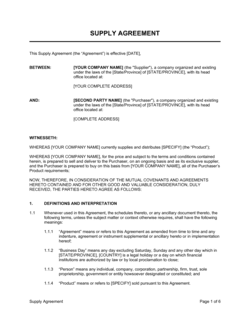
Manufacturing Quality Agreement Template

Free Word download • Edit online • Save & share with Drive • Export to PDF

5 pages25–35 min to fillDifficulty: ComplexSignature requiredLegal review recommended
Learn more ↓
FreeManufacturing Quality Agreement Template

At a glance

What it is
A Manufacturing Quality Agreement is a legally binding contract between a brand owner or buyer and a contract manufacturer that defines the quality standards, testing requirements, inspection rights, and corrective-action procedures governing the production relationship. This free Word download gives you a structured, attorney-reviewed starting point you can edit online and export as PDF to execute with any contract manufacturer or supplier.
When you need it
Use it before production begins with any contract manufacturer, co-packer, or third-party supplier whose output carries your brand or enters a regulated supply chain. It is particularly critical when products are subject to FDA, ISO, or CE-mark compliance requirements.
What's inside
The template covers quality standards and specifications, approved materials and suppliers, inspection and testing protocols, non-conformance and corrective-action procedures, record-keeping and audit rights, regulatory compliance obligations, change-control requirements, and indemnification and liability allocation.

What is a Manufacturing Quality Agreement?

A Manufacturing Quality Agreement is a legally binding contract between a brand owner or buyer and a contract manufacturer that defines the quality standards, testing protocols, inspection rights, non-conformance procedures, and regulatory compliance obligations governing the production relationship. Unlike a general manufacturing agreement — which addresses commercial terms such as pricing, volumes, and delivery — a quality agreement focuses specifically on how the product must be made, what constitutes acceptable output, and what both parties must do when quality failures occur. In regulated industries including pharmaceuticals, medical devices, and food manufacturing, a written quality agreement is required by law or regulatory guidance and is a standard expectation during authority inspections.

Why You Need This Document

Without a manufacturing quality agreement, quality obligations exist only as informal understandings — and informal understandings collapse the moment a batch fails, a recall is triggered, or a regulator arrives at your manufacturer's door. The consequences are concrete: products released outside specification with no contractual basis to demand rework or compensation; manufacturers changing raw material suppliers without notice, invalidating your regulatory filings; batch records destroyed before a defect surfaces three years later because no retention period was agreed. Brand owners face product liability exposure for manufacturing failures they had no contractual mechanism to prevent or detect. A properly executed quality agreement converts those risks into enforceable obligations — giving you audit access when you need it, documented CAPA timelines, and an indemnification structure that puts liability where causation actually lies. This template gives you a complete, attorney-reviewed starting point that covers every critical quality obligation in a format ready for execution before your next production run begins.

Which variant fits your situation?

If your situation is…Use this template
Pharmaceutical, biotech, or nutraceutical contract manufacturing under GMPGMP Quality Agreement
Medical device manufacturing requiring ISO 13485 complianceMedical Device Quality Agreement
Food or beverage co-packing with allergen and HACCP requirementsFood Safety and Quality Agreement
Software or SaaS product with embedded hardware componentHardware Manufacturing Quality Agreement
Ongoing supplier relationship covering multiple product linesSupplier Quality Agreement
Short-run or prototype manufacturing with limited regulatory exposureManufacturing Agreement (Standard)
Cosmetics or personal care products under FDA OTC requirementsCosmetics Manufacturing Quality Agreement

Common mistakes to avoid

❌ No versioned specification schedule

Why it matters: When specifications change mid-relationship, disputes arise over which version governed a recalled batch. Without a versioned Schedule A, both parties point to different documents.

Fix: Attach all specifications as a separately versioned Schedule A with an effective date and revision history, and require written sign-off from both quality representatives for every revision.

❌ Omitting a change-control clause

Why it matters: Manufacturers routinely switch raw material suppliers or adjust process parameters without notifying buyers — changes that can invalidate a product's regulatory filing or trigger a recall.

Fix: Include an explicit change-control clause with a minimum notice period and a written-approval requirement before any change is implemented.

❌ CoA requirement with no specified content

Why it matters: A CoA that lists test names without numerical results or pass/fail declarations against specification limits cannot support batch release decisions or regulatory inspections.

Fix: Define the mandatory CoA fields in Schedule C: lot number, manufacture date, test names, methods, results, acceptance criteria, pass/fail status, and authorized signatory.

❌ Indemnification without a gross negligence carve-out

Why it matters: Liability caps that apply to gross negligence or willful misconduct are unenforceable in most jurisdictions and signal that the drafter did not anticipate worst-case scenarios.

Fix: State explicitly that the liability cap does not apply to gross negligence, willful misconduct, or indemnification obligations arising from personal injury or death.

❌ No record retention obligation on the manufacturer

Why it matters: Without a contractual floor, manufacturers may purge batch records after their own internal retention period ends — leaving no documentation trail if a defect surfaces years later.

Fix: Specify a minimum retention period (5 years is standard for most industries; 30 years for some implantable medical devices) and require electronic copies to be provided to the brand owner on request.

❌ Audit rights limited to scheduled visits only

Why it matters: Regulatory inspections, recalls, and serious non-conformances require immediate access to facilities and records — annual scheduled audits provide no protection when a crisis occurs mid-year.

Fix: Include a for-cause audit right triggered by any non-conformance above a defined severity threshold, regulatory authority inspection, or product recall, with a 24-hour notice window.

The 10 key clauses, explained

Parties, scope, and effective date

In plain language: Identifies the brand owner or buyer and the contract manufacturer as legal entities, defines which products and facilities are covered, and records the date the agreement takes effect.

Sample language
This Manufacturing Quality Agreement ('Agreement') is entered into as of [EFFECTIVE DATE] between [BRAND OWNER LEGAL NAME], a [STATE/COUNTRY] [ENTITY TYPE] ('Company'), and [MANUFACTURER LEGAL NAME], a [STATE/COUNTRY] [ENTITY TYPE] ('Manufacturer'). This Agreement covers the manufacture of [PRODUCT DESCRIPTION] at Manufacturer's facility located at [FACILITY ADDRESS].

Common mistake: Listing only the facility address without naming the specific products covered. A site-level agreement that doesn't enumerate product lines leaves ambiguity about which quality standards apply to each SKU.

Quality standards and specifications

In plain language: Establishes the agreed product specifications — physical, chemical, microbiological, or performance — and incorporates them by reference as binding schedules.

Sample language
Manufacturer shall produce all Products in conformance with the Specifications set out in Schedule A, as amended in writing from time to time. Specifications include, but are not limited to, [CHEMICAL PARAMETERS], [PHYSICAL ATTRIBUTES], and [LABELING REQUIREMENTS]. In the event of a conflict between this Agreement and Schedule A, Schedule A controls.

Common mistake: Embedding specification values directly in the contract body rather than a versioned Schedule A. When specs evolve, an inline reference requires a formal contract amendment instead of a simple schedule update.

Approved materials and supplier controls

In plain language: Restricts the manufacturer to using raw materials, components, and sub-suppliers from a pre-qualified Approved Supplier List, and requires advance written approval before substitutions.

Sample language
Manufacturer shall source all raw materials and components exclusively from the Approved Supplier List attached as Schedule B. Manufacturer shall not substitute, add, or remove any supplier from Schedule B without prior written consent from Company's Quality representative, not to be unreasonably withheld.

Common mistake: No approved supplier clause at all, or one that permits substitutions with only email notification. Uncontrolled material substitutions are one of the most common root causes of product quality failures and regulatory recalls.

Inspection, testing, and certificate of analysis

In plain language: Sets the in-process and finished-goods testing requirements, defines who bears testing costs, and requires the manufacturer to provide a CoA for every released batch.

Sample language
Manufacturer shall perform all in-process and final product testing set out in Schedule C and shall issue a Certificate of Analysis ('CoA') for each batch prior to shipment. CoAs shall include lot number, test date, test results, and a pass/fail declaration against each Specification. Company reserves the right to conduct independent third-party testing at its own cost.

Common mistake: Requiring a CoA but not specifying what it must contain. A CoA that lists test names without results or pass/fail declarations is useless for batch release decisions and regulatory inspections.

Non-conformance reporting and disposition

In plain language: Requires the manufacturer to notify the buyer within a defined timeframe when a batch or material fails to meet specifications, and establishes a process for quarantine, rework, or rejection.

Sample language
Manufacturer shall notify Company in writing within [48] hours of discovering any Non-Conformance affecting a released or unreleased batch. Non-conforming product shall be quarantined immediately and shall not be shipped without Company's written disposition instruction. Disposition options: rework to Specification, destruction, or return at Manufacturer's expense.

Common mistake: A 48-hour notice window without a corresponding obligation to quarantine immediately. Manufacturers who notify on time but continue shipping non-conforming product create significant downstream liability for the brand owner.

Corrective and preventive action (CAPA)

In plain language: Obligates the manufacturer to investigate the root cause of any non-conformance and submit a documented CAPA plan within a specified number of days.

Sample language
For each Non-Conformance, Manufacturer shall submit a written CAPA report within [30] calendar days of identification, including: (a) root cause analysis, (b) immediate corrective actions taken, (c) preventive measures implemented, and (d) effectiveness verification timeline. Company may reject and require resubmission of any CAPA report that lacks documented root cause evidence.

Common mistake: Accepting CAPA reports that describe corrective actions without root cause evidence. Correcting symptoms without identifying root cause results in recurrence — and creates a documented pattern regulators treat as systemic failure.

Change control

In plain language: Requires the manufacturer to seek written approval before making any change to materials, processes, equipment, or facility conditions that could affect product quality or regulatory status.

Sample language
Manufacturer shall provide Company with no less than [60] days' written notice prior to implementing any proposed change to manufacturing processes, equipment, facility, raw materials, or sub-suppliers. No change shall be implemented without Company's prior written approval. Emergency changes affecting product safety shall be notified within [24] hours.

Common mistake: A change-control clause with no defined notice period. Without a specific lead time, manufacturers notify on the day of implementation — giving the buyer no time to assess regulatory impact or update product registrations.

Audit rights and facility access

In plain language: Grants the buyer the right to conduct scheduled and for-cause audits of the manufacturer's facilities, records, and quality systems.

Sample language
Company shall have the right to conduct up to [2] scheduled quality audits per year upon [10] business days' written notice, and unlimited for-cause audits upon [24] hours' notice following a Non-Conformance, regulatory action, or recall event. Manufacturer shall provide full access to facilities, equipment, batch records, and quality system documentation during audits.

Common mistake: Limiting audit rights to scheduled visits only. A for-cause audit triggered by a recall or regulatory inspection is the moment access matters most — contracts that restrict it to annual visits leave the buyer blind at the worst time.

Regulatory compliance and record retention

In plain language: Allocates responsibility for maintaining regulatory licenses, managing authority inspections, and retaining batch and quality records for the required statutory periods.

Sample language
Manufacturer shall maintain all licenses, registrations, and certifications required by applicable law to manufacture the Products, including [FDA registration / ISO 13485 certification / FSSC 22000]. Manufacturer shall retain all batch records, CoAs, and CAPA documentation for a minimum of [5] years from the date of manufacture, or such longer period as required by applicable law.

Common mistake: No record retention clause, or one that defers to 'applicable law' without specifying a minimum floor. When a recall occurs 3 years after production, a manufacturer with no retention obligation may have already destroyed the batch records needed to identify scope.

Indemnification and liability

In plain language: Allocates financial responsibility between the parties for losses arising from manufacturing defects, regulatory violations, or third-party product liability claims.

Sample language
Manufacturer shall indemnify, defend, and hold harmless Company from any third-party claims, losses, fines, or recall costs arising directly from Manufacturer's failure to comply with the Specifications, this Agreement, or applicable law. Company shall indemnify Manufacturer for claims arising solely from Company's product design, labeling, or marketing. Neither party's liability shall exceed [DOLLAR CAP OR FORMULA] in any 12-month period, except in cases of gross negligence or willful misconduct.

Common mistake: A mutual indemnification clause with no carve-out for gross negligence or willful misconduct. Caps on liability should never apply to intentional or reckless conduct — courts in most jurisdictions will void those limitations anyway, but having them in the contract creates an argument about scope.

How to fill it out

  1. 1

    Identify the parties and covered products

    Enter the full registered legal names of the brand owner and manufacturer, the facility address, and a precise description of each product or product family covered by the agreement.

    💡 Use the manufacturer's registered corporate name — not the facility's trade name — so the agreement binds the legal entity responsible for obligations.

  2. 2

    Attach and version your product specifications

    Create a Schedule A listing every product specification with version number and effective date. Reference the schedule in the agreement body rather than embedding values in the text.

    💡 Number each specification document and include a revision history table in Schedule A — this makes change-control disputes far easier to resolve.

  3. 3

    Build the approved supplier list

    List every approved raw material and component supplier in Schedule B, including the specific materials they are approved to supply. Leave a field for the date of last qualification audit.

    💡 Qualify at least two approved suppliers for every critical raw material — sole-source dependencies become quality emergencies during supply disruptions.

  4. 4

    Define testing requirements and CoA content

    In Schedule C, list every required in-process and final test, the method reference (e.g., USP <61>, ASTM D412), the acceptance criteria, and who performs the test.

    💡 Specify the analytical method by number, not just by name. 'Microbial testing' is ambiguous; 'USP <61> Total Aerobic Microbial Count' is enforceable.

  5. 5

    Set non-conformance timelines and disposition authority

    Enter the notification window (typically 24–48 hours), define who at the brand owner has authority to approve dispositions, and specify the default treatment for non-conforming product if no instruction is received within a set period.

    💡 Name a backup disposition authority in case the primary contact is unreachable — production halts caused by approval delays cost more than the NC itself.

  6. 6

    Configure change-control notice periods

    Set the advance notice period for planned changes (typically 30–90 days depending on regulatory complexity) and the emergency window for safety-related changes.

    💡 For regulated products subject to FDA or EMA filings, use 90 days as the standard notice period — many regulatory submissions require 60 days alone.

  7. 7

    Set audit frequency and access conditions

    Define the number of routine audits per year, the notice period, the scope of records accessible during audit, and the for-cause trigger events that allow unscheduled access.

    💡 Include regulatory authority inspections as a for-cause trigger — brand owners need to be notified immediately if an FDA or MHRA investigator arrives at the manufacturing site.

  8. 8

    Review indemnification caps and execute before production

    Set the liability cap at a figure tied to annual contract value or insurance coverage limits, confirm both parties' insurers have reviewed the indemnification structure, and execute the agreement before any production run begins.

    💡 Require certificates of insurance from the manufacturer naming the brand owner as an additional insured — the indemnification clause is only as good as the manufacturer's ability to pay.

Frequently asked questions

What is a manufacturing quality agreement?

A manufacturing quality agreement is a legally binding contract between a brand owner or buyer and a contract manufacturer that allocates quality assurance responsibilities, defines product specifications, and establishes the procedures for inspection, testing, non-conformance handling, and corrective action. It is the primary document that makes quality obligations enforceable rather than aspirational. In regulated industries such as pharmaceuticals, food, and medical devices, a written quality agreement is required by law or regulatory guidance.

Is a manufacturing quality agreement legally required?

In pharmaceuticals, the FDA's guidance on contract manufacturing relationships — and the EU's GMP Annex 16 — require a written quality agreement between the marketing authorization holder and the contract manufacturer. For medical devices, ISO 13485 requires documented supplier agreements covering quality requirements. In food manufacturing, FSMA supply-chain rules effectively require documented quality controls. For non-regulated manufactured goods, a quality agreement is not legally mandated but is strongly advisable to establish enforceable standards.

What is the difference between a manufacturing agreement and a manufacturing quality agreement?

A manufacturing agreement governs the commercial relationship — pricing, volumes, lead times, payment terms, and intellectual property. A manufacturing quality agreement focuses specifically on quality standards, testing protocols, non-conformance procedures, audit rights, and regulatory compliance obligations. In practice, both documents are used together: the manufacturing agreement defines the business terms, and the quality agreement defines the quality obligations. Some parties combine them into a single document; others keep them separate for ease of updating quality requirements without renegotiating commercial terms.

Who should sign a manufacturing quality agreement?

Both parties' quality representatives and authorized legal signatories should sign the agreement. In regulated industries, the quality agreement must be signed by the person responsible for quality at each organization — typically the VP of Quality, Head of Quality Assurance, or Qualified Person. Commercial or operations executives alone are insufficient signatories for FDA or EMA audit purposes. The agreement should be executed before any production run begins.

What is a CAPA and why must it be in the quality agreement?

CAPA stands for Corrective and Preventive Action — a structured investigation and response process triggered by a quality failure. The corrective action addresses the specific defect; the preventive action eliminates the root cause to prevent recurrence. Embedding CAPA requirements in the quality agreement makes the manufacturer contractually obligated to investigate and document root causes within defined timelines, rather than simply fixing the immediate problem. Without a contractual CAPA obligation, brand owners have no leverage to demand root cause analysis or verify that preventive measures were actually implemented.

How specific should product specifications in the quality agreement be?

Specifications should be specific enough that a third-party laboratory could test the product and reach a clear pass or fail decision without calling either party. Each specification should state the test parameter, the analytical method by number, the acceptance criterion (a range, limit, or attribute), and the units of measure. Vague specifications such as "good appearance" or "acceptable color" are not enforceable. Attach specifications as a versioned schedule so they can be updated without amending the entire agreement.

What happens when a product batch fails to meet specifications?

Under a properly drafted quality agreement, the manufacturer is required to quarantine the non-conforming batch immediately, notify the brand owner within the agreed window (typically 24–48 hours), and await written disposition instructions. The brand owner then directs one of three outcomes: rework to specification, destruction, or return. Following disposition, the manufacturer must submit a CAPA report within the agreed timeframe. Costs associated with non-conforming batches are typically allocated to the manufacturer when the failure is traceable to their materials, processes, or personnel.

How often should a manufacturing quality agreement be reviewed?

Most quality agreements include a periodic review clause requiring both parties to confirm or update the agreement at least every two years. In regulated industries, the FDA and EMA expect quality agreements to be reviewed following any significant change in product, process, regulation, or organizational structure. Practically, any change to the product specifications, manufacturing site, key personnel, or regulatory requirements should trigger a targeted review of the affected clauses.

Do manufacturing quality agreements need to be notarized?

No — notarization is not required for a manufacturing quality agreement to be legally binding in any major jurisdiction. Both parties' authorized signatures are sufficient. However, for cross-border agreements involving parties in civil-law jurisdictions such as France, Germany, or certain Latin American countries, notarization or apostille may be required for the agreement to be admissible in a local court proceeding. Consult local counsel when the manufacturer is in a jurisdiction unfamiliar to your legal team.

How this compares to alternatives

vs Manufacturing Agreement

A manufacturing agreement covers commercial terms — pricing, volumes, lead times, payment, and IP ownership. A manufacturing quality agreement covers quality standards, testing, non-conformance handling, and audit rights. The two documents complement each other and are typically executed together; combining them into a single contract is common for simpler relationships but risks commercial renegotiations disrupting quality obligations.

vs Supplier Agreement

A supplier agreement governs the purchase of goods or materials and typically addresses delivery, pricing, warranties, and liability. A manufacturing quality agreement goes further by specifying how the product must be made — detailing process controls, material sourcing restrictions, change-control requirements, and regulatory compliance. Use both when the supplier is also the manufacturer of a regulated or branded product.

vs Non-Disclosure Agreement

An NDA protects confidential information exchanged during a business relationship, including formulations, processes, and proprietary specifications. A manufacturing quality agreement does not replace an NDA — it governs quality obligations, not information confidentiality. Execute the NDA first, before sharing specifications, then execute the quality agreement to govern production.

vs Quality Assurance Plan

A quality assurance plan is an internal operational document describing how a single organization manages quality — its processes, roles, and checkpoints. A manufacturing quality agreement is a bilateral contract that binds both parties to specific quality obligations and creates legal remedies when those obligations are breached. The internal plan informs what the company requires of its manufacturer; the agreement makes those requirements enforceable.

Industry-specific considerations

Pharmaceutical and Biotech

GMP compliance under FDA 21 CFR Parts 210–211, EU GMP Annex 16 Qualified Person obligations, batch release procedures, and annual product reviews are all typically addressed in a pharma quality agreement.

Medical Devices

ISO 13485 requires documented supplier agreements covering design controls, sterilization validation, and device history records; quality agreements for Class II and III devices often reference 510(k) or PMA filing commitments.

Food and Beverage

HACCP plan references, allergen control procedures, FSMA supplier verification requirements, and co-packer audit rights are standard additions to food industry quality agreements.

Consumer Products and Cosmetics

FDA OTC drug or cosmetics GMP compliance, restricted ingredient lists, country-of-origin labeling requirements, and third-party testing obligations for heavy metals or contaminants are common additions.

Jurisdictional notes

United States

FDA guidance on contract manufacturing relationships — including the 2016 Contract Manufacturing Arrangements for Drugs guidance — requires a written quality agreement for pharmaceutical and biologics manufacturing. FSMA imposes supplier verification obligations on food manufacturers. Medical device quality agreements must align with 21 CFR Part 820 Quality System Regulation (transitioning to ISO 13485 under the 2024 Quality Management System Regulation). State product liability law governs indemnification enforceability; some states void indemnification clauses that cover a party's own negligence.

Canada

Health Canada requires quality agreements for licensed pharmaceutical and natural health product manufacturers under the Food and Drugs Act and the Natural Health Products Regulations. Quebec's Civil Code governs contracts differently from common-law provinces — indemnification and liability limitation clauses require careful drafting for Quebec-based manufacturers. The Canadian Food Inspection Agency (CFIA) expects documented supplier controls for federally regulated food products. Bilingual documentation may be required for products sold in Quebec.

United Kingdom

The MHRA requires written technical agreements between Marketing Authorization Holders and contract manufacturers under UK GMP Chapter 7, which mirrors EU GMP Annex requirements post-Brexit. Qualified Person (QP) responsibilities for batch certification must be clearly allocated in the agreement. The Contracts (Rights of Third Parties) Act 1999 may give third parties rights under a quality agreement unless explicitly excluded. Post-Brexit, CE-marked products exported to the UK may require UKCA marking, which should be addressed in the regulatory compliance clause.

European Union

EU GMP Annex 16 and Chapter 7 require written contracts between manufacturers and marketing authorization holders, with explicit allocation of Qualified Person responsibilities for batch release. GDPR considerations apply when batch records, audit reports, or personnel records containing personal data are shared across borders. The EU's General Product Safety Regulation (replacing the General Product Safety Directive in 2024) strengthens supply chain traceability requirements. Indemnification clauses must comply with applicable national contract law — French and German courts have different standards for liability cap enforceability.

Template vs lawyer — what fits your deal?

PathBest forCostTime
Use the templateNon-regulated manufactured goods where the primary risk is product consistency rather than regulatory complianceFree2–4 hours to complete and execute
Template + legal reviewFood, cosmetics, or consumer products with moderate regulatory exposure or a manufacturer in a different jurisdiction$500–$1,500 for a one-time legal and quality review3–7 business days
Custom draftedPharmaceutical, medical device, or Class II/III device manufacturing where regulatory non-compliance carries criminal liability$2,500–$8,000+ depending on regulatory complexity2–6 weeks

Glossary

Quality Agreement
A binding contract that allocates quality assurance responsibilities and defines acceptable standards between a buyer and a contract manufacturer.
Non-Conformance (NC)
Any product, material, or process that fails to meet the agreed specifications or quality standards defined in the agreement.
Corrective and Preventive Action (CAPA)
A documented process for identifying the root cause of a defect, correcting it, and implementing controls to prevent recurrence.
Certificate of Analysis (CoA)
A document issued by the manufacturer certifying that a specific batch of product was tested and met the agreed quality specifications.
GMP (Good Manufacturing Practice)
Regulatory standards — issued by the FDA, EMA, or equivalent authority — governing facilities, processes, and records in the production of pharmaceuticals, food, or medical devices.
Change Control
A formal process requiring advance written notice and approval before the manufacturer alters materials, processes, equipment, or facility conditions that may affect product quality.
Approved Supplier List (ASL)
A written register of raw material and component suppliers pre-qualified by one or both parties for use in manufacturing the contracted product.
Audit Right
A contractual entitlement allowing the buyer to inspect the manufacturer's facilities, records, and processes to verify compliance with the quality agreement.
Specification
A documented set of requirements — dimensions, chemical properties, microbiological limits, appearance, or performance criteria — that a product or material must meet.
Indemnification
A clause requiring one party to compensate the other for losses arising from defined events, such as manufacturing defects, regulatory violations, or third-party claims.
Lot / Batch Record
Documented evidence showing all steps, materials, equipment, and personnel involved in manufacturing a specific production run, used to trace quality issues to their source.

Part of your Business Operating System

This document is one of 3,000+ business & legal templates included in Business in a Box.

  • Fill-in-the-blanks — ready in minutes
  • 100% customizable Word document
  • Compatible with all office suites
  • Export to PDF and share electronically

Create your document in 3 simple steps.

From template to signed document — all inside one Business Operating System.
1
Download or open template

Access over 3,000+ business and legal templates for any business task, project or initiative.

2
Edit and fill in the blanks with AI

Customize your ready-made business document template and save it in the cloud.

3
Save, Share, Send, Sign

Share your files and folders with your team. Create a space of seamless collaboration.

Save time, save money, and create top-quality documents.

★★★★★

"Fantastic value! I'm not sure how I'd do without it. It's worth its weight in gold and paid back for itself many times."

Managing Director · Mall Farm
Robert Whalley
Managing Director, Mall Farm Proprietary Limited
★★★★★

"I have been using Business in a Box for years. It has been the most useful source of templates I have encountered. I recommend it to anyone."

Business Owner · 4+ years
Dr Michael John Freestone
Business Owner
★★★★★

"It has been a life saver so many times I have lost count. Business in a Box has saved me so much time and as you know, time is money."

Owner · Upstate Web
David G. Moore Jr.
Owner, Upstate Web

Run your business with a system — not scattered tools

Stop downloading documents. Start operating with clarity. Business in a Box gives you the Business Operating System used by over 250,000 companies worldwide to structure, run, and grow their business.

Free Forever Plan · No credit card required