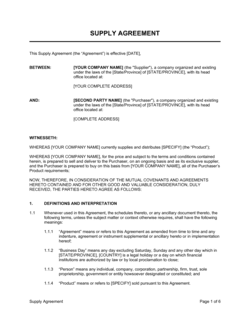
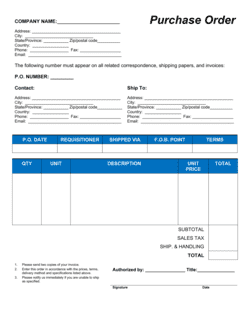
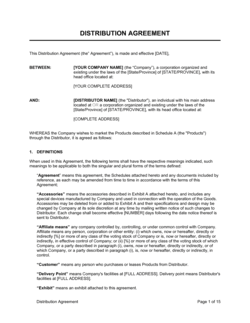
Oem Agreement Template

Free Word download • Edit online • Save & share with Drive • Export to PDF

26 pages35–50 min to fillDifficulty: ComplexSignature requiredLegal review recommended
Learn more ↓
FreeOem Agreement Template

At a glance

What it is
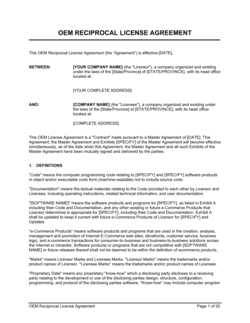
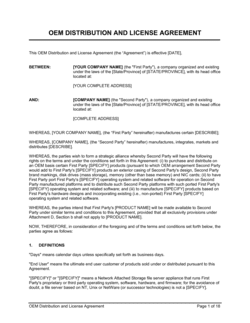
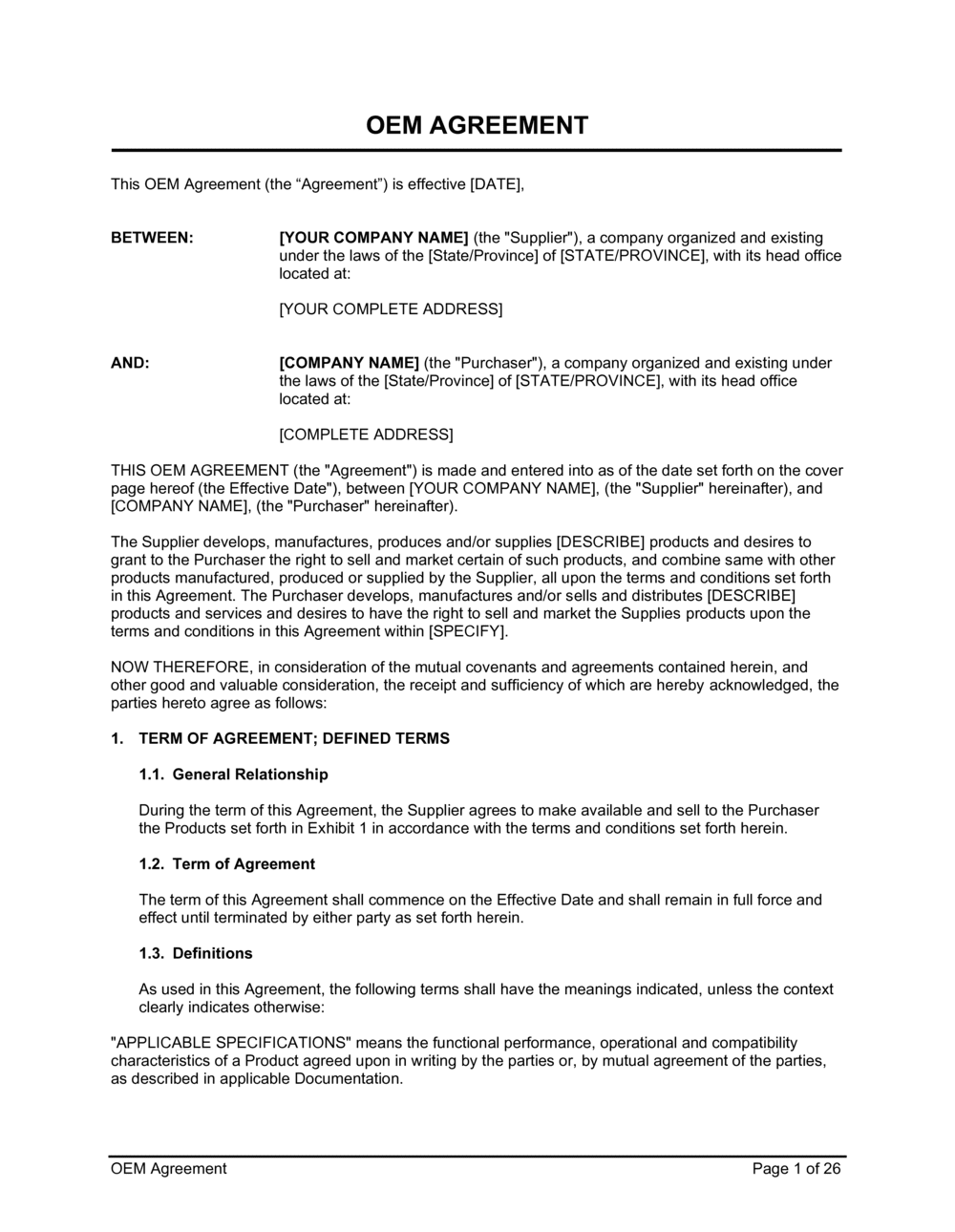
An OEM Agreement is a legally binding contract between an Original Equipment Manufacturer and a brand owner under which the manufacturer produces components or finished goods to the brand owner's specifications, and the brand owner sells those goods under its own label. This free Word download covers product specifications, IP ownership, quality control, exclusivity, pricing, term, and sublicensing — ready to edit online and export as PDF.
When you need it
Use it when a brand owner is engaging a third-party manufacturer to produce goods that will be sold under the brand owner's name, or when a manufacturer is formalizing a white-label supply relationship with a new commercial customer. It is essential before any tooling investment, production run, or transfer of proprietary specifications.
What's inside
Product specifications and technical standards, IP assignment and licensing, quality assurance obligations and audit rights, pricing and payment terms, exclusivity and territory restrictions, term and renewal, confidentiality, and termination triggers including for-cause and convenience provisions.

What is an OEM Agreement?

An OEM Agreement is a legally binding contract between an Original Equipment Manufacturer and a brand owner under which the manufacturer produces components or finished goods to the brand owner's precise specifications, and the brand owner sells those goods under its own commercial label. The agreement defines every material dimension of the production relationship: what is built and to what standard, who owns the IP and tooling created in the process, how quality is measured and enforced, whether the manufacturer is exclusive to the brand owner, how pricing and purchase orders work, and what happens when either party wants to exit. Unlike a standard purchase order or supply agreement, an OEM agreement involves the transfer or licensing of proprietary specifications and often significant tooling investment — making it one of the more consequential commercial contracts a product company will sign.

Why You Need This Document

Without a written OEM agreement, your product specifications, tooling investment, and brand are exposed from the moment you share them with a manufacturer. A manufacturer who receives your specs without a signed contract can legally produce your product for a competitor — or hold custom-funded tooling hostage at the end of the relationship. Quality disputes devolve into subjective arguments rather than objective pass/fail criteria when no AQL threshold is defined. Exclusivity granted verbally offers no protection in arbitration or court. The brand owner also carries strict product liability under most consumer protection regimes, meaning defective goods sold under your label are your legal problem regardless of who built them — making manufacturer indemnification and warranty terms essential. This template gives you a complete, enforceable OEM framework ready to customize for your product, your manufacturer, and your jurisdiction, cutting the drafting time from weeks to hours.

Which variant fits your situation?

If your situation is…Use this template
Manufacturer producing finished goods sold under the buyer's brandOEM Agreement (Finished Goods)
Manufacturer supplying components integrated into a third-party productComponent Supply Agreement
Brand owner licensing its IP to a manufacturer for productionManufacturing License Agreement
Supplier delivering goods under a private label with no IP transferWhite Label Agreement
Ongoing purchasing relationship without full OEM IP obligationsSupplier Agreement
Manufacturer with exclusive territory rights and volume commitmentsExclusive Manufacturing Agreement
Short-term production run for a single product or prototype batchPurchase Order Agreement

Common mistakes to avoid

❌ Granting exclusivity without a minimum purchase commitment

Why it matters: The manufacturer gives up the right to produce for competitors but has no guaranteed revenue — if the brand owner underorders or pivots, the manufacturer bears the full economic loss of the exclusivity concession.

Fix: Tie any exclusivity grant to a binding annual minimum purchase quantity or value, with a 90-day cure window and automatic conversion to non-exclusive if the commitment is not met.

❌ Leaving tooling ownership unaddressed

Why it matters: Custom molds and dies can cost $50,000–$500,000 or more. Without clear ownership language, a manufacturer can hold tooling hostage at termination or use it to produce competing goods for other customers.

Fix: State explicitly whether tooling is brand-owner property (typically when brand owner funds it) or manufacturer property with a limited-use license, and include a physical return or destruction obligation on termination.

❌ No numeric quality threshold for batch rejection

Why it matters: Without a defined acceptable quality level, every shipment quality dispute becomes a subjective argument — giving the stronger negotiating party an advantage rather than resolving the issue on objective criteria.

Fix: Reference an AQL standard (e.g., ANSI/ASQ Z1.4) and state the specific AQL level (typically 1.0–2.5) and inspection level (typically General Inspection Level II) that will govern acceptance and rejection.

❌ Short termination-for-convenience window with no inventory tail obligation

Why it matters: A 30- or 60-day termination window on a contract with long lead times leaves the manufacturer with funded raw materials, work-in-progress, and finished goods that the brand owner effectively ordered but is not obligated to purchase.

Fix: Set a minimum 90–180 day convenience termination window and include a tail provision obligating the brand owner to purchase all finished goods and in-progress inventory at the contract price within 30 days of the termination notice.

❌ No post-termination confidentiality survival period

Why it matters: Without a survival clause, confidentiality obligations technically lapse the moment the agreement ends, leaving proprietary specifications, formulas, and pricing immediately unprotected.

Fix: Include an explicit survival clause stating that confidentiality obligations continue for at least three to five years after termination or expiry of the agreement.

❌ Choosing a litigation-only dispute resolution clause for a cross-border agreement

Why it matters: A US or UK court judgment is difficult and expensive to enforce in China, Vietnam, Mexico, and many other manufacturing jurisdictions — effectively rendering a court-only clause unenforceable in practice.

Fix: Use binding international arbitration under a recognized body (ICC, AAA, HKIAC) with a seat in a neutral jurisdiction. International arbitration awards are enforceable in 170+ countries under the New York Convention.

The 10 key clauses, explained

Parties, recitals, and definitions

In plain language: Identifies the manufacturer and brand owner as legal entities, states the commercial purpose of the agreement, and defines all key terms used throughout the contract.

Sample language
This OEM Agreement ('Agreement') is entered into as of [DATE] between [MANUFACTURER LEGAL NAME], a [STATE/COUNTRY] [ENTITY TYPE] ('Manufacturer'), and [BRAND OWNER LEGAL NAME], a [STATE/COUNTRY] [ENTITY TYPE] ('Brand Owner').

Common mistake: Using trade names instead of registered legal entity names — if the entity name does not match corporate registration records, enforcing IP assignment or exclusivity clauses against the right party becomes legally complicated.

Product specifications and technical standards

In plain language: Sets out exactly what the manufacturer must produce — materials, dimensions, tolerances, performance benchmarks, and applicable regulatory standards — typically by reference to a detailed Schedule A.

Sample language
Manufacturer shall produce the Products in strict conformance with the specifications set out in Schedule A ('Specifications'). Any deviation from the Specifications requires Brand Owner's prior written approval. Manufacturer shall comply with all applicable regulatory standards, including [ISO STANDARD / CE / FCC / UL], as listed in Schedule A.

Common mistake: Embedding specification details in the contract body rather than in a versioned schedule — when specs evolve, the entire contract appears to be amended, creating version-control and enforceability problems.

Intellectual property ownership and licensing

In plain language: Defines who owns any IP created during the relationship — including tooling designs, firmware, and improvements — and grants the manufacturer a limited license to use the brand owner's IP solely for production.

Sample language
All IP created by Manufacturer in connection with the Products, including tooling designs, molds, and process improvements specific to the Specifications, shall be the sole property of Brand Owner and is hereby assigned to Brand Owner. Brand Owner grants Manufacturer a non-exclusive, non-transferable license to use Brand Owner's trademarks and technical IP solely to manufacture the Products under this Agreement.

Common mistake: Failing to address IP in incremental improvements — if the manufacturer innovates on the production process, ownership of that improvement is ambiguous without an explicit 'improvements and derivatives' clause.

Quality assurance, inspection, and audit rights

In plain language: Establishes the manufacturer's QA obligations, acceptable defect rates, pre-shipment inspection procedures, and the brand owner's right to audit the manufacturing facility.

Sample language
Manufacturer shall maintain a quality management system meeting [ISO 9001 / equivalent] standards. Brand Owner shall have the right, upon [5] business days' written notice, to inspect the manufacturing facility and audit quality records. Shipments with a defect rate exceeding [X]% may be rejected at Manufacturer's expense.

Common mistake: Setting no numeric defect-rate threshold — without a defined acceptable quality level (AQL), disputes about whether a batch is rejectable become purely subjective and are hard to resolve or litigate.

Pricing, purchase orders, and payment terms

In plain language: States the unit price or pricing formula, minimum order quantities, how purchase orders are issued and accepted, and the payment schedule — including currency and late-payment consequences.

Sample language
Unit price: [CURRENCY] [AMOUNT] per unit at MOQ of [X] units per order, as set out in Schedule B. Brand Owner shall issue purchase orders in writing; Manufacturer shall confirm acceptance within [5] business days. Payment: [50]% upon order confirmation, [50]% prior to shipment. Late payments accrue interest at [1.5]% per month.

Common mistake: Not specifying currency on cross-border agreements — a price stated in a single currency without an FX adjustment mechanism can make the deal uneconomic for the manufacturer if the rate shifts significantly during a long-term contract.

Exclusivity and territory

In plain language: Specifies whether the manufacturer may produce the same or substantially similar products for other brand owners, and/or whether the brand owner is restricted to a single manufacturer — including geographic and product-category scope.

Sample language
During the Term, Manufacturer shall not manufacture or supply the Products, or any substantially similar product incorporating the Specifications or tooling funded by Brand Owner, to any third party within [TERRITORY] without Brand Owner's prior written consent. This exclusivity is conditioned on Brand Owner meeting the minimum annual purchase commitment set out in Schedule B.

Common mistake: Granting exclusivity without a minimum purchase obligation — the manufacturer accepts competitive restrictions but has no guarantee of sufficient volume, leaving them exposed if the brand owner underperforms or pivots.

Term, renewal, and termination

In plain language: Sets the initial contract period, the conditions for automatic renewal or notice-based renewal, and the grounds for termination — including for-cause termination (material breach, insolvency) and termination for convenience with a notice period.

Sample language
This Agreement commences on [DATE] and continues for an initial term of [X] years ('Initial Term'), renewing automatically for successive [1]-year periods unless either party provides [90] days' written notice of non-renewal. Either party may terminate for Cause upon [30] days' written notice if the other party commits a material breach and fails to cure within [30] days. Brand Owner may terminate for convenience upon [180] days' written notice.

Common mistake: Using a short termination-for-convenience window (e.g., 30 days) without accounting for the manufacturer's tooling investment and production pipeline — this exposes the brand owner to claims of bad-faith termination and leaves the manufacturer with unrecoverable costs.

Confidentiality and non-disclosure

In plain language: Prohibits both parties from disclosing the other's proprietary information — including product specifications, pricing, customer data, and trade secrets — during and for a defined period after the agreement ends.

Sample language
Each party agrees to hold the other's Confidential Information in strict confidence and not to disclose it to any third party without prior written consent. 'Confidential Information' includes Specifications, pricing, customer data, and technical know-how. Obligations survive termination for [5] years.

Common mistake: Omitting a post-termination survival period — without one, the confidentiality obligation technically ends when the contract ends, leaving trade secrets and specs exposed immediately after the relationship concludes.

Representations, warranties, and indemnification

In plain language: Each party warrants that it has authority to enter the agreement; the manufacturer additionally warrants that goods will conform to specifications and be free from defects; both parties agree to indemnify the other against third-party claims arising from their own breach or negligence.

Sample language
Manufacturer warrants that the Products will conform to the Specifications for a period of [12] months from the date of delivery and will be free from defects in materials and workmanship. Each party shall indemnify, defend, and hold harmless the other from any third-party claims, damages, and costs arising from the indemnifying party's breach of this Agreement or gross negligence.

Common mistake: Limiting the warranty period to the date of shipment rather than the date of delivery to the end customer — for products with long distribution chains, a shipment-date warranty can expire before the product reaches the consumer.

Governing law, dispute resolution, and entire agreement

In plain language: Specifies which jurisdiction's law governs the contract, how disputes are resolved (arbitration, mediation, or court), and confirms that the written agreement supersedes all prior representations and understandings.

Sample language
This Agreement is governed by the laws of [STATE / COUNTRY], without regard to conflict-of-law principles. Any dispute shall be resolved by binding arbitration under [ICC / AAA / HKIAC] rules in [CITY], conducted in [LANGUAGE]. This Agreement constitutes the entire agreement between the parties and supersedes all prior negotiations, representations, and understandings.

Common mistake: Selecting a governing law jurisdiction that has no connection to either party's operations — some jurisdictions' courts will disregard a governing-law clause that lacks a reasonable nexus, creating unpredictable outcomes in litigation.

How to fill it out

  1. 1

    Identify both parties with their registered legal names

    Enter the full registered legal name, entity type, and jurisdiction of incorporation for both the manufacturer and the brand owner. Confirm names against corporate registry filings before execution.

    💡 Cross-border OEM agreements often involve holding companies or trading subsidiaries — ensure you are contracting with the entity that actually operates the factory, not a parent that cannot directly perform.

  2. 2

    Attach a detailed product specification as Schedule A

    Draft or attach a complete product specification covering materials, dimensions, tolerances, performance benchmarks, applicable certifications (CE, FCC, RoHS), and packaging requirements. Reference it in the main agreement body rather than embedding it inline.

    💡 Version-control your spec schedule (e.g., 'Spec Rev 1.0, dated [DATE]') so that subsequent engineering changes are documented as formal schedule amendments, not informal emails.

  3. 3

    Define IP ownership for tooling and improvements

    Specify whether the brand owner funds tooling and therefore owns it outright, or whether the manufacturer owns tooling and grants a limited-use license. Address who owns process improvements made during production.

    💡 If the brand owner is funding custom molds, include a clause requiring the manufacturer to label tooling as brand-owner property and to return or destroy it upon termination.

  4. 4

    Set quality standards, AQL thresholds, and audit rights

    Reference a recognized quality management standard (ISO 9001 or equivalent), define the acceptable quality level (AQL) for defect rates, and specify the inspection and audit procedures — including how often audits may occur and what records must be available.

    💡 Build in a pre-production sample approval step (golden sample) so that both parties agree on the physical standard before mass production begins — this prevents the most common end-of-run rejection disputes.

  5. 5

    Complete the pricing and purchase order schedule

    Fill in unit prices, MOQs, lead times, currency, and payment milestones in Schedule B. State whether pricing is fixed or subject to annual review, and include an FX adjustment mechanism for cross-border agreements.

    💡 Add a material cost escalation clause tied to a published commodity index (e.g., LME copper price) so that price renegotiation triggers are objective rather than adversarial.

  6. 6

    Calibrate exclusivity to volume commitments

    If granting exclusivity to the brand owner, tie it to an annual minimum purchase commitment — specified in units or dollar value — with a clear consequence (exclusivity converts to non-exclusive) if the commitment is missed.

    💡 Set the minimum purchase commitment at roughly 70–80% of your realistic forecast, not the optimistic projection, to avoid triggering a non-exclusive conversion in a flat year.

  7. 7

    Set termination notice periods proportionate to the manufacturer's investment

    Set the termination-for-convenience notice period to at least cover the manufacturer's average tooling amortization and outstanding purchase order pipeline — typically 90–180 days for established production relationships.

    💡 Include a 'tail' purchase obligation: if the brand owner terminates for convenience, it must purchase all finished goods and in-progress inventory at the contract price within 30 days of the termination notice.

  8. 8

    Select governing law and arbitration venue appropriate to both parties

    Choose a governing law and arbitration venue with a clear commercial nexus to the parties — ideally a neutral jurisdiction both parties recognize. For China-based manufacturers, ICC or HKIAC arbitration is commonly accepted.

    💡 Avoid US-only litigation clauses in agreements with manufacturers outside North America — enforcing a US court judgment in China, Vietnam, or Mexico is practically very difficult compared to an international arbitration award.

Frequently asked questions

What is an OEM agreement?

An OEM agreement is a contract under which a manufacturer produces goods — either components or finished products — to another company's specifications, and that company sells the goods under its own brand. The manufacturer is the OEM; the brand-owning company is typically called the brand owner or buyer. The agreement governs product specifications, IP ownership, quality standards, pricing, exclusivity, and termination. It is distinct from a simple supply agreement because it typically involves the transfer or licensing of proprietary specifications and tooling.

What should an OEM agreement include?

At minimum: the parties' legal names and roles, a detailed product specification (usually as a schedule), IP ownership and licensing terms, quality assurance obligations and audit rights, pricing and MOQ, payment terms, exclusivity provisions tied to volume commitments, term and renewal mechanics, confidentiality, warranties, indemnification, and governing law. Missing IP or tooling ownership language is the single most common and costly gap in OEM contracts.

Who owns the IP in an OEM relationship?

IP ownership depends entirely on what the contract says. In most well-drafted OEM agreements, the brand owner retains ownership of the product specifications, trademarks, and any tooling it funds. The manufacturer is granted a limited, non-transferable license to use that IP solely for production under the contract. Without an explicit assignment clause, the party that creates IP — including the manufacturer — may retain rights to it by default under most jurisdictions' IP laws.

What is the difference between an OEM agreement and a white-label agreement?

The terms are often used interchangeably, but there is a functional distinction. In an OEM arrangement, the brand owner typically provides proprietary specifications, funded tooling, or licensed technology — meaning the product is custom-built to the brand owner's design. In a white-label arrangement, the manufacturer has an existing off-the-shelf product that the buyer rebrands with minimal customization. OEM agreements therefore involve more IP complexity, while white-label agreements are closer to a standard reseller or supply relationship.

Is exclusivity standard in OEM agreements?

Exclusivity is common but not universal. Brand owners typically seek exclusivity to prevent the manufacturer from producing the same product for competitors. Manufacturers typically accept exclusivity only if paired with a binding minimum purchase commitment that compensates for the foregone revenue from other potential customers. Exclusivity without a volume commitment is a significant risk for the manufacturer and is frequently negotiated out or converted to a non-exclusive arrangement after the first contract year.

Do I need a lawyer to draft an OEM agreement?

For straightforward domestic OEM relationships with a trusted manufacturer, a high-quality template reviewed by a commercial lawyer is usually sufficient. Engage a specialist when the relationship is cross-border, involves significant tooling investment (above $50,000), includes complex IP assignment, or covers regulated product categories (medical devices, electronics with certification requirements, food-contact materials). A lawyer review of an OEM template typically costs $500–$1,500, which is negligible compared to the cost of a tooling dispute or IP leakage.

How do I protect my product specifications in an OEM agreement?

Three mechanisms work together: a confidentiality clause with a defined post-termination survival period, a limited-use IP license that restricts the manufacturer to production under the agreement only, and a tooling ownership clause that gives the brand owner physical custody or a right of return. Additionally, avoid sending full specifications until the agreement is signed, and consider registering key design elements as registered designs or patents before disclosing them to any manufacturer.

What happens to tooling when an OEM agreement ends?

The outcome depends entirely on the tooling ownership clause. If the brand owner funded and owns the tooling, the agreement should require the manufacturer to return it or certify its destruction within a defined period after termination. If the manufacturer owns the tooling and grants a license, that license terminates with the contract and the manufacturer may reuse or repurpose the tooling. Failing to address this at contract stage is a leading cause of post-termination disputes in OEM relationships.

What minimum order quantities are typical in OEM agreements?

MOQs vary widely by product category, manufacturing complexity, and geography. Electronics and consumer goods MOQs with Chinese manufacturers commonly range from 500 to 5,000 units per run. Custom injection-molded plastic products may have MOQs of 1,000–10,000 units to justify tooling setup costs. The MOQ should be negotiated to balance the manufacturer's fixed-cost recovery against the brand owner's inventory risk, and stated explicitly in the pricing schedule rather than left to purchase-order negotiation.

How should quality standards be enforced in an OEM agreement?

Reference a specific international quality standard (ISO 9001 or equivalent) for the manufacturer's management system. Define a numeric acceptable quality level (AQL) for defect rates using a recognized inspection standard (ANSI/ASQ Z1.4 is most common). Include a pre-production golden sample approval process, a right to conduct pre-shipment inspections (either by the brand owner or a nominated third-party inspection firm), and a clear rejection and cure procedure specifying who bears the cost of rework or replacement.

How this compares to alternatives

vs Supplier Agreement

A supplier agreement governs the recurring purchase of standard, off-the-shelf goods or materials with no significant IP or specification transfer. An OEM agreement is appropriate when the brand owner provides proprietary specifications, funds custom tooling, or licenses trademarks to the manufacturer. If no IP changes hands, a supplier agreement is typically sufficient and less complex.

vs Manufacturing License Agreement

A manufacturing license agreement grants the manufacturer a license to use the licensor's IP to make products for its own account — the manufacturer sells the finished goods itself. In an OEM agreement, the brand owner buys back all production and sells under its own name. The direction of the commercial relationship is reversed: in an OEM deal, the manufacturer is a vendor; in a manufacturing license, the manufacturer is a licensee-seller.

vs White Label Agreement

A white label agreement covers the resale of an existing manufacturer's product under a buyer's brand, with minimal customization and no transfer of proprietary specifications or tooling. An OEM agreement is warranted when the product is custom-engineered to the brand owner's design, funded tooling is involved, or IP assignment obligations exist. White-label contracts are simpler and closer to a standard reseller arrangement.

vs Non-Disclosure Agreement

An NDA protects confidential information during pre-contract discussions before any manufacturing commitment is made. It does not govern production, IP ownership, quality, or pricing. An NDA should be signed before sharing product specifications with a potential manufacturer; the OEM agreement then replaces and supersedes the NDA's confidentiality terms once the relationship is formalized.

Industry-specific considerations

Consumer Electronics

Firmware IP ownership, FCC and CE certification obligations, component-level traceability requirements, and rapid product-cycle spec amendments make detailed schedule versioning and IP assignment clauses critical.

Medical Devices

FDA 21 CFR Part 820 and ISO 13485 quality system requirements must be incorporated by reference; the manufacturer's status as a Contract Manufacturer of Record affects 510(k) clearance and CE mark responsibilities.

Automotive and Industrial

IATF 16949 quality standards, PPAP approval requirements, long tooling amortization periods (5–10 years), and liability exposure for component failures in safety-critical assemblies require enhanced warranty and indemnification language.

Apparel and Consumer Goods

Seasonal ordering cycles with tight lead times, private-label trademark licensing, country-of-origin labeling compliance, and ethical sourcing audit rights are standard commercial expectations in this sector.

Jurisdictional notes

United States

OEM agreements in the US are primarily governed by Article 2 of the UCC (goods) and common-law contract principles for service elements. IP assignment must be in writing and signed to be enforceable under the Copyright Act and patent assignment rules. Non-compete and exclusivity clauses are generally enforceable but subject to reasonableness review; California courts apply heightened scrutiny. Federal trade secret protections under the DTSA supplement state-level NDA enforcement.

Canada

Canadian OEM agreements are governed by provincial sale of goods legislation (based on the UK Sale of Goods Act model) and common-law contract principles, with Quebec governed by the Civil Code. IP assignment must be in writing under the Copyright Act and Patent Act. Exclusivity and non-compete clauses are enforceable if reasonable in scope and duration. Cross-border agreements with US manufacturers should address CUSMA (formerly NAFTA) rules of origin and tariff classification obligations.

United Kingdom

UK OEM agreements are governed by the Sale of Goods Act 1979 and the Supply of Goods and Services Act 1982, with implied terms on quality and fitness for purpose that cannot be excluded in consumer-facing supply chains. IP assignments must comply with the Copyright, Designs and Patents Act 1988 (written assignment required). Post-Brexit, CE marking and UKCA marking obligations may apply simultaneously for products sold in both UK and EU markets — the OEM agreement should clearly allocate certification responsibilities.

European Union

EU OEM agreements must account for the Vertical Block Exemption Regulation (VBER), which governs exclusivity and territory restrictions in supply relationships — exclusivity clauses must be structured carefully to avoid competition law violations. Product liability under the EU Product Liability Directive places strict liability on the entity that places a product on the EU market under its brand, regardless of who manufactured it — the brand owner should ensure the OEM agreement includes appropriate indemnification. GDPR applies if the agreement involves any exchange of personal data. Member state contract law varies; governing law selection and the Rome I Regulation are important.

Template vs lawyer — what fits your deal?

PathBest forCostTime
Use the templateDomestic OEM relationships with established manufacturers, standard consumer goods, and no significant tooling investmentFree1–3 hours
Template + legal reviewCross-border agreements, deals involving tooling above $10,000, or products in regulated categories requiring certification compliance$500–$1,5003–7 days
Custom draftedHigh-value exclusive relationships, medical device or automotive component manufacturing, complex multi-jurisdiction IP portfolios, or agreements with significant liability exposure$3,000–$10,000+2–6 weeks

Glossary

OEM (Original Equipment Manufacturer)
A company that manufactures products or components that another company purchases and sells under its own brand name.
Brand Owner
The party that owns the trademark and commercial identity under which OEM-produced goods are marketed and sold to end customers.
Product Specifications
A detailed written description of the physical, functional, and quality attributes a manufactured product must meet, including materials, tolerances, and testing standards.
White Labeling
The practice of selling a manufacturer's product under the buyer's brand with no reference to the original manufacturer.
Exclusivity
A contractual restriction preventing the manufacturer from producing the same or substantially similar product for competing brand owners, or limiting the brand owner to a single manufacturer.
Tooling
The molds, dies, jigs, and specialized equipment created or procured to manufacture a specific product — often a significant upfront capital cost.
Minimum Order Quantity (MOQ)
The smallest number of units a manufacturer will produce in a single production run, typically set to cover fixed setup and tooling costs.
Quality Assurance (QA)
The systematic process — including inspections, testing, and audits — used to verify that manufactured goods meet the agreed specifications before shipment.
Sublicensing
The right granted by the brand owner to the manufacturer to use the brand owner's IP solely for the purpose of manufacturing the contracted goods.
Incoterms
Standardized international trade terms (published by the ICC) that define which party bears the cost and risk of shipping goods at each stage of transit — e.g., FOB, CIF, DDP.
Warranty Period
The contractually defined window after delivery during which the manufacturer is obligated to repair or replace goods that fail to meet specifications.
Force Majeure
A clause excusing a party's non-performance when an extraordinary event beyond their control — such as a natural disaster, war, or pandemic — makes performance impossible.

Part of your Business Operating System

This document is one of 3,000+ business & legal templates included in Business in a Box.

  • Fill-in-the-blanks — ready in minutes
  • 100% customizable Word document
  • Compatible with all office suites
  • Export to PDF and share electronically

Create your document in 3 simple steps.

From template to signed document — all inside one Business Operating System.
1
Download or open template

Access over 3,000+ business and legal templates for any business task, project or initiative.

2
Edit and fill in the blanks with AI

Customize your ready-made business document template and save it in the cloud.

3
Save, Share, Send, Sign

Share your files and folders with your team. Create a space of seamless collaboration.

Save time, save money, and create top-quality documents.

★★★★★

"Fantastic value! I'm not sure how I'd do without it. It's worth its weight in gold and paid back for itself many times."

Managing Director · Mall Farm
Robert Whalley
Managing Director, Mall Farm Proprietary Limited
★★★★★

"I have been using Business in a Box for years. It has been the most useful source of templates I have encountered. I recommend it to anyone."

Business Owner · 4+ years
Dr Michael John Freestone
Business Owner
★★★★★

"It has been a life saver so many times I have lost count. Business in a Box has saved me so much time and as you know, time is money."

Owner · Upstate Web
David G. Moore Jr.
Owner, Upstate Web

Run your business with a system — not scattered tools

Stop downloading documents. Start operating with clarity. Business in a Box gives you the Business Operating System used by over 250,000 companies worldwide to structure, run, and grow their business.

Free Forever Plan · No credit card required