1
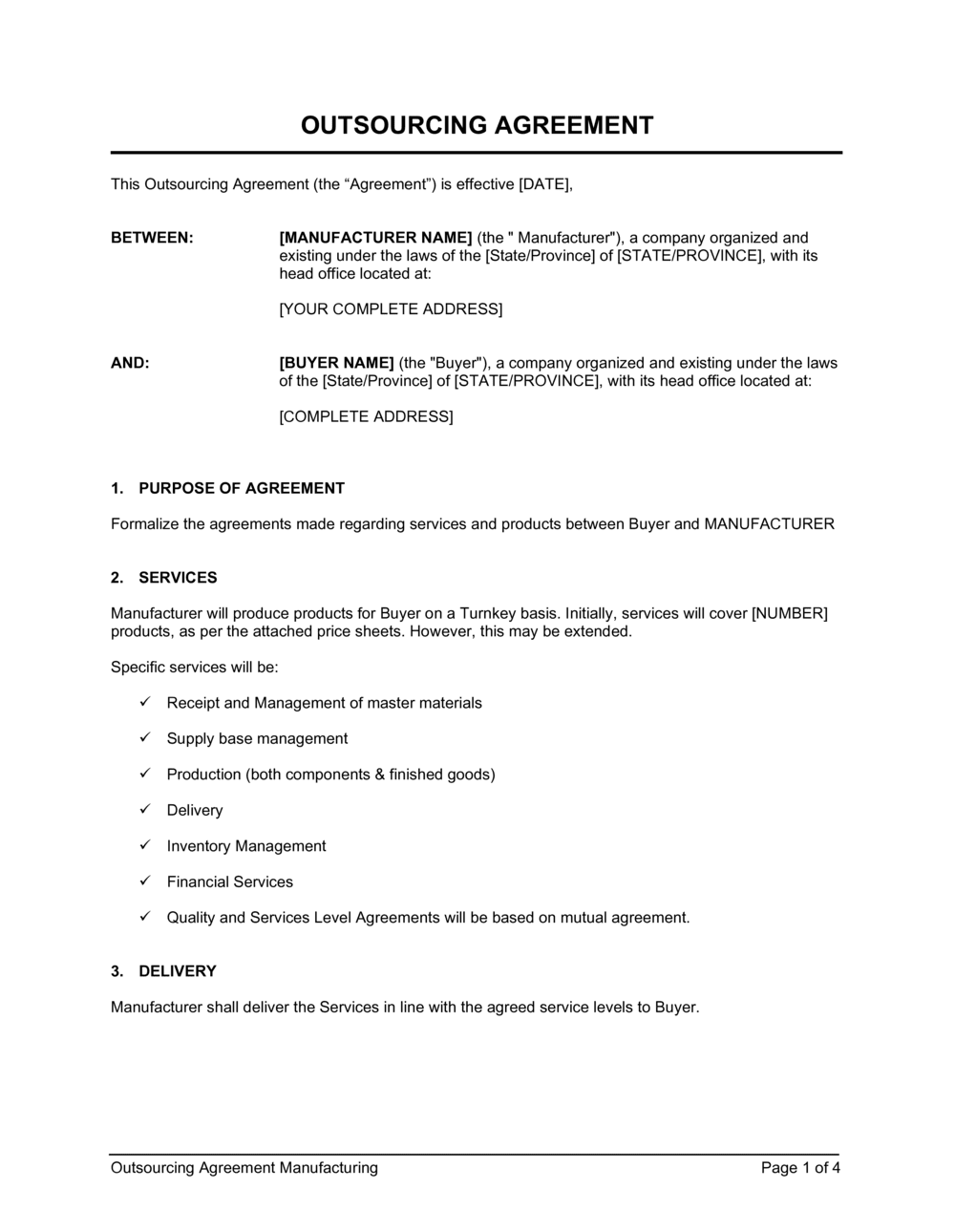
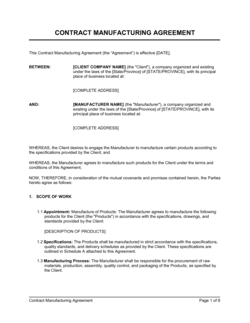
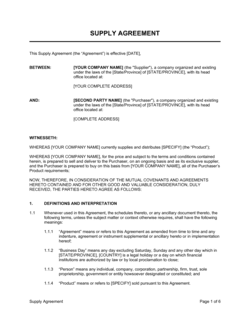
Enter legal entity names and effective date
Use the full registered corporate name of both parties — not trade names or DBAs. Confirm the manufacturer's legal name against their business registration before inserting it.
💡 Request the manufacturer's certificate of incorporation or equivalent to verify the legal entity name before contract execution.
2
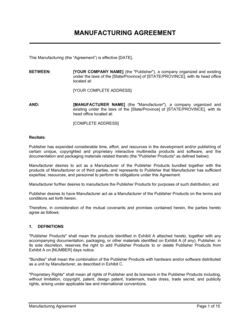
Draft and attach the Statement of Work as Schedule A
The SOW should include product name and description, bill of materials, dimensional and performance tolerances, applicable regulatory standards (FDA, CE, RoHS, etc.), and packaging requirements. Version-control the SOW so amendments are traceable.
💡 Assign a version number and date to every iteration of the SOW. Reference 'Schedule A, Version [X], dated [DATE]' in the body of the agreement — not just 'Schedule A.'
3
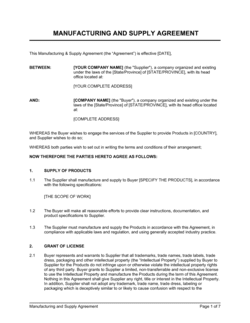
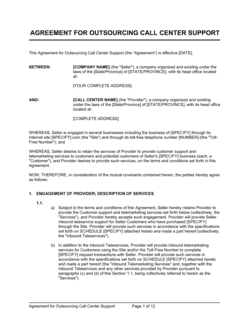
Set unit pricing, MOQ, and payment terms
Enter the agreed unit price, the minimum order quantity per purchase order, payment terms (Net 30 is standard), and any annual price adjustment cap tied to a published index such as the Producer Price Index.
💡 For agreements exceeding 12 months, tie price adjustment triggers to a specific PPI or commodity index rather than to the manufacturer's discretion.
4
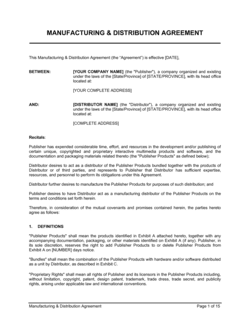
Define Incoterms and delivery obligations
Select the applicable Incoterm (FOB origin, DDP, or EXW are most common for manufacturing), insert the specific named location, and set the lead time from purchase order confirmation to shipment. Specify late-delivery penalties in percentage terms.
💡 For offshore manufacturing, DDP (Delivered Duty Paid) places the import burden on the manufacturer — confirm the manufacturer can legally act as importer of record in your country.
5
Specify quality standards and acceptance procedures
Name the applicable quality standard (ISO 9001, GMP, etc.), set the inspection window after delivery (5–10 business days is typical), and define the rejection and replacement procedure including who bears return shipping costs.
💡 Include a right to audit the manufacturer's quality control records and production facility with reasonable advance notice — this right is rarely exercised but critical if quality problems arise.
6
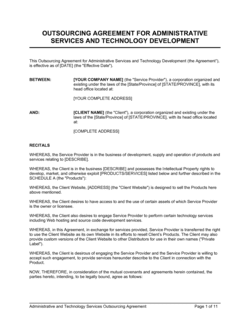
Address IP ownership, tooling, and licensing
Confirm client ownership of all specifications, formulations, and tooling. List client-owned tooling items in a Schedule C. Grant the manufacturer only a limited license to use client IP for the specific production engagement.
💡 Photograph and record serial numbers of all client-owned tooling held at the manufacturer's facility and attach the record to Schedule C — this simplifies recovery if the relationship ends acrimoniously.
7
Set liability caps and insurance minimums
Insert a mutual liability cap expressed as a multiple of fees paid in the prior 12 months (2× to 3× is typical). Specify the manufacturer's required product liability insurance limits and request a certificate of insurance naming you as additional insured before production begins.
💡 Set the insurance requirement to renew annually and require the manufacturer to provide updated certificates within 10 days of each policy renewal — lapsed coverage is a common oversight.
8
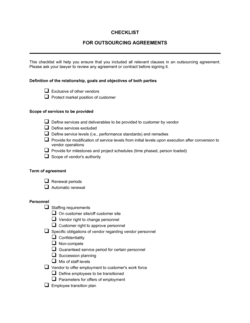
Define term, termination triggers, and wind-down obligations
Set the initial term (1–3 years is typical), the auto-renewal notice period (90 days is standard), termination-for-cause cure period (30 days), and the wind-down procedure for completing accepted purchase orders and returning tooling after termination.
💡 Include a termination-for-convenience right with 90–180 days' notice and a defined fee for cancellation of in-progress orders — without it, you may have no clean exit from an underperforming manufacturer.